
Most Pontiac, Saturn and Hummer models are platform siblings of a Chevrolet, GMC or Buick that is still easy to buy parts for. A Hummer H3 sits on the Chevrolet Colorado's frame architecture. A Pontiac G6 and Saturn Aura share the Epsilon platform with the Chevrolet Malibu. A Saturn Outlook is a GMC Acadia. Knowing the sibling turns a dead-brand parts search into an ordinary one.
The catch is that platform sharing is not the same as parts interchange. GM stated the H3 shared roughly ten percent of its components with the Colorado and Canyon, so a shared platform gets you a shortlist, not an answer. The table below gives you the shortlist; the verification steps further down give you the answer. Start your search in Saturn, Pontiac and Hummer parts and cross-reference from there.
Parts and tools you'll need
- Saturn, Pontiac and Hummer parts and accessories
- The wider parts and accessories catalog for the donor-model equivalents
- Your VIN, and the RPO code sticker from the glovebox or console lid
- A phone camera for casting numbers and part numbers on the old part
Hummer parts
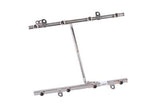 ACDelco Fuel Rail
$241.99ACDelco and GM parts for Hummer. Confirm fitment by VIN before ordering.
ACDelco Fuel Rail
$241.99ACDelco and GM parts for Hummer. Confirm fitment by VIN before ordering.
 ACDelco Oxygen Sensor, 4-wire
$100.99ACDelco and GM parts for Hummer. Confirm fitment by VIN before ordering.
ACDelco Oxygen Sensor, 4-wire
$100.99ACDelco and GM parts for Hummer. Confirm fitment by VIN before ordering.
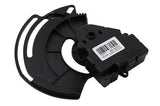 ACDelco HVAC Mode Door Actuator
$90.99ACDelco and GM parts for Hummer. Confirm fitment by VIN before ordering.
ACDelco HVAC Mode Door Actuator
$90.99ACDelco and GM parts for Hummer. Confirm fitment by VIN before ordering.
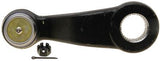 ACDelco Pitman Arm
$107.99ACDelco and GM parts for Hummer. Confirm fitment by VIN before ordering.
ACDelco Pitman Arm
$107.99ACDelco and GM parts for Hummer. Confirm fitment by VIN before ordering.

Which GM vehicles share parts with a Pontiac, Saturn or Hummer?
Almost all of them have a living sibling. Pontiac and Saturn were badge-engineered onto Chevrolet, GMC and Buick platforms through the 2000s, and Hummer's H2 and H3 were built on GM truck architecture. The table below maps each orphan to the vehicle whose parts catalog you should be searching alongside it.
| Orphaned model | Years | Platform | Search these siblings | How much actually crosses over |
|---|---|---|---|---|
| Hummer H3 / H3T | 2005–2010 (H3T 2009–2010) | Modified GMT355 | Chevrolet Colorado, GMC Canyon (2004–2012) | Powertrain and many chassis wear items; body and suspension geometry differ substantially |
| Hummer H2 / H2 SUT | 2002–2009 (SUT from 2005) | GMT820 front, 1500 frame rear | Chevrolet Silverado 2500, Suburban 2500, Avalanche 2500 | Strong on engine, transmission and driveline; body is unique |
| Pontiac G6 | 2005–2011 | Epsilon (long wheelbase) | Chevrolet Malibu, Saturn Aura | Extensive across suspension, brakes, powertrain |
| Saturn Aura | 2007–2010 | Epsilon (long wheelbase) | Chevrolet Malibu, Pontiac G6 | Extensive; closest sibling of the three |
| Saturn Outlook | 2007–2010 | Lambda | GMC Acadia (2007–2016), Buick Enclave (2008–2017), Chevrolet Traverse (2009–2017) | Very high; same 3.6L V6 and driveline family |
| Pontiac Torrent | 2006–2009 | Theta | Chevrolet Equinox, Saturn Vue | High on chassis and powertrain |
| Saturn Vue (first generation) | 2002–2007 | Theta | Chevrolet Equinox, Pontiac Torrent | Moderate; several unique early-Vue components |
| Pontiac G5 | 2007–2010 | Delta | Chevrolet Cobalt, Saturn Ion | Very high; the G5 is effectively a Cobalt |
| Saturn Ion | 2003–2007 | Delta | Chevrolet Cobalt, Pontiac G5 | Moderate to high; Ion has unique body panels and interior |
| Pontiac Solstice / Saturn Sky | 2006–2010 | Kappa | Each other, and only each other | High between the two, near zero to anything else |
| Pontiac Vibe | 2003–2010 | Toyota | Toyota Matrix, Toyota Corolla | Search Toyota catalogs, not GM ones |
Two rows in that table are the ones worth memorizing. The Saturn Outlook row is the good news: it is a Lambda crossover, and the Acadia, Enclave and Traverse stayed in production for years after Saturn closed, so parts availability is excellent. The Pontiac Vibe row is the trap, and it gets its own section below.
Does a Hummer H3 really use Chevy Colorado parts?
Some of them, yes. The H3 was built on a modified and strengthened version of the GMT355 architecture that carried the Chevrolet Colorado and GMC Canyon. GM's own position was that the two shared roughly ten percent of their components, so treat Colorado and Canyon listings as a place to check, not a guarantee.
The engines are the strongest crossover. H3s used the Atlas straight-five: a 3.5-liter L52 for 2005 and 2006, then a 3.7-liter LLR from 2007 through 2010. Both of those engines also went into Colorado and Canyon trucks of the same era, which means ignition, sensors, gaskets and many service parts cross-reference directly. The 5.3-liter LH8 V8 in the H3 Alpha, offered for 2008 through 2010, is a small-block and shares an enormous parts catalog with the rest of GM's V8 line.
Where it stops is the chassis. The H3 frame was reinforced, the suspension geometry is its own, the axles and gearing differ, and the body shares nothing. Steering, braking and suspension components should be verified individually rather than assumed.
Interestingly, the interchange runs in both directions now — Colorado and Canyon owners buy H3 suspension components specifically for the off-road geometry. That only works because the pieces were engineered as variants of each other, and it does not generalize to every part on the truck.
What about the Hummer H2?
The H2 is closer to a GM truck than the H3 is. It was built by AM General under contract to GM from 2002 to 2009, on a modified GMT820 three-quarter-ton front structure with a 1500-series frame at the rear. Powertrain and driveline parts overlap heavily with Silverado 2500 and Suburban 2500 of the same era.
Engines make this easy. Through 2007, the H2 used a 6.0-liter V8 rated at 325 horsepower. For 2008 and 2009, a 6.2-liter V8 rated at 393 horsepower replaced it. Both are Gen IV small-blocks, which is one of the best-supported engine families in the aftermarket. Filters, sensors, coils, water pumps and gaskets are ordinary parts.
The body is where the H2 stops being a Silverado. Panels, glass, lighting, bumpers and the interior are Hummer-specific, and the H2 SUT's midgate is unique to that vehicle. Those parts come from Hummer-specific sources, salvage, or specialty suppliers. There is more on that in our guide to Hummer accessories across the H2, H3 and Hummer EV.
Which Pontiac and Saturn models are effectively rebadged Chevrolets?
The Pontiac G5 and the Chevrolet Cobalt are the same car with different noses. The Pontiac G6, Saturn Aura and Chevrolet Malibu are three variations of the same Epsilon platform. The Saturn Outlook, GMC Acadia, Buick Enclave and Chevrolet Traverse are four versions of one Lambda crossover.
For those cars, the practical approach is to search under the sibling name whenever the orphan name returns nothing. Suspension components, brake rotors and pads, wheel bearings, water pumps, sensors, filters and most engine service parts will frequently show fitment for all the platform siblings on the same listing.
The G6 and Aura are especially convenient because the Malibu stayed in production continuously. A 2008 Aura owner is shopping in the same catalog as a very large population of Malibu owners, which keeps prices reasonable and availability high.
Where badge engineering stops mattering is anything cosmetic. Bumper covers, headlamps, tail lamps, grilles, badges, interior trim and seats were the entire point of the differentiation. Those never interchange, even between cars that share every mechanical component.
Pontiac and Saturn parts
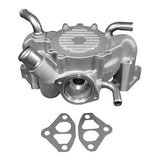 ACDelco Water Pump, Mechanical
$224.99Parts for Pontiac and Saturn models. Confirm fitment by VIN before ordering.
ACDelco Water Pump, Mechanical
$224.99Parts for Pontiac and Saturn models. Confirm fitment by VIN before ordering.
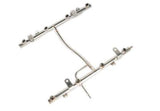 ACDelco Fuel Rail
$404.99Parts for Pontiac and Saturn models. Confirm fitment by VIN before ordering.
ACDelco Fuel Rail
$404.99Parts for Pontiac and Saturn models. Confirm fitment by VIN before ordering.
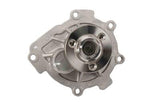 ACDelco Water Pump, New, Saturn
$145.99Parts for Pontiac and Saturn models. Confirm fitment by VIN before ordering.
ACDelco Water Pump, New, Saturn
$145.99Parts for Pontiac and Saturn models. Confirm fitment by VIN before ordering.
 ACDelco EGR Valve, GM Original Equipment
$100.99Parts for Pontiac and Saturn models. Confirm fitment by VIN before ordering.
ACDelco EGR Valve, GM Original Equipment
$100.99Parts for Pontiac and Saturn models. Confirm fitment by VIN before ordering.

Which orphaned GM models do not interchange?
Four categories to watch. The Pontiac Vibe is a Toyota. The Pontiac G8 and 2004–2006 GTO are Australian Holdens. The Saturn Astra is a European Opel. And the Pontiac Solstice and Saturn Sky share only with each other. For all of these, searching GM catalogs by the domestic sibling will waste your time.
The Vibe is the one that costs people the most money. It was built alongside the Toyota Matrix and uses Toyota engines, transmissions and the great majority of its mechanical components. If you own a Vibe, shop it as a Matrix or a Corolla of the same generation. Ordering GM parts by the Pontiac badge produces returns, not fitment.
The G8 and GTO were built in Australia on Holden architecture. Some driveline parts cross to the Chevrolet Caprice PPV and later Chevrolet SS, and the LS-family engines in them are well supported, but body, interior and much of the chassis is Holden-specific and increasingly hard to source.
The Saturn Astra was an imported Opel Astra. Its parts are European, not American, and the catalogs to search are Opel and Vauxhall. Solstice and Sky are Kappa roadsters that share nothing meaningful with any other GM vehicle beyond generic hardware and some engine components.
How do you confirm an interchange before you order?
- Write down your VIN and pull the RPO code sticker from the glovebox, console lid or trunk area.
- Identify the engine RPO code specifically. Two cars with the same badge and year can have different engines and completely different service parts.
- Remove the old part, or at least get a clear look at it, before ordering anything.
- Photograph every number cast, stamped or printed on it. Casting numbers settle arguments that catalogs cannot.
- Search the part number itself rather than the vehicle. A number that returns fitment for four models across three brands is a confirmed interchange.
- Check the sibling model's listing and read its fitment notes for exclusions by year, engine or trim.
- Compare physical dimensions where you can — bolt spacing, connector shape, pin count, overall length.
- Confirm the electrical connector matches. GM changed connectors mid-generation more often than it changed the parts behind them.
- For anything safety-related, verify against a catalog rather than a forum post. Forums are good for leads and unreliable for final answers.
- Keep the old part until the new one is installed and working.
Safety note: brakes, steering and suspension are the wrong place to experiment with an interchange that looks close. A rotor with the correct diameter but a different hub bore or offset will mount and will not run true. Verify these by part number, not by eye.
Which systems interchange most reliably?
| System | Interchange odds | Why |
|---|---|---|
| Engine internals, gaskets, sensors | Very high | GM engine families were shared across brands with little change |
| Filters, belts, plugs, coils | Very high | Sourced to the engine, not the badge |
| Transmission and driveline | High | Shared across platform siblings, but check the transmission RPO code |
| Brake rotors, pads, calipers | Moderate | Often shared, but brake packages varied by trim and year |
| Suspension and steering | Moderate | Geometry frequently differs even on a shared platform — this is where the H3 diverges from a Colorado |
| Cooling and HVAC components | Moderate | Radiators and condensers often shared; hoses and ducting frequently are not |
| Electrical modules | Low | Programming and connector differences make these brand-specific |
| Body panels, lighting, glass | Very low | This is what badge engineering changed on purpose |
| Interior trim and seats | Very low | Brand differentiation, plus different option content |
Read that top to bottom as a search strategy. Start with the assumption that anything attached to the engine will cross over and anything you can see from outside the car will not. That single heuristic will be right most of the time.
What does not carry over
- Pontiac Vibe parts do not come from GM catalogs. Search Toyota Matrix and Corolla.
- Hummer H3 suspension and steering should not be assumed to match a Colorado just because the platform is related.
- Hummer H2 body panels, glass and lighting are not Silverado parts.
- Body panels, lamps, grilles and interior trim never cross between badge-engineered siblings.
- Saturn Astra parts are Opel parts, not domestic GM parts.
- Pontiac G8 and 2004–2006 GTO body and chassis parts are Holden-sourced.
- Solstice and Sky share with each other and effectively nothing else.
- Electronic modules generally do not swap between siblings even when they physically fit.
What to check before you order
- Your exact model year and the engine RPO code, not just the badge.
- The platform sibling you should be cross-shopping, from the table above.
- The part number or casting number on the old part.
- Whether the listing's fitment notes exclude your specific year or engine.
- Whether the electrical connector on the new part matches the one on the vehicle.
- For brakes and suspension, hub bore, offset and bolt pattern in addition to the obvious dimensions.
- For a Vibe, whether you are searching a Toyota catalog rather than a GM one.
- Whether the part is cosmetic. If it is, assume it does not interchange until proven otherwise.
Tools for confirming fitment
 Launch CRE 2.0 for Buick/Chevrolet/Cadillac All System
$159.00Scanners and tools for orphaned GM models.
Launch CRE 2.0 for Buick/Chevrolet/Cadillac All System
$159.00Scanners and tools for orphaned GM models.
 FOXWELL NT624 Elite OBD2 Scanner, All-System Scan Tool
$332.09Scanners and tools for orphaned GM models.
FOXWELL NT624 Elite OBD2 Scanner, All-System Scan Tool
$332.09Scanners and tools for orphaned GM models.
 95 Piece Mechanics Tool Set in Metric and SAE for Small
$99.99Scanners and tools for orphaned GM models.
95 Piece Mechanics Tool Set in Metric and SAE for Small
$99.99Scanners and tools for orphaned GM models.
 ACDelco Tools Torque Wrenches, Digital LCD Display, 1/2 in.
$162.99Scanners and tools for orphaned GM models.
ACDelco Tools Torque Wrenches, Digital LCD Display, 1/2 in.
$162.99Scanners and tools for orphaned GM models.


Frequently Asked Questions
Does a Hummer H3 use Chevy Colorado parts?
Some of them. The H3 was built on a modified GMT355 architecture shared with the Colorado and Canyon, but GM's own position was that the two shared roughly ten percent of their components. Engines cross over strongly — the Atlas straight-five and the 5.3L LH8 V8 are widely shared — while the frame was reinforced, the suspension geometry is its own, and the body shares nothing.
What is the Pontiac Vibe's sibling?
The Toyota Matrix, not any GM vehicle. This is the trap that costs people the most money on this page. The Vibe was built alongside the Matrix and uses Toyota engines, transmissions and most mechanical components. Ordering GM parts by the Pontiac badge produces returns, not fitment.
What car is a Saturn Outlook the same as?
It is a Lambda crossover — the same platform as the GMC Acadia, Buick Enclave and Chevrolet Traverse, sharing the 3.6L V6 and driveline family. This is the best-case scenario for an orphaned brand, because those siblings stayed in production for years after Saturn closed, so parts availability is excellent.
Is a Pontiac G5 just a Chevy Cobalt?
Effectively yes — the same Delta-platform car with different noses. The Saturn Ion is the third sibling, though it has more unique body panels and interior. For mechanical parts, search under Cobalt whenever the Pontiac name returns nothing.
Which parts interchange most reliably between GM siblings?
Anything attached to the engine. Filters, belts, plugs, coils, gaskets and sensors are sourced to the engine rather than the badge, so they cross over readily. The useful heuristic: assume engine-attached parts interchange and anything visible from outside the car does not.
Do body panels interchange between badge-engineered siblings?
No. Bumper covers, headlamps, tail lamps, grilles, badges, interior trim and seats were the entire point of the differentiation. They never cross over, even between cars sharing every mechanical component.
Are Pontiac G8 and GTO parts available?
Partly. Both were built in Australia on Holden architecture. Some driveline parts cross to the Chevrolet Caprice PPV and later Chevrolet SS, and their LS-family engines are well supported, but body, interior and much of the chassis is Holden-specific and increasingly hard to source.
What about the Saturn Astra?
It is an imported Opel Astra, so the catalogues to search are Opel and Vauxhall rather than domestic GM. The Pontiac Solstice and Saturn Sky are a similar dead end — Kappa roadsters that share with each other and effectively nothing else.
How do I confirm an interchange before ordering?
Search the part number rather than the vehicle. Pull your RPO codes, identify the engine code specifically, then photograph every number cast or stamped on the old part. A number returning fitment for four models across three brands is a confirmed interchange — casting numbers settle arguments catalogues cannot.
Can I interchange brake and suspension parts by eye?
No. A rotor with the correct diameter but a different hub bore or offset will mount and will not run true. Check hub bore, offset and bolt pattern alongside the obvious dimensions, and verify safety-related parts against a catalogue rather than a forum post.
A Note on Sourcing
Platform assignments, production years and engine specifications come from GM published product information. The ten percent component-sharing figure between the H3 and the Colorado and Canyon is GM's own characterisation, and it is the most useful number on this page precisely because it is so much lower than owners assume.
The interchange-odds column is our own assessment, based on how GM organised its platforms rather than on any manufacturer interchange table. It is a search strategy, not a fitment guarantee — which is why the verification steps sit below it.
Part-number verification outranks everything on this page. A shared platform produces a shortlist to check; the casting or part number on your own old part produces the answer. For brakes, steering and suspension this is not optional.
Non-GM-sourced models are flagged deliberately. The Vibe is a Toyota, the G8 and 2004–2006 GTO are Holdens, and the Astra is an Opel. Searching domestic GM catalogues for any of them wastes time and produces returns.
Will this part fit your vehicle?
Check your year, model and engine code before you order, and confirm the interchange by part number rather than by platform. Orphaned-brand fitment is solvable, but it is solved with a VIN and a casting number, not with a guess. Start from Saturn, Pontiac and Hummer parts, cross-reference against the sibling model in the full parts and accessories catalog, and browse more GM parts and accessories guides for model-specific breakdowns.