
A leaking water pump on a Buick Enclave 3.6L V6 usually shows up as orange Dex-Cool crust behind the front of the engine, a low-coolant light, and a sweet smell after a highway run. GM sells the repair as a pump kit — currently part 12709178, which supersedes several older numbers and covers 3.6L Enclaves from 2008 through 2024. The thermostat is a separate housing assembly, and most people replace both at once.
That is the short version. The rest of this guide covers how to tell a pump leak from a thermostat-housing leak, which part numbers apply to which years, what else you should buy while the coolant is already drained, and where the job gets annoying. If you already know what you need, start with engine and drivetrain parts for your 3.6L Enclave.
Check coverage before you pay for anything. GM has issued two separate special coverage programs relevant to coolant leaks on this family of crossovers.
- 2025–2026 Enclave — currently active. Special Coverage N262546590 covers a leaking radiator inlet hose quick-connect for 5 years or 60,000 miles, regardless of ownership. Note this is the third-generation Enclave, which does not use the 3.6L.
- 2008–2010 Enclave — long expired. Special Coverage 13091 extended water pump shaft seal coverage to 10 years or 120,000 miles. Useful history, but the window closed by 2020 at the latest.
Both are covered in detail below. Ask a dealer to check your VIN in Investigate Vehicle History before authorising a paid repair.
Parts and tools you'll need
- Water pump, gasket and cooling components for your 2008–2024 Enclave — the pump normally ships as a kit with its seal
- Buick-specific parts and accessories for your Enclave — thermostat housing assembly, hoses, clamps and coolant
- Dex-Cool (orange) extended-life coolant, premixed 50/50 or concentrate plus distilled water
- A torque wrench that reads accurately in the 7–20 lb-ft range, a serpentine belt tool, a drain pan that holds at least two gallons, and new hose clamps if yours are the crimped factory type
Nothing on this job needs a specialty puller or a scan tool. It needs patience and a socket set with a long extension.
Water pumps
 2015 Chevrolet Traverse 3.6L Water Pump
$38.993.6L water pumps — confirm year and VIN. Confirm fitment by VIN before ordering.
2015 Chevrolet Traverse 3.6L Water Pump
$38.993.6L water pumps — confirm year and VIN. Confirm fitment by VIN before ordering.
 2016 Chevrolet Traverse 3.6L Water Pump
$38.993.6L water pumps — confirm year and VIN. Confirm fitment by VIN before ordering.
2016 Chevrolet Traverse 3.6L Water Pump
$38.993.6L water pumps — confirm year and VIN. Confirm fitment by VIN before ordering.
 2017 Chevrolet Traverse 3.6L Water Pump
$38.993.6L water pumps — confirm year and VIN. Confirm fitment by VIN before ordering.
2017 Chevrolet Traverse 3.6L Water Pump
$38.993.6L water pumps — confirm year and VIN. Confirm fitment by VIN before ordering.
 2014 Chevrolet Traverse 3.6L Water Pump
$38.993.6L water pumps — confirm year and VIN. Confirm fitment by VIN before ordering.
2014 Chevrolet Traverse 3.6L Water Pump
$38.993.6L water pumps — confirm year and VIN. Confirm fitment by VIN before ordering.


What are the symptoms of a failing water pump on an Enclave 3.6L?
The classic signs are a slow coolant loss with no puddle on the driveway, dried orange or pink residue on the front of the engine and on the belt-side accessories, a coolant smell through the vents at idle, and a temperature gauge that creeps up in traffic but settles on the highway. Bearing noise is a later, louder symptom.
Water pumps on this engine family tend to fail by seeping, not bursting. The pump has a weep hole that intentionally vents coolant when the internal seal starts to pass. That means the first evidence is usually a stain, not a stream. Dex-Cool dries to a chalky orange crust, which makes it easy to trace once you know to look for it.
Two other symptoms get misread often. A low-coolant message that comes back a few weeks after you top off is far more likely a slow external leak than a head gasket on this engine. And a heater that blows cool at idle but warms up when you drive is usually a low coolant level or air in the system — which is what a seeping pump eventually causes.
Bearing failure is the loud version. If you hear a grinding or chirping that changes pitch with engine RPM and does not change when you press the clutch or shift, and it comes from the belt side of the engine, stop driving it. A pump that seizes takes the serpentine belt with it, and losing the belt means losing power steering assist and charging at the same time.
GM's water pump special coverage — and why it probably no longer helps you
This condition is well documented by GM, and for a while it carried extended coverage.
GM special coverage bulletin 13091, dated May 2013, covered water pump shaft seal leaks on 2008–2010 Buick Enclave, 2009–2010 Chevrolet Traverse, 2007–2010 GMC Acadia and 2007–2010 Saturn Outlook vehicles with the HFV6 engine (LY7, LLT). GM extended coverage for that condition to 10 years or 120,000 miles, whichever came first, from the original in-service date and regardless of ownership, with the pump replaced at no charge.
Be clear-eyed about the timing: that window has closed. A 2010 vehicle reached ten years in 2020 at the latest, so no current owner will get a free pump under this program. It is worth knowing for two reasons anyway.
First, it confirms the failure is a known design characteristic rather than something you did wrong. Second, note GM's stated cause: the bulletin says these leaks "are often due to vehicle operation with a low engine coolant level," and that maintaining coolant level increases shaft seal reliability. Whatever you think of that framing, the practical advice inside it is sound — running these engines low on coolant shortens pump life, so a slow leak left unattended becomes a pump failure.
If your Enclave is a 2025 or 2026, read this instead
The third-generation Enclave arrived for 2025 on a new platform, and it does not use the 3.6L V6. So if you have a coolant leak on a 2025 or 2026 Enclave, nothing in the parts tables on this page applies to your vehicle — and there is active coverage you should check first.
GM issued Special Coverage N262546590 on 1 April 2026 for a radiator inlet hose leak, covering the 2025–2026 Buick Enclave, 2024–2026 Chevrolet Traverse and 2024–2026 GMC Acadia. Coverage runs five years or 60,000 miles from the original in-service date, whichever comes first, regardless of ownership.
The failure is a degraded seal in the quick-connect fitting where the inlet hose joins the radiator, and the dealer repair is a seal replacement rather than a whole cooling system job. GM has since extended the same program to certain Colorado and Canyon trucks.
Ask the dealer to check your VIN in Investigate Vehicle History before you pay for a coolant leak diagnosis. Coverage is applied per VIN, and it survives a change of ownership — so a used-vehicle buyer within the window qualifies too.
Where is the water pump, and how hard is the job?
On the 3.6L V6 the pump bolts to the front timing chain cover and is turned by the accessory drive belt through its own pulley. On the transverse Enclave, that face of the engine points toward the passenger-side fender rather than the radiator, so the job is done from the side and from underneath rather than from straight ahead.
Practically, that means access is the hard part, not the pump itself. Expect to pull the right front wheel and the inner fender liner, remove the serpentine belt, and work around the accessory bracket. GM's own torque data refers to the fastener as "water pump to timing chain cover," which tells you where it lives and also tells you that the mating surface is aluminum — so overtightening is a real way to turn a two-hour job into an engine-out job.
If you have never had a serpentine belt off, read through the belt routing before you start and photograph the belt on the vehicle. The Enclave's routing is not intuitive and the underhood diagram is not always legible on a ten-year-old truck.
Which water pump part number fits my Enclave?
GM currently lists pump kit 12709178 for 3.6L Enclaves across the 2008–2024 range, and that number supersedes the earlier 12645176, 12637479, 12618472 and 12657499. If a catalog hands you one of the older numbers, it is not wrong — it has simply been rolled into the current kit. Always confirm against your VIN.
| Years | Engine | Cooling part | GM part number | Notes |
|---|---|---|---|---|
| 2008–2024 | 3.6L V6 | Water pump kit | 12709178 | Supersedes 12645176, 12637479, 12618472, 12657499 |
| 2008–2017 | 3.6L V6 | Thermostat housing assembly | 12689041 | Supersedes 12599235, 12638893; thermostat is part of the housing |
| 2018–2024 | 3.6L V6 | Thermostat housing assembly | 12681133 | Supersedes 12664190; second-generation Enclave, different housing |
| 2021–2024 | 3.6L V6 | Auxiliary water pump | 13546434 | Later replaced by 13551861; separate electric pump, not the main pump |
| 2025–2026 | Not 3.6L | — | — | Third-generation Enclave, different engine and cooling system. Check Special Coverage N262546590 for inlet hose leaks. |
Two things to take from that table. First, the main pump number is common across both 3.6L Enclave generations, which is unusual and genuinely convenient. Second, the thermostat is not common across generations — the 2008–2017 first-generation Enclave and the 2018-and-later second-generation Enclave use different housing assemblies, and they are not interchangeable.
The auxiliary pump in the fourth row confuses a lot of owners. It is a small electric pump that circulates coolant for a secondary circuit, and it is a completely different failure with completely different symptoms. If a parts lookup offers you that number when you searched "water pump," you are looking at the wrong part.
Is the thermostat separate, or part of the housing?
On the 3.6L Enclave, GM sells the thermostat as an integrated housing assembly rather than a bare thermostat disc. That is why the OEM listings read "Housing Assembly, Eng Cool Therm." Aftermarket brands do sell standalone thermostats, and they can work, but the housing assembly is the version GM services.
This matters for how you plan the job. On engines with a bare thermostat, replacing it is a ten-dollar, twenty-minute afterthought. Here you are buying a plastic housing with the thermostat and usually the seal already installed, which is a larger purchase but removes the most common leak point on the whole cooling system: an aged plastic housing that has gone brittle and cracked at the hose neck.
If your Enclave is past about 100,000 miles and you already have the coolant drained for a pump, replacing the housing at the same time is the obvious call. You will not save meaningful labor by doing it later, and you will spend another gallon of Dex-Cool.
Thermostat symptoms are distinct from pump symptoms. A thermostat stuck open gives you a gauge that never reaches normal, weak heat in cold weather, and sometimes a check-engine light for coolant temperature below regulating range. A thermostat stuck closed gives you rapid overheating with a hot upper radiator hose and a cold lower one. Neither of those is a leak. If you are seeing coolant loss, look at the pump and the housing body, not the thermostat itself. Our walkthrough of thermostat behavior across the GM lineup covers the diagnostic split in more depth.
Thermostats and coolant
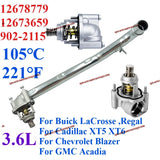 12678779 12673659 902-2115 For Buick LaCrosse Regal Cadillac
$36.33Thermostat, DEX-COOL and cap for the cooling job. Confirm fitment by VIN before ordering.
12678779 12673659 902-2115 For Buick LaCrosse Regal Cadillac
$36.33Thermostat, DEX-COOL and cap for the cooling job. Confirm fitment by VIN before ordering.
 ACDelco 10-101 DEX-COOL Extended Life Coolant, 1 Gallon
$31.95Thermostat, DEX-COOL and cap for the cooling job. Confirm fitment by VIN before ordering.
ACDelco 10-101 DEX-COOL Extended Life Coolant, 1 Gallon
$31.95Thermostat, DEX-COOL and cap for the cooling job. Confirm fitment by VIN before ordering.
 ACDelco RC85 15 PSI Radiator Cap 15042975
$17.99Thermostat, DEX-COOL and cap for the cooling job. Confirm fitment by VIN before ordering.
ACDelco RC85 15 PSI Radiator Cap 15042975
$17.99Thermostat, DEX-COOL and cap for the cooling job. Confirm fitment by VIN before ordering.
 ACDelco 12346290 DEX-Cool Coolant Antifreeze 12346290
$31.95Thermostat, DEX-COOL and cap for the cooling job. Confirm fitment by VIN before ordering.
ACDelco 12346290 DEX-Cool Coolant Antifreeze 12346290
$31.95Thermostat, DEX-COOL and cap for the cooling job. Confirm fitment by VIN before ordering.


What coolant does the Enclave 3.6L take?
Dex-Cool, mixed 50/50 with clean water. The Buick owner's manual specifies a 50/50 mixture of DEX-COOL and drinkable water, rated for five years or 150,000 miles when the system is maintained, with freeze protection to −34°F and boil protection to 265°F. Do not substitute green conventional coolant.
The 50/50 ratio is not a suggestion. Straight concentrate actually transfers heat worse than a proper mix, and more water than 50 percent costs you freeze and corrosion protection. If you buy concentrate, mix it with distilled water — tap water mineral content is what turns a healthy system into a scaled one.
Keeping the level right is not just good practice on this engine — it is what GM identifies as a contributing cause of the pump seal failure itself. If the low-coolant light comes on, find the leak rather than topping up indefinitely.
On total capacity: GM publishes cooling system capacity in service information rather than consistently in the owner's manual, and it varies by model year and options. Check your owner's manual or service information for your exact year rather than relying on a generic figure — and buy more than you think you need. A full drain-and-fill on a V6 crossover of this size will take well over a gallon of mixed coolant, and running short mid-job with the system open is a miserable place to be.
Whatever you do, do not mix coolant chemistries. Dex-Cool and conventional green coolant together can gel. If you have bought the vehicle used and do not know what is in it, flush the system rather than topping off and hoping.
What torque specs apply to the pump and thermostat housing?
Published GM data for the 3.6L lists the water pump fasteners as a two-step: 7.5 lb-ft followed by an additional 45 degrees, using new bolts. Water pump pulley bolts and thermostat housing bolts are also listed at 7.5 lb-ft, or 90 in-lb. These figures are documented for the 2007–2013 3.6L; verify against service information for your specific year before you tighten anything.
Those are small numbers, and that is the point. Everything here threads into aluminum. A 7.5 lb-ft spec is well below what most people's arm calls "snug," and it is very easy to strip a timing cover thread with a half-inch ratchet and good intentions. Use a small torque wrench that is actually accurate at the bottom of its range — a 1/4-inch drive inch-pound wrench is the right tool here, not a 1/2-inch drive lug wrench.
Torque-to-yield fasteners, the ones with an angle step, are single-use by design. If the kit comes with new bolts, use them. If it does not, buy them. Reusing a stretched bolt on a sealing surface that lives at 200°F is how a fresh pump starts weeping in six months.
If you are unsure which wrench covers this range properly, our general water pump service guide for GM engines goes through tool selection and sealing surface prep in more detail than we can fit here.
How do you replace the water pump on a 3.6L Enclave?
The outline below is the shape of the job, not a substitute for model-year service information. Read it to decide whether you want to take this on, then work from a manual for your exact year. Budget most of a Saturday the first time.
- Let the engine cool completely. Opening a hot pressurized cooling system will burn you badly.
- Disconnect the negative battery terminal.
- Raise the vehicle safely on jack stands rated for its weight, on level ground. Never work under a vehicle held up only by a jack.
- Remove the right front wheel and the inner fender liner to reach the belt side of the engine.
- Drain the cooling system into a pan and store the used coolant sealed — it is toxic to animals and sweet-tasting.
- Photograph the serpentine belt routing, release the tensioner, and remove the belt.
- Remove whatever accessory brackets or components block the pump on your specific year.
- Unbolt the pump, remove it, and note which bolts came from which holes — lengths often differ.
- Scrape and clean the sealing surface on the timing cover until it is bright and flat. Do not gouge the aluminum with a screwdriver.
- Fit the new pump with its supplied seal or gasket dry unless the instructions specifically call for sealant.
- Torque the fasteners to the published spec and angle for your year, using new bolts where the procedure calls for them.
- Replace the thermostat housing now if you are doing it, then reinstall brackets and the belt.
- Refill with 50/50 Dex-Cool and bleed the air out following the procedure for your vehicle. Air pockets cause false overheating.
- Run the engine to full operating temperature with the heater on, watch the gauge, and recheck the level cold the next morning.
The bleed step is the one people skip and regret. A 3.6L transverse V6 will trap air, and trapped air reads to the driver exactly like a failed repair — high gauge, no heat, and a sinking feeling.
What else should you replace while you're in there?
Since the coolant is out and the front of the engine is open, the cheap add-ons are the thermostat housing assembly, the upper and lower radiator hoses if they are original or feel spongy, the serpentine belt if it is glazed or cracked, and the belt tensioner if it rattles or the pulley has any wobble.
The tensioner deserves a specific mention. A worn tensioner puts a shock load on every pulley in the accessory drive including the brand-new water pump. If the arm bounces visibly at idle, replace it while the belt is off rather than doing this work twice.
Radiator cap is the cheapest part in the whole system and one of the more common causes of coolant loss that gets blamed on a pump. If the cap's seal is hardened, the system will not hold pressure and will push coolant into the overflow. Replace it as a matter of course on a high-mileage vehicle.
What is not worth doing preemptively: the radiator itself, unless it is leaking or the fins are corroded through, and the coolant temperature sensor, unless you have a code pointing at it. Both get sold as part of "while you're in there" packages and neither is a wear item on a schedule.
Tools and sensors
 ACDelco Tools Torque Wrenches, Digital LCD Display, 3/8 in.
$249.99Tools and parts that go with the water pump job.
ACDelco Tools Torque Wrenches, Digital LCD Display, 3/8 in.
$249.99Tools and parts that go with the water pump job.
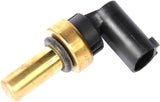 GM Genuine Parts 55591401 Engine Coolant Temperature Sensor
$19.22Tools and parts that go with the water pump job. Confirm fitment by VIN before ordering.
GM Genuine Parts 55591401 Engine Coolant Temperature Sensor
$19.22Tools and parts that go with the water pump job. Confirm fitment by VIN before ordering.
 FOXWELL NT726 Bidirectional OBD2 Scanner
$368.99Tools and parts that go with the water pump job.
FOXWELL NT726 Bidirectional OBD2 Scanner
$368.99Tools and parts that go with the water pump job.
 95 Piece Mechanics Tool Set in Metric and SAE for Small
$99.99Tools and parts that go with the water pump job.
95 Piece Mechanics Tool Set in Metric and SAE for Small
$99.99Tools and parts that go with the water pump job.


How do you tell a pump leak from a housing leak before you buy anything?
Pressure-test the cold system with a hand pump tester, hold pressure, and look with a flashlight. A pump seal leak shows at the weep hole under the pump body. A housing leak shows at the plastic seam or the hose neck. If you see neither and pressure still drops, look at hoses and the radiator seams before you assume anything internal.
Do this before ordering parts. It takes twenty minutes and it is the difference between buying one part and buying three. Auto parts chains commonly loan pressure testers, and a cheap one is worth owning if you keep vehicles past 100,000 miles. Test to the pressure marked on your radiator cap, not to whatever the gauge will read.
UV dye is the fallback for a leak that only shows up under load or after a long drive. Add the dye, drive for a week, then look with a UV light in the dark. Slow seeps that hide behind brackets in daylight light up instantly.
One diagnostic trap worth knowing: coolant that appears on the passenger-side floor mat is a heater core, not the pump. Coolant that appears in the oil, or white smoke that keeps coming after the engine is warm, is a different and much more serious conversation. Neither of those is fixed by a water pump.
What to check before you order
Run through this list and you will not be sending anything back.
- Confirm your generation and engine. The 2008–2017 and 2018–2024 Enclaves share a water pump number but use different thermostat housings — and the 2025-onward Enclave is not a 3.6L at all.
- Check coverage first if your vehicle is a 2025 or 2026. Special Coverage N262546590 may pay for the repair.
- Check for superseded numbers. If your catalog lookup shows 12645176, 12637479, 12618472 or 12657499, the current kit is 12709178. Order the current number.
- Verify against your VIN, not just the model year. Early-year production changes are common on this platform.
- Decide on the thermostat housing now. Doing it later means draining the coolant twice.
- Buy the coolant with the parts. Dex-Cool, 50/50 mix, more than you think you need.
- Confirm the kit includes the seal and new bolts. If it does not, add them to the order.
- Look up torque specs for your model year before the wrench comes out. Aluminum threads do not forgive guesses.
Frequently Asked Questions
What are the symptoms of a bad water pump on a Buick Enclave 3.6L?
Slow coolant loss with no puddle, dried orange Dex-Cool crust on the belt side of the engine, a sweet smell through the vents at idle, and a gauge that creeps up in traffic but settles on the highway. These pumps seep from a weep hole rather than bursting, so the first evidence is usually a stain. Grinding or chirping that tracks engine RPM means the bearing is going and you should stop driving it.
Which water pump fits a 3.6L Enclave?
GM lists kit 12709178 across 2008–2024 3.6L Enclaves, superseding 12645176, 12637479, 12618472 and 12657499. If a catalogue offers one of the older numbers it is not wrong, just outdated. Confirm against your VIN before ordering.
Did GM ever extend the warranty on these water pumps?
Yes, but it has expired. Special coverage bulletin 13091 from May 2013 covered water pump shaft seal leaks on 2008–2010 Enclave, 2009–2010 Traverse and 2007–2010 Acadia and Outlook models with the HFV6 engine, for 10 years or 120,000 miles from the in-service date regardless of ownership. A 2010 vehicle reached that limit by 2020, so no current owner qualifies.
My 2025 Enclave has a coolant leak. Does this guide apply?
No. The third-generation Enclave arrived for 2025 on a new platform and does not use the 3.6L V6, so none of the part numbers here fit it. Check Special Coverage N262546590 instead, which covers a radiator inlet hose leak on 2025–2026 Enclaves for five years or 60,000 miles regardless of ownership.
Is the special coverage still valid if I bought the car used?
Yes for N262546590 — GM states the coverage applies regardless of ownership, running five years or 60,000 miles from the vehicle's original in-service date rather than from your purchase. Ask a dealer to check your VIN in Investigate Vehicle History before paying for a diagnosis.
Is the thermostat separate from the housing on an Enclave?
No. GM services it as an integrated housing assembly, which is why the listings read "Housing Assembly, Eng Cool Therm." That costs more than a bare thermostat but replaces the plastic housing, which is itself a common leak point once it goes brittle at the hose neck. The 2008–2017 and 2018–2024 housings are different parts and do not interchange.
What coolant does a Buick Enclave take?
Dex-Cool, mixed 50/50 with clean water — use distilled if you are mixing from concentrate. Never substitute conventional green coolant or mix chemistries, which can gel. If you bought the vehicle used and do not know what is in the system, flush it rather than topping up.
Can low coolant actually cause the water pump to fail?
According to GM, it contributes. Its own bulletin states these shaft seal leaks are often due to operating the vehicle with a low coolant level, and that maintaining the level increases seal reliability. Practically: a small leak ignored becomes a pump replacement, so trace a low-coolant warning rather than topping up indefinitely.
What torque do the water pump bolts take?
Published GM data for the 3.6L gives a two-step: 7.5 lb-ft followed by an additional 45 degrees, with new bolts. Pulley and thermostat housing bolts are also around 7.5 lb-ft (90 in-lb). Those figures are documented for the 2007–2013 engine — verify for your year. Everything threads into aluminium, so use a 1/4-inch drive inch-pound wrench, not a big ratchet.
How do I tell a water pump leak from a thermostat housing leak?
Pressure-test the cold system and look with a flashlight. A pump seal leak shows at the weep hole under the pump body; a housing leak shows at the plastic seam or hose neck. If pressure drops with neither visible, check hoses, the radiator seams and the cap. UV dye catches seeps that only appear after a long drive.
A Note on Sourcing
The expired water pump program — its model coverage, the HFV6 (LY7, LLT) engine scope, the 10 year / 120,000 mile term and GM's stated cause — comes from GM special coverage bulletin 13091, May 2013 (PDF).
The active program — model years, the five year / 60,000 mile term, the regardless-of-ownership provision and the 1 April 2026 release date — comes from GM Special Coverage N262546590 (PDF). Both are published by NHTSA as manufacturer communications and were read directly. GM has since extended N262546590 to certain Colorado and Canyon models; check current scope, as programs are revised.
Coverage is applied per VIN. Nothing on this page confirms that your specific vehicle qualifies — only a dealer checking Investigate Vehicle History can do that.
Part numbers and supersessions are from GM parts catalogue data, and torque figures are documented for the 2007–2013 3.6L and should be verified for your year. The diagnostic sequence and the "while you're in there" recommendations are our own, based on service practice rather than manufacturer instruction.
For more on cooling system diagnosis, belt drive service and related jobs across the GM lineup, browse more GM repair guides.
Get the whole cooling job in one order
Doing the pump without the rest of the wear parts means opening the same system twice. A complete 3.6L Enclave cooling refresh usually looks like this:
- Water pump kit with seal and hardware
- Thermostat housing assembly for your generation
- Upper and lower radiator hoses plus clamps
- Serpentine belt and, if it is worn, the tensioner
- Radiator cap
- Dex-Cool coolant, enough for a full fill
Filter by your year and engine and build the whole list from GM engine and drivetrain parts, then add trim and model-specific items from Buick parts and accessories. Check your year, generation and VIN before you order.