
Before you pull the rear calipers on a GM vehicle with an electronic parking brake, the EPB has to be put into service mode. GM's documented procedure uses a scan tool: ignition on, engine off, then Electronic Brake Control Module > Control Functions > Rear Brake Caliper Piston Retract. Skip that and forcing the piston back can strip the actuator gearset inside the caliper.
That one requirement is what turns a straightforward rear brake job into a two-day parts hunt. The pads and rotors are the easy part. The gate is a scan tool with bidirectional control, and most people find that out with the wheel already off and the truck on jack stands. If you are planning the job this weekend, sort the tool first — start with scan tools and shop equipment for your GM truck or SUV and work backward to the brake parts.
And if the reason you are doing this job is that the rear pads wore out early, read the section on GM bulletin 21-NA-089 below before you order anything. On 2019–2021 trucks there is a documented cause, a specific part that fixes it, and a warranty position worth knowing in advance.
Parts and tools you'll need
- A bidirectional scan tool that supports GM EPB service mode — see diagnostic tools and mechanic equipment
- Rear pads, rotors and hardware — GM brake parts and hardware for your truck or SUV
- New caliper guide pin boots or a complete hardware kit, plus high-temp silicone caliper grease
- Copper paste for the pad abutments — GM specifies it whenever pads are removed or replaced
- A torque wrench, jack stands, and a wire brush for the bracket abutment surfaces
Everything else in this guide is about the order you do things in, and about knowing which of the shortcuts floating around the forums are real.
Scan tools for service mode
 FOXWELL NT604 OBD2 Scanner
$209.09Scanners that put the electronic parking brake into service mode.
FOXWELL NT604 OBD2 Scanner
$209.09Scanners that put the electronic parking brake into service mode.
 FOXWELL NT614 Elite OBD2 Scanner
$233.69Scanners that put the electronic parking brake into service mode.
FOXWELL NT614 Elite OBD2 Scanner
$233.69Scanners that put the electronic parking brake into service mode.
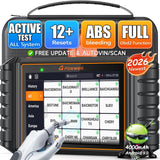 FOXWELL NT726 Bidirectional OBD2 Scanner
$368.99Scanners that put the electronic parking brake into service mode.
FOXWELL NT726 Bidirectional OBD2 Scanner
$368.99Scanners that put the electronic parking brake into service mode.
 FOXWELL NT624 Elite OBD2 Scanner, All-System Scan Tool
$332.09Scanners that put the electronic parking brake into service mode.
FOXWELL NT624 Elite OBD2 Scanner, All-System Scan Tool
$332.09Scanners that put the electronic parking brake into service mode.


What is the electronic parking brake actually doing back there?
On most GM applications the parking brake is an electric motor and gear reduction bolted to the back of each rear caliper. When you press the switch, the motor drives a screw that pushes the piston out against the pads. There is no cable, no drum-in-hat shoe, and no adjuster star wheel.
That design is why the normal C-clamp trick fails. On an older cable-actuated GM rear caliper you either wound the piston in with a cube tool or pushed it straight back. On an EPB caliper the piston is sitting on the end of a screw that the module thinks is at a known position. Push it in mechanically and you are back-driving a gearbox that was not built to be back-driven, and the module has no idea the piston moved.
Service mode does two things. It fully retracts the motor and screw so the piston can move freely, and it tells the module to stop applying the brake until you tell it the job is finished. Both matter.
Which GM vehicles have an electronic parking brake?
If your GM vehicle has a small pull or push switch on the dash or center console instead of a foot pedal or hand lever, you have an EPB and this procedure applies. GM began rolling it out broadly with the 2019 Silverado 1500 and Sierra 1500, and it spread across the truck and SUV lineup with each redesign.
| Platform | Generation that introduced the EPB switch | What to confirm before ordering |
|---|---|---|
| Silverado 1500 / Sierra 1500 | 2019 redesign (T1XX) | 2014–2018 K2XX trucks use a foot-pedal parking brake and a drum-in-hat rear rotor — completely different parts |
| Tahoe / Suburban / Yukon / Yukon XL / Escalade | 2021 redesign | 2015–2020 full-size SUVs are the older pedal-and-drum design |
| Colorado / Canyon | 2023 redesign | 2015–2022 trucks are a different rear brake architecture entirely |
| Silverado / Sierra 2500HD & 3500HD | Varies by model year and cab configuration | Check the switch in your own cab; HD rear brake hardware differs from half-ton |
| Cars, crossovers and EVs (Malibu, Blazer, Equinox, Lyriq, Hummer EV and others) | Varies widely | Some use a motor-on-caliper EPB, some use an electric cable puller unit — the service procedure differs |
The important line in that table is the second column of every row: the generation before the EPB is a different brake job with different parts. If you search a part by model name alone and ignore the year break, you will end up with a rotor that has a parking brake drum machined into the hat and no way to fit it.
Do not trust a generic "fits 2014–2024" listing on a rear brake kit. Confirm the year range covers your specific generation, and confirm the listing mentions EPB or electric parking brake explicitly if your truck has the switch.
Rapid rear pad wear on 2019–2021 trucks: GM bulletin 21-NA-089
If your rear pads wore out early — and owners report this happening well before the fronts — there is a documented GM bulletin for it, and it changes what you should buy.
GM service bulletin 21-NA-089, titled "Rapid Rear Brake Pad Wear" and dated April 2021, covers the 2019 and 2020 Silverado 1500 and Sierra 1500, and 2021 trucks built without RPO RG1.
The cause GM gives: the rear caliper becomes packed with dirt, mud or debris, which holds the brake pads against the rotor. The pads then drag continuously, which is why they wear out fast and why the rotors are often scored by the time anyone investigates.
The fix GM gives: where mud is found to be the cause, replace the rear caliper with a shielded version that prevents the packing. GM released that updated caliper for the 2021 model year as a dealer-installed option under the RG1 designation, and states it can be installed on any 2019–2021 LD 1500 pickup not originally built with it.
The part numbers in the bulletin are 84946818 for the left-hand rear caliper and 84946819 for the right-hand, both described as including the dirt deflector.
The part most people will not want to hear
GM is unusually direct about who pays. The bulletin states that installation of these calipers is a customer-paid expense, and that there is no provision for coverage under the New Vehicle Limited Warranty.
It goes further. GM instructs dealers to inform the customer that if the brakes are not cleaned after off-road use, the accumulated dirt, mud and debris can cause the brake pads to wear — and that this wear is not covered by warranty.
Two practical conclusions follow. First, if you drive on unpaved surfaces, rinsing the rear brakes afterward is not fussiness; it is the difference between a warranty conversation you can win and one you cannot. Second, if you are buying a used rear caliper for one of these trucks, source one from a 2021 or later truck with the RG1 shielded design rather than an early one, or you have bought the original problem again.
Note the model years carefully. The bulletin is scoped to 2019–2021 trucks. If yours is newer and the rear pads are wearing fast, the shielded caliper is already fitted and the cause is something else — start with seized guide pins and corroded abutment clips.
What happens if you compress the piston without service mode?
Best case, nothing visible happens and the brake works. Realistic case, you damage the actuator's internal gears or the screw, the module logs a fault, and the parking brake either will not release or will not hold. Worst case you are buying a caliper you did not need to buy.
There is a second failure mode that catches people even when the piston survives. Because the module tracks actuator position, a piston that was moved mechanically can leave the system out of calibration. The brake may apply with the wrong clamping force or throw a fault the first time you use it. That is why the retract function and the apply function are a matched pair, not two optional steps.
None of this is exotic. It is the same discipline as any other electronically supervised system on a modern GM — if a module is counting something, you tell the module before you change it. If you are new to reading what those modules are complaining about, our walkthrough on pulling and interpreting Chevy trouble codes covers the basics of getting a straight answer out of the vehicle instead of guessing.
How do you put a GM electronic parking brake in service mode?
Use a scan tool with bidirectional control. Connect it, turn the ignition on with the engine off, navigate to the brake control module, open Control Functions, and run the rear caliper piston retract routine. The tool drives the actuators back and holds the system in a serviceable state until you command the apply routine at the end.
- Park on level ground, chock the front wheels, and put the transmission in Park.
- Plug the scan tool into the OBD-II port under the dash.
- Turn the ignition to ON with the engine OFF. Do not start the engine.
- In the tool, select the Electronic Brake Control Module or Brake System Control Module, depending on how your tool labels it.
- Open Control Functions and select the rear brake caliper piston retract routine.
- Confirm the actuators run. You will usually hear both rear motors cycle.
- Leave the tool connected. Raise the vehicle, support it on jack stands, and do the brake work.
- With everything reassembled and the wheels back on, run the corresponding apply or calibration routine before you drive the vehicle.
- Pump the brake pedal until it is firm, then cycle the parking brake switch on and off a few times and confirm no warning lamps remain.
Safety note: the vehicle must be on jack stands rated for its weight, on a hard level surface. A truck that rolls or drops while a parking brake actuator is retracted has nothing holding it. Chock the wheels that are still on the ground and never rely on the transmission alone.
The switch-only method, and why it is not a substitute
You will find forum threads describing a way to release the EPB with no tool at all — ignition on, engine off, hold the parking brake switch for several seconds until the lamp flashes, release, then immediately press and release the switch again. Variations of this appear in trade publications as a release procedure for specific GM applications.
Treat it as a way to release a stuck brake in an emergency, not as service mode. The reports on it are inconsistent from one platform and model year to the next, and it does not necessarily put the module into the state that lets you compress the piston safely or recalibrate afterward. If you try it and the actuators do not audibly run, they did not run.
The honest position here: the switch sequence for your exact year and model needs to come from GM service information for that vehicle, not from a generic instruction on a blog. If you cannot confirm it, use a scan tool. A tool costs less than a pair of rear calipers.
What scan tool do you actually need?
You need bidirectional control, not just code reading. A basic code reader will show you a stored fault but cannot command the brake module to do anything. The feature you are shopping for is usually listed as EPB service, EPB retract, or brake caliper piston retract.
| Tool class | Reads codes | Live data | EPB retract | Good enough for this job? |
|---|---|---|---|---|
| Basic OBD-II code reader | Yes | Limited | No | No |
| Enhanced DIY scanner with service functions | Yes | Yes | Usually, if GM EPB is listed | Yes, if the spec sheet names EPB and your model year |
| Professional bidirectional scan tool | Yes | Yes | Yes | Yes |
| Phone dongle with a generic app | Yes | Varies | Rarely | Only if the app explicitly lists GM EPB service |
Two cautions worth more than the tool comparison itself. First, coverage is model-year specific — a tool that handles EPB on a 2019 Silverado may not have been updated for a 2024. Read the vehicle coverage list, not the marketing bullet. Second, owners do report brake modules going unresponsive during a failed retract attempt with mismatched tools. Make sure the battery is healthy and the tool is at its current software version before you start, and avoid running the routine with a charger cycling on and off.
Browse bidirectional scan tools and workshop equipment and filter by the functions listed, not by brand recognition.
What parts should you buy for a GM rear brake job?
Pads, rotors, and hardware. On an EPB caliper the hardware kit matters more than usual because the caliper is heavier and the guide pins take more abuse from the actuator's clamping cycles. Buy the abutment clips and pin boots with the pads rather than reusing 60,000-mile parts.
| Part | Replace every rear brake job? | Why |
|---|---|---|
| Rear brake pads | Yes | The consumable. Rear pads on EPB trucks often wear before the fronts. |
| Rear rotors | Usually | Cheaper to replace than to machine on most half-ton applications, and thickness variation is what causes pedal pulsation. |
| Abutment clips / hardware kit | Yes | Corroded clips bind the pads and cause uneven wear that looks like a caliper problem. |
| Guide pins and boots | Inspect, replace if torn | A torn boot lets water in, the pin seizes, and the inboard pad does all the work. |
| Copper paste | Yes | GM specifies it on the pad backing plate abutments whenever pads are removed or replaced. |
| Caliper with actuator | Only if faulty, or if replacing with the RG1 shielded design | Replace when the motor is dead, the piston is seized, the actuator was damaged by a no-service-mode compression, or mud packing is the documented cause of rapid pad wear. |
| Brake fluid | Flush on schedule | Pushing pistons back sends old fluid upstream. Old fluid in an ABS module is a bad trade. |
One thing not on that table: torque specifications. Caliper bracket bolts on GM trucks are commonly torque-to-yield, meaning a torque value plus an additional angle, and the values differ between half-ton, HD, and mid-size platforms. Published numbers on forums disagree with each other. Get the figure for your VIN from GM service information or a subscription service database before you tighten anything — a rear caliper bracket bolt is not a place to estimate.
When you are ready for the consumables, filter rear brake pads, rotors and hardware for your GM truck or SUV by year, model, and drivetrain rather than by model name alone.
Rear brake parts
 ACDelco Brake Pads, OE Replacement
$180.99Rear pads, rotors and calipers. Confirm fitment by VIN before ordering.
ACDelco Brake Pads, OE Replacement
$180.99Rear pads, rotors and calipers. Confirm fitment by VIN before ordering.
 ACDelco Brake Pads, OE Replacement
$142.99Rear pads, rotors and calipers. Confirm fitment by VIN before ordering.
ACDelco Brake Pads, OE Replacement
$142.99Rear pads, rotors and calipers. Confirm fitment by VIN before ordering.
 ACDelco Brake Pads, Gold Ceramic
$88.99Rear pads, rotors and calipers. Confirm fitment by VIN before ordering.
ACDelco Brake Pads, Gold Ceramic
$88.99Rear pads, rotors and calipers. Confirm fitment by VIN before ordering.
 ACDelco Brake Pads, OE Replacement
$139.99Rear pads, rotors and calipers. Confirm fitment by VIN before ordering.
ACDelco Brake Pads, OE Replacement
$139.99Rear pads, rotors and calipers. Confirm fitment by VIN before ordering.


How does the job go once the EPB is retracted?
Exactly like any other floating-caliper disc brake, with one addition at each end: you are handling a caliper with a wiring harness on it. Do not let it hang by the harness, and do not yank the connector.
- With service mode active, loosen the rear lug nuts, raise the vehicle, and support it on stands.
- Remove the wheel and inspect the caliper, boots, and rotor surface before you take anything apart. Look for packed mud or debris inside the caliper assembly — that finding changes the repair.
- Unclip the actuator harness from its retainer so the cable is not under tension while you work.
- Remove the caliper guide pin bolts and lift the caliper off. Support it on a hook or a block — never on the harness.
- Remove the old pads and the abutment clips, then clean the bracket surfaces down to bare metal with a wire brush.
- Remove the bracket bolts if you are replacing the rotor, then pull the rotor.
- Install the new rotor, clean the hub face first, and check that it seats flat against the hub.
- Fit new abutment clips, a thin film of high-temp caliper grease on the contact points, and apply copper paste to the pad backing plate abutments before fitting the new pads.
- Compress the piston gently with a proper push-back tool. It should move without heavy force. If it fights you, stop — service mode did not take.
- Reinstall the caliper, torque the fasteners to the specification for your vehicle, and reconnect the harness in its retainer.
- Repeat on the other side, refit the wheels, and torque the lug nuts in a star pattern to the specification on your door jamb placard or owner's manual.
- Run the apply or calibration routine on the scan tool, pump the pedal firm, and cycle the parking brake before you move the vehicle.
Then bed the brakes. A series of moderate stops from around 40 mph, spaced out enough to avoid overheating, transfers an even friction layer onto the new rotors. Skipping it is the most common cause of a pedal pulse that shows up two weeks after a brake job.
Why do the rear pads wear out first on newer GM trucks?
On 2019–2021 Silverado and Sierra 1500s, GM's own answer is mud and debris packing the rear caliper and holding the pads against the rotor — the condition documented in bulletin 21-NA-089 above, with the shielded RG1 caliper as the fix.
There are contributing factors beyond that. Stability control, trailer sway control, and automatic braking features all bias effort rearward at moments a driver never notices, and the EPB's clamping cycles add wear the old cable system did not.
If your truck is outside the bulletin's model years and the rears are still going early, work through three things before blaming the pads: seized guide pins, corroded abutment clips holding a pad against the rotor, and an actuator that is not fully releasing.
One more thing worth ruling out first, because it costs nothing. GM has documented a separate software condition on early 2019 trucks where the brake pad life percentage on the driver information centre drops faster than the pads are actually wearing. If your evidence for worn rear pads is a number on the dash rather than a measurement, measure the pads before you buy any.
If a warning message or a stored code is part of the picture, read the code before you buy parts. Our guide to decoding and clearing GM fault codes walks through separating a real brake module fault from a stale stored code.
What if the parking brake warning stays on afterward?
Almost always it means the apply or calibration routine was never run, or one actuator did not complete its cycle. Reconnect the scan tool, read the codes in the brake module, and run the apply routine again with the ignition on and the engine off before you assume a part failed.
If a fault returns immediately and names a specific actuator circuit, check the harness and connector at that corner first. These connectors live in a wheel well and see everything the road throws at them. A green pin or a chafed wire looks exactly like a dead motor to the module.
If the actuator genuinely does not run and the wiring is good, the caliper assembly is the repair. That is the outcome the whole service-mode discipline exists to avoid.
What to check before you order
- Confirm your vehicle actually has an EPB — a switch on the dash or console, not a foot pedal or hand lever.
- Confirm your generation. The model year the platform was redesigned is the dividing line for every rear brake part.
- If the rear pads wore early on a 2019–2021 truck, check for mud packing in the caliper before you just fit new pads and repeat the outcome.
- If you are buying a used rear caliper for one of these trucks, get the RG1 shielded version, not an early one.
- Confirm the scan tool's coverage list names GM EPB service and your model year, not just "GM".
- Buy the hardware kit and copper paste with the pads. Cheapest part of the job, most common cause of a repeat.
- Get the torque specifications for your VIN from GM service information before you start, including the lug nut spec from your door jamb placard.
- Have a plan for the calibration step before you take the wheel off, not after.
Parking brake parts and tools
 ACDelco Module, Parking Brake Control, Stock Replacement
$597.99Parking brake parts and torque tools. Confirm fitment by VIN before ordering.
ACDelco Module, Parking Brake Control, Stock Replacement
$597.99Parking brake parts and torque tools. Confirm fitment by VIN before ordering.
 ACDelco Parking Brake Cables, ACDeloc Parking Brake Cables
$96.99Parking brake parts and torque tools. Confirm fitment by VIN before ordering.
ACDelco Parking Brake Cables, ACDeloc Parking Brake Cables
$96.99Parking brake parts and torque tools. Confirm fitment by VIN before ordering.
 ACDelco Brake Shoes, GM Genuine Parts, Organic
$119.99Parking brake parts and torque tools. Confirm fitment by VIN before ordering.
ACDelco Brake Shoes, GM Genuine Parts, Organic
$119.99Parking brake parts and torque tools. Confirm fitment by VIN before ordering.
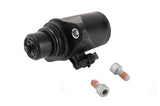 ACDelco Parking Brake Components, GM Genuine Parts Parking
$391.99Parking brake parts and torque tools. Confirm fitment by VIN before ordering.
ACDelco Parking Brake Components, GM Genuine Parts Parking
$391.99Parking brake parts and torque tools. Confirm fitment by VIN before ordering.


Frequently Asked Questions
Can I do a rear brake job on a GM truck without a scan tool?
Not safely on a vehicle with an electronic parking brake. The piston sits on a screw driven by a motor whose position the module tracks, so forcing it back mechanically can strip the actuator gearset and leaves the system out of calibration. The retract and apply routines are a matched pair. A bidirectional scan tool costs considerably less than a pair of rear calipers.
Why did my rear brake pads wear out so fast on my 2019 Silverado?
GM documents this in bulletin 21-NA-089, covering 2019 and 2020 Silverado and Sierra 1500s plus 2021 trucks built without RPO RG1. The cause is dirt, mud or debris packing into the rear caliper and holding the pads against the rotor, so they drag constantly. The fix is a shielded replacement caliper.
Is the rapid rear brake wear covered under warranty?
No. GM states plainly in 21-NA-089 that installing the shielded calipers is a customer-paid expense with no provision for coverage under the New Vehicle Limited Warranty. GM also instructs dealers to tell owners that if the brakes are not cleaned after off-road use, the resulting pad wear is not covered by warranty either.
What is the RG1 caliper?
RG1 is the RPO designation for GM's updated rear brake caliper with an improved shield that prevents mud packing. It was released for the 2021 model year as a dealer-installed option, and GM states it can be fitted to any 2019–2021 LD 1500 pickup not originally built with it. The bulletin lists part 84946818 for the left-hand side and 84946819 for the right.
Should I rinse my brakes after driving off-road?
Yes, and GM effectively makes this your responsibility. The bulletin instructs dealers to inform customers that accumulated dirt, mud and debris from off-road use can cause pad wear that warranty does not cover. Rinsing the rear brakes after driving on unpaved surfaces is cheap insurance on these trucks.
How do I put a GM electronic parking brake into service mode?
With a bidirectional scan tool: ignition on and engine off, select the electronic brake control module, open Control Functions, and run the rear brake caliper piston retract routine. You should hear both rear actuators cycle. Leave the tool connected through the job and run the apply or calibration routine before the vehicle moves.
Does the parking brake switch trick work instead of a scan tool?
Treat it as an emergency release, not as service mode. Reports of the switch sequence vary between platforms and model years, and it does not reliably put the module in the state that lets you compress the piston safely or recalibrate afterwards. If the actuators do not audibly run, they did not run.
Which GM vehicles have an electronic parking brake?
Any with a small switch on the dash or console instead of a foot pedal or hand lever. Broadly: Silverado and Sierra 1500 from the 2019 redesign, the full-size SUVs from 2021, Colorado and Canyon from 2023, and varying across cars, crossovers and EVs. The generation before the switch is a completely different rear brake job.
What if the parking brake warning stays on after the job?
Usually the apply or calibration routine was never run, or one actuator did not finish its cycle. Reconnect the tool, read the brake module codes, and run the apply routine again with ignition on and engine off. If a fault names a specific actuator circuit, inspect the connector at that corner — a corroded pin looks exactly like a dead motor to the module.
My dash says the rear pads are worn. Should I just replace them?
Measure them first. GM has documented a software condition on early 2019 trucks where the brake pad life percentage on the driver information centre counts down faster than the pads actually wear. If your only evidence is a number on the display, confirm it with a measurement before buying parts.
A Note on Sourcing
The rapid rear pad wear section — the model year coverage, the mud-packing cause, the RG1 shielded caliper, the part numbers 84946818 and 84946819, the customer-paid warranty position and the off-road cleaning instruction — comes from GM service bulletin 21-NA-089, April 2021 (PDF), published by NHTSA as a manufacturer communication and read in full.
The copper paste guidance comes from GM service bulletin 17-NA-040 (PDF), also read directly.
The pad-life-percentage software condition is documented by GM separately for early-build 2019 trucks. It is mentioned here as a reason to measure rather than trust the display, not as a diagnosis for any specific vehicle.
The service mode sequence reflects GM's documented scan tool procedure, but menu labels differ between tools. Torque figures are deliberately omitted — caliper bracket bolts on these trucks are commonly torque-to-yield with an angle specification, and the values differ between platforms.
The switch-only release method is deliberately not given as a procedure. Reports of it vary by platform and model year, and publishing a sequence that does not apply to a reader's vehicle would risk exactly the actuator damage this page exists to prevent.
More background on GM systems and procedures is in our GM repair guides library.
Get the tools and the brake parts in one order
Everything in this guide, in one place. Start with diagnostic tools and shop equipment, then add GM brake parts and hardware for the same visit. Check the coverage list on the tool and the year range on the brake parts against your own vehicle before you order.