
If your GM engine idles rough, the oxygen sensor is usually the wrong part to buy. Rough idle points at the MAF or MAP first, because those two sensors tell the computer how much air is entering the engine. The O2 sensors mostly correct fueling after the fact — a failing one shows up as bad fuel economy, a catalyst code, or a slow-responding trim, not a shake at idle.
The way to decide is with a scan tool and about fifteen minutes, not by replacing sensors in price order. Before you order anything from the GM sensors and engine electrical collection, work through the data below. Two of these three parts can be tested well enough in a driveway to rule them out.
Parts and tools you'll need
- MAF, MAP and oxygen sensors for your Chevrolet, GMC, Buick or Cadillac — order after you have data, not before
- A scan tool that shows live data, not just codes. Freeze-frame and fuel trims are the whole diagnosis
- MAF-specific aerosol cleaner. Not brake clean, not carb clean, not a generic contact cleaner
- A vacuum gauge, and an O2 sensor socket if you end up going that route
Diagnostic tools
 FOXWELL NT614 Elite OBD2 Scanner
$233.69Read MAF, MAP and O2 data before replacing anything.
FOXWELL NT614 Elite OBD2 Scanner
$233.69Read MAF, MAP and O2 data before replacing anything.
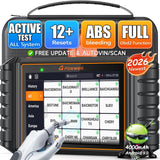 FOXWELL NT726 Bidirectional OBD2 Scanner
$368.99Read MAF, MAP and O2 data before replacing anything.
FOXWELL NT726 Bidirectional OBD2 Scanner
$368.99Read MAF, MAP and O2 data before replacing anything.
 Launch CRE 2.0 for Buick/Chevrolet/Cadillac All System
$159.00Read MAF, MAP and O2 data before replacing anything.
Launch CRE 2.0 for Buick/Chevrolet/Cadillac All System
$159.00Read MAF, MAP and O2 data before replacing anything.
 ZEAJSRU Engine Cylinder Compression Tester Kit Dual Fuel
$25.65Read MAF, MAP and O2 data before replacing anything.
ZEAJSRU Engine Cylinder Compression Tester Kit Dual Fuel
$25.65Read MAF, MAP and O2 data before replacing anything.


Which sensor causes a rough idle most often?
The MAF, followed by the MAP. A contaminated mass airflow sensor under-reports airflow, the computer under-fuels, and you get a lean stumble at idle plus lean codes. A failed MAP sensor produces surging and rough idle because the computer is calculating load from bad pressure data. O2 sensors rarely cause idle problems on their own.
That ordering holds for most port-injected and direct-injected GM V8s, V6s and turbo fours. It is not universal. A downstream sensor that has failed short can drag fuel trims in some strategies, and a badly biased upstream sensor will absolutely make an engine run poorly. But if you are choosing what to test first, test airflow first.
There is also a fourth possibility that outranks all three: nothing is wrong with any sensor. Vacuum leaks, dirty throttle bodies, carbon on intake valves, weak coils, worn plugs and failing injectors all produce a rough idle and can set the same codes. The sensors get blamed because the code has a sensor name in it.
What does each sensor actually do?
The MAF measures the mass of air entering the engine directly, using a heated wire or film that is cooled by airflow. The MAP measures absolute pressure in the intake manifold, which the computer converts to load. Upstream O2 sensors measure oxygen left in the exhaust so the computer can trim fueling; downstream sensors watch the catalytic converter.
| Sensor | What it measures | Typical output | Classic failure symptom | Common code range |
|---|---|---|---|---|
| MAF | Air mass entering the engine | Grams per second on a scan tool; 0–5 V or a frequency signal at the connector | Lean stumble, hesitation on tip-in, lean codes, poor economy | P0100–P0104 |
| MAP | Absolute pressure in the intake manifold | kPa on a scan tool; roughly 1–5 V on an analog sensor | Surging idle, rough idle, detonation, plug fouling | P0105–P0109 |
| Upstream O2 / AFR | Oxygen remaining in exhaust, pre-catalyst | Narrowband roughly 0.2–0.9 V; wideband reported as lambda or equivalence ratio | Poor fuel economy, emissions failure, sluggish trim response | P0130–P0147 |
| Downstream O2 | Catalyst efficiency | Should be slow and relatively steady near mid-range | Catalyst efficiency codes, usually no driveability change | P0036–P0058, P0420/P0430 |
Note that a lot of GM engines run both a MAF and a MAP. That is not redundancy for its own sake — the computer cross-checks one against the other, and it will set a range/performance code when the two disagree even if both sensors are technically alive. That is why a MAF performance code so often turns out not to be the sensor.
How do you read the MAF on a scan tool?
Watch grams per second at idle and at wide open throttle. A common shop rule of thumb is that idle airflow in grams per second lands near the engine's displacement in liters — published figures put most engines around 3 to 5 g/s at idle, rising to roughly 100 to 240 g/s at wide open throttle depending on the engine.
So a healthy 5.3L V8 should show something in the neighborhood of 5 g/s at a warm idle. If yours reads 2.5, the sensor is under-reporting and your fuel trims will confirm it. If it reads sensibly at idle but never climbs anywhere near expectation on a hard pull, the sensor is going lazy rather than dead.
GM's own diagnostic method is a comparison, not an absolute number. Its bulletin on contaminated airflow sensors tells technicians to compare the grams-per-second and hertz readings against a like vehicle running an OEM air box and filter under the same driving conditions. That is worth knowing, because it means a figure from a forum for a different truck on a different day is not evidence of anything.
The tell for a dirty MAF, as opposed to a dead one, is sluggishness. A contaminated element becomes slow to respond to airflow changes and drifts low, which sets lean codes. A completely failed sensor produces no usable signal at all, and the computer falls back to a default fueling table.
Check your long-term fuel trims at the same time. Positive trims mean the computer is adding fuel to compensate for something, which is consistent with a MAF reading low or with an unmetered air leak. Many technicians treat total fuel trim beyond roughly ten percent as worth chasing, but compare against a known-good baseline for your engine rather than treating that as a hard threshold.
How do you test a MAP sensor?
Two quick checks. With the key on and the engine off, a good MAP sensor should read barometric pressure — around 28 to 31 inches of mercury equivalent depending on your elevation, or close to 101 kPa near sea level. Start the engine and it should drop to idle vacuum, typically 16 to 20 inches of mercury on a healthy engine.
If the key-on reading is wrong, the sensor or its reference voltage is suspect. If the key-on reading is right but the running reading is not, you have either a bad sensor, a plugged or cracked vacuum line to it, or an engine with a genuine vacuum problem.
That last case matters more than people expect. A low, unsteady idle vacuum reading is a mechanical finding, not a sensor finding. Sticking valves, a leaking intake gasket, a worn camshaft or an exhaust restriction will all show up here, and no sensor you buy fixes any of them.
Snap the throttle and watch the value move. A MAP that responds instantly and smoothly through the range is almost certainly fine. One that hangs, steps, or drops out momentarily is not.
When is the O2 sensor actually the problem?
When the complaint is fuel economy, an emissions failure, a catalyst code, or a heater-circuit code — not when the complaint is a shake at idle. Narrowband upstream sensors should swing across roughly 0.2 volts lean to 0.9 volts rich, crossing about 0.45 volts, and on multiport injection they should switch several times per second at 2500 rpm.
A lazy sensor is one that still swings but does it slowly. That costs fuel and emissions without producing a dramatic symptom, which is exactly why they get ignored until an inspection fails. Heater circuit codes are also worth taking seriously — a sensor that takes too long to reach operating temperature leaves the engine in open loop longer than it should be.
Downstream sensors are a different animal. Their job is to grade the catalytic converter, and a downstream sensor that mirrors the upstream one is usually telling you the converter is finished, not that the sensor is bad. Replacing the downstream sensor to clear a catalyst efficiency code works about as often as you would expect.
One practical note: if an upstream sensor has genuinely failed, some engines default to a fixed, rich mixture, and fuel consumption goes up sharply. If your economy fell off a cliff and the idle is fine, the O2 sensor moves up the list.
Should you clean the MAF or just replace it?
Clean it first. It costs almost nothing and it fixes a meaningful share of lean-code complaints. Use an aerosol cleaner made for MAF sensors, spray the element and let it soak, and let it dry completely before reinstalling. Do not use any other cleaner and do not touch the element with anything.
- Disconnect the battery negative terminal.
- Unplug the MAF connector and remove the sensor from the intake tube. Note its orientation.
- Look at the element. Oily film, dust bridging, or a visibly darkened wire tells you a lot before you spray anything.
- Spray the element thoroughly with MAF cleaner and let it soak for several minutes.
- Do not scrub, wipe, brush or touch the sensing element. It is fragile and a fingerprint will change how it reads.
- Let it air dry completely. Installing a wet sensor can damage it.
- Reinstall in the original orientation, reconnect, and clear codes.
- Drive it through a full warm-up and recheck grams per second and fuel trims.
If cleaning does not move the numbers, replace the sensor. If cleaning fixes it and it comes back in two months, find out why it is getting contaminated — which brings us to the single most useful thing on this page.
Over-oiled air filters: what GM's bulletin actually says
If you run a reusable oiled-gauze air filter and you keep killing MAF sensors, this is your answer, and it comes from GM rather than from us.
GM's service bulletin 04-07-30-013D — "Automatic Transmission Shift and Engine Driveability Concerns and/or MIL ON Due to Aftermarket Oil Bath Air Filter Use" — covers 2018 and prior GM passenger cars and light-duty trucks. GM states that filter oil can transfer onto the MAF or combined MAF/IAT sensor, contaminating it so the grams-per-second and hertz signals become "skewed, low or generally out of range."
What GM says that can result:
- The malfunction indicator lamp illuminating and codes setting
- The automatic transmission shifting early or late, slipping, and damaged clutches or bands
- Driveability complaints including poor acceleration from a stop, stumble, rough idle and limited engine RPM range
Read the transmission line again. A contaminated airflow sensor is not only an engine problem. The transmission uses calculated engine load for shift scheduling, so a sensor reading low can produce shift complaints and genuine clutch damage. That is a several-thousand-dollar consequence from an air filter.
The warranty position, stated precisely
This gets misreported constantly in both directions, so here is the distinction GM actually draws.
Fitting an aftermarket reusable filter does not, by itself, void your warranty. But GM instructs technicians to inspect the MAF sensor element and the air induction hose for oil contamination before making warranty repairs, and states that transmission or driveability concerns resulting from that contamination are not considered warrantable repair items.
So the filter is not the problem for warranty purposes. The oil on your sensor is. If you run one of these filters, under-oil rather than over-oil it, and check the sensor element before you present a driveability complaint at a dealer.
What gets misdiagnosed as a bad sensor?
Unmetered air is the big one. Any air that gets into the engine after the MAF — a cracked intake duct, a failed PCV hose, a leaking intake manifold gasket, a brake booster hose — makes the MAF look like it is under-reporting when it is reading correctly.
Ignition faults are the second. A worn plug or a failing coil produces a rough idle that people chase through the sensor aisle for weeks. If the shake is rhythmic and the check engine light flashes under load, you are looking at a misfire, and our breakdown of misfire causes on GM engines is the better starting point.
Third is a dirty throttle body or carbon-loaded intake valves on direct-injected engines. Both change idle airflow in ways the computer has to fight, and both produce exactly the rough, hunting idle people attribute to a MAP sensor. One caution if you clean a throttle body: some GM vehicles need an idle relearn afterwards, and skipping it produces its own fault.
Fourth is a wiring or connector problem. Corroded pins, a chafed harness, a bad ground, or a reference voltage that is not what it should be will produce sensor codes with a perfectly good sensor on the end of the wire. Wiggle-test the connector while watching live data before you condemn anything.
What do the codes actually narrow down?
Circuit codes point at wiring and connectors. Range or performance codes point at a sensor reading implausibly compared with other inputs. Lean and rich codes are system-level, not sensor-level. Read all of them together, and read the freeze frame — it tells you engine speed, load and coolant temperature at the moment of failure.
| What you see | What it usually means | First thing to check |
|---|---|---|
| MAF range/performance code plus positive fuel trims | MAF reading low, or unmetered air after the sensor | Intake ducting and PCV, then clean the MAF |
| MAF circuit high or low code | Electrical fault more than sensor fault | Connector, reference voltage, ground |
| MAP range/performance code with surging idle | MAP sensor, its vacuum source, or genuine low vacuum | Key-on barometric reading, then running vacuum |
| Lean codes on one bank only | Localized leak or injector, rarely the MAF | Intake gasket and injectors on that bank |
| Lean codes on both banks | Something common to both — MAF, PCV, fuel supply | MAF data and fuel pressure |
| Catalyst efficiency code, drives fine | Usually the converter, not the downstream sensor | Compare upstream and downstream waveforms |
| O2 heater circuit code | Sensor heater or its circuit | Fuse, connector, then the sensor |
| MAF codes plus transmission shift complaints | Check for an over-oiled reusable air filter first | Inspect the sensor element and induction hose for oil |
If you are not sure how to pull and interpret the codes in the first place, start with our walkthrough on reading and clearing Chevrolet trouble codes, and the rundown of the most common GM check engine light codes.
The decision tree, in order
- Pull all codes and record the freeze frame before clearing anything.
- Read long-term and short-term fuel trims at idle and at about 2000 rpm.
- Inspect the intake ducting, PCV plumbing and every vacuum line you can reach. Fix leaks before testing sensors.
- If the truck has a reusable oiled filter, inspect the MAF element for oil before anything else.
- Compare MAF grams per second at idle against the rough displacement rule, and watch it climb under load.
- Check the MAP key-on-engine-off reading against local barometric pressure, then check running vacuum.
- If MAF data is low and trims are positive, clean the MAF and retest.
- If MAP data is implausible and the vacuum line is intact, replace the MAP.
- Only after airflow is verified good, evaluate the upstream O2 sensors for switching speed and range.
- Treat downstream sensor codes as catalyst questions until proven otherwise.
- If the idle is still rough with all sensor data plausible, go back to mechanical causes: ignition, injectors, valve deposits, compression.
Safety note: O2 sensors thread into exhaust components that stay hot long after shutdown, and they seize. Let the vehicle cool, use a proper O2 sensor socket, and do not put your body in a position where a sudden release lands your hand on a manifold.
OEM or aftermarket?
For MAF sensors, this is one place where the OE or OE-equivalent part is worth it. MAF sensors are calibrated to a specific intake tract, and cheap units frequently read a few percent off across the range — enough to set the same code you were trying to fix. For MAP sensors, quality aftermarket parts do fine; the sensing element is simpler.
For oxygen sensors, buy a reputable brand and buy the correct type. Narrowband and wideband sensors are not interchangeable, and universal splice-in sensors are a false economy on a vehicle you plan to keep. If your engine uses a wideband air-fuel ratio sensor upstream, a narrowband will not work no matter how well it threads in.
One more: replace O2 sensors in pairs per bank only if both are actually degraded. There is no rule that says they fail together, and an unnecessary sensor is money you could put toward the converter you are probably going to need.
Which GM MAF Sensor Fits Your Vehicle
Every part below is a GM Genuine Parts, ACDelco or Delphi number we stock, matched against GM's own parts catalogue. Order by VIN if your vehicle sits on a changeover year — several of these look identical and differ only by connector.
| Vehicle | Years | Engine | Part | Price |
|---|---|---|---|---|
| Silverado 1500, Sierra 1500, Tahoe, Suburban, Yukon, Escalade | 2013–2020 | 4.3L V6, 5.3L V8, 6.0L, 6.2L V8 | ACDelco 20787043 — the sensor GM later renumbered 23262343 | $183.65 |
| Silverado, Sierra, Tahoe, Suburban, Yukon, Escalade, Avalanche, Hummer H2 | 2001–2007 | 4.3L, 4.8L, 5.3L, 6.0L, 8.1L | Delphi AF10043 (interchange for GM 19330121) | $163.99 |
| Tahoe, Suburban, Yukon, Yukon XL, Escalade | 2023–2024 | 6.2L V8 (L87) | GM 12721126 | $113.01 |
| Equinox, Terrain | 2018–2022 | 1.5L turbo (LYX) | GM 23366103 | $88.41 |
| Malibu | 2016–2024 | 1.5L turbo (LFV) | GM 23366103 | $88.41 |
| Cruze, Sonic, Trax, Encore, Verano | 2012–2021 | 1.4L turbo, 1.8L, 1.6L diesel | GM 12671624 | $123.79 |
| Cruze | 2011–2012 | 1.4L turbo, 1.8L | GM 12671616 | $75.44 |
| Cruze | 2018–2019 | 1.4L turbo (LE2) | GM 55498433 | $67.24 |
| Silverado 2500/3500 HD, Sierra 2500/3500 HD | 2017–2023 | 6.6L Duramax (L5P) | GM 23324767 | $90.75 |
| Silverado / Sierra 2500 HD & 3500 HD, Express, Savana | 2007–2010 | 6.6L Duramax (LMM) | ACDelco 213-3856 (98002762) | $204.16 |
| Silverado / Sierra 2500 & 3500 | 2001–2007 | 6.6L Duramax (LB7/LLY/LBZ) | ACDelco 213-4115 (97209545) | $243.27 |
| Traverse, Acadia, Enclave, CTS, STS, Outlook | 2009–2011 | 3.6L V6 | GM 19355502 | $122.73 |
| Equinox, SRX, CTS, STS, G8, Torrent | 2008–2009 | 3.6L V6 | GM 19355501 | $101.25 |
| Camaro, Corvette, Colorado, Impala, Malibu, Equinox, CTS, Regal, HHR | 2005–2019 (see listing) | Many — incl. LS2/LS3/LS7 and 2.4L | ACDelco 213-4222 (15865791) | $76.25 |
| Colorado, Canyon, Hummer H3, Malibu, Ion Redline | 2004–2008 | 2.2L, 2.8L, 3.5L, 2.0L SC | ACDelco 213-1585 (12579352) | $119.24 |
| Cruze | 2014–2015 | 2.0L diesel (LUZ) | GM 22821558 | $116.05 |
Three fitment traps worth knowing before you order. 2019 is a split year for the Silverado and Sierra 1500 — the carryover old-body LD/Limited takes the 23262343-family sensor above, while the new-body truck takes a different part. 2014 Tahoe, Suburban and Yukon are the older GMT900 body and take a different sensor again; the changeover is 2015. And the 2014–2015 Cruze 2.0 diesel sensor in the last row is not interchangeable with any 1.4L turbo Cruze part, despite the same model name and overlapping years.
MAF sensors
 ACDelco MAF Sensor, GM OE, Stock
$162.99GM MAF sensors. Confirm fitment by VIN before ordering.
ACDelco MAF Sensor, GM OE, Stock
$162.99GM MAF sensors. Confirm fitment by VIN before ordering.
 GM Genuine Parts 213-4222 (15865791) Mass Airflow Sensor
$76.25GM MAF sensors. Confirm fitment by VIN before ordering.
GM Genuine Parts 213-4222 (15865791) Mass Airflow Sensor
$76.25GM MAF sensors. Confirm fitment by VIN before ordering.
 GM Genuine Parts 12671610 Mass Airflow Sensor with Intake Air
$75.99GM MAF sensors. Confirm fitment by VIN before ordering.
GM Genuine Parts 12671610 Mass Airflow Sensor with Intake Air
$75.99GM MAF sensors. Confirm fitment by VIN before ordering.
 ACDelco MAF Sensor, GM OE, Stock
$115.99GM MAF sensors. Confirm fitment by VIN before ordering.
ACDelco MAF Sensor, GM OE, Stock
$115.99GM MAF sensors. Confirm fitment by VIN before ordering.


What to check before you order
- Codes and freeze frame recorded. Clearing them before reading them throws away the diagnosis.
- Fuel trims noted at idle and at cruise, both banks.
- Vacuum and intake leaks ruled out before any sensor gets condemned.
- Air filter checked for over-oiling if it is a reusable type.
- MAF cleaned and retested before it gets replaced.
- Correct sensor type — narrowband versus wideband, upstream versus downstream, correct bank.
- Engine, year and RPO verified, since GM ran several sensor designs across the same nameplate.
MAP and O2 sensors
 Delphi MAP Sensor PS10000 for 2000-2011 Chevy
$94.99GM MAP and oxygen sensors. Confirm fitment by VIN before ordering.
Delphi MAP Sensor PS10000 for 2000-2011 Chevy
$94.99GM MAP and oxygen sensors. Confirm fitment by VIN before ordering.
 GM Genuine Parts 213-4760 (55567257) Manifold Absolute
$47.70GM MAP and oxygen sensors. Confirm fitment by VIN before ordering.
GM Genuine Parts 213-4760 (55567257) Manifold Absolute
$47.70GM MAP and oxygen sensors. Confirm fitment by VIN before ordering.
 Delphi Oxygen Sensor ES20008 for 2006-2017 Chevy
$115.99GM MAP and oxygen sensors. Confirm fitment by VIN before ordering.
Delphi Oxygen Sensor ES20008 for 2006-2017 Chevy
$115.99GM MAP and oxygen sensors. Confirm fitment by VIN before ordering.
 GM Genuine Parts 12659516 Heated Oxygen Sensor
$63.69GM MAP and oxygen sensors. Confirm fitment by VIN before ordering.
GM Genuine Parts 12659516 Heated Oxygen Sensor
$63.69GM MAP and oxygen sensors. Confirm fitment by VIN before ordering.


Frequently Asked Questions
Which sensor causes a rough idle: MAF, MAP or O2?
Usually the MAF, then the MAP. Both tell the computer how much air is entering the engine, so bad data from either produces a stumble or a surge immediately. Oxygen sensors trim fuelling after combustion, so a failing one typically shows up as poor economy, an emissions failure or a catalyst code rather than a shake at idle. If your complaint is a rough idle, test airflow first.
What should my MAF read at idle?
A common shop rule of thumb puts idle airflow in grams per second near the engine's displacement in litres, so roughly 5 g/s on a 5.3L V8 at a warm idle. Treat that as a sanity check rather than a specification. GM's own method is comparative: compare your readings against a like vehicle running an OEM air box and filter under the same conditions.
Can an over-oiled air filter really damage my transmission?
According to GM, yes. Its bulletin 04-07-30-013D states that oil transferred from an aftermarket oil bath filter onto the MAF sensor can cause the automatic transmission to shift early or late, slip, and suffer damaged clutches or bands, alongside engine driveability complaints. The transmission uses calculated engine load for shift scheduling, so a sensor reading low affects it directly.
Does an aftermarket air filter void my GM warranty?
Fitting one does not void the warranty by itself. But GM instructs technicians to inspect the MAF sensor element and air induction hose for oil contamination before making warranty repairs, and states that transmission or driveability problems resulting from that contamination are not warrantable. The filter is not the issue for warranty purposes; oil on your sensor is.
Should I clean the MAF sensor or replace it?
Clean it first, with MAF-specific cleaner only. Spray the element, let it soak, and let it dry completely before reinstalling. Never scrub, wipe or touch the sensing element. If cleaning does not move the grams-per-second reading or the fuel trims, replace it. If cleaning fixes it and the fault returns within a couple of months, find out what is contaminating it.
How do I test a MAP sensor at home?
Two checks. Key on, engine off, it should read barometric pressure, around 101 kPa near sea level. Start the engine and it should drop to idle vacuum, typically 16 to 20 inches of mercury. If the key-on reading is wrong, suspect the sensor or its reference voltage. If key-on is right but running is not, suspect the sensor, its vacuum line, or a genuine engine vacuum problem.
My scan tool shows lean codes on both banks. Is that the MAF?
It points at something common to both banks, which does include the MAF, but also the PCV system and fuel supply. Lean codes on one bank only are almost never the MAF, since a single sensor measures air for the whole engine. Rule out unmetered air after the sensor before condemning anything.
Will replacing the downstream O2 sensor clear a P0420 code?
Rarely. The downstream sensor's job is to grade the catalytic converter, so a downstream reading that mirrors the upstream one usually means the converter is finished rather than the sensor is faulty. Compare the two waveforms before spending anything, because replacing the sensor to clear a catalyst code works about as often as you would expect.
Are narrowband and wideband oxygen sensors interchangeable?
No. If your engine uses a wideband air-fuel ratio sensor upstream, a narrowband will not work regardless of whether it threads in. Universal splice-in sensors are a false economy on a vehicle you plan to keep. Confirm the sensor type, the bank and the position before ordering.
Do I need to replace oxygen sensors in pairs?
Only if both are actually degraded. There is no rule that says they fail together. An unnecessary sensor is money better kept for the converter you may end up needing.
A Note on Sourcing
The over-oiled air filter section comes from GM service bulletin 04-07-30-013D, dated November 2017 (PDF), published by NHTSA as a manufacturer communication and read in full. That bulletin supplies the covered models, the listed consequences including transmission clutch and band damage, the description of the grams-per-second and hertz signal becoming skewed or low, the comparative diagnostic method, and the warranty position.
The warranty distinction is GM's, and it is finer than the version that circulates online. Fitting a reusable filter does not void the warranty; damage traced to oil contamination of the sensor is not a warrantable repair. Both halves of that matter.
The diagnostic thresholds — the grams-per-second rule of thumb, the ten percent fuel trim guideline, the vacuum ranges and the oxygen sensor switching figures — are standard technician practice, not GM specifications for your engine. Use them to decide what to test next, not as pass/fail limits.
Part numbers and fitment are matched against GM's parts catalogue, but sensors were revised mid-generation on several platforms. Order against your VIN on any changeover year.
For more diagnostic walkthroughs, see the rest of our GM diagnostics guides.
Still deciding which sensor to buy?
Compare the three side by side against your own scan data. If airflow readings are low and trims are positive, you are looking at a MAF — and if you run an oiled filter, look at that before you look at the sensor. If the idle surges and the key-on pressure reading is wrong, you are looking at a MAP. If the car drives fine but drinks fuel or fails emissions, you are looking at an oxygen sensor.
All three, plus the connectors and pigtails that go with them, are in the GM engine electrical and sensor collection. Filter by your model year and engine, and confirm sensor type before you order — the same vehicle often used more than one.