
P118B is "Particulate Matter Sensor Temperature Not Plausible" on GM diesels. Two things are worth knowing before you spend anything. It is not a diesel particulate filter failure — the PM sensor is the device that judges the filter, not the filter itself. And on a long list of 2016–2018 GM diesels there is a free emission recall covering an ECM software fault that stopped the module diagnosing this sensor correctly in the first place.
Jump to a section: What P118B means · What it does not mean · Check the emission recall first · Exhaust leaks cause false sensor codes · Why the code won't clear · Where the sensor is · Symptoms · Causes and how to confirm each · How it's diagnosed · Parts and cost · GM documents · What other pages get wrong · FAQ
What P118B Means
The particulate matter sensor measures soot in the exhaust after the diesel particulate filter. Its job is to confirm the filter is doing its job.
It is not a simple two-wire sensor. It is closer to a heated oxygen sensor with a ceramic element, but it carries its own individually calibrated sensor control unit — the black box attached to the sensor body. The sensing element contains comb-shaped interdigital electrodes, a heater, and a positive temperature coefficient resistor used to measure temperature.
The measuring cycle works like this:
- Exhaust flows over the element and soot collects in the combs between the electrodes.
- Once enough soot bridges them, a conductive path forms and current flows across the applied voltage.
- Measurement continues until a preset current value is reached.
- The sensor then regenerates itself — heating the element to burn the soot off — before starting the next measurement.
- After a calibrated number of these cycles, the cumulative readings tell the module how much soot is getting past the filter, which is how DPF collection efficiency is determined.
That self-heating cycle is why the sensor needs to know its own temperature. P118B sets when the temperature the sensor reports is not plausible — so the module cannot trust the readings and stops acting on them.
Note what that describes: a measurement problem, not an emissions problem. The instrument is unreliable. Nothing has yet been said about the filter.
What P118B Does Not Mean
This is the part that costs people money, so it is worth stating flatly.
P118B does not mean your diesel particulate filter has failed. The words "particulate matter" appear in both names, and that similarity does real damage — a DPF is a several-thousand-dollar component, while the PM sensor is a bolt-in part with a modest labour time.
| Particulate matter (PM) sensor | Diesel particulate filter (DPF) | |
|---|---|---|
| What it is | A sensor with its own control unit, in the exhaust downstream of the filter | The filter itself — the component that traps soot |
| What it does | Checks how well the filter is working | Does the actual filtering |
| Cost | A sensor, plus a short labour operation | Substantial |
| What P118B says about it | Its temperature reading is implausible | Nothing directly |
If a quote for P118B includes a particulate filter, ask specifically what evidence points at the filter rather than the sensor. There may be a good answer — other codes, a failed test, visible damage — but P118B alone is not it.
One real cautionary note. Owners have reported the sensor snapping off during removal because it seizes in the exhaust, turning a sensor job into a filter replacement. That is an argument for careful removal by someone who has done it, not an argument for replacing the filter up front.
Check the Emission Recall Before Paying for Anything
This is the single most valuable thing on this page, and it is free to act on.
In November 2017, GM issued a voluntary emission recall — N172118140, also referenced as #17337, "Diesel Particulate Matter Sensor Diagnostic Fault." The description of the problem is remarkable:
The engine control module in these vehicles may not properly diagnose a fault in the exhaust particulate matter sensor.
In other words, the module's diagnosis of this sensor was itself defective. The remedy is to reprogram the engine control module (and the transmission control module on some vehicles).
GM service bulletin 18-NA-024 (January 2018) confirms the mechanism directly. Covering the 2017 Cruze with the 1.6L turbocharged diesel (RPO LH7), it states the cause as:
a software anomaly in the engine control module (ECM) that may prevent it from properly diagnosing a fault in the exhaust particulate matter sensor.
Its correction is not a part. It is to check Investigate Vehicle History and, if the recall shows as Open, perform it.
Vehicles named in the recall:
| Model year | Vehicles (diesel-equipped) |
|---|---|
| 2016 | Chevrolet Colorado, GMC Canyon |
| 2017 | Chevrolet Express, GMC Savana |
| 2017–2018 | Chevrolet Colorado, Chevrolet Cruze, Chevrolet Silverado HD, GMC Canyon, GMC Sierra HD |
| 2018 | Chevrolet Equinox, GMC Terrain |
That list overlaps heavily with the vehicles people are reading this page about.
Being precise about what this does and does not say: 18-NA-024 names DTCs U0074, P040B, P046E, P11CC, P24B0 and P2453 — P118B is not on that list, and we would rather tell you that than let a citation imply more than it supports. What the recall addresses is the module's ability to diagnose particulate matter sensor faults generally. Given that P118B is a particulate matter sensor code, and that the vehicle coverage lines up, checking your VIN against this recall costs nothing and should happen before any part is bought. A dealer can tell you in minutes whether it shows Open or Closed.
An Exhaust Leak Can Cause a False Sensor Code
GM has documented a second way to get a PM sensor fault that is not the sensor.
The PIP5748 series — revisions B, C and F, published through 2020 and 2021 for the 3.0L LM2 Duramax in Silverado, Sierra, Tahoe, Suburban, Yukon and Escalade — is titled "Particulate Matter Sensor Protection Tube Performance Diagnostic May Set A False DTC." GM's own words are that the diagnostic "may falsely fail." On the cause, GM says plainly that the condition was under investigation by engineering.
The inspection sequence GM published is the useful part, and it generalises:
- Check whether the PM sensor is loose in the exhaust pipe. If it is, that is the problem and the bulletin does not apply.
- If the sensor is properly torqued, test the exhaust for leaks — GM specifies a smoke leak detector.
- Check the tailpipe and exhaust joints for proper alignment, using the witness marks on the joint. GM notes a misaligned joint can cause the fault even if it is not leaking.
- Replace the exhaust clamp if it is bottomed out, and inspect both halves of the joint for deformation.
GM's labor operation for the sensor itself, 4087528 Exhaust Particulate Sensor Replacement, is 0.4 hours — a useful number to have when reviewing a quote.
Again, honestly: these bulletins name DTC P1488 and P24DA, not P118B, and they cover the LM2 engine specifically. We include them because they establish something that applies to any PM sensor code: a loose sensor, an exhaust leak, or a misaligned exhaust joint can make this sensor report nonsense. Those are cheap things to check before condemning a sensor with a control unit attached to it.
Scan tools
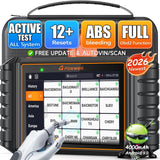 FOXWELL NT726 Bidirectional OBD2 Scanner
$368.99Read the PM sensor and soot data.
FOXWELL NT726 Bidirectional OBD2 Scanner
$368.99Read the PM sensor and soot data.
 FOXWELL NT614 Elite OBD2 Scanner
$233.69Read the PM sensor and soot data.
FOXWELL NT614 Elite OBD2 Scanner
$233.69Read the PM sensor and soot data.
 FOXWELL NT604 OBD2 Scanner
$209.09Read the PM sensor and soot data.
FOXWELL NT604 OBD2 Scanner
$209.09Read the PM sensor and soot data.


Why the Code Won't Clear After You Fix It
A predictable frustration, and it usually is not a failed repair.
Emissions-related codes on modern vehicles include permanent DTCs. Unlike ordinary codes, a permanent DTC cannot be erased with a scan tool. It clears only after the relevant monitor has run and passed, which can take several drive cycles.
So the normal sequence after replacing a PM sensor is: the check engine light goes out fairly quickly, but P118B remains stored as a permanent code for a while afterwards. Owners have reported exactly that, with the code clearing itself after a handful of drives. That is the system working as designed.
Two practical consequences:
- Do not judge the repair on the first drive. Give the monitors time to run before concluding anything.
- Do not book an emissions test immediately after the repair. A stored permanent DTC or incomplete monitors will fail you even though the vehicle is fixed. Drive it for a week first.
It is also worth knowing that clearing codes on GM's newer module architectures can be inconsistent — some tools are refused outright. That is a tool and architecture quirk rather than a fault with your vehicle.
Where the Sensor Is and What It Looks For
The PM sensor sits in the exhaust downstream of the particulate filter, since it is measuring what got past. On the Colorado and Canyon 2.8L, owners consistently describe it in the S-bend of the exhaust after the catalyst — and identify it as the sensor with the black box attached. That black box is the sensor control unit, and it is why this is not a generic bolt-in probe.
Two things follow. First, the assembly can be more expensive than a typical sensor, because you are buying a small control module with it. Second, replacement may need the new unit to be recognised by the vehicle, so if you fit one yourself and the code persists, a dealer visit may still be needed.
These sensors have also spent time under GM parts restriction and on back-order, which is worth anticipating if you are quoted a long wait.
Symptoms of P118B
- Check engine light on
- Frequently no drivability change at all — this is the most common report
- Reduced fuel economy in some cases
- Reduced engine performance in some cases
- Failed emissions test, or incomplete readiness monitors
- Other diesel aftertreatment codes stored alongside
On urgency: this is a monitoring fault rather than a mechanical one, so it is not an emergency. But it is not something to leave indefinitely either — while the sensor is untrusted, the system cannot verify that your particulate filter is working, and a genuine filter problem developing behind a disabled monitor is a considerably more expensive outcome. Deal with it within a reasonable window, and sooner if you have a test due.
Causes and How to Confirm Each
| Cause | How to confirm it | Source |
|---|---|---|
| ECM software fault — the module misdiagnosing the sensor | Check your VIN for emission recall N172118140 / #17337. Free, and takes minutes | GM emission recall; mechanism confirmed by 18-NA-024 — verified |
| PM sensor loose in the exhaust pipe | Check torque before anything else | PIP5748 series — GM's own first step |
| Exhaust leak, or a misaligned exhaust joint | Smoke test the exhaust; check joint witness marks. A misaligned joint can do it without leaking | PIP5748 series |
| Failed PM sensor or its control unit | After the above are excluded — scan tool data and circuit testing | The common eventual finding |
| Damaged or corroded sensor wiring | Inspect the harness and connector; exhaust-area wiring lives a hard life | Heat and road exposure |
| Poor connector contact | Inspect and reseat the connector | Cheap to check |
| Heavy soot contamination on the element | Sometimes cleanable, but an internal electrical fault will not respond | Worth attempting before replacement |
| Aftermarket tuning or emissions equipment changes | Disclose any modifications up front | Owners report the code returning on modified trucks |
Exhaust and sensor parts
 ACDelco 6.6L Diesel Exhaust Temperature Sensor, Position 2
$153.99Sensors, gaskets and loom — confirm engine. Confirm fitment by VIN before ordering.
ACDelco 6.6L Diesel Exhaust Temperature Sensor, Position 2
$153.99Sensors, gaskets and loom — confirm engine. Confirm fitment by VIN before ordering.
 MAHLE Exhaust Pipe Flange Gasket F32274
$13.00Sensors, gaskets and loom — confirm engine. Confirm fitment by VIN before ordering.
MAHLE Exhaust Pipe Flange Gasket F32274
$13.00Sensors, gaskets and loom — confirm engine. Confirm fitment by VIN before ordering.
 Nomex Split Loom, 1 in. x 10 ft
$105.66Sensors, gaskets and loom — confirm engine. Confirm fitment by VIN before ordering.
Nomex Split Loom, 1 in. x 10 ft
$105.66Sensors, gaskets and loom — confirm engine. Confirm fitment by VIN before ordering.


How Is P118B Diagnosed?
- Check the VIN against emission recall N172118140 / #17337 first. If it shows Open, the fix is a free reprogram and no part at all.
- Record every stored code. Diesel aftertreatment codes cluster, and the pattern matters.
- Check that the PM sensor is properly torqued in the exhaust pipe — GM's own first step.
- Inspect for exhaust leaks, ideally with a smoke tester, and check joint alignment against the witness marks.
- Inspect the sensor, its control unit, wiring and connector for damage, corrosion and heat distress.
- Review scan tool data from the sensor to see what it is actually reporting.
- Replace the sensor only after the above — and expect the assembly to cost more than a plain sensor because of the control unit.
- Allow several drive cycles before judging the repair, because permanent DTCs will not clear on demand.
- Do not book an emissions test straight away. Let the monitors complete first.
Parts and Cost
| Repair | What it involves | Cost picture |
|---|---|---|
| Emission recall reprogram | ECM software update at a dealer where the recall is Open | No charge. Check this before anything else |
| Tightening a loose sensor | Torque to specification | Minimal |
| Exhaust leak or joint alignment repair | Smoke test, realign the joint, replace a bottomed-out clamp | Modest — and far cheaper than a wrongly replaced sensor |
| Wiring or connector repair | Where corrosion or damage is found | Modest |
| PM sensor assembly | Sensor plus its control unit. GM's labor operation for replacement is 0.4 hours | More than an ordinary sensor; labour is short |
| Dealer recognition of a new sensor | Where the code persists after self-installation | A diagnostic charge |
| Diesel particulate filter | Not indicated by P118B on its own | Substantial — ask what evidence points at the filter |
Confirm part numbers against your VIN. These sensors are engine-specific and have been revised, so a number from a forum post about a different engine is not a safe basis for ordering.
Diesel service items
 ACDelco 10-4022 Diesel Exhaust Fluid 19286291 (DEF), 1 Gallon
$22.99DEF, fuel filter and dexosD oil. Confirm fitment by VIN before ordering.
ACDelco 10-4022 Diesel Exhaust Fluid 19286291 (DEF), 1 Gallon
$22.99DEF, fuel filter and dexosD oil. Confirm fitment by VIN before ordering.
 ACDelco 6.6L Diesel Fuel/Water Separator Filter TP1014
$101.99DEF, fuel filter and dexosD oil. Confirm fitment by VIN before ordering.
ACDelco 6.6L Diesel Fuel/Water Separator Filter TP1014
$101.99DEF, fuel filter and dexosD oil. Confirm fitment by VIN before ordering.
 ACDelco dexosD 0W-20 Diesel Oil Change Kit
$125.46DEF, fuel filter and dexosD oil. Confirm fitment by VIN before ordering.
ACDelco dexosD 0W-20 Diesel Oil Change Kit
$125.46DEF, fuel filter and dexosD oil. Confirm fitment by VIN before ordering.


GM Documents Relevant to the PM Sensor
| Document | Subject | Status |
|---|---|---|
| 18-NA-024 (Jan 2018) | MIL illuminated with DTCs U0074, P040B, P046E, P11CC, P24B0 or P2453. Cause: a software anomaly in the ECM that may prevent it from properly diagnosing a fault in the exhaust particulate matter sensor. Correction: check Investigate Vehicle History and perform emission recall #17337 if Open | 2017 Cruze, 1.6L turbo diesel (LH7) — verified. Does not name P118B |
| Emission Recall N172118140 / #17337 (Nov 2017) | "Diesel Particulate Matter Sensor Diagnostic Fault." The ECM may not properly diagnose a fault in the exhaust particulate matter sensor. Remedy: program the ECM, and the TCM on some vehicles | 2016 Colorado/Canyon; 2017 Express/Savana; 2017–18 Colorado, Cruze, Silverado HD, Canyon, Sierra HD; 2018 Equinox/Terrain — diesel. Corroborated across sources; confirmed as the referenced remedy by 18-NA-024 |
| PIP5748F and earlier revisions (2020–21) | PM sensor protection tube diagnostic may falsely fail, setting P1488 or P24DA. Check the sensor is not loose; if properly torqued, test the exhaust for leaks and check joint alignment by witness marks — a misaligned joint can cause it without leaking. Labor op 4087528, 0.4 hours | 3.0L LM2 — Silverado, Sierra, Tahoe, Suburban, Yukon, Escalade, 2020–21 — verified. Names P1488/P24DA, not P118B |
On sourcing: we did not find a GM bulletin naming P118B directly. Everything above concerns the same sensor and the same failure modes, and we have said in each case which codes the document actually names. Have a dealer check your VIN against current recalls and bulletins.
What Other P118B Pages Get Wrong
- Never mentioning the emission recall. GM recalled a long list of diesels because the ECM could not correctly diagnose this very sensor. For an affected vehicle the fix is a free reprogram — and no page that omits it is serving the reader.
- Letting readers conflate the sensor with the filter. "Particulate matter sensor" and "particulate filter" sound alike and differ by thousands of dollars. P118B points at the sensor.
- Going straight to sensor replacement. GM's own first steps are checking that the sensor is properly torqued and testing the exhaust for leaks. A misaligned exhaust joint can set a false PM sensor code without leaking at all.
- Treating it as a plain sensor. It carries its own calibrated control unit, which affects both the price and whether the vehicle will recognise a new one.
- Not explaining permanent DTCs. People replace the sensor, see the code still stored, and assume the repair failed. It clears when the monitor runs and passes, not when you press erase.
- Saying it will not affect anything. It will not strand you, but it disables verification that your particulate filter is working — and it will fail an emissions test.
- Padding the page with unrelated parts. An earlier version of this page recommended a battery tester and a battery cable for a diesel exhaust sensor fault. Neither has anything to do with this code, and we have removed them.
Frequently Asked Questions
Does P118B mean my DPF is bad?
No. The particulate matter sensor is the device that checks the filter, and this code says its temperature reading is implausible. That is a problem with the instrument, not a verdict on the filter. If a quote includes a particulate filter, ask what evidence beyond P118B points to it.
Is there a recall for this?
There is a GM voluntary emission recall — N172118140, also referenced as #17337 — covering a long list of 2016 to 2018 diesel models, because the engine control module may not properly diagnose a fault in the exhaust particulate matter sensor. The remedy is an ECM reprogram at no charge. Have a dealer check your VIN before buying any parts.
Why won't the code clear after I replaced the sensor?
Emissions codes include permanent DTCs, which cannot be erased with a scan tool. They clear on their own once the relevant monitor runs and passes, which can take several drive cycles. The warning light often goes out well before the stored code does. Drive it for a while before concluding the repair failed.
Can I just clean the sensor?
Sometimes. A sensor fouled with soot can occasionally be cleaned and retested, and it costs little to try. But the element carries a heater and a temperature-sensing resistor, and an internal electrical fault will not respond to cleaning.
Where is the sensor located?
In the exhaust downstream of the particulate filter — on the Colorado and Canyon 2.8L, owners describe it in the S-bend after the catalyst. It is the sensor with a black box attached, that box being its control unit.
Is it safe to drive?
Generally yes in the short term, since most owners report no drivability change. But while the sensor is untrusted the system cannot verify your particulate filter is working, so do not leave it indefinitely — a filter problem developing behind a disabled monitor is a much more expensive outcome.
Will it fail an emissions test?
Very likely, both because of the stored code and because the readiness monitors may be incomplete. After a repair, drive the vehicle for a week or so before testing to give the monitors time to run.
Does this code appear on petrol engines?
No. The particulate matter sensor is part of diesel exhaust aftertreatment, so this code is specific to diesel-equipped vehicles.
Shop Related Parts & Tools
The first two steps on this code — checking the recall and checking sensor torque — cost nothing. These help with the rest.
-
 MOTOPOWER MP69033 OBD2 Scanner — reads the full code set, which matters here because diesel aftertreatment codes cluster, and confirms readiness monitors before you book an emissions test.
-
 95-Piece Mechanics Tool Set (Metric & SAE) — for exhaust and sensor access. Work carefully on removal, since a seized sensor that snaps off turns a small job into a large one.
-
 3-In-1 Cordless Impact Wrench & Screwdriver Kit — helps with exhaust clamps and hardware, particularly where a bottomed-out clamp or a misaligned joint needs attention.