
P0138 on a Buick is GM's "O2 Sensor Circuit High Voltage, Bank 1 Sensor 2" — the oxygen sensor behind the catalytic converter is reporting a voltage higher than a working sensor can physically produce. GM's tables set it above 1,050 millivolts, and a real oxygen sensor tops out close to one volt even in a very rich exhaust. So on a Buick, P0138 is first and foremost a wiring question — a signal shorted to voltage — not a "running rich" code. On the 2013–2015 Enclave 3.6L, GM documented exactly that kind of wiring fault: a harness chafing on an A/C fitting behind the engine.
Jump to a section: What P0138 means · Why it is not a rich-mixture code · Which Buicks set it · The Enclave harness bulletin · Where Bank 1 Sensor 2 is · What P0138 blocks · Symptoms · Causes and how to confirm each · How it's diagnosed · Parts and cost · GM documents · What other pages get wrong · FAQ
What Does P0138 Mean on a Buick?
The rear oxygen sensor on a Buick is a conventional switching sensor. Its signal sits between roughly a tenth of a volt (lean) and just under a volt (rich). The engine control module (ECM) uses it to judge the catalytic converter and to fine-tune the front fuel control through the post-catalyst trim.
GM's OBD parameter tables define P0138 identically across the Buick engine groups we checked — 2015 tables for the Encore 1.4L turbo, the Regal and Verano 2.0L turbo and 2.4L, and the Enclave and LaCrosse 3.6L, plus the 2018 and 2021 tables for later Encores, Envision, Cascada and Enclave:
- Oxygen sensor signal above 1,050 mV.
- 100 failures out of 125 samples, checked every 100 ms.
- Only after the heater warm-up delay is complete, the engine has run for at least 5 seconds, and an initial delay has passed after the start (about 105–150 seconds depending on the engine).
- Not during power enrichment, and not while related faults (throttle, MAF, MAP, injector circuits, excess purge) are active.
- Type B — normally two failing trips before the check engine light.
GM's purpose statement in the 2015 tables is "determines if the O2 sensor circuit is shorted to high." In the 2021 Encore-group table GM widens it to "shorted high or open," so on newer Buicks an open signal circuit can also set P0138.
Why It Is Not a Rich-Mixture Code
Many pages describe P0138 as "the engine is running rich." That does not match GM's test. A rich exhaust makes a good rear sensor read high — up near 0.8 to 0.9 volts — but not above 1,050 mV. A reading above that threshold means voltage is getting onto the signal wire from somewhere it should not: a short to the heater supply inside a damaged harness or connector, a short to another powered circuit, or a sensor that has failed internally.
A genuinely rich Buick usually sets other codes instead — P0172 for the main fuel trim, or the post-catalyst trim codes covered in our Buick P2096 guide. If you see P0138 with those, fix the P0138 wiring first, because the post-catalyst trim relies on a trustworthy rear sensor.
Tools for checking sensor voltage
 Launch CRE 2.0 GM All-System Scanner
$159.00GM all-system scanner with O2 sensor live data.
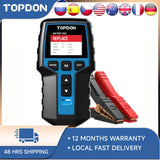 TOPDON BT200 Battery Tester
$103.99Battery tester — check charging voltage before chasing a sensor.

Which Buicks Set P0138
GM's tables list P0138 for every modern Buick engine group we checked:
- Encore 1.4L turbo and Encore GX
- Verano and Regal, 2.0L turbo and 2.4L
- LaCrosse four-cylinder and 3.6L V6
- Envision and Cascada
- Enclave 3.6L
GM's tables mark separate P0138 entries for single-bank exhaust (the four-cylinders) and dual-bank exhaust (the 3.6L V6). On the Enclave and LaCrosse V6, P0138 is the bank 1 rear sensor; bank 2's equivalent is P0158.
The Enclave Harness Bulletin
GM bulletin PIT5336 (October 2014) covers the 2013–2015 Buick Enclave, Chevrolet Traverse and GMC Acadia with the 3.6L (RPO LLT). Its code list explicitly includes P0138, with P0131, P0132, P0134, P0137, P0140, the heater codes P0030–P0060 and purge code P0443.
GM's finding: the engine harness to the bank 1 oxygen sensor can chafe on the A/C hose coupling at the back side of the engine, and the technician may also find the Emission 1 fuse open. A wire rubbing through its insulation is precisely how a signal circuit ends up touching voltage — and how a shared fuse ends up blown.
The fix is wiring: repair the damaged circuits, insulate the harness, pull it away from the A/C coupling and tie-strap it to the main harness. No sensor is listed.
A related GM bulletin, PIP5516A, covers the 2016–2017 Enclave 3.6L with power steering fluid contaminating the bank 1 oxygen sensor wiring. Its code list is front-sensor and rear low-voltage codes (P0137), not P0138, but it is a reminder that the bank 1 wiring on this engine lives in a hostile spot.
Where Bank 1 Sensor 2 Is on a Buick
Sensor 2 is downstream — after the catalytic converter. Sensor 1 is upstream. On the four-cylinder Encore, Verano, Regal, Envision and Cascada, there is one rear sensor, after the converter.
On the 3.6L V6 in the Enclave and LaCrosse, bank 1 is the bank with cylinder 1, which in these transverse installations is the rear bank, toward the firewall. GM's PIT5336 places the bank 1 sensor harness at the back of the engine. Follow the bank 1 rear sensor's pigtail back from the exhaust to its connector and inspect every inch.
What P0138 Blocks
GM groups P0138 into a bank 1 sensor 2 fault bundle with P0137, P0140, P0141, P0036 and P0054. GM's tables list that bundle as a condition that must be clear before the post-catalyst fuel trim test (P2096/P2097) runs. Catalyst efficiency monitoring (P0420) also depends on a working rear sensor. Until P0138 is fixed, expect those readiness monitors to stay incomplete.
Symptoms of P0138
- Check engine light on
- Usually no drivability change — the rear sensor does not run the main fuel mixture
- Catalyst or oxygen sensor readiness monitors "not ready"
- Several O2 or purge codes at once if a shared fuse has blown (2013–2015 Enclave)
- Rear sensor reading pinned above one volt on a scan tool
Causes and How to Confirm Each
| Cause | How to confirm it | Notes |
|---|---|---|
| Signal circuit shorted to voltage | Unplug the sensor, key on: the ECM side of the signal circuit should not show battery or heater voltage | GM's definition of the test |
| Chafed harness | Inspect the run, especially at the A/C hose coupling at the back of the engine | Documented on 2013–2015 Enclave (PIT5336) |
| Connector damage or water intrusion | Inspect for melted housings, corrosion and bridged pins; wiggle test | Heater and signal pins sit side by side |
| Open signal circuit (newer Buicks) | Circuit continuity back to the ECM | GM's 2021 Encore-group table says "shorted high or open" |
| Failed rear sensor | Only after the circuit tests good: a sensor that reads above one volt on its own | Internal heater-to-signal short is possible |
| ECM fault | Only after everything else tests normal | Rare |
Downstream O2 sensors
 Delphi ES20008 O2 Sensor (2006–2017)
$115.99Delphi O2 sensor for 2006–2017 Chevy, GMC and Cadillac. Confirm fitment by VIN before ordering.
 GM Genuine 12657188 Heated O2 Sensor
$46.47GM Genuine heated O2 sensor 12657188. Confirm fitment by VIN before ordering.
 GM Genuine 12606671 Heated O2 Sensor
$50.05GM Genuine heated O2 sensor 12606671. Confirm fitment by VIN before ordering.


How Is P0138 Diagnosed on a Buick?
- Record every code. P0138 with other O2 and purge codes on a 2013–2015 Enclave points at PIT5336.
- Watch the rear sensor voltage on a scan tool. A reading stuck above one volt is the P0138 picture; a normal rich reading is below it.
- Check the shared fuse. If it is blown, the short that blew it is your lead.
- Unplug the sensor and watch the reading. If it stays high with the sensor disconnected, the fault is in the harness or ECM side.
- Inspect the harness along its full run — on an Enclave, at the A/C coupling behind the engine.
- Test the signal circuit for a short to voltage and, on newer Buicks, for an open.
- Inspect the connector for heat damage or moisture bridging the heater and signal pins.
- Replace the sensor only when the circuit tests good — by VIN and position.
- Clear the codes and drive long enough for the catalyst and post-cat trim monitors to run.
Parts and Cost
| Repair | What it involves | Cost picture |
|---|---|---|
| Harness repair and re-routing | Repair, insulate and secure chafed circuits (PIT5336) | Often the real fix; cheaper than a sensor |
| Fuse | Only after the short is found | Pennies |
| Connector repair | Melted or corroded connector, bridged pins | Modest |
| Rear oxygen sensor | When the sensor itself reads above one volt | Moderate; order by VIN and position |
| Catalytic converter or injectors sold for "running rich" | What happens when P0138 is misread | Money spent with the short still there |
Exhaust leak and wiring parts
 MAHLE F32274 Exhaust Flange Gasket
$13.00MAHLE exhaust flange gasket — a leak ahead of the sensor skews voltage. Confirm fitment by VIN before ordering.
 ACDelco 2-Pin Replacement Connector PT3739
$90.99Two-pin replacement connector for a corroded harness connector. Confirm fitment by VIN before ordering.
 Nomex Split Loom, 1 in. x 10 ft
$105.66Heat-resistant split loom to protect sensor wiring near the exhaust.


GM Documents Relevant to P0138 on a Buick
| Document | Subject | Status |
|---|---|---|
| PIT5336 (Oct 2014) | O2 sensor or purge DTCs incl. P0138 and/or Emission 1 fuse open; bank 1 O2 harness chafing on A/C hose coupling; repair, insulate, re-secure | 2013–2015 Buick Enclave 3.6L LLT — verified |
| GM 2015 OBD parameter tables, group 06 | P0138 (dual bank): signal above 1,050 mV, 100 of 125 samples, Type B | Enclave 3.6L LLT, LaCrosse 3.6L LFX — verified |
| GM 2015 OBD parameter tables, group 05 | P0138 (single bank): same threshold | Regal 2.0L LTG and 2.4L LEA, Verano — verified |
| GM 2021 OBD parameter tables, group 03A | P0138: "shorted high or open," above 1,050 mV | Encore and Encore GX group — verified |
| PIP5516A (Jan 2018) | P/S fluid contaminating bank 1 O2 wiring; repeat O2 failures. Does not list P0138 | 2016–2017 Buick Enclave 3.6L — verified |
Have a dealer check your VIN against current bulletins rather than relying on any article, including this one.
What Other P0138 Pages Get Wrong
- "P0138 means the engine is running rich." GM's threshold is above 1,050 mV — beyond what a rich exhaust produces. It is a circuit shorted high.
- "Replace the rear O2 sensor." Unplug it first. If the reading stays high, the sensor is not the problem.
- Confusing Sensor 1 and Sensor 2. P0138 is after the converter; the front sensor's high-voltage code is P0132.
- Getting the V6 bank wrong. On the Enclave and LaCrosse, bank 1 is the firewall side.
- Chasing P2096 or P0420 first. GM's post-catalyst trim test will not run while the rear sensor fault bundle is active.
Frequently Asked Questions
Can I drive my Buick with P0138?
Usually yes in the short term — the rear sensor does not control the main fuel mixture. But your catalyst and post-cat trim monitors will not complete, and a short that has blown a shared fuse may be disabling other emission parts.
Does P0138 mean my Buick is running rich?
Not by GM's definition. The code sets above 1,050 mV, higher than a rich exhaust produces. Look for a circuit shorted to voltage first.
Is P0138 the front or rear sensor?
Rear — Bank 1 Sensor 2, after the catalytic converter. The front sensor's low-voltage code is P0131.
Why does my 2013–2015 Enclave have P0138 and several other codes?
GM's PIT5336 lists P0138 among codes caused by the bank 1 O2 harness chafing on the A/C hose coupling at the back of the engine, which can also blow the Emission 1 fuse. Repair the harness.
Can a bad connector cause P0138?
Yes. Water or heat damage can bridge the heater supply and signal pins, putting voltage on the signal wire. Inspect the connector before buying a sensor.
What is the bank 2 version?
On the V6 Enclave and LaCrosse, P0158 is the same fault on the bank 2 rear sensor. The rear heater code on bank 1 is P0036.
Shop Related Parts & Tools
Unplug the sensor and test the circuit before buying anything — if the reading stays high with the sensor disconnected, the fault is in the wiring. If the sensor itself is bad, order it by VIN and position.
-
 FOXWELL NT301 OBD2 Scanner — shows live rear O2 voltage, so you can see a reading pinned above one volt and whether it stays there with the sensor unplugged.
-
 FOXWELL NT614 Elite OBD2 Scanner — more system coverage and live data for checking related O2 and catalyst codes.
-
 ACDelco Oxygen Sensor 55574135 (Buick, Chevy) — an ACDelco GM-original rear-position (position 2) oxygen sensor; confirm fitment against your VIN before ordering.
-
 95-Piece Mechanics Tool Set (Metric & SAE) — for harness clips, heat shields and sensor access.
Related Guides
- P0036 Code on a Buick: HO2S Heater Control, Bank 1 Sensor 2 — same sensor, heater circuit
- P2096 Code on a Buick: Post Catalyst Fuel Trim Low Limit — a test P0138 blocks
- P0420 Code on a Buick: Catalyst Efficiency Below Threshold
- P0172 Code on a Buick: System Too Rich, Bank 1 — the real rich-mixture code
- MAF, MAP or O2 Sensor: Which One to Replace