
P0300 on a Cadillac is GM's "Engine Misfire Detected" code. It means the engine computer saw misfires it could not pin on one cylinder, or saw them on several cylinders at once. On a Cadillac that covers a lot of ground. One code can come from a Northstar V8, a 3.6L V6, a 2.0L turbo four, a supercharged CTS-V or a 6.2L Escalade, and GM's bulletins for each of those engines point somewhere different. The surprise: on most Cadillac misfire bulletins, GM's first step is not "replace the coils." It is a coolant-dye borescope check on the 3.6L V6, a valve-movement check on Escalade lifters, or a leak-down test on the 2.0T. This page is the hub for our Cadillac misfire guides. Start here, then use the cylinder-specific pages (P0301–P0306) once you know which cylinders are involved.
Jump to a section: What P0300 means · Which Cadillac engines set it · Read the pattern first · What GM has documented · Symptoms · Causes and how to confirm each · How it's diagnosed · Parts and cost · GM documents · What other pages get wrong · FAQ
What Does P0300 Mean on a Cadillac?
The engine control module (ECM) watches crankshaft speed through the crankshaft position sensor. Each firing cylinder gives the crankshaft a small push. When a cylinder fails to fire, the crank slows for an instant, and the ECM counts a misfire. GM's monitor tracks counts for every cylinder. When the misfires are spread across cylinders, or the ECM can't assign them cleanly, it sets P0300. When one cylinder is clearly at fault it also sets that cylinder's code, P0301 through P0308. GM's own bulletins usually list P0300 together with the single-cylinder codes for that reason.
A misfire comes down to one of four things: no spark, the wrong amount of fuel, no compression (valves, rings, pistons, lifters), or something in the cylinder that shouldn't be there, such as coolant or oil. P0300 tells you that one of those happened, but not which one. The misfire counts per cylinder in your scan data are what start to narrow it down. For the GM-wide explanation, see our P0300 GM diagnosis guide.
Which Cadillac Engines Can Set P0300
Every gasoline Cadillac sold with OBD-II can set P0300. Which single-cylinder codes can follow it depends on the cylinder count. Cylinder deactivation also matters, because GM's bulletins keep pointing at the cylinders that deactivate.
| Cadillac engine family | Typical models | Cylinder codes possible | Cylinders GM deactivates |
|---|---|---|---|
| Northstar 4.6L/4.4L V8 (LD8, L37, LH2, LC3) | DeVille, DTS, Seville, Eldorado, STS, XLR, SRX V8 | P0301–P0308 | None (no cylinder deactivation) |
| 3.6L/3.0L/2.8L V6, first generation (LY7, LLT, LFX, LF1/LFW, 2.8L turbo and twin-turbo LF3/LF4) | CTS, STS, SRX, ATS, XTS | P0301–P0306 | None |
| Gen 2 V6 (3.6L LGX, 3.0TT LGW/LGY) | ATS, CTS, CT6, CT5, XT5, XT6 | P0301–P0306 | Cylinders 2 and 5 (GM 21-NA-036) |
| GM small-block V8 with AFM (6.2L L94, L86; 6.0L LFA hybrid; LT4) | 2007–2020 Escalade, CTS-V (LT4), CT5-V Blackwing | P0301–P0308 | Cylinders 1, 4, 6 and 7 (GM 20-NA-038) |
| 6.2L L87 with Dynamic Fuel Management | 2021-and-later Escalade | P0301–P0308 | Any cylinder (GM 20-NA-038) |
| 4.2L twin-turbo V8 (LTA) | 2019–2020 CT6 and CT6-V | P0301–P0308 | Cylinders 2, 3, 5 and 8 (GM 20-NA-038) |
| Four-cylinder (2.0T LTG and LSY, 2.5L, 2.7T L3B) | ATS, CTS, CT6, CT4, CT5, XT4, XT5, XT6 | P0301–P0304 only | Not covered in this guide |
| 3.0L 54° V6 (L81) | 1997–2001 Catera | P0301–P0306 | None |
The Lyriq, Optiq and other Cadillac EVs have no engine, so they never set P0300.
Tools for finding the misfire
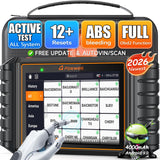 FOXWELL NT726 Bidirectional Scanner
$368.99Shows per-cylinder misfire counts to tell random from cylinder-specific.
 AUTOWN 300 PSI Compression Tester Kit
$49.19300 PSI compression tester for checking every cylinder.
 Compression Tester with Fuel/Vacuum Gauge
$25.65Compression tester with a vacuum gauge for finding intake leaks.


Read the Pattern Before You Replace Anything
The single most useful thing on your scan tool is the per-cylinder misfire count. GM's bulletins sort themselves by pattern, and so should your diagnosis:
- One cylinder far ahead of the rest — go to that cylinder's guide: P0301, P0302, P0303, P0304, P0305 or P0306. Each one covers where that cylinder sits on each Cadillac engine and the GM bulletins that name it.
- Cylinders 2 and 5 on a Gen 2 V6 — those are GM's AFM cylinders. GM points to the AFM oil control valve or the switching rockers, not ignition.
- Cylinders 1, 4, 6 and/or 7 on an Escalade or LT4 — those are GM's AFM cylinders on the small-block V8. GM points to lifters.
- Every cylinder on one bank — look at what the bank shares. GM has documented a failing high-pressure fuel pump lifter that shows up as bank-1 misfires on the 2018 Escalade (PIP5642), and a failed PCV oil separator causing bank-one misfires on the CT6 4.2L (PIP6013).
- Only on a cold start, then gone — on the 3.6L V6 that's GM's coolant-in-the-cylinder pattern (18-NA-115). On the 6.2L, look at P050D (PIP5498M).
- Only on deceleration, every cylinder — GM's PIP5264 for 3.6L, 3.0L and 2.8L V6 Cadillacs points to belt or pulley debris or worn engine mounts. It's a false misfire from crankshaft speed noise, not a real combustion problem.
What GM Has Documented for P0300 on Cadillacs
3.6L and 3.0L V6: Coolant in the cylinder on a cold start
Bulletin 18-NA-115 (latest July 2024 version) covers the ATS (2013–2019), CTS (2010–2019), CT5 3.0L (2020–2025), CT6 (2016–2020), SRX (2010–2016), XTS (2013–2019), XT5 (2018 and later) and XT6 (2020 and later). GM describes a cold-start misfire or rough idle that "always" occurs "on one or two cylinders" and goes away once the engine warms up. The cause is porosity in the cylinder block at the liner-to-deck face, which lets coolant into the cylinder. GM's test is coolant dye, then a pressure test on a cold-soaked engine, then a blacklight borescope through the plug hole. If the porosity is confirmed, GM says the engine must be replaced. Normal pitting on the deck face is not the cause. GM's earlier PIP4959 versions warned that engines replaced for normal pitting would be returned as non-defective.
Gen 2 V6 (LGX, LGW, LGY): Rockers, lash adjusters and noise
21-NA-278 covers ATS, CTS, CT5, CT6, XT5 and XT6 Gen 2 V6 engines that have a tick or rattle with P0300 or P0301–P0306. GM lists spongy stationary hydraulic lash adjusters, damaged switching roller finger followers, damaged camshaft actuators or locating slots, and a left-bank timing chain tensioner gasket that doesn't seal. GM asks for a sound recording before anything is taken apart.
2.0L turbo four (LTG): Coils, pistons and pre-ignition
On 2019 ATS and CTS 2.0T engines, 19-NA-246 blames talc powder inside the coil boot. It has lower insulation strength than dielectric grease, so it can lead to arcing and carbon tracking. GM warns that "a prolonged misfire condition can result in piston damage." Service update N192281810 had dealers inspect those same 2019 engines for carbon tracking and, where found, replace all four plugs and coils. For 2013–2018 ATS, 2014–2018 CTS and 2016–2018 CT6 2.0T engines, PI1178F describes P0300 with low compression in one cylinder caused by a crack in the piston between the compression rings. The 2013 ATS 2.0T also had customer satisfaction program 14591 for piston damage from pre-ignition. It ran until December 31, 2016, so it has passed for practical purposes.
Escalade and V-series V8s: Lifters
15-06-01-002O covers 2015–2020 Escalade and 2016–2019 CTS-V engines with P0300 and a tick. The causes are an AFM lifter that is collapsed or stuck, internal locking-pin damage from oil aeration, a lifter stuck in its bore, or a bent pushrod. On the 2021 Escalade 6.2L L87 built September 1, 2020 through March 31, 2021, 23-NA-043 covers collapsed or separated lifters with P0300–P0308. GM's replacement rule depends on mileage: all lifters and guides on both banks under 16,000 miles, the affected bank only above that. Separately, safety recall 25V-274 covers certain 2021–2024 Escalade and Escalade ESV 6.2L engines for connecting rod or crankshaft defects that can lead to engine failure. If your misfire comes with a knock, check that recall first.
Older Cadillacs
NHTSA's index lists older GM documents we could only see summarized:
- A 2003 emission recall (03005) for 2002–2003 DeVille, Eldorado and Seville misfires caused by lost signal from the PCM to the ignition coils
- Bulletin 01616 for P0300 on the rear-drive Northstar in the 2004 SRX and XLR
- Bulletin 010100 for intermittent P0300–P0306 on the 2000 Catera
We list them as corroborated only.
Symptoms of P0300 on a Cadillac
- Check engine light, flashing when the misfire is severe enough to harm the catalytic converter
- Rough idle, shake at a stop, or a stumble when accelerating
- Misfire only on a cold start (3.6L coolant pattern), only under load, or only after an AFM event
- A tick or tap at camshaft speed (lifter or rocker problems on the Escalade and Gen 2 V6)
- Loss of power and fuel economy; a fuel smell from the exhaust
- Companion codes: P050D (cold start rough idle), injector circuit codes, or camshaft correlation codes P0016–P0019 on the Gen 2 V6
Causes and How to Confirm Each
| Cause | How to confirm it | Notes |
|---|---|---|
| Ignition coil or plug | Swap with an adjacent cylinder; see if the misfire follows | Check 2019 2.0T boots for carbon tracking (19-NA-246) |
| Plug wire off or loose (V8 with wires) | Inspect the wire and its C-clip at the coil | 2015–2019 Escalade L86 and CTS-V LT4 (PIP5159C) |
| Coolant entering a cylinder | Dye, cold-soak pressure test, blacklight borescope | 3.6L/3.0L V6 — 18-NA-115 |
| AFM/DFM lifter or rocker failure | Watch valves move with covers off; AFM compression test | Escalade, CTS-V, Gen 2 V6 cylinders 2 and 5 |
| Cracked piston / low compression | Compression, then leak-down to the crankcase | 2.0T LTG — PI1178F |
| Injector or injector circuit | GDS2 injector balance or AFIT test | Replace only the injector that fails the test (PIP5498M, PIP6073) |
| Shared bank problem | Compare bank misfire counts, fuel trims, MAF | HPFP lifter (2018 Escalade), PCV separator (CT6 4.2L) |
Ignition parts
 ACDelco Ignition Coil 12739916
$109.99ACDelco GM Genuine coil pack. Confirm fitment by VIN before ordering.
 ACDelco 41-114 Iridium Spark Plugs, Qty 8
$109.99ACDelco 41-114 iridium plugs, set of 8. Confirm fitment by VIN before ordering.
 ACDelco 41-162 Iridium Spark Plugs (2)
$14.99ACDelco 41-162 iridium plugs. Confirm fitment by VIN before ordering.


How Is P0300 Diagnosed on a Cadillac?
- Identify the engine by RPO code (glovebox label or VIN decode). The same model name can carry four different engines.
- Save freeze-frame data and the misfire counts for each cylinder before clearing anything. GM's Technical Assistance misfire template (PIP5628G) asks dealers for exactly this.
- Classify the pattern: one cylinder, AFM cylinders, one bank, cold-start only, or deceleration only.
- Swap coils and plugs on the worst cylinder and re-test. On 2025 Escalade L87/LT4 and CT5-V Blackwing, GM's PIP6073 asks for this coil swap before anyone condemns an injector.
- Test injectors with GDS2 balance or AFIT rather than replacing them on suspicion.
- Run compression and leak-down tests on any cylinder that won't respond. On the CT6 4.2L, GM's 19-NA-253 relative compression test sorts mechanical from non-mechanical misfires.
- Run the engine-specific checks: the dye-and-borescope test on the 3.6L, valve-movement checks on Escalade AFM lifters and Gen 2 V6 rockers, or a leak-down on the 2.0T.
- Check your VIN for open recalls and bulletins, then verify the repair under the same conditions that set the code.
Parts and Cost
| Repair | What it involves | Cost picture |
|---|---|---|
| Coil, plug or plug wire | The part the swap test proved | Lowest; rear-bank V6 and V8 access adds labor |
| Injector | Direct-injection injector with seals, after a failed balance test | Moderate |
| AFM oil control valve (Gen 2 V6) | Solenoid in the camshaft cover | Moderate |
| Rockers and lash adjusters (Gen 2 V6) | Four rockers and four lash adjusters per affected cylinder | Significant labor |
| Escalade lifters and guides | Heads off; one bank or both per GM's rules | Major |
| Pistons (2.0T) or engine (3.6L porosity) | All four pistons, or engine replacement if porosity is verified | Largest — confirm with GM's tests first |
Fuel and intake parts
 ACDelco Fuel Injector Kit 19420316
$104.99ACDelco GM OE fuel injector kit. Confirm fitment by VIN before ordering.
 Intake Manifold Gasket Set, 2008–2017 3.6L
$34.99Intake gasket set for the 2008–2017 3.6L — a leak causes lean random misfires. Confirm fitment by VIN before ordering.


GM Documents That List P0300 on Cadillac Models
| Document | Subject | Status |
|---|---|---|
| 18-NA-115 (Jul 2024) | Cold start misfire on one or two cylinders; block porosity lets coolant in | ATS, CTS, CT5, CT6, SRX, XTS, XT5, XT6 V6 — verified |
| 21-NA-278 (Nov 2021) | Tick/rattle with P0300, P0301–P0306; lash adjusters, rockers, actuators | 2016–2022 Gen 2 V6 Cadillacs — verified |
| 21-NA-036 (Mar 2022) | P0300, P0302, P0305 on AFM cylinders 2 and 5 | ATS, CTS, CT5, CT6, XT5, XT6 — verified |
| 15-06-01-002O (Mar 2023) | Misfire/tick, AFM lifters, P0300 | 2015–2020 Escalade, 2016–2019 CTS-V — verified |
| 23-NA-043 (Mar 2024) | Collapsed or separated lifters, P0300–P0308 | 2021 Escalade 6.2L L87, Sep 2020–Mar 2021 builds — verified |
| 19-NA-246 (Dec 2019) | Coil boot talc, carbon tracking, P0300 | 2019 ATS, CTS 2.0T — verified |
| PI1178F (Nov 2018) | Low compression, cracked piston, P0300 | 2013–2018 ATS, 2014–2018 CTS, 2016–2018 CT6 2.0T — verified |
| PIP5642 (Apr 2019) | P0300 on bank 1 from HPFP lifter | 2018 Escalade 6.2L L86 — verified |
| PIP6013 (Oct 2024) | Bank-one misfires, PCV oil separator | 2019–2020 CT6 / CT6-V 4.2L — verified |
| PIP5498M (Aug 2020) | P050D and P0300 on cold start; coolant in cylinders | 2016–2020 CTS-V LT4, 2015–2020 Escalade L86 — verified |
| Recall 25V-274 | 6.2L connecting rod/crankshaft defects | 2021–2024 Escalade/ESV — verified (NHTSA recall record) |
| 03005 / 01616 / 010100 | Northstar coil signal loss; RWD Northstar P0300; Catera P0300–P0306 | 2002–2003 DeVille/Eldorado/Seville; 2004 SRX/XLR; 2000 Catera — corroborated (NHTSA summary only) |
Have a dealer check your VIN for open recalls and bulletins. The check is free, and it is more reliable than any article, including this one.
What Other P0300 Pages Get Wrong
- "Replace all the coils and plugs." On a Cadillac with GM's documented lifter, rocker, piston or coolant faults, new coils won't fix anything. Do the swap test first.
- "P0300 means random, so it isn't one cylinder." GM sets P0300 alongside single-cylinder codes all the time. Check the per-cylinder counts.
- "Cylinder deactivation cylinders are the same on every GM engine." They are 1, 4, 6, 7 on the small-block V8, 2 and 5 on the Gen 2 V6, and 2, 3, 5, 8 on the CT6 4.2L. The L87 can deactivate any cylinder.
- "A cold-start misfire that clears up is harmless." On the 3.6L that's exactly the pattern GM ties to coolant entering the cylinder.
- "Swap the injector." In PIP6073 (2025 Escalade and CT5-V Blackwing), GM says injectors returned for this concern were inspected and no trouble was found. The coil was the problem. Test before you replace.
Frequently Asked Questions
Can I drive my Cadillac with P0300?
With a steady light and a mild misfire, a short careful drive to a shop is usually fine. A flashing check engine light means the misfire is severe enough to overheat the catalytic converter. Avoid hard acceleration and get it checked promptly.
Why does my Escalade only misfire with a ticking noise?
A tick at camshaft speed with misfires on cylinders 1, 4, 6 or 7 matches GM's AFM lifter bulletins (15-06-01-002O and PIP4568S). The check is whether the valves on that cylinder actually move.
My XT5 misfires only on cold mornings. What should I ask for?
Ask the dealer about bulletin 18-NA-115. It covers a cold-start misfire on one or two cylinders caused by coolant entering through block porosity, confirmed with dye and a borescope.
Does a Northstar get P0300 for the same reasons?
Partly. Coils, plugs and fuel delivery apply to every engine. The Northstar has no cylinder deactivation, so the AFM lifter and rocker bulletins don't apply to it. The GM Northstar misfire documents we found are older, and we could only see them summarized.
Will a tune-up fix P0300 on my 2.0T ATS?
Possibly, if the cause is a carbon-tracked coil boot or a worn plug. GM also documents cracked pistons on the 2.0T (PI1178F), so check compression on any cylinder that keeps misfiring after new plugs and coils.
Which page should I read next?
If one cylinder's misfire count stands out, read that cylinder's guide. If the misfires are on one bank or the AFM cylinders, the sections above tell you which GM bulletin to bring to your service advisor.
Shop Related Parts & Tools
Read per-cylinder misfire counts and swap the worst cylinder's coil before buying parts. GM's Cadillac misfire bulletins often end at lifters, rockers or a coolant test instead. Order coils and plugs by VIN.
-
 Launch CRE 2.0 GM All-System Scanner — a GM all-system scanner that shows misfire counts per cylinder, which is how you tell a single-cylinder fault from an AFM-cylinder or one-bank pattern.
-
 Ignition Coil UF569 / 12618542 / 12632479 (GM V6 incl. Buick Allure) — a coil listed for Cadillac ATS, CTS, SRX, STS and XTS 3.6L V6 engines; confirm fitment against your VIN and buy it only if the misfire follows the coil.
-
 IWOKPHD Ignition Coil 12654078 (Buick, Cadillac, Chevrolet, GMC) — listed under GM number 12654078, the coil GM's service update N192281810 specifies for 2019 ATS and CTS 2.0T engines; confirm fitment against your VIN.
-
 95-Piece Mechanics Tool Set (Metric & SAE) — for coil, plug and valve-cover access during the swap test.
Related Guides
- P0300 Code: GM Diagnosis & Repair Guide — the GM-wide explanation
- P0301 Cadillac: Cylinder 1 Misfire
- P0302 Cadillac: Cylinder 2 Misfire
- Engine Misfire: Meaning, Symptoms & Repair Guide for GM Vehicles
- How to Check for Open GM Vehicle Recalls Using Your VIN — including Escalade recall 25V-274