
Dex-Cool is GM's orange, extended-life coolant, specified against GM's GWM3420 standard (formerly GM6277M), and it has been the factory fill across most of the GM lineup since the late 1990s. Do not mix it with conventional green coolant. Doing so does not cause an instant failure, but it drops the mixture's service life to that of the shorter-lived fluid and can produce sludge in a neglected system.
The short answer for most owners: put back what came out, at the correct concentration, on the interval in your maintenance schedule. Everything below is about how to tell what came out, what the color actually means, and which mistakes cause real damage. If you already know what you need, start with coolant and maintenance fluids for your GM vehicle.
Parts and tools you'll need
- Dex-Cool coolant, distilled water, and cooling system maintenance parts — decide between concentrate and 50/50 premix before you order
- A refractometer or a quality coolant tester — the cheap floating-ball hydrometers are not precise enough to trust
- A drain pan large enough for your system's full capacity, plus a sealed container for disposal
- Distilled water only if you are diluting concentrate. Tap water introduces minerals that deposit in the system
DEX-COOL coolant
 ACDelco 10-101 DEX-COOL Extended Life Coolant, 1 Gallon
$31.95GM DEX-COOL extended life coolant.
ACDelco 10-101 DEX-COOL Extended Life Coolant, 1 Gallon
$31.95GM DEX-COOL extended life coolant.
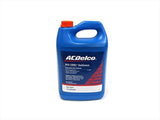 ACDelco 12346290 DEX-Cool Coolant Antifreeze 12346290
$31.95GM DEX-COOL extended life coolant.
ACDelco 12346290 DEX-Cool Coolant Antifreeze 12346290
$31.95GM DEX-COOL extended life coolant.
 ACDelco 10-5046 Dex-Cool Leak Detection Tracer Dye
$12.95GM DEX-COOL extended life coolant.
ACDelco 10-5046 Dex-Cool Leak Detection Tracer Dye
$12.95GM DEX-COOL extended life coolant.


What is Dex-Cool and why is it orange?
Dex-Cool is an extended-life ethylene glycol coolant built on organic acid corrosion inhibitors rather than the silicates and phosphates used in traditional green antifreeze. The orange dye is a marker so technicians can identify it, not a chemical property. ACDelco describes its Dex-Cool as silicate, borate, nitrite, and phosphate free.
The engineering reason for the change was inhibitor depletion. Traditional silicate-based inhibitors coat cooling system surfaces and wear away relatively quickly, which is why green coolant historically needed replacement every two years or so. Organic acid inhibitors work more selectively, attaching where corrosion is actually starting, so they last far longer before they are used up.
The tradeoff is that organic acid chemistry protects differently. It builds protection more slowly on a fresh surface and it is less tolerant of running low, because the inhibitors need to be in contact with the metal to do anything. That distinction turns out to explain most of what went wrong in the early years.
Can you mix Dex-Cool with green coolant?
You can without immediate catastrophe, but you should not. Mixing organic acid coolant with conventional silicate coolant produces a fluid with the service life of the shorter-lived one, and in systems with air intrusion or low coolant level it can form gel and deposits. If it has already happened, plan on a full flush rather than a top-off and hope.
The practical failure mode is not a chemical explosion. It is that you now have a coolant you cannot put an interval on. The extended-life claim depends on the organic acid inhibitor package being intact and undiluted by a competing chemistry, and once you have mixed them, no one can tell you how long the result will protect.
Emergencies are different. If you are on the shoulder of a highway with a leak and the only thing available is a jug of green, put it in and drive to somewhere you can do a proper flush. A diluted mixed coolant is far better than running an engine with no coolant. Just do not treat it as a repair.
What about universal or all-makes coolant?
Universal coolants are formulated to be compatible with multiple chemistries, and reputable brands sell licensed Dex-Cool products that meet the GM specification. The distinction that matters is whether the bottle carries the Dex-Cool license, not whether the marketing says compatible with. Read the specification claim on the label, not the color of the bottle.
Does coolant color actually tell you anything?
Color is a weak signal. Dye choice is up to the manufacturer and there is no industry standard tying a color to a chemistry, so two orange coolants can be entirely different fluids. Use color as a starting hint, then confirm by the specification printed on the container and the requirement printed in your owner's manual.
| Common color | Typically associated with | Chemistry family | What to do with it |
|---|---|---|---|
| Orange | Dex-Cool and licensed equivalents | Organic acid (OAT) | Verify the Dex-Cool license on the label before assuming |
| Green | Conventional antifreeze | Silicate / phosphate (IAT) | Short service life; not what a Dex-Cool GM vehicle wants |
| Yellow | Many universal and some OE fills | Varies widely | Color tells you nothing here; read the spec claim |
| Pink / red | Several import OE fills and some HOAT products | Hybrid organic acid | Not a substitute for Dex-Cool unless the label says so |
| Blue | Various import OE and some EV-specific fluids | Varies | Verify against the vehicle requirement, never by color |
| Brown, murky, or oily | Contaminated or badly degraded coolant | Not a chemistry, a symptom | Investigate before flushing — this can indicate oil intrusion |
The last row deserves attention. Coolant that looks like chocolate milk is usually oil crossing into the cooling system, and that is a head gasket, oil cooler, or transmission cooler problem. Flushing the system without finding the source just wastes fresh coolant.
What specification does your GM vehicle actually require?
Look for the GM specification number, not the brand. Licensed Dex-Cool products are formulated against GM's GWM3420 standard, which was formerly designated GM6277M. Datasheets for licensed products commonly state a 5 year / 150,000 mile service life. Your vehicle's maintenance schedule is the final authority, and intervals differ by model year and engine.
ACDelco sells GM Original Equipment Dex-Cool in two forms you should not confuse. There is a 50/50 pre-mix, GM part number 12378390 (ACDelco 10-5027), which is ready to pour. There is also an extended life concentrate, GM part number 12346290 (ACDelco 10-101), which must be diluted, and the recommended dilution is 50/50 with distilled water.
Pouring concentrate straight into a system is a genuine mistake with consequences. Undiluted ethylene glycol has worse heat transfer than a 50/50 mixture and a higher freeze point than you would expect, so a system full of concentrate cools worse and can still freeze. Check the label for concentrate or pre-mix before you open the jug.
How often should Dex-Cool be replaced?
Follow your vehicle's maintenance schedule rather than a generic number. Licensed Dex-Cool product datasheets commonly state 5 years or 150,000 miles, but GM's published interval has varied by model year, engine, and duty cycle, and some manuals specify a shorter initial interval than the coolant's rated life. Look it up in your own owner's manual before you plan the job.
Two things shorten the interval in practice. Repeated topping off with plain water dilutes the inhibitor package, and a system that has been opened repeatedly for repairs has had air introduced each time. If your truck has had a water pump, radiator, or heater core replaced and the coolant was reused, treat the fluid as older than its calendar age.
Test rather than guess. A refractometer tells you the freeze point, which tells you the glycol concentration. Test strips that read pH and inhibitor level tell you whether the additive package is still working. A coolant that is still the right concentration but chemically exhausted looks perfectly fine in the reservoir.
Why does Dex-Cool have such a bad reputation?
The early complaints traced mostly to systems that ran low on coolant and drew in air, not to the chemistry itself failing in a full, sealed system. Organic acid inhibitors need contact with metal surfaces to protect them. Air in the system exposes hot metal with no protection, and the resulting corrosion products are what people found as sludge.
Several specific GM engines of that era had intake manifold gasket and coolant loss issues that let air in and coolant out, and the fluid took the blame for the leak. That does not mean the complaints were imaginary. It means the fix is to keep the system full and sealed, which is good advice for any coolant chemistry.
GM makes the same point in its own service literature, in a different context. Its special coverage bulletin for water pump shaft seal leaks on the 3.6L V6 states that those leaks are often due to operating the vehicle with a low engine coolant level, and that maintaining the coolant level increases shaft seal reliability. Whatever you make of that framing, the practical advice inside it is the same one this section arrives at: a system running low does damage that gets blamed on parts and fluid.
The practical lesson for today's owner is simple. Chasing down small leaks matters more than which orange jug you buy. If you are losing coolant slowly and cannot find where, work through the cooling system flush and service procedure for GM vehicles and pressure test before you refill.
What should you never put in a GM cooling system?
A short list, and each item on it has ruined somebody's engine.
- Tap water. Minerals in tap water deposit on hot surfaces and reduce heat transfer, and chlorides accelerate corrosion of aluminum. Distilled only.
- Stop-leak products, as a plan. They work by circulating particles that lodge in small openings, and heater cores and radiators have a lot of small openings. Acceptable as a roadside measure, not as a repair.
- Concentrate poured undiluted. Worse heat transfer and no benefit.
- Straight water for more than the drive home. No corrosion protection, no boil-over protection, and it freezes.
- A different chemistry just to top off. This is how mixed systems happen. Keep a small bottle of the correct premix in the truck instead.
Safety note: a hot cooling system is pressurized, and opening the cap releases scalding coolant that will flash to steam. Let the engine cool completely before you open anything. Ethylene glycol is also toxic and sweet-tasting, which is a real hazard around pets — clean up spills immediately and store containers sealed.
How do you change GM coolant properly?
The general sequence is below. Capacities, drain point locations, and bleed procedures vary substantially between engines — a 5.3L V8 truck, a Duramax with a separate low-temperature circuit, and a transverse V6 crossover are three different jobs. Get the capacity and the bleed procedure for your specific engine from a service manual before you start.
- Let the engine cool completely, then park on level ground.
- Position a pan under the radiator drain and open it, then remove the pressure cap to let the system drain fully.
- Drain any additional drain points your engine has, including block drains if the procedure calls for them.
- Close the drains, fill with distilled water, run the engine to operating temperature with the heater on full, then cool and drain again if you are flushing.
- Refill with the correct coolant at the correct concentration, adding slowly to limit trapped air.
- Follow the engine-specific bleed procedure to purge air, since many GM engines have bleed screws or a required fill sequence.
- Run the engine to temperature, verify the thermostat opens and the upper hose gets hot, then recheck level cold and top off.
- Recheck the level after a few drive cycles. Trapped air works its way out and the level will usually drop once.
Air pockets cause more post-service complaints than anything else. A heater that blows cold at idle but warms up at speed, or a temperature gauge that swings, usually means air is still trapped rather than that something you replaced is faulty.
Cooling system parts
 ACDelco RC85 15 PSI Radiator Cap 15042975
$17.99Thermostats, caps and hoses for a coolant service. Confirm fitment by VIN before ordering.
ACDelco RC85 15 PSI Radiator Cap 15042975
$17.99Thermostats, caps and hoses for a coolant service. Confirm fitment by VIN before ordering.
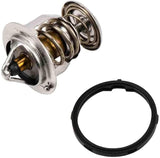 ACDelco 131-160 187° Engine Coolant Thermostat with Seal
$45.36Thermostats, caps and hoses for a coolant service. Confirm fitment by VIN before ordering.
ACDelco 131-160 187° Engine Coolant Thermostat with Seal
$45.36Thermostats, caps and hoses for a coolant service. Confirm fitment by VIN before ordering.
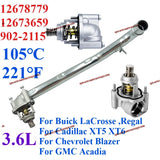 12678779 12673659 902-2115 For Buick LaCrosse Regal Cadillac
$36.33Thermostats, caps and hoses for a coolant service. Confirm fitment by VIN before ordering.
12678779 12673659 902-2115 For Buick LaCrosse Regal Cadillac
$36.33Thermostats, caps and hoses for a coolant service. Confirm fitment by VIN before ordering.
 ACDelco Hoses, Gold Molded Radiator Coolant Hoses, Reinforced
$146.99Thermostats, caps and hoses for a coolant service. Confirm fitment by VIN before ordering.
ACDelco Hoses, Gold Molded Radiator Coolant Hoses, Reinforced
$146.99Thermostats, caps and hoses for a coolant service. Confirm fitment by VIN before ordering.
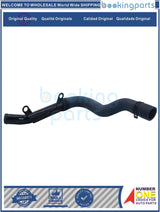 RAH81389, 95965573 Radiator Hose For CHEVROLET SPARK 2010-15
$77.09Thermostats, caps and hoses for a coolant service. Confirm fitment by VIN before ordering.
RAH81389, 95965573 Radiator Hose For CHEVROLET SPARK 2010-15
$77.09Thermostats, caps and hoses for a coolant service. Confirm fitment by VIN before ordering.


What are the signs your coolant or cooling system needs attention?
Watch for temperature gauge behavior that has changed, a heater that is not as hot as it used to be, sweet smell after shutdown, and crusty residue at hose connections. Coolant that has turned rusty, cloudy, or gritty needs replacing regardless of its age or mileage. None of these are things to postpone through a summer.
Dried orange or pink crust on the front of the engine is worth learning to recognise, because Dex-Cool leaves a distinctive chalky residue where it has been seeping. That is how a water pump shaft seal announces itself long before it drips on the driveway.
Some failures present as coolant problems but are mechanical. A water pump with a weeping seal or bearing noise, or a thermostat stuck open or closed, will produce temperature complaints that no coolant change fixes. Our guides on GM water pump service and failure symptoms, how to diagnose a failing thermostat, and the model-specific Enclave 3.6L water pump guide cover how to tell those apart from a fluid issue.
A note on diesels and EVs
Duramax trucks use additional cooling circuits beyond the main engine loop, and the fill and bleed procedures reflect that. Do not assume a gas-truck procedure transfers. Look up the correct capacity, circuit layout, and coolant requirement for your specific Duramax generation.
GM's electric vehicles use multiple thermal loops for the battery, drive units, and cabin, and those systems operate near high-voltage components. Coolant service on an EV is not a general-guide job. Follow the manufacturer's procedure for your specific vehicle or leave it to someone equipped for high-voltage work.
What to check before you order coolant
- Confirm what your manual specifies. The maintenance section names the required coolant and the interval for your exact model year and engine.
- Confirm what is currently in the system. If the car has service history you cannot verify, assume the fluid is mixed and plan a flush rather than a top-off.
- Concentrate or pre-mix. Pre-mix is more forgiving and more expensive per usable gallon. Concentrate requires distilled water and careful measuring.
- Buy enough. Look up your engine's capacity and buy a little over, because a flush uses more than a drain and fill.
- Check the specification claim on the label. Look for the Dex-Cool license or the GM specification, not just the word orange or compatible.
- Order the related parts now if you are opening the system anyway. Thermostat, upper and lower hoses, and the radiator cap are cheap while the coolant is already out.
Sensors and tools
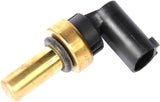 GM Genuine Parts 55591401 Engine Coolant Temperature Sensor
$19.22Temperature sensors and a scanner to verify the repair. Confirm fitment by VIN before ordering.
GM Genuine Parts 55591401 Engine Coolant Temperature Sensor
$19.22Temperature sensors and a scanner to verify the repair. Confirm fitment by VIN before ordering.
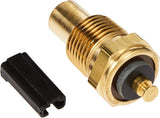 ACDelco Gold G1852 (12334869) Engine Coolant Temperature
$30.98Temperature sensors and a scanner to verify the repair. Confirm fitment by VIN before ordering.
ACDelco Gold G1852 (12334869) Engine Coolant Temperature
$30.98Temperature sensors and a scanner to verify the repair. Confirm fitment by VIN before ordering.
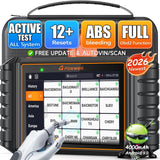 FOXWELL NT726 Bidirectional OBD2 Scanner
$368.99Temperature sensors and a scanner to verify the repair.
FOXWELL NT726 Bidirectional OBD2 Scanner
$368.99Temperature sensors and a scanner to verify the repair.
 FOXWELL NT614 Elite OBD2 Scanner
$233.69Temperature sensors and a scanner to verify the repair.
FOXWELL NT614 Elite OBD2 Scanner
$233.69Temperature sensors and a scanner to verify the repair.

Frequently Asked Questions
Can I mix Dex-Cool with green coolant?
You can without immediate catastrophe, but you should not. The mixture takes on the service life of the shorter-lived fluid, and in a system with air intrusion or low level it can form gel and deposits. The real problem is that you now have a coolant nobody can put an interval on. If it has already happened, plan a full flush.
What does coolant colour tell me?
Very little. Dye choice is up to the manufacturer and no standard ties a colour to a chemistry, so two orange coolants can be entirely different fluids. Use colour as a starting hint, then confirm against the specification printed on the container and the requirement in your owner's manual.
What specification does GM require?
Licensed Dex-Cool products are formulated against GM's GWM3420 standard, formerly GM6277M. Look for that specification or the Dex-Cool licence on the label rather than the brand or the colour of the bottle. Your maintenance schedule is the final authority on which fluid and interval apply to your vehicle.
What is the difference between Dex-Cool concentrate and pre-mix?
Pre-mix (GM 12378390, ACDelco 10-5027) is 50/50 and ready to pour. Concentrate (GM 12346290, ACDelco 10-101) must be diluted 50/50 with distilled water. Pouring concentrate straight in is a real mistake — undiluted glycol transfers heat worse than a 50/50 mix and can still freeze.
How often should Dex-Cool be changed?
Follow your maintenance schedule rather than a generic figure. Product datasheets commonly state 5 years or 150,000 miles, but GM's published interval varies by model year, engine and duty cycle, and some manuals specify a shorter first interval than the coolant's rated life.
Why does Dex-Cool have a bad reputation?
The early complaints traced mostly to systems running low and drawing in air rather than the chemistry failing in a full sealed system. Organic acid inhibitors need contact with metal to protect it; air exposes hot metal with no protection, and the corrosion products are the sludge people found. Several GM engines of that era also had gasket and coolant loss issues that let air in.
Can I use tap water to top off my coolant?
No. Minerals in tap water deposit on hot surfaces and reduce heat transfer, and chlorides accelerate corrosion of aluminium. Use distilled water only, and only when diluting concentrate — repeated topping off with plain water also dilutes the inhibitor package and shortens the fluid's life.
My coolant looks like chocolate milk. What is that?
Usually oil crossing into the cooling system, which points at a head gasket, oil cooler or transmission cooler. That is a symptom rather than a coolant chemistry, and flushing without finding the source just wastes fresh coolant. Investigate before you refill.
Why is my heater cold at idle after a coolant change?
Almost always trapped air rather than a faulty part. Many GM engines have bleed screws or a required fill sequence, and skipping it leaves a pocket in the system. Follow the engine-specific bleed procedure, then recheck the level cold after a few drive cycles — it will usually drop once.
Is stop-leak ever acceptable?
As a roadside measure to get somewhere, yes. As a repair, no. These products work by circulating particles that lodge in small openings, and heater cores and radiators are full of small openings. You are trading a known leak for an unpredictable restriction.
A Note on Sourcing
The GM specification designations — GWM3420, formerly GM6277M — and the ACDelco part numbers and product descriptions come from GM and ACDelco published product information. The 5 year / 150,000 mile figure is what licensed product datasheets commonly state; it is not necessarily the interval GM publishes for your vehicle, which is why this page defers to your maintenance schedule throughout.
GM's own statement that water pump shaft seal leaks are often due to operating with a low coolant level appears in its special coverage bulletin for the 3.6L V6, cited in full in our Enclave water pump guide. It is included here because it supports the same point from the manufacturer's side.
Coolant colour conventions are not standardised, which is why the colour table is presented as a hint to be verified rather than a lookup. Two products of the same colour can be entirely different chemistries.
Capacities, drain points and bleed procedures vary too much between engines to publish here. A gas V8, a Duramax with additional circuits and a transverse V6 are three different jobs, and EV thermal loops are not a general-guide job at all.
For related cooling system work and other routine service intervals, there are more GM maintenance guides covering the jobs that pair with this one.
Everything in this guide, in one place
Dex-Cool coolant, distilled water, testers, thermostats, hoses, and caps for Chevrolet, GMC, Buick, and Cadillac are all in the GM fluids, filters and maintenance parts collection. Filter by your year, model, and engine, and check your owner's manual for the required specification and capacity before you order.