
Bed length, not model year, decides whether a bed rail or cargo system fits your truck. A Silverado 1500 short bed measures 69.9 in at the floor; the standard bed is GM's 6.6 ft box and the long bed is longer again. Same truck, same year, three different part numbers. Measure before you order.
Cargo accessories are the highest-return category in truck parts, and almost all of it comes down to this one number. The good news is that once you know your bed length, filtering truck bed accessories for your Silverado or Sierra becomes a two-minute job instead of a guessing game. Below is how to measure, what GM actually builds, and which system to buy for what you haul.
Parts and tools you'll need
- Bed rails, tie-downs and cargo management hardware — filter by bed length first, model second
- Silverado and Colorado parts and accessories for the model-specific brackets and stake pocket hardware
- A 25 ft tape measure and someone to hold the other end
- A torque wrench, and a socket set that includes the stake pocket bolt size for your kit
Tie-downs and cargo nets
 Car Tie Down Anchor Pickup Truck Bed Side Wall Clip
$32.19Bed tie-downs, anchors and nets for GM pickups. Confirm fitment by VIN before ordering.
Car Tie Down Anchor Pickup Truck Bed Side Wall Clip
$32.19Bed tie-downs, anchors and nets for GM pickups. Confirm fitment by VIN before ordering.
 Auto Straps For Cargo Tape Retractable Tie Down Belts
$64.59Bed tie-downs, anchors and nets for GM pickups. Confirm fitment by VIN before ordering.
Auto Straps For Cargo Tape Retractable Tie Down Belts
$64.59Bed tie-downs, anchors and nets for GM pickups. Confirm fitment by VIN before ordering.
 AUTOWN Truck Bed Cargo Net for GMC Sierra & Chevy Silverado
$22.13Bed tie-downs, anchors and nets for GM pickups. Confirm fitment by VIN before ordering.
AUTOWN Truck Bed Cargo Net for GMC Sierra & Chevy Silverado
$22.13Bed tie-downs, anchors and nets for GM pickups. Confirm fitment by VIN before ordering.
 Universal Car Trunk Organizer Elastic Cargo Net Heavy Duty
$36.14Bed tie-downs, anchors and nets for GM pickups. Confirm fitment by VIN before ordering.
Universal Car Trunk Organizer Elastic Cargo Net Heavy Duty
$36.14Bed tie-downs, anchors and nets for GM pickups. Confirm fitment by VIN before ordering.


Why does bed length decide almost every bed accessory?
Because bed rails, cargo bars, bed dividers, tonneau covers, bed slides and rack systems all reference the length of the box rail rather than the truck. Two Silverados built the same week with the same engine can take different rails if one is a crew cab short bed and the other is a crew cab standard bed.
Width is largely constant across a given generation, which is why bed extenders and cargo bars are usually sold by model rather than by bed. Length is not. Anything that runs front-to-back — rails, slides, covers, drawer systems — is length-specific.
The other thing that varies is what the bed is made of and how it is finished. GMC's available CarbonPro composite bed is not a steel bed with a coating; it is a different structure, and accessories that clamp to a steel rail lip may not be approved for it. If your Sierra has CarbonPro, verify it explicitly rather than assuming a Sierra part is a Sierra part.
What bed lengths do GM trucks come in?
Full-size half-tons are sold in three boxes: short, standard and long. The Silverado 1500 and Sierra 1500 short bed measures 69.9 in at the floor, which GM designates as the 5.8 ft box. The standard bed is designated 6.6 ft, and the long bed is the 8 ft box, generally limited to regular cab work trucks.
Mid-size trucks are simpler and getting simpler still. The 2021 Colorado offered a 5.1 ft bed measuring 61.7 in and a 6.2 ft option. The 2025 Colorado is sold with the 61.7 in bed and crew cab only — one configuration, which removes the guesswork entirely for that generation.
Cab and bed pairings are not free choices. On the 2025 Silverado 1500, the 5.8 ft bed comes with double cab and crew cab, while the 6.6 ft bed is crew cab only. On the 2023 Silverado 1500 the 69.9 in short bed spanned regular cab, double cab and crew cab, with the long bed offered on regular cab work trucks. Those pairings shift year to year, which is exactly why 2022 Silverado is not enough information for an accessory listing.
GM truck bed length reference
Figures below come from published manufacturer specifications. Where a dimension is not published in the sources available, the table says so rather than filling in a rounded guess — measure your own bed in those cases.
| Truck | Bed designation | Published floor length | Typical cab pairing | Notes |
|---|---|---|---|---|
| Silverado 1500 / Sierra 1500 | Short bed, 5.8 ft | 69.9 in | Regular, double and crew cab depending on model year | The most common half-ton bed by a wide margin |
| Silverado 1500 / Sierra 1500 | Standard bed, 6.6 ft | Not published in the specs reviewed — measure yours | Crew cab on recent model years | Roughly ten inches longer than the short bed |
| Silverado 1500 / Sierra 1500 | Long bed, 8 ft | Not published in the specs reviewed — measure yours | Regular cab, generally work truck trims | Fewest accessory options; verify availability before buying |
| Colorado / Canyon (2021 generation) | Short bed, 5.1 ft | 61.7 in | Extended and crew cab | Not interchangeable with any half-ton part |
| Colorado / Canyon (2021 generation) | Long bed, 6.2 ft | Not published in the specs reviewed — measure yours | Extended cab and select crew cab builds | Discontinued on the current generation |
| Colorado (2023 and newer) | Single bed length | 61.7 in | Crew cab only | One configuration; no bed length decision to make |
The 2019 model year needs its own warning. GM sold two Silverado and Sierra generations side by side that year — the carryover trucks were badged Silverado 1500 LD and Sierra 1500 Limited and use the previous-generation box. If yours has the older dashboard, order 2014–2018 accessories regardless of what the title says.
How do you measure your bed correctly?
Measure the floor, not the rail, and measure inside the bed rather than along the outside of the body. The number accessory manufacturers publish is the interior floor length from the bulkhead to the inside face of the closed tailgate.
- Drop the tailgate and clear the bed completely, including any loose liner or mat.
- Close the tailgate.
- Hook your tape at the front bulkhead, at floor level, in the center of the bed.
- Run it straight back to the inside face of the closed tailgate and read the number.
- Write it down, then compare it against the table above. If you get 69 to 70 in, you have the short bed. If you get around 61 to 62 in, you are in a mid-size truck.
- For rail-mounted accessories, also measure the rail from the front of the box to the rear corner, since rail length and floor length are not identical.
If your reading falls between two published figures, measure again with the bed mat out. Drop-in and spray-in liners change interior dimensions enough to push a measurement into the wrong bracket, and that is a common source of the it-says-it-fits-but-it-does-not complaint.
What tie-downs does your truck already have?
More than most owners use. The Silverado 1500 DuraBed comes with 12 standard tie-downs rated at 500 lb per corner, and the Sierra 1500 is likewise equipped with 12 cargo tie-downs. That is a genuinely capable factory system, and a large share of people buying an aftermarket tie-down kit did not need one.
Before you order anything, count what is in your bed and check the rating. Twelve anchors at 500 lb per corner will secure most residential loads — appliances, lumber, motorcycles with the right straps, yard debris. What the factory system does not give you is adjustability: the anchors are where GM put them, and if your load does not line up with them, you end up running straps at bad angles.
That is the actual argument for an aftermarket system. Not more strength — more placement options. A rail-mounted or track-based system lets you put an anchor point where the load is, which is what makes the difference between a strap that holds and a strap that slowly works loose over a hundred miles.
One safety note worth stating plainly: strap ratings and anchor ratings are different numbers, and the weakest link governs. A 3,000 lb ratchet strap on a 500 lb anchor is a 500 lb connection. Match your hardware to the load, and check the working load limit stamped on the strap rather than the breaking strength on the packaging.
Bed covers
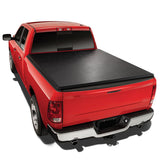 04-13 Chevy Silverado GMC Sierra 1500 Roll-Up Tonneau Cover
$379.99Tonneau covers for Silverado, Sierra, Colorado and Canyon — match your bed length. Confirm fitment by VIN before ordering.
04-13 Chevy Silverado GMC Sierra 1500 Roll-Up Tonneau Cover
$379.99Tonneau covers for Silverado, Sierra, Colorado and Canyon — match your bed length. Confirm fitment by VIN before ordering.
 07-18 Chevy Silverado GMC Sierra Hard Tri-Fold Tonneau Cover
$619.99Tonneau covers for Silverado, Sierra, Colorado and Canyon — match your bed length. Confirm fitment by VIN before ordering.
07-18 Chevy Silverado GMC Sierra Hard Tri-Fold Tonneau Cover
$619.99Tonneau covers for Silverado, Sierra, Colorado and Canyon — match your bed length. Confirm fitment by VIN before ordering.
 04-13 Chevy Silverado / GMC Sierra Hard Tri-Fold Tonneau Cover
$619.99Tonneau covers for Silverado, Sierra, Colorado and Canyon — match your bed length. Confirm fitment by VIN before ordering.
04-13 Chevy Silverado / GMC Sierra Hard Tri-Fold Tonneau Cover
$619.99Tonneau covers for Silverado, Sierra, Colorado and Canyon — match your bed length. Confirm fitment by VIN before ordering.
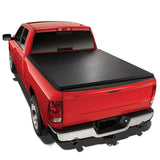 07-14 Chevrolet Silverado GMC Sierra Roll-Up Tonneau Cover
$369.99Tonneau covers for Silverado, Sierra, Colorado and Canyon — match your bed length. Confirm fitment by VIN before ordering.
07-14 Chevrolet Silverado GMC Sierra Roll-Up Tonneau Cover
$369.99Tonneau covers for Silverado, Sierra, Colorado and Canyon — match your bed length. Confirm fitment by VIN before ordering.


What is the difference between bed rails, rail caps and cargo management systems?
Three different products that get lumped together in search results. Bed rails, in the aftermarket sense, are tubular or track-style rails that mount to the top of the box side and give you mounting points, tie-down positions or a base for racks. Rail caps are protective covers for the painted top of the box side. Cargo management systems are the modular track-plus-accessory kits that let you add dividers, cleats and cargo bars.
If your goal is protecting paint on the box rail from tools and lumber, you want rail caps, and they are inexpensive. If your goal is anchoring loads in places the factory anchors do not reach, you want a track or cleat system. If your goal is stopping a load from sliding forward under braking, you want a bed divider or cargo bar, which is a different part again.
Stake pocket accessories are the fourth category and the most flexible. GM full-size beds have stake pockets in the box rail, and a large ecosystem of clamps, cleats and rack feet mounts through them without drilling. If you are undecided, stake pocket hardware is usually the reversible choice.
Bed extenders deserve a specific mention, because people buy them for the wrong reason. An extender flipped into the bed acts as a cargo divider; flipped out over a dropped tailgate it extends usable length. It does not increase what the truck can carry, and it is not a substitute for securing a load properly.
What about the Multi-Flex and MultiPro tailgates?
They change what accessories fit. The available Multi-Flex tailgate on the Silverado offers six configurations including a full-width step rated up to 375 lb and an inner gate that doubles as a work surface. GMC's MultiPro tailgate is the six-function equivalent on the Sierra.
These tailgates have moving inner panels and their own latch hardware, and some tonneau covers, bed extenders and tailgate-mounted accessories either interfere with the inner gate or block a function you paid for. Any listing for these trucks should state Multi-Flex or MultiPro compatibility explicitly. If it does not, treat that as a no.
Also check the step rating before you use it as one. A step rated to 375 lb is rated for a person, not a person carrying an engine block, and the rating assumes the gate is fully deployed in the correct configuration.
Do bed accessories work with a tonneau cover or a liner?
Sometimes, and this is where most compatibility failures happen. Tonneau covers clamp to the box rail, and so do most rail-mounted cargo systems. Both want the same real estate. Track systems mounted to the top of the rail can prevent a folding or roll-up cover from sealing, and some covers require a completely clear rail.
The order of operations matters. Decide on the cover first, since it is the least flexible part, then choose a cargo system that mounts under the rail lip, in the stake pockets, or on the bed floor. Our guide to measuring and installing a tonneau cover correctly covers the clamp positions in detail, and it is worth reading before you buy either product.
Bed liners are the second conflict. A drop-in liner covers the factory tie-down anchors and can block floor-mounted hardware entirely. Spray-in liners do not, but they add thickness at the rail and can make a tight-fitting clamp genuinely tight. If you are running a spray-in liner, say so when you check fitment — our comparison of drop-in, spray-in and bed mats covers which type suits which use.
Which system should you buy for what you haul?
- Lumber, sheet goods, general home projects. Factory tie-downs plus a bed extender used as a divider. You almost certainly do not need more.
- Motorcycles, ATVs, mowers. A stake pocket cleat system so you can place anchors at the wheel positions, plus proper wheel chocks.
- Tools and gear that must stay dry and secure. Tonneau cover first, then a low-profile floor-mounted divider that clears the cover.
- Kayaks, ladders, long loads. A rail-mounted rack in the stake pockets, with a bed extender for anything overhanging the tailgate.
- Daily-driver truck, occasional loads. Rail caps to protect the paint and a set of adjustable cleats. Skip the full system.
- Work truck, loaded daily. A full track-based cargo management system, because the time saved on repositioning anchors adds up.
The category is heavy on products that look impressive and do very little. A cargo net, for example, keeps light items from blowing out; it does not secure anything. A bed extender does not add capacity. Neither is a bad purchase, but buy them for what they are.
What to check before you order
- Bed length, measured, in inches. Not short bed from the window sticker. Floor length, tailgate closed, liner out.
- Cab configuration. It determines which beds your truck could have had and it appears in most fitment tables.
- Model year against generation, not just year. The 2019 model year overlapped two Silverado generations, and mid-size trucks changed platforms in 2023.
- Whether you have Multi-Flex or MultiPro. If yes, the listing must say it is compatible.
- Bed material. CarbonPro composite beds have their own accessory approvals.
- What is already mounted. Tonneau cover, liner type, existing rails. Anything that clamps to the box rail is competing for the same inches.
- Torque values for the mounting hardware. Stake pocket and rail clamps have specified values in the kit instructions — use those rather than tightening by feel, since overtightening a rail clamp will dent the box side.
Bed mats and protection
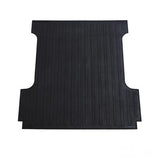 Westin Rubber Truck Bed Mat 506465 for 2019-2026 Chevy & GMC
$187.99Bed mats that pair with tie-down systems. Confirm fitment by VIN before ordering.
Westin Rubber Truck Bed Mat 506465 for 2019-2026 Chevy & GMC
$187.99Bed mats that pair with tie-down systems. Confirm fitment by VIN before ordering.
 2019-2024 Chevy Silverado GMC Sierra 1500 5.8ft TPE 3D Truck
$139.99Bed mats that pair with tie-down systems. Confirm fitment by VIN before ordering.
2019-2024 Chevy Silverado GMC Sierra 1500 5.8ft TPE 3D Truck
$139.99Bed mats that pair with tie-down systems. Confirm fitment by VIN before ordering.
 BedRug XLT Bed Mat XLTBMC19LBS for 2019-2025 Chevy & GMC
$378.99Bed mats that pair with tie-down systems. Confirm fitment by VIN before ordering.
BedRug XLT Bed Mat XLTBMC19LBS for 2019-2025 Chevy & GMC
$378.99Bed mats that pair with tie-down systems. Confirm fitment by VIN before ordering.
 BedRug BedTred Impact Bed Mat (Multi-Pro Tailgate) IMC19SBMPS
$311.99Bed mats that pair with tie-down systems. Confirm fitment by VIN before ordering.
BedRug BedTred Impact Bed Mat (Multi-Pro Tailgate) IMC19SBMPS
$311.99Bed mats that pair with tie-down systems. Confirm fitment by VIN before ordering.


Frequently Asked Questions
How do I measure my truck bed length?
Measure the floor, not the rail, and inside the bed rather than along the body. Clear the bed including any loose mat, close the tailgate, hook the tape at the front bulkhead at floor level, and run it to the inside face of the tailgate. Around 69 to 70 in is a half-ton short bed; 61 to 62 in is a mid-size.
How long is a Silverado 1500 short bed?
69.9 in at the floor, which GM designates the 5.8 ft box. The standard bed is the 6.6 ft designation and the long bed is the 8 ft box, generally limited to regular cab work trucks. Cab and bed pairings shift year to year, so the model year alone is not enough for an accessory listing.
How many tie-downs does a Silverado come with?
The DuraBed comes with 12 standard tie-downs rated at 500 lb per corner, and the Sierra 1500 is likewise equipped with 12. That covers most residential loads, so a large share of people buying an aftermarket tie-down kit did not need one.
Why buy an aftermarket tie-down system then?
Placement, not strength. The factory anchors are where GM put them, and if your load does not line up with them you end up running straps at bad angles. A track or cleat system lets you put an anchor where the load actually is.
Does a 3,000 lb strap on a 500 lb anchor give me 3,000 lb?
No — it is a 500 lb connection. The weakest link governs, and strap ratings and anchor ratings are different numbers. Check the working load limit stamped on the strap rather than the breaking strength printed on the packaging.
What is the difference between bed rails, rail caps and cargo systems?
Rail caps protect the painted top of the box side. Bed rails are tubular or track-style mounts that add tie-down positions or a rack base. Cargo management systems are modular track-plus-accessory kits. Stake pocket hardware is the fourth category and usually the most reversible choice.
Will a cargo system work with my tonneau cover?
Often not, because both clamp to the box rail and want the same real estate. Decide the cover first since it is least flexible, then choose a cargo system that mounts under the rail lip, in the stake pockets, or on the bed floor.
Do bed liners interfere with cargo accessories?
A drop-in liner covers the factory tie-down anchors and can block floor-mounted hardware entirely. Spray-in liners do not, but they add thickness at the rail and can make a tight clamp genuinely tight — mention a spray-in when checking fitment.
Do accessories fit a Multi-Flex or MultiPro tailgate?
Only if the listing says so explicitly. These tailgates have moving inner panels and their own latch hardware, and some covers, extenders and tailgate accessories interfere with the inner gate or block a function you paid for. If compatibility is not stated, treat it as a no.
Does a bed extender increase what my truck can carry?
No. Flipped in it acts as a cargo divider; flipped out over a dropped tailgate it extends usable length. It does not raise capacity and it is not a substitute for securing a load. The same applies to cargo nets — they stop light items blowing out, they do not secure anything.
A Note on Sourcing
Bed dimensions, tie-down counts and tailgate specifications come from GM published vehicle specifications. Where a floor length was not published in the sources reviewed — the 6.6 ft and 8 ft half-ton boxes, and the 6.2 ft mid-size bed — the table says so rather than publishing a rounded guess. In a fitment table, an invented number costs you a return.
Cab and bed pairings change by model year, which is why this page repeatedly says the model year alone is not enough. The 2019 overlap between two Silverado generations affects bed accessories the same way it affects brakes, tyres and lighting on these trucks.
The 375 lb Multi-Flex step rating assumes the gate is fully deployed in the correct configuration, and it is rated for a person rather than a person carrying a load.
The buying recommendations and the assessment of what cargo nets and bed extenders actually do are our own. We sell these products, and the position stated here is that most owners already have enough factory tie-downs and are buying placement flexibility rather than capacity.
For everything else on the accessory side, there are more GM parts and accessory fitment guides.
Will this fit your truck bed?
Check your bed length, cab configuration and model year before you order — and measure the bed rather than trusting the trim name. Sixty-nine point nine inches is a short bed. Sixty-one point seven is a mid-size. Anything else, write the number down and match it to the listing.
With that number in hand, filter bed rails, tie-downs and cargo management for your bed length, and check Silverado and Colorado specific parts for the brackets and hardware that mount them.