
Running boards are flat platforms mounted flush to the rocker panel. Nerf bars are tubular side steps with individual step pads under each door. Power steps are motorized boards that deploy when a door opens and retract flush when it closes. For a Tahoe, Suburban or Yukon carrying kids and groceries, running boards or power steps are the right answer; nerf bars are the off-road choice.
The harder question is not which style — it is which fitment. GM's full-size SUVs come in two wheelbases, two platform generations since 2015, and a stack of trims with different lower body cladding, and a set that fits one combination will not fit the next. Below is the style comparison and, more usefully, the fitment map. You can browse running boards, nerf bars and power steps for your SUV while you read.
Parts and tools you'll need
- Running boards, nerf bars, side steps and exterior accessories for your Tahoe, Suburban or Yukon
- Chevrolet Tahoe and Suburban parts or GMC Yukon and Yukon XL parts, filtered to your exact year
- A floor jack and stands if you want to work comfortably, plus a torque wrench and a socket set through 18 mm
- A helper. These assemblies are long and awkward and holding one up alone while starting bolts is how you scratch a rocker panel.
Running boards
 2019-2020 Chevrolet Silverado GMC Sierra 5" Black Running
$319.99Running boards for GM trucks and SUVs. Confirm fitment by VIN before ordering.
2019-2020 Chevrolet Silverado GMC Sierra 5" Black Running
$319.99Running boards for GM trucks and SUVs. Confirm fitment by VIN before ordering.
 2019-2024 Silverado GMC Sierra 1500 Extended Cab OE 6"
$281.99Running boards for GM trucks and SUVs. Confirm fitment by VIN before ordering.
2019-2024 Silverado GMC Sierra 1500 Extended Cab OE 6"
$281.99Running boards for GM trucks and SUVs. Confirm fitment by VIN before ordering.
 2018-2023 Chevrolet Traverse Nerf Bar Side Step Running
$508.99Running boards for GM trucks and SUVs. Confirm fitment by VIN before ordering.
2018-2023 Chevrolet Traverse Nerf Bar Side Step Running
$508.99Running boards for GM trucks and SUVs. Confirm fitment by VIN before ordering.
 2015-2024 Chevrolet Colorado / GMC Canyon Nerf Bar Side Step
$508.99Running boards for GM trucks and SUVs. Confirm fitment by VIN before ordering.
2015-2024 Chevrolet Colorado / GMC Canyon Nerf Bar Side Step
$508.99Running boards for GM trucks and SUVs. Confirm fitment by VIN before ordering.


What is the actual difference between running boards, nerf bars and power steps?
Running boards are wide flat platforms — commonly five to seven inches of stepping surface — that run the length of the doors and mount close to the body. Nerf bars are round or oval tubes, usually two to six inches in diameter, with rubber step pads only under the doors. Power steps are running boards on motorized linkage that retract out of sight.
Everything else follows from those three shapes. A flat board gives the most secure footing and the best protection from door dings and road spray. A tube gives you ground clearance and does not hold snow or mud. A power step gives you a low step when you need it and a clean silhouette when you do not, at the cost of motors, wiring and complexity.
The terminology is used loosely in listings. Side steps, step bars, nerf bars and tube steps all mean roughly the same thing, and running board is sometimes applied to anything you step on. Judge by the photograph and the stated dimensions, not the product name.
Side-by-side comparison
| Running boards | Nerf bars | Power steps | |
|---|---|---|---|
| Step surface | Flat, roughly 5–7 in wide | Tubular, pads under doors only | Flat, typically about 6 in wide |
| Typical materials | Aluminum or steel frame with polymer tread | Stainless or powder-coated steel tube | Aluminum board on die-cast alloy linkage |
| Published load ratings | Commonly 300–500 lb | Commonly 300–500 lb | Commonly 600–660 lb per side |
| Ground clearance impact | Most — hangs lowest and widest | Least | None when retracted |
| Winter behavior | Collects snow, ice and salt | Sheds debris | Retracted board stays cleaner |
| Door and paint protection | Best | Partial | Good when deployed |
| Installation | Bolt-on, often no drilling | Bolt-on, often no drilling | Roughly 3 hours, wiring and sometimes drilling |
| Things that can break | Tread pads, brackets | Brackets, finish | Motors, linkage, harness, controller |
| Best for | Families, short passengers, daily use | Off-road, snow country, lifted trucks | Lowered step height without the permanent look |
Load ratings deserve a caution. Published figures vary enormously between brands and there is no common test standard behind them, so a 500 lb board from one company and a 500 lb board from another are not necessarily comparable. Use the number to compare within a brand's lineup, not across brands.
Nerf bars
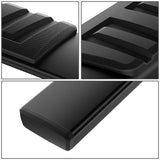 2019-2022 Chevrolet Silverado GMC Sierra Nerf Bar Step Bar
$289.99Nerf and step bars. Confirm fitment by VIN before ordering.
2019-2022 Chevrolet Silverado GMC Sierra Nerf Bar Step Bar
$289.99Nerf and step bars. Confirm fitment by VIN before ordering.
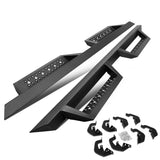 07-19 Chevy Silverado GMC Sierra Drop Down Nerf Bars
$349.99Nerf and step bars. Confirm fitment by VIN before ordering.
07-19 Chevy Silverado GMC Sierra Drop Down Nerf Bars
$349.99Nerf and step bars. Confirm fitment by VIN before ordering.
 07-18 Chevy Silverado / GMC Sierra 6" Oval Nerf Bars
$329.99Nerf and step bars. Confirm fitment by VIN before ordering.
07-18 Chevy Silverado / GMC Sierra 6" Oval Nerf Bars
$329.99Nerf and step bars. Confirm fitment by VIN before ordering.
 07-19 Chevrolet Silverado GMC Sierra Crew Cab Nerf Bar Step
$299.99Nerf and step bars. Confirm fitment by VIN before ordering.
07-19 Chevrolet Silverado GMC Sierra Crew Cab Nerf Bar Step
$299.99Nerf and step bars. Confirm fitment by VIN before ordering.


Does a Tahoe board fit a Suburban?
No. Tahoe and Yukon share a shorter wheelbase; Suburban and Yukon XL are longer. Side steps are cut to the door opening length, so the long-wheelbase boards are physically longer and the bracket spacing is different. Listings routinely say exclude Yukon XL or Suburban / Yukon XL only for exactly this reason.
Chevrolet and GMC versions of the same length generally do interchange, because the underlying vehicle is the same. A Tahoe board will normally fit a Yukon of the same years, and a Suburban board a Yukon XL. What does not interchange is short wheelbase to long wheelbase, in either direction.
The mistake happens because people search for Tahoe running boards, find something they like, and only notice the wheelbase note after the box arrives. Read the fitment line all the way to the end, including anything in parentheses.
What changed in 2021?
GM's full-size SUVs moved to a new platform for the 2021 model year, with a new body, a new rocker panel profile, and independent rear suspension. Nothing designed for a 2015–2020 Tahoe, Suburban or Yukon fits a 2021 or newer one. This is the single most common fitment error on these vehicles.
| Generation | Short wheelbase | Long wheelbase | Notes |
|---|---|---|---|
| 2015–2020 | Tahoe, Yukon | Suburban, Yukon XL | Cadillac Escalade and Escalade ESV share this era's fitment |
| 2021–2026 | Tahoe, Yukon | Suburban, Yukon XL | New body and rocker profile; earlier parts do not transfer |
That 2021 break is the same one that governs brakes, suspension and cabin filters on these vehicles — the 2021 redesign moved them to an entirely different platform with independent rear suspension. If you have ever been told a part for your Tahoe does not cross that year, this is why.
Within each generation, mid-cycle refreshes changed appearance more than they changed mounting points, but they did change trim-level cladding. Verify the year range on the listing covers your exact model year rather than assuming a 2021–2024 kit covers a 2026.
Do trim level and cladding affect fitment?
Yes, and this is where the marketplace listings are least reliable. Z71 and AT4 trims carry different lower body cladding than a base LS or SLE, and Denali, High Country and Premier trims add chrome or body-color side moldings. Some kits interfere with that cladding or leave a visible gap. Check whether the listing calls out your trim.
The failure mode is not usually that it will not bolt on. It is that the board sits at a slightly different height relative to the cladding, or the bracket passes through where a molding sits, and the result looks wrong even though it is technically installed. That is a return, and side steps are expensive to ship back.
Photograph your rocker area from directly beside the vehicle before you shop, straight on, with the door closed. Compare that photograph to the product photos. Fifteen seconds of effort catches most of these.
What if my SUV already has factory power assist steps?
Vehicles that came with factory power-retractable assist steps use trim-specific brackets and a wiring harness. Going from factory power steps to fixed boards, or the other way, generally requires the correct brackets for the target configuration — the mounting provisions are not shared. Budget for brackets in that conversion.
People do this swap in both directions. Owners of Denali and High Country trims with failing power step motors often convert to fixed boards to be rid of the complexity. Owners of lower trims add aftermarket power steps for the convenience. Both work; both need the right brackets rather than the ones already on the vehicle.
If your factory power steps have stopped working, diagnose before you replace. The common failures are the motor assembly itself, a corroded connector at the motor, and a controller module. Only one of those requires new hardware on both sides.
How much weight will they actually hold?
Published ratings run roughly 300 to 500 lb for fixed boards and nerf bars, and 600 to 660 lb per side for the better power steps. Those are static ratings under ideal loading. Treat them as an ordering comparison, not as a promise about a person landing on the outer edge with momentum.
What actually determines whether a board survives is the bracket count and the bracket material, not the headline number. A board with four brackets per side spreads load better than one with three, and steel brackets tolerate abuse that stamped aluminum does not. Look at the mounting hardware in the product photos.
The load case that breaks boards is not a person standing on them. It is a person stepping on the far end while carrying a child, or someone using the board to climb to the roof rack, which loads the outboard edge in a way no rating covers. If roof access is a regular part of your life, buy the heavier option.
What is actually involved in installing them?
Fixed boards and nerf bars usually bolt to existing threaded holes in the pinch weld or frame, and a competent DIYer can do a set in one to two hours. Power steps take about three hours and involve routing a harness, tapping a power source, and sometimes drilling. Neither job needs special tools beyond a torque wrench.
- Unbox and lay everything out. Confirm you have left and right boards and that the bracket count matches the instructions before you touch the vehicle.
- Clean the mounting holes along the pinch weld. On a salt-belt vehicle, spray penetrating oil into them the night before and chase the threads.
- Hang the brackets loosely first. Do not torque anything until every bracket and the board itself are in place, or you will fight alignment for an hour.
- Set the board so the front and rear ends are equidistant from the body, sight it from ten feet back, then torque to the manufacturer's spec in the sequence given.
- For power steps, route the harness away from the exhaust and away from any suspension component that moves. Zip-tie it properly rather than letting it hang.
- Cycle a power step twenty times with the vehicle stationary before you trust it. Watch for the board contacting the cladding at either end of travel.
- Re-check every fastener after the first week. Bolts settle, and a board that comes loose at highway speed is a serious problem.
Torque specs come with the kit and vary between manufacturers and bracket designs. Use the number in your instructions rather than a generic figure — there is no universal spec for this, and over-torquing a bracket into a pinch weld will crush it. If you do not own a wrench that reads accurately in the range the instructions call for, our torque wrench buying guide covers picking one.
What about winter, salt and ground clearance?
Flat running boards hold snow, slush and salt against the rocker panel, which is the part of a GM SUV most prone to rust. Nerf bars let it fall through. Power steps spend most of their life retracted and stay cleanest, but their linkage is exposed to the same salt and can seize.
If you live where roads are salted, the practical hierarchy is: nerf bars are lowest maintenance, power steps need the linkage cleaned and lubricated a couple of times a winter, and running boards need you to actually look under them occasionally. None of these are dealbreakers, but a running board that has been packing salt against a rocker panel for eight winters is a real thing to be aware of.
On clearance, a fixed running board on a full-size SUV hangs lower and wider than the rocker. It will find curbs and driveway aprons. If your SUV is lifted or you take it anywhere with ruts, that flat board becomes the lowest point on the side of the vehicle, which is the strongest argument for tubes.
Are power steps worth the money?
They are worth it if step height is the actual problem you are solving — short passengers, older parents, small children climbing in unassisted. They are not worth it if you mainly want the look. You are buying two electric motors, a controller and a harness that live in the salt spray under a vehicle, and every one of those is a future failure point.
The features that separate good ones from cheap ones are obstruction detection that stops the board when something is in the way, an interior override switch, sealed motors, and a warranty measured in years rather than months. The better units use plug-and-play harnesses that tap the vehicle's data connection rather than requiring you to splice into door switches.
Buy once here. A power step is one of the few exterior accessories where the cheap option genuinely is not fine, because the failure is not cosmetic — it is a board that will not deploy on a school run in February.
A short safety note
These are load-bearing parts that people trust with their body weight, often while holding a child. Torque the brackets properly, re-check them after the first week and each season, and replace tread pads when they glaze over. A worn step pad on a wet morning is genuinely slippery.
If you jack the vehicle, do it at the factory jacking points on the frame, not on the running board brackets. The brackets are designed for downward step loads, not for supporting the vehicle, and they will fold.
What to check before you order
- Wheelbase first. Tahoe and Yukon are short; Suburban and Yukon XL are long. They do not share boards.
- Generation second. 2015–2020 and 2021–2026 are different vehicles. Nothing crosses.
- Confirm the listing covers your exact model year, not a range that stops before it.
- Check your trim's cladding. Z71, AT4, Denali, High Country and Premier all differ down there.
- Note whether you have factory power assist steps and budget for the correct brackets if you are converting.
- Count the brackets in the product photos. More brackets and heavier material beat a bigger number on the spec sheet.
- Decide about winter honestly. Salt-belt owners should think hard before choosing a flat board.
- Use the torque specs that come in the box, not a generic figure from the internet.
Install tools
 ACDelco Tools Torque Wrenches, Digital LCD Display, 1/2 in.
$162.99Tools for a bolt-on step install.
ACDelco Tools Torque Wrenches, Digital LCD Display, 1/2 in.
$162.99Tools for a bolt-on step install.
 ACDelco Tools Torque Wrenches, Digital LCD Display, 3/8 in.
$249.99Tools for a bolt-on step install.
ACDelco Tools Torque Wrenches, Digital LCD Display, 3/8 in.
$249.99Tools for a bolt-on step install.
 95 Piece Mechanics Tool Set in Metric and SAE for Small
$99.99Tools for a bolt-on step install.
95 Piece Mechanics Tool Set in Metric and SAE for Small
$99.99Tools for a bolt-on step install.


Frequently Asked Questions
What is the difference between running boards, nerf bars and power steps?
Running boards are wide flat platforms, typically five to seven inches, mounted close to the body. Nerf bars are round or oval tubes with step pads only under the doors. Power steps are boards on motorised linkage that deploy when a door opens and retract flush. Flat boards suit families, tubes suit snow and dirt, power steps solve step height.
Do Tahoe running boards fit a Suburban?
No. Tahoe and Yukon share the short wheelbase; Suburban and Yukon XL are longer, and boards are cut to the door opening length with different bracket spacing. Chevrolet and GMC versions of the same length generally do interchange — a Tahoe board normally fits a Yukon of the same years.
Will 2015–2020 side steps fit a 2021 Tahoe?
No. GM's full-size SUVs moved to a new platform for 2021 with a new body and rocker panel profile. Nothing from the previous generation transfers, and this is the single most common fitment error on these vehicles.
Does trim level affect side step fitment?
Yes, and it is where listings are least reliable. Z71 and AT4 carry different lower cladding than a base LS or SLE, and Denali, High Country and Premier add side moldings. The usual failure is not that it will not bolt on — it is that the board sits wrong relative to the cladding.
How much weight do running boards hold?
Published ratings run roughly 300–500 lb for fixed boards and nerf bars, and 600–660 lb per side for better power steps. There is no common test standard, so ratings are not comparable across brands. Bracket count and material matter more than the headline figure.
Are power steps worth it?
Worth it if step height is the actual problem — short passengers, older parents, small children. Not worth it for the look alone, since you are adding two motors, a controller and a harness living in salt spray. This is one accessory where the cheap option genuinely is not fine.
Are running boards a bad idea in the salt belt?
They are the worst of the three for it. Flat boards hold snow, slush and salt against the rocker panel, which is the area of a GM SUV most prone to rust. Nerf bars shed debris; power steps stay cleaner retracted but their linkage can seize. None are dealbreakers, but a board packing salt for eight winters is a real consideration.
Can I swap factory power steps for fixed boards?
Yes, and people do it in both directions — but the mounting provisions are not shared, so budget for the correct brackets for the target configuration. If your factory power steps have failed, diagnose first: the common causes are the motor assembly, a corroded connector, and the controller module.
Can I jack the vehicle on the running board brackets?
No. They are designed for downward step loads, not for supporting the vehicle, and they will fold. Use the factory jacking points on the frame.
How often should I re-check the mounting bolts?
After the first week, then each season. Bolts settle, and these are load-bearing parts people trust with their body weight while often holding a child. Also replace tread pads when they glaze over — a worn pad on a wet morning is genuinely slippery.
A Note on Sourcing
Load ratings quoted here are manufacturers' published figures and there is no common test standard behind them, which is why this page tells you to compare within a brand's lineup rather than across brands, and to look at bracket count and material instead.
Wheelbase and generation boundaries reflect GM's platform history. The 2021 redesign of the full-size SUVs is a genuine platform change with a new body and rocker profile, and it governs fitment for side steps the same way it governs brakes and suspension on these vehicles.
Trim-level cladding differences are the least reliable area in marketplace listings, which is why the advice here is to photograph your own rocker area and compare it to the product photos rather than trusting a fitment line.
Torque figures are deliberately not given. They vary by manufacturer and bracket design, and over-torquing into a pinch weld will crush it. Use the numbers supplied with your kit.
There are more GM parts and accessories guides covering exterior fitment on these SUVs, including the trim-level differences that cause most wrong-part orders.
Still deciding?
Pick the style that matches how the vehicle is actually used — flat boards for families, tubes for snow and dirt, power steps when step height is the real problem — then compare running boards, nerf bars and power steps filtered to your wheelbase, generation and trim. Tahoe and Suburban owners can start from Chevrolet Tahoe and Suburban parts; Yukon owners from GMC Yukon and Yukon XL parts.