
Safety Recall N262554630 (NHTSA campaign 26V304) covers 2,464 full-size GM SUVs — 2025–2026 Cadillac Escalade and Escalade ESV, Chevrolet Tahoe and Suburban 1500, GMC Yukon and Yukon XL — fitted with 24-inch wheels. Incorrect bolts may have been installed on the left and right front wheel hubs, and those bolts can loosen or deform over time. What makes this recall unusual is where the defect came from: not the assembly line, but the dealer service bay.
Read the primary document yourself: Part 573 Safety Recall Report for NHTSA campaign 26V304 (PDF), submitted by General Motors on 14 May 2026.
Update — this page has been revised. An earlier version stated that we had not opened GM's Part 573 report for this campaign and therefore lacked the chronology, the bolt part numbers and any incident count. We have since obtained and read that filing, and this page now carries those details. Two things in the earlier version were corrected as a result: GM does state a warning that drivers may notice, and the hub joint uses four bolts rather than being the single-point attachment the earlier wording implied. Both corrections are described in the sections below rather than edited away.
Jump to a section: What to do right now · A defect introduced during service · Which vehicles · What goes wrong · Why these bolts matter · Signs of a loose hub fastener · How GM found it · The remedy · Is it safe to drive? · A note on sourcing · What other pages get wrong · FAQ
What to Do Right Now
Run your VIN. VINs for this campaign became searchable on NHTSA.gov on 14 May 2026.
- nhtsa.gov/recalls, or your Chevrolet, GMC or Cadillac owner app
- Our GM recall VIN check guide walks through it
Owner notification letters were scheduled to begin mailing 29 June 2026, and dealers were notified on 14 May 2026.
Customer service, referencing N262554630 or NHTSA 26V304:
- Chevrolet: 1-800-222-1020
- GMC: 1-800-462-8782
- Cadillac: 1-800-333-4223
- NHTSA Vehicle Safety Hotline: 1-888-327-4236
And one thing specific to this recall: if your SUV has had the accessory brake package (RPO 5JL) fitted, or front wheel hub bearing work done, mention that when you call — those are the two service operations that created this defect.
A Defect Introduced During Service
This is the part that sets this recall apart from almost every other one on this site, and it changes how you should think about who is affected.
Most recalls trace back to the factory — a supplier part out of specification, an assembly step missed, a design that did not account for something. The population is then a production window, and you can reason about it from build dates.
This one is different. GM's filing states it plainly:
Dealers may have used incorrect bolts to install an accessory brake package or service the front wheel-hub bearings on these vehicles. The bolts may loosen or deform over time.
In other words, the vehicles left the factory correctly assembled. The wrong fastener went in later, during dealer work. GM's own scoping line confirms it: the recall only affects vehicles with 24-inch wheels that either received the dealer-installed accessory brake package (RPO 5JL) or received a front hub replacement in service.
Three consequences follow, and they are all practical.
- The population is a service-history population, not a build window. Two identical Escalades built the same day can have different recall status depending on what was done to them afterwards. GM states it used manufacturing records and vehicle service records to determine the affected population — you cannot reason your way to an answer from model year or production date.
- The 24-inch wheel connection is a clue, not a rule. The accessory brake package associated with this work is tied to the larger wheel fitment, which is why the recall is scoped to 24-inch-wheeled vehicles. But having 24s does not mean you are affected — it means you are in the group worth checking.
- The VIN lookup is the only authority. GM knows which vehicles had the relevant work performed. You do not, unless you have every service record.
One number is worth flagging. GM's estimated percentage of the population with the defect is 100%. On many recalls that figure is well below 100 and the remedy begins with an inspection. Here GM expects every vehicle in the population to have the wrong bolts, which is why the remedy is replacement rather than inspect-then-decide.
It is worth saying plainly that this reflects reasonably well on the process. GM identified work performed in its own dealer network, traced which vehicles received it, and recalled them. That is harder to catch than a bad batch of parts arriving at a plant.
Which Vehicles
The recall covers 2,464 vehicles across six nameplates, all full-size body-on-frame SUVs sharing the same front hub architecture. GM's filing breaks the population down by model and model year:
| Vehicle | Model year | Units |
|---|---|---|
| Cadillac Escalade | 2025 | 737 |
| Cadillac Escalade | 2026 | 647 |
| Cadillac Escalade ESV | 2025 | 411 |
| Cadillac Escalade ESV | 2026 | 335 |
| Chevrolet Tahoe | 2025 | 83 |
| Chevrolet Tahoe | 2026 | 51 |
| Chevrolet Suburban 1500 | 2025 | 76 |
| Chevrolet Suburban 1500 | 2026 | 35 |
| GMC Yukon | 2025 | 12 |
| GMC Yukon | 2026 | 49 |
| GMC Yukon XL | 2025 | 7 |
| GMC Yukon XL | 2026 | 21 |
| Total | 2,464 |
The distribution is the story here. Escalade and Escalade ESV account for 2,130 of the 2,464 vehicles — about 86%. The Chevrolet and GMC nameplates together make up barely one in seven. That follows directly from the defect being tied to 24-inch wheels and an accessory brake package: 24s are standard or common on Escalade trims and a rarer option elsewhere.
Note what is not on this list. The Silverado 1500 and Sierra 1500 pickups are not included, despite sharing a great deal with these SUVs. Neither are earlier model years. The scope is narrow and specific, which is consistent with a defect created by a particular service operation rather than a production problem.
What Goes Wrong
GM's description of the defect and its consequence:
Dealers may have used incorrect bolts to install an accessory brake package or service the front wheel-hub bearings on these vehicles. The bolts may loosen or deform over time.
If a bolt breaks or completely loosens during vehicle operation, additional load could be placed on the three remaining bolts and lead to partial loss of vehicle control, increasing the risk of a crash.
That second sentence tells you something the summaries leave out: this is a four-bolt joint. A single bolt failing does not release the hub. It transfers that bolt's share of the load onto three fasteners that were never specified to carry it, and GM's stated consequence is partial loss of vehicle control.
An earlier version of this page described the joint as having "no redundancy of the kind people assume." That was wrong, and GM's own filing is the correction. There is redundancy — four bolts — which is precisely why the failure is progressive rather than instantaneous, and why GM describes a partial rather than total loss of control.
Read "loosening or deforming" carefully, because it describes a process rather than an event.
A bolt of the wrong specification can be wrong in several ways that all end in the same place — wrong grade, wrong length, wrong thread, wrong shoulder geometry. Whatever the specific mismatch, the result is a fastener that cannot hold its clamp load properly.
And fasteners that cannot hold clamp load do not fail immediately. They work loose progressively under the load cycles of driving — every corner, every bump, every braking event. The bolt yields a little, the joint loosens slightly, which increases the load on the remaining bolts and accelerates the process. That is the mechanism GM is describing when it says load shifts to the three remaining bolts.
That is why GM's language is "over time." A vehicle that has been fine for thousands of miles is not therefore fine. The condition develops.
The correct and incorrect parts are identified in the filing. The involved component is the front hub bearing bolt, part numbers 11605137 and 11547070.
Hub assemblies
 ACDelco Front Hub Assembly 84856653
$339.99ACDelco front wheel bearing and hub assembly 84856653. Confirm fitment by VIN before ordering.
ACDelco Front Hub Assembly 84856653
$339.99ACDelco front wheel bearing and hub assembly 84856653. Confirm fitment by VIN before ordering.
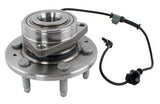 ACDelco Front Hub Assembly 84856654
$305.99ACDelco front wheel bearing and hub assembly 84856654. Confirm fitment by VIN before ordering.
ACDelco Front Hub Assembly 84856654
$305.99ACDelco front wheel bearing and hub assembly 84856654. Confirm fitment by VIN before ordering.
 ACDelco Digital Torque Wrench, 1/2 in. (14.8–147.5 ft-lb)
$162.99Half-inch digital torque wrench for hub bolts and lug nuts.
ACDelco Digital Torque Wrench, 1/2 in. (14.8–147.5 ft-lb)
$162.99Half-inch digital torque wrench for hub bolts and lug nuts.
 FOXWELL NT301 Code Reader
$68.82Budget code reader with live data.
FOXWELL NT301 Code Reader
$68.82Budget code reader with live data.
 Nomex Split Loom, 1 in. x 10 ft
$105.66Split loom to protect repaired wiring.
Nomex Split Loom, 1 in. x 10 ft
$105.66Split loom to protect repaired wiring.


Why These Bolts Matter
Worth understanding, because it explains why a handful of fasteners warrants a federal safety recall.
The front wheel hub bearing assembly is what your wheel actually turns on, and it is bolted to the steering knuckle. Those bolts carry everything the wheel does: the vehicle's weight, cornering loads, braking torque, and every impact the tyre transmits.
On a full-size SUV with 24-inch wheels, those loads are substantial. These are heavy vehicles, and a larger diameter wheel increases the leverage acting on the hub joint. That is not incidental to this recall — it is the whole reason 24-inch fitments needed different fasteners in the first place, and the reason the kit's failure to specify them mattered.
That is a different failure from a wheel bearing wearing out. Our wheel bearing failure guide covers the ordinary wear condition, which announces itself with noise and gives you time. A fastener failure is a structural one, and while GM does describe a warning you may notice, it is not one to rely on.
Signs of a Loose Hub Fastener
GM's filing does identify a warning, under the heading of any warning that can occur:
Drivers may hear noise or feel vibration from the affected wheel hub.
An earlier version of this page said no warning signs came from GM's recall documents. That was written before we had read the Part 573 report, and it was wrong — the sentence above is GM's own.
What has not changed is what you should do with it. Noise or vibration from a front hub is worth acting on, but its absence proves nothing, because the condition develops over time. The VIN lookup remains the only way to know whether your vehicle is affected.
Beyond GM's stated warning, these are the general signs of a loosening front hub joint. This list is general diagnostic knowledge rather than GM's language, offered because it is worth knowing while you arrange the repair:
- A clunk or knock from the front of the vehicle over bumps, or when transitioning between acceleration and braking
- A vibration through the steering wheel that changes with speed
- A wheel that feels unsteady or a change in how the steering tracks
- Uneven or unusual tyre wear appearing on one front corner
- An ABS or stability control warning light, since the wheel speed sensor lives at the hub and misalignment disturbs its signal
If you notice any of these, stop driving the vehicle and have it inspected — regardless of what your VIN lookup said, and regardless of this recall. A suspected loose or failing front hub joint is not something to drive on while you wait for an appointment.
Tools for checking the front end
 FOXWELL NT604 ABS/SRS/Transmission Scanner
$209.09Reads ABS codes from a damaged wheel speed sensor.
FOXWELL NT604 ABS/SRS/Transmission Scanner
$209.09Reads ABS codes from a damaged wheel speed sensor.
 ACDelco Front ABS Wheel Speed Sensor 22873507
$123.99ACDelco front ABS wheel speed sensor. Confirm fitment by VIN before ordering.
ACDelco Front ABS Wheel Speed Sensor 22873507
$123.99ACDelco front ABS wheel speed sensor. Confirm fitment by VIN before ordering.
 TOPDON BT200 Battery Tester
$103.99Battery tester.
TOPDON BT200 Battery Tester
$103.99Battery tester.


How GM Found It
The filing sets out a chronology that is worth reading, because it shows this was caught by document review rather than by a failure in the field.
- April 2026 — a GM product investigator discovered that the kit supplied to dealers for the accessory brake package (RPO 5JL) did not include separate instructions or special fasteners for vehicles equipped with 24-inch wheels, as required by GM's specifications. Dealers may therefore have reused production-installed bolts.
- The same review found a second failure point. GM's electronic parts catalog did not identify the correct bolt for service operations involving replacement or reattachment of the front hub bearing on 24-inch-wheeled vehicles. So both routes to the defect — the accessory kit and ordinary hub service — traced back to GM's own documentation.
- Seven field complaints potentially associated with the condition had been reported to GM, on 9 January 2025, 4 August 2025, 13 September 2025, 29 October 2025, 25 November 2025, 18 December 2025 and 13 April 2026. GM is not aware of any crashes or injuries associated with this condition.
- 7 May 2026 — GM's Safety Field Action Decision Authority decided to conduct a safety recall.
- 14 May 2026 — report filed, dealers notified, VINs searchable.
- 29 June 2026 — owner notification estimated to begin mailing.
Note the shape of those complaint dates. They run from January 2025 to April 2026 — more than a year of individual reports before the pattern was identified. That is characteristic of a service-induced defect: each complaint arrives at a different dealer, on a different vehicle, and looks like an isolated fastener problem until someone connects them to a common service operation.
The fix went upstream as well as to the vehicles. GM corrected its electronic parts catalogue on 1 May 2026 and initiated containment of the RPO 5JL accessory brake package for 24-inch wheels on 8 May 2026, so the documentation that caused the problem was addressed before owner notification began.
The Remedy
Dealers will replace the front left and right wheel hub bolts, free of charge.
Both sides, regardless of which side had the work done. That is the sensible approach when the question is which fasteners went in during a past service operation.
What to expect:
- This is a straightforward job by recall standards — fasteners rather than assemblies, no programming, no parts backorder reported.
- It costs you nothing. Under 49 C.F.R. § 573.13(d)(1), all covered vehicles are under warranty, so GM offers no separate reimbursement plan — parts and labour are simply covered.
- A dealer cannot legally deliver a new vehicle covered by an open safety recall until the defect is remedied, so inventory vehicles are handled before sale.
One thing worth asking when you book: whether the hub assemblies themselves will be inspected, not just the bolts replaced. If fasteners have been loosening for some time, the joint they clamp may have taken damage. That is a reasonable question rather than a demand, and a good service department will already be looking.
Is It Safe to Drive?
Being precise here, because this recall sits differently from some others we cover.
GM has not issued a "do not drive" advisory for this campaign. Owners are not being told to park the vehicle, and NHTSA's own record for 26V304 carries no park-it or park-outside flag.
But this is a loss-of-control recall, and it should be treated with more urgency than a convenience-feature campaign. The failure mode is progressive, GM expects 100% of the population to be affected, and the consequence is severe. That combination argues for booking it promptly rather than waiting for the letter.
Practical guidance:
- Check your VIN now rather than waiting for notification.
- If affected, book it in without delay — this is a quick job, so there is little reason to defer.
- Avoid heavy loading and towing until it is done, which is our own judgement rather than GM guidance. Loads increase the forces on the joint, and this is a fastener problem.
- Act on any noise or vibration from a front hub immediately — that is GM's stated warning, not ours.
If a do-not-drive advisory is later attached to your VIN, follow it over anything on this page.
A Note on Sourcing
We cite documents we have read and label the rest.
This page is built from the Part 573 Safety Recall Report for NHTSA campaign 26V304, submitted by General Motors on 14 May 2026, which we have opened and read in full. That covers the 2,464-vehicle population and its model-by-model breakdown, the 100% defect estimate, the RPO 5JL and front-hub-service scoping, the defect and safety risk language, the stated cause, the warning drivers may notice, the bolt part numbers, the seven field complaint dates, the absence of crashes or injuries, the chronology, the remedy, the reimbursement position and the schedule.
Quoted passages are GM's own wording from that filing, and the document is linked so you can check any of it against the original.
This page previously carried a different sourcing note stating that we had not opened the Part 573 report and therefore lacked the chronology, part numbers and incident count. That was accurate when written. Having since read the filing, we have updated the page and marked the two places where the earlier version was wrong rather than correcting them silently.
The earlier note also flagged a discrepancy over the owner notification mailing date, with sources reporting either 29 June 2026 or mid-June. The filing settles it: owner notification of an available remedy was estimated to start mailing on 29 June 2026.
The additional signs of a loosening hub joint, beyond GM's stated warning, are general diagnostic knowledge and are labelled as such where they appear. The suggestion to avoid heavy loads and towing before the repair is our own judgement, not GM guidance.
Recalls develop. Populations get expanded and remedies get revised. Your VIN lookup and your dealer are current in a way this page cannot be.
Tools for hub work
 95-Piece Mechanics Tool Set (Metric & SAE)
$99.99Metric and SAE mechanic tool set.
95-Piece Mechanics Tool Set (Metric & SAE)
$99.99Metric and SAE mechanic tool set.
 50-Piece 1/4 in. Drive Socket Set
$54.99Quarter-inch drive socket set.
50-Piece 1/4 in. Drive Socket Set
$54.99Quarter-inch drive socket set.
 ACDelco Digital Torque Wrench, 3/8 in. (5–99.5 ft-lb)
$249.993/8-inch digital torque wrench.
ACDelco Digital Torque Wrench, 3/8 in. (5–99.5 ft-lb)
$249.993/8-inch digital torque wrench.
 FOXWELL BC521 Battery Charger & Tester
$162.35Charger and tester for battery health.
FOXWELL BC521 Battery Charger & Tester
$162.35Charger and tester for battery health.


What Other Pages on This Recall Get Wrong
- Missing that this is a service-induced defect. The bolts were installed during dealer work — the RPO 5JL accessory brake package or front hub bearing service — not on the assembly line. That single fact explains the narrow population and why build date tells you nothing.
- Treating 24-inch wheels as the test. The wheel size is the scope, not the answer. Plenty of 24-inch-wheeled Escalades are not affected, because they never had the relevant work done.
- Not naming RPO 5JL. Owners can check whether the accessory brake package was fitted. Coverage that says only "an accessory brake package" leaves out the one identifier that makes that checkable.
- Describing it as a wheel problem. The wheels are fine. The issue is the fasteners securing the front hub assemblies, which is a structural joint rather than a wheel or tyre matter.
- Reporting it as total wheel separation. GM's filing describes one bolt failing, load transferring to the three remaining bolts, and partial loss of vehicle control. That is serious enough without overstating it — and we got this wrong ourselves in an earlier version of this page.
- Not conveying that it is progressive. "Loosening or deforming over time" means a vehicle that has been fine so far is not therefore fine. The absence of symptoms today is not evidence of absence.
- Confusing it with the transfer case recall. GM ran a separate campaign on these same nameplates covering a missing transfer case component that can lock the wheels — and that one does carry a do-not-drive advisory. They are different recalls with different remedies.
- Citing the filing without linking it. The report is a public PDF and it is linked here.
Frequently Asked Questions
What is actually wrong?
Incorrect bolts may have been fitted to the left and right front wheel hubs. Bolts of the wrong specification cannot hold their clamp load properly, so they loosen or deform over time. GM's filing states that if a bolt breaks or completely loosens while driving, additional load is placed on the three remaining bolts, which can lead to partial loss of vehicle control. The involved part numbers are 11605137 and 11547070.
How did the wrong bolts get in there?
Not at the factory. GM found in April 2026 that the dealer kit for the accessory brake package (RPO 5JL) did not include separate instructions or special fasteners for 24-inch wheels as its own specifications required, so dealers may have reused production-installed bolts. GM also found its electronic parts catalog did not identify the correct bolt for front hub bearing service on those vehicles. Both routes trace back to GM's own documentation.
My Escalade has 24-inch wheels. Am I affected?
Not necessarily. The recall only covers 24-inch-wheeled vehicles that either received the RPO 5JL accessory brake package or had a front hub replacement in service. Having those wheels does not mean the relevant work was ever done to your vehicle. Since GM used service records to build the population, the VIN lookup is the only way to know. That said, Escalade and Escalade ESV make up about 86% of the 2,464 vehicles involved.
Can I keep driving it?
GM has not issued a do-not-drive advisory. But this is a loss-of-control recall with a progressive failure mode and a 100% expected defect rate, so treat it with more urgency than a routine campaign — check your VIN now rather than waiting for the letter, and book it promptly. Our own suggestion, not GM's, is to avoid heavy loads and towing until it is done.
Is there anything I would notice?
GM's filing says drivers may hear noise or feel vibration from the affected wheel hub. Do not treat the absence of that as reassurance, since the condition develops over time. Other general signs of a loosening front hub joint include a clunk over bumps, vibration through the steering that changes with speed, unusual tyre wear on one front corner, or an ABS warning light. If you notice any of those, stop driving and have it inspected regardless of your recall status.
What will the dealer do?
Replace the front left and right wheel hub bolts, free of charge — both sides. It is a comparatively quick job, with no programming and no reported parts delay. Worth asking whether the hub assemblies will be inspected as well as the bolts replaced, since a joint whose fasteners have been loosening may have taken damage.
Have there been any crashes from this?
GM reported seven field complaints potentially associated with the condition between January 2025 and April 2026, and states it is not aware of any crashes or injuries associated with it.
Will it cost me anything?
No. Parts and labour are covered. GM's filing notes that because all covered vehicles are under warranty, no separate reimbursement plan is offered under 49 C.F.R. § 573.13(d)(1).
I have a Tahoe and I have heard about a wheel lockup recall too. Are they the same?
No, they are separate campaigns. The lockup recall concerns a component missing from the drivetrain transfer case that can cause the front or rear wheels to lock without warning, and that one advises owners not to drive until the remedy is completed. This recall concerns front wheel hub bolts. One VIN lookup at NHTSA.gov returns every open recall on your vehicle.
Where can I read the actual recall document?
It is public. The Part 573 Safety Recall Report for campaign 26V304 is hosted by NHTSA as a PDF and contains the defect description, the cause, the chronology, the model-by-model population table, the bolt part numbers and the remedy in GM's own words.
Related Guides
Sources
- Part 573 Safety Recall Report, NHTSA campaign 26V304 (PDF) — General Motors, LLC, submitted 14 May 2026. GM recall number N262554630. Primary source for every fact on this page; opened and read in full.
- NHTSA recall lookup — search your VIN for current recall status. Campaign number 26V304.
Owner questions: Chevrolet 1-800-222-1020, GMC 1-800-462-8782, Cadillac 1-800-333-4223. NHTSA Vehicle Safety Hotline 1-888-327-4236.