
Air treatment is a sequence, not a purchase. The single most common mistake in a home or small shop is buying one filter, screwing it onto the compressor outlet, and expecting dry air at the gun. Each stage removes something different, and the order they sit in decides whether the last one lasts six months or six weeks.
This guide covers what each stage actually removes, the order to install them, how to size by line diameter rather than by model number, and some honest warnings about the spec sheets in this category.
On this page
- What each stage removes
- What order should they go in?
- Why mounting at the compressor is the wrong place
- Sizing: line diameter, not model number
- Reading the spec sheets honestly
- Maintenance
- Frequently Asked Questions
What each stage removes
There are three distinct jobs, and no single device does all three well.
| Stage | Removes | Does not remove | Typical rating |
|---|---|---|---|
| Water / oil separator | Liquid water droplets, oil mist, dirt | Water vapour | 1 micron |
| Desiccant dryer | Water vapour still dissolved in the air | Bulk liquid, heavy oil | Bead media, colour indicator |
| Regulator | Nothing — sets working pressure | All contaminants | Gauge, adjustable |
The distinction that matters is liquid water versus water vapour. A separator uses centrifugal action and a filter element to fling out droplets you can see collecting in the bowl. It cannot touch the moisture still dissolved in the air as vapour. That vapour stays invisible until the air expands and cools downstream — typically inside your spray gun or your tool — where it condenses back into water at exactly the worst moment.
That is why a shop can have a separator with a bowl full of water and still get fisheyes in the paint. The separator is working. It is just not the stage that removes vapour.
What order should they go in?
Compressor → separator → desiccant dryer → regulator → tool.
The separator goes first because it is the cheap, high-capacity stage. It strips the bulk liquid so the desiccant only has to deal with vapour. Reverse those two and the desiccant beads saturate on bulk water within weeks, which is expensive and entirely avoidable.
The regulator goes last, closest to the tool, because pressure drops across every fitting and every length of hose. Regulating at the compressor and then running thirty feet of hose means the pressure at the gun is not the pressure on the gauge. For HVLP spray work, where the gun wants a specific inlet pressure, this is the difference between a good finish and a guess.
If you only buy one stage, buy the separator. It protects tools from rust and washout, and it is the prerequisite for everything downstream. Add the desiccant when you start spraying finish, powder coating, or blasting — work where moisture shows up in the result.
Why mounting at the compressor is the wrong place
Air leaves the pump hot. Water stays in vapour form while it is hot and only condenses as the air cools travelling down the line. Mount a separator directly on a hot compressor outlet and much of the moisture is still vapour when it passes through — it condenses later, in your hose, downstream of the thing you bought to catch it.
Mount at the point of use, or at minimum after a run of line long enough for the air to cool. In a plumbed shop, a drop leg with the take-off from the top of the line and a drain at the bottom does most of this work before the filter ever sees the air.
Regulators
 Professional Digital Air Regulator
$28.99Regulators to pair with the separator.
Professional Digital Air Regulator
$28.99Regulators to pair with the separator.
 Professional Analog Air Compressor Regulator
$21.99Regulators to pair with the separator.
Professional Analog Air Compressor Regulator
$21.99Regulators to pair with the separator.
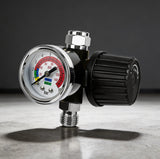 Professional Air Pressure Regulator with Gauge
$22.99Regulators to pair with the separator.
Professional Air Pressure Regulator with Gauge
$22.99Regulators to pair with the separator.


Sizing: line diameter, not model number
Match the port size to your air line. A 1/4" NPT unit in a 3/8" line creates a restriction that shows up as pressure drop under load — the tool runs fine until it needs sustained flow, then falls off.
- 1/4" NPT — single tool, home garage, most impact wrenches and blow guns. The AI303 and ZN312 both sit here.
- 3/8" NPT — plumbed shop lines, sustained-demand tools such as sanders and blast cabinets. The 3/8" ZN312E-3 desiccant dryer is the high-flow option.
Size to the tool with the highest sustained CFM demand, not the average. Continuous-draw tools such as sanders and sandblasters set the requirement; an impact wrench used in short bursts does not.
More separators
 1/4 in. NPT Air Compressor Water Separator
$17.99Compact separator option.
1/4 in. NPT Air Compressor Water Separator
$17.99Compact separator option.

Reading the spec sheets honestly
A few things worth knowing before you compare model numbers in this category, because the published figures are not always self-consistent.
The same model number appears in two port sizes. ZN312E-3 is sold as both a 1/4" and a 3/8" desiccant dryer. They are not the same physical unit. Check the port size in the listing rather than trusting the model number.
The 22 CFM figure is carried across both. A manufacturer flow rating is measured at a stated pressure with the housing wide open, and the same number gets applied to both port sizes. In practice 1/4" NPT is the restriction long before 22 CFM. Treat the CFM number as an upper bound for the media, not a promise for your line.
Desiccant colour direction varies. Some indicating beads run blue when dry and pink when saturated; others run orange when active and clear when spent. Product listings in this category are inconsistent about which. Check the chart supplied with your specific unit rather than assuming pink means spent.
Separator ratings differ. The AI303 and ZN312 are 1-micron units. The AI303-R1 filter-regulator combo uses a 5-micron element and is rated to 140 PSI rather than 150. It trades a little filtration for built-in regulation and a gauge, which is a reasonable trade for general tool use and the wrong one if you are chasing paint-grade air.
Maintenance
Drain the separator bowl at the end of every session, and during long sessions in humid weather. A bowl that fills to the baffle starts passing water straight through, which means you are running unfiltered without knowing it.
The 1-micron elements in these separators are reusable. Rinse in warm soapy water, dry completely, and reinstall. Replace when the element is physically damaged or when airflow drops noticeably with a clean, drained bowl.
Desiccant life depends almost entirely on whether there is a separator upstream. With one, expect months. Without one, expect weeks in humid conditions, because the beads are doing a job they were not designed for.
Air tools
 LE LEMATEC 1/2 in. 1,000 ft-lb Impact Wrench
$94.99Tools that benefit from dry air.
LE LEMATEC 1/2 in. 1,000 ft-lb Impact Wrench
$94.99Tools that benefit from dry air.
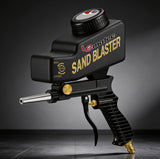 Professional Sandblaster Kit
$49.45Tools that benefit from dry air.
Professional Sandblaster Kit
$49.45Tools that benefit from dry air.

Frequently Asked Questions
Do I need a separator filter even with an oil-free compressor?
Yes. Oil-free refers to the pump not using oil for lubrication. It says nothing about water. Every compressor concentrates atmospheric moisture as it compresses air, and an oil-free pump still delivers wet air. It also does not stop rust particles from an ageing tank travelling down the line.
Where exactly should the filter be mounted?
At or near the point of use, not on the compressor outlet. Air leaving the pump is hot and its moisture is still vapour, so a filter mounted there passes vapour that condenses further down the hose. Give the air distance to cool first.
What is the difference between a water separator and a desiccant dryer?
A separator removes liquid water and oil droplets mechanically, by spinning them out and catching them in a filter element. A desiccant dryer removes water vapour chemically, by absorbing it into bead media. They address different phases of the same problem, which is why serious spray setups run both in sequence.
How do I know if my filter element needs replacing?
Airflow drop with a clean, empty bowl is the signal. Since the 1-micron elements are reusable, try rinsing and fully drying it first. Visible damage to the element is the point at which you replace rather than clean.
Can a separator filter prevent tank rust?
No, and this is a common misunderstanding. An inline separator sits downstream of the tank, so it protects tools and hoses but does nothing for the tank itself. Tank rust is controlled by draining the tank regularly through its bottom drain valve, which is a separate habit.
Can I install multiple filters in series?
Yes, and that is the intended setup for paint-grade air. Separator first for bulk liquid, desiccant second for vapour. The order matters, because putting the desiccant first saturates it on water the separator should have caught.
Which do I buy first if I can only buy one?
The separator. It is the stage that protects your tools from rust and lubrication washout, and it is the prerequisite that makes a desiccant dryer economical later.
Shop Related Parts & Accessories
- AI303 inline separator, 1 micron, 1/4" NPT, manual drain
- ZN312 inline separator, 1 micron, 1/4" NPT, auto drain
- ZN312E-3 desiccant dryer, 1/4" NPT
- ZN312E-3 desiccant dryer, 3/8" NPT high flow
- AI303-R1 filter and regulator combo with gauge
- 15-piece quick-connect NPT fitting kit