
P0131 on a Cadillac is GM's "O2 Sensor Circuit Low Voltage, Bank 1 Sensor 1" — the oxygen sensor ahead of the catalytic converter, the one the engine uses to control fuel, is reporting a signal stuck at the bottom of its range. GM's own tables describe the test as a check for a circuit "shorted to low," so wiring belongs at the top of the list. The Cadillac twist: on the 2.0L turbo ATS, CTS and CT6 and the 3.0L twin-turbo CT6, the front sensor is a wide-range design and P0131 means something different — and GM's PIP5529B links P0131 on those 2.0T cars to loose intake manifold bolts, not a sensor at all.
Jump to a section: What P0131 means · Two kinds of front sensor · Which Cadillacs set it · The 2.0T intake bolt bulletin · Northstar and Catera · Where Bank 1 Sensor 1 is · Symptoms · Causes and how to confirm each · How it's diagnosed · Parts and cost · GM documents · What other pages get wrong · FAQ
What Does P0131 Mean on a Cadillac?
A conventional switching oxygen sensor produces a small voltage that swings between roughly a tenth of a volt (lean) and close to a volt (rich) many times a second once the engine is in closed loop. The engine control module (ECM) reads that swing and trims fuel to keep the mixture centered.
P0131 sets when the signal sits at the floor when it should be switching. GM's 2015 OBD parameter tables for the Cadillac 3.6L V6 group — the LFX in the ATS, CTS, SRX and XTS and the LF3 twin-turbo in the CTS and XTS — define it this way:
- Signal below 40 millivolts.
- Only in closed loop, with the commanded mixture close to stoichiometric (an equivalence ratio of roughly 0.98 to 1.10) and a moderate load — so a deceleration fuel cut or a genuinely lean engine does not trip it.
- No throttle, MAP, EVAP, injector or ethanol-sensor faults active, and no intrusive tests running.
- 320 failures out of 400 samples, sampled every 100 ms.
- Type B — normally two consecutive failing trips before the check engine light.
GM's description of the purpose is one sentence: "This DTC determines if the O2 sensor circuit is shorted to low." That is a wiring statement first and a sensor statement second.
Two Kinds of Front Sensor on Cadillacs
This is where most generic pages go wrong on a Cadillac. GM's 2019 tables (group 03B) contain three different P0131 rows for Cadillac engines:
- Switching sensor (common table): signal below 40 mV, 285 failures out of 350 samples, Type B. This is the version for the 3.6L V6s in that group — LGX, LF3, LFX — and the other engines without their own row.
- Wide-range (WRAF) sensor, 2.0L turbo LTG (ATS, CTS, CT6): GM describes P0131 as a short to ground on the pump current, reference cell or reference ground circuit, reported by the sensor's interface chip (GM names a Delphi ASIC on controller E80).
- Wide-range sensor, 3.0L twin-turbo LGW (CT6): the same idea, with GM naming a Continental ASIC on controller E81 and a fault indication when one of those pins reads below 150 mV.
On the WRAF versions GM adds that a ground short on the pump current or reference circuit "may also set a P223C DTC," and the test only runs once the heater warm-up is complete and heater codes P0030, P0031, P0032 and P0135 are not active. GM's 2016 table for the group covering the 2.0T ATS already uses the WRAF version.
The practical point: a switching sensor and a wide-range sensor are not interchangeable, and the voltage you see on a generic scanner means different things on each. Order the replacement by VIN, not by description.
Tools for checking sensor voltage
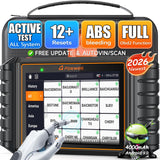 FOXWELL NT726 Bidirectional Scanner
$368.99Shows O2 sensor voltage and heater status, and runs output tests on supported vehicles.
 Compression Tester with Fuel/Vacuum Gauge
$25.65Vacuum gauge for finding an intake leak that drives the sensor lean.

Which Cadillacs Set P0131
Every gasoline Cadillac engine group we checked in GM's tables lists P0131, from the 1997 Northstar to the 2019 V6 and turbo four-cylinders:
| Engine / Cadillac models | GM table | What P0131 checks |
|---|---|---|
| 4.6L Northstar L37/LD8 — Eldorado, Seville, DeVille | 1997 | Signal below 249 mV; Type A (light on first failing trip) |
| 4.6L Northstar L37/LD8 — Eldorado, Seville, DeVille | 2000 and 2003 | Below 75 mV, or below 575 mV during power enrichment ("checking for a lean") |
| 4.6L Northstar LH2 and 4.4L LC3 | 2007 | Below 25 mV in closed loop, 160 of 200 samples, Type B |
| 4.6L Northstar L37/LD8 — DTS | 2011 | Below 50 mV, Type B |
| 3.0L L81 — Catera | 1997–1998 / 1999–2001 | Signal below −0.148 V, then a lambda-based "dynamic value" test |
| 3.6L LY7 — CTS, STS, SRX | 2004–2006 | Wide-range A/F sensor circuit shorted low |
| 3.6L LFX/LF3 — ATS, CTS, SRX, XTS | 2015 | Below 40 mV, 320 of 400 samples, Type B |
| 2.0L turbo LTG — ATS, CTS, CT6 | 2016, 2019 | WRAF circuit short to ground |
| 3.0L twin-turbo LGW — CT6 | 2019 | WRAF circuit short to ground |
On four-cylinder Cadillacs there is only one bank, so P0131 is simply "the front sensor." On V6 and V8 Cadillacs, P0131 is the bank 1 front sensor; bank 2's equivalent is P0151. The Lyriq and Optiq are electric and never set it.
The 2.0T Intake Bolt Bulletin (PIP5529B)
GM's Preliminary Information PIP5529B (September 2019, third version of a PI first issued in October 2017) covers the 2013–2017 ATS (LTG 2.0T and LCV 2.5L), 2014–2017 CTS (LTG) and 2016–2017 CT6 (LTG), along with several Buick and Chevrolet models.
GM's condition: in rare cases the check engine light is on, the car hesitates or may stall, and technicians find any combination of P0068, P0101, P0106, P0131, P0137, P0171, P0324, P0326, P0331 and P0506. GM's cause: if service information does not lead to a fix, inspect the intake manifold bolts for being loose.
The correction: if the bolts were loose, remove them one at a time, add medium-strength threadlocker, and torque them in sequence to the specification in service information. GM specifically says not to replace the intake manifold gasket unless testing shows it is still leaking after the bolts are torqued.
Unmetered air past the manifold leans the mixture, and the front sensor reports it — P0131 as a symptom, not the fault.
Northstar and Catera: Different Rules
If you own an older Cadillac, GM's own definition of P0131 changed several times:
- 1997 Northstar (Eldorado, Seville, DeVille): the threshold was 249 mV — much higher than today's 40 mV — and the code was Type A, meaning the light could come on after a single failing trip.
- 2000–2003 Northstar: GM added a second condition: below 575 mV during power enrichment. Under hard acceleration the engine is commanded rich, so a sensor reading lean then means a real lean condition or a fault.
- 2003 DeVille and Seville: GM issued bulletin 030604039 (August 2003), titled "Revised Diagnostic Trouble Code (DTC) P0131 and P0151." We could only see its NHTSA summary, not the document, so we cannot say what changed.
- Catera (1997–2001, Opel-built 3.0L L81): a Bosch-style system. In 1997–1998 GM's tables set P0131 when the signal drops below −0.148 V — a negative voltage, which points squarely at wiring or a ground fault. From 1999 the test became a lambda-based "standardized dynamic value" check while the engine runs between 1,400 and 2,400 rpm at moderate load.
The 1999 Catera was also covered by GM special policy 04015 (2004) for engine control oxygen sensors, after customer reports of a check engine light, rough running and oxygen sensor codes. We saw only the NHTSA summary. That policy is two decades old and its term has passed for practical purposes; a dealer VIN check is still free.
Where Bank 1 Sensor 1 Is on a Cadillac
Sensor 1 is upstream — between the engine and the catalytic converter. On the 2.0T ATS, CTS and CT6 and the XT4, it sits in the exhaust just after the turbocharger.
On the 3.6L V6, bank 1 is the bank with cylinder 1. In the longitudinal (rear-drive-based) ATS, CTS, STS and CT6 that is the right, passenger-side bank. In transverse installations — SRX (2010–2016), XTS, XT5 and XT6 — it is the rear bank toward the firewall. On the Northstar V8, confirm bank location in the service information for your VIN; we have not verified it from a GM document for this article.
Symptoms of P0131
- Check engine light on
- Hesitation or stalling in some cases (PIP5529B on the 2.0T)
- Rough idle or poorer fuel economy — the front sensor controls fueling
- Companion codes on the same bank: P0132, P0133, P0171, or on the 2.0T P0068, P0101 or P0106
- On wide-range engines, a P223C alongside P0131
Causes and How to Confirm Each
| Cause | How to confirm it | Notes |
|---|---|---|
| Signal circuit shorted to ground | Unplug the sensor; check the signal circuit for continuity to ground | GM's own definition of the test |
| Loose intake manifold bolts (2.0T, 2.5L) | Check bolt torque after normal diagnosis comes up empty | PIP5529B — threadlocker and re-torque, no gasket unless it still leaks |
| Chafed or heat-damaged harness | Trace the run along the exhaust and turbo; look for melted loom | Common wherever wiring passes hot parts |
| Connector damage or corrosion | Inspect pins and seals; wiggle test while watching live data | WRAF sensors use more circuits, so more pins to check |
| Exhaust leak ahead of the sensor | Smoke or pressure test the exhaust; soap-test joints | Outside air drives a switching sensor low |
| Failed front sensor | Only after the circuit tests good; signal will not respond to added fuel | Order the correct type by VIN |
| Software or calibration | Ask a dealer to check for updates on your VIN | GM revised P0131 on the 2003 DeVille and Seville |
Upstream O2 sensors
 ACDelco Pre-Cat O2 Sensor 12701634
$92.99ACDelco pre-catalyst O2 sensor 12701634. Confirm fitment by VIN before ordering.
 Delphi ES20008 O2 Sensor (2006–2017)
$115.99Delphi O2 sensor for 2006–2017 Chevy, GMC and Cadillac. Confirm fitment by VIN before ordering.
 GM Genuine 12657188 Heated O2 Sensor
$46.47GM Genuine heated O2 sensor 12657188. Confirm fitment by VIN before ordering.


How Is P0131 Diagnosed on a Cadillac?
- Record every code and the freeze frame. P0131 with P0171 and P0106 on a 2.0T points toward air leaks; P0131 with P223C points toward the WRAF circuit.
- Identify the sensor type. Use your engine RPO: the 2.0T LTG and 3.0TT LGW use wide-range front sensors; the 3.6L LFX, LF3 and LGX in GM's 2015 and 2019 tables use the 40 mV switching test.
- Fix heater codes first. GM's WRAF test will not run while P0030, P0031, P0032 or P0135 is active.
- Watch live data. A switching sensor should flick rapidly in closed loop; one pinned near zero is the P0131 picture. On a WRAF sensor, read equivalence ratio or current rather than expecting a 0–1 V swing.
- Test the response. Briefly add fuel (or use a scan tool fuel control test). A good switching sensor goes rich; a shorted circuit does not move.
- Unplug and test the circuits for a short to ground and for continuity back to the ECM.
- Check for intake and exhaust leaks, including the intake manifold bolts on a 2.0T or 2.5L under PIP5529B.
- Replace the sensor only once wiring and leaks are ruled out — with the correct type for your VIN.
- Clear the codes and drive two trips to confirm it stays off.
Parts and Cost
| Repair | What it involves | Cost picture |
|---|---|---|
| Intake bolt re-torque (2.0T/2.5L) | Threadlocker and torque per PIP5529B | Small — GM allows 0.4 hours |
| Harness or connector repair | Repair and re-secure damaged circuits | Often cheaper than a sensor |
| Switching front sensor | When the circuit tests good and the sensor will not respond | Moderate |
| Wide-range front sensor | 2.0T, 3.0TT and other WRAF engines | Usually more than a switching sensor |
| Exhaust leak repair | Gasket, flange or manifold ahead of the sensor | Modest to large, depending on location |
| Repeat sensors with no root cause | Replacing parts without finding the short or leak | The expensive loop to avoid |
Leak and wiring parts
 Exhaust Manifold Gasket Set, 2010–2017 3.0L/3.6L
$10.99Exhaust manifold gasket set for 2010–2017 3.0L/3.6L V6s. Confirm fitment by VIN before ordering.
 ACDelco 2-Pin Replacement Connector PT3739
$90.99Two-pin replacement connector for a damaged harness connector. Confirm fitment by VIN before ordering.
 Nomex Split Loom, 1 in. x 10 ft
$105.66Heat-resistant split loom to protect sensor wiring near the exhaust.


GM Documents Relevant to P0131 on a Cadillac
| Document | Subject | Status |
|---|---|---|
| PIP5529B (Sep 2019) | Stall/hesitation with P0068, P0101, P0106, P0131, P0137, P0171, P0324, P0326, P0331, P0506 — loose intake manifold bolts | 2013–2017 ATS (LTG, LCV), 2014–2017 CTS (LTG), 2016–2017 CT6 (LTG) — verified |
| 030604039 (Aug 2003) | Revised DTC P0131 and P0151 | 2003 DeVille, Seville — corroborated (NHTSA summary only) |
| Special policy 04015 (2004) | Engine control oxygen sensors — replace; MIL, rough running, O2 sensor codes | 1999 Catera — corroborated (NHTSA summary only); term has passed |
| GM 2019 OBD parameter tables, group 03B | P0131: 40 mV switching test (common) and WRAF short-to-ground versions for LTG and LGW | ATS, CTS, CT6, XT5, XTS engines — verified |
| GM 2015 OBD parameter tables, group 06 | P0131: below 40 mV in closed loop, 320 of 400 samples, Type B | 3.6L LFX/LF3 — ATS, CTS, SRX, XTS — verified |
| GM 2007 OBD parameter tables, LH2/LC3 | P0131: below 25 mV in closed loop, Type B | Northstar LH2 and 4.4L LC3 — verified |
| GM 1997 Catera 3.0L L81 parameters | P0131: sensor signal below −0.148 V | 1997 Catera — verified |
Have a dealer check your VIN against current bulletins rather than relying on any article, including this one.
What Other P0131 Pages Get Wrong
- "Replace the O2 sensor." GM defines the test as a circuit shorted low, and its only recent Cadillac bulletin naming P0131 is an intake bolt fix.
- Calling it a lean-engine code. GM runs the modern test only in closed loop near the correct mixture; a genuinely lean Cadillac sets P0171.
- Assuming a 0–1 V sensor. The 2.0T and 3.0TT use wide-range front sensors, and so did the 2004–2006 LY7 V6.
- Quoting one threshold for every year. GM's P0131 limit has ranged from 249 mV on the 1997 Northstar to 25 mV in 2007 and 40 mV in 2015–2019.
Frequently Asked Questions
Can I drive my Cadillac with P0131?
Usually for a short time, but this is the fuel-control sensor. Expect poorer economy and possibly hesitation, and on a 2.0T with stalling, have it checked promptly.
Is P0131 the upstream or downstream sensor?
Upstream — Bank 1 Sensor 1, before the catalytic converter. The downstream low-voltage code is P0137.
Why does my ATS or CTS 2.0T have P0131 and P0171 together?
GM's PIP5529B lists that combination on 2013–2017 ATS, 2014–2017 CTS and 2016–2017 CT6 2.0T cars and points to loose intake manifold bolts once normal diagnosis is done.
Does my Cadillac have a wide-range front sensor?
GM's 2019 tables give the 2.0L turbo LTG and 3.0L twin-turbo LGW wide-range P0131 tests, and the 3.6L V6 engines in that table the 40 mV switching test. Confirm by VIN — the parts are not interchangeable.
Can an exhaust leak cause P0131?
Yes, on a switching sensor. A leak ahead of the sensor pulls in outside air and drives the reading low. GM's bulletin 20-NA-065 recommends smoke or soapy-water testing for small leaks around O2 sensor bosses.
What is the bank 2 version?
P0151 on V6 and V8 Cadillacs. If both banks set at once, look for something shared — a fuse, a ground, an intake leak or the ECM — before replacing two sensors.
Is there a related heater code?
Yes. The same sensor's heater faults set P0030 or P0135. Fix heater codes first: GM's wide-range P0131 test will not run while they are active.
Shop Related Parts & Tools
Test the circuit and check for intake and exhaust leaks before you buy a sensor — GM defines P0131 as a circuit shorted low. If a sensor is needed, order it by VIN and position, because Cadillac engines use both switching and wide-range front sensors.
-
 FOXWELL NT301 OBD2 Scanner — reads P0131 with live front O2 data, so you can see whether a switching sensor is pinned near zero or flicking normally.
-
 Launch CRE 2.0 GM All-System Scanner — a GM all-system scanner for GM-specific descriptions, freeze-frame data and WRAF sensor parameters on newer Cadillacs.
-
 ACDelco Oxygen Sensor 12659516 (Cadillac, Chevy, GMC) — an ACDelco 4-wire, 0–1 V heated oxygen sensor listed for Cadillac; it is a switching sensor, so confirm position and fitment against your VIN before ordering.
-
 95-Piece Mechanics Tool Set (Metric & SAE) — for heat shields, harness clips and connector access along the exhaust.
Related Guides
- P0134 Code on a Cadillac: O2 Sensor No Activity, Bank 1 Sensor 1 — the open-circuit code
- P0171 Code on a Cadillac: System Too Lean, Bank 1 — also on PIP5529B
- P0137 Code on a Cadillac: O2 Sensor Low Voltage, Bank 1 Sensor 2 — the rear sensor
- P0131 Code on a Buick: O2 Sensor Low Voltage, Bank 1 Sensor 1 — the Enclave harness bulletins
- MAF, MAP or O2 Sensor: Which One to Replace