
P0135 is "O2 Sensor Heater Circuit, Bank 1 Sensor 1." Every oxygen sensor contains a small electric heater whose job is to bring it up to working temperature fast, so the engine can stop guessing at the fuel mixture and start measuring it. P0135 is a fault in that heater circuit, not in the sensor's ability to read oxygen — and the single most common expensive mistake on this code is buying a sensor when the actual fault is a blown fuse costing a couple of dollars.
Jump to a section: What P0135 means · Check the fuse first · Why the heater exists at all · Upstream is the fuel control sensor · A note on sourcing · Companion codes · Symptoms · Causes and how to confirm each · How it's diagnosed · Parts and cost · What other pages get wrong · FAQ
What Does P0135 Mean?
An oxygen sensor only works hot. Below its operating temperature it produces no useful signal, so the engine cannot use it to control the fuel mixture.
Waiting for exhaust heat alone would take minutes — minutes during which the engine runs on a pre-programmed guess and emissions are at their worst. So every modern sensor carries an electric heating element inside it, energised at startup to bring it up to temperature in seconds rather than minutes.
At every start, the module tests that heater circuit. It checks whether the circuit is open, shorted, or drawing a current that does not match what it expects for the coolant temperature. If the answer is wrong, it sets P0135 for the Bank 1 Sensor 1 position — the sensor upstream of the catalytic converter, on the bank containing cylinder one.
Note carefully what that does and does not say. It is a statement about a heating element and the wiring that feeds it. It says nothing about whether the sensor can accurately read oxygen. That distinction is why the fault is so often electrical rather than a dead sensor — and why the cheapest checks come first.
Check the Fuse Before You Buy Anything
This is the most valuable paragraph on the page, and it takes five minutes.
The oxygen sensor heaters are fed through fuses, and on GM trucks and SUVs those fuses are commonly labelled O2A and O2B in the underhood fuse block, typically 15 amp. A blown heater fuse produces exactly this code with a perfectly healthy sensor.
Documented cases follow a painful pattern: the owner replaces the oxygen sensor, the code returns immediately, and the actual fault turns out to be a blown fuse. That is a sensor bought, a job done, and the problem still present.
The diagnostic tell that makes this easy:
| What you see | What it means |
|---|---|
| P0135 alone | One circuit. Could be the sensor, its wiring, or its connector |
| P0135 and P0155 together (Bank 1 and Bank 2 upstream) | Look at the shared fuse. Two sensors on opposite banks failing simultaneously is far less likely than one supply feeding both going down |
| Three or more heater codes | Almost certainly a fuse, relay or supply problem rather than multiple dead sensors |
The principle generalises: when several sensors on separate circuits fail at once, suspect what they have in common. The same reasoning appears on our P0325 guide, where two knock sensor codes together point at a shared environment rather than two coincidental failures.
Check the fuse. If it is blown, note that something blew it — a shorted heater or a chafed wire will blow the replacement too, so if the new fuse goes immediately you have found the next thing to look for.
Tools for testing the heater circuit
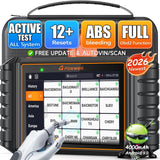 FOXWELL NT726 Bidirectional Scanner
$368.99Shows O2 heater status and runs output tests on supported vehicles.
FOXWELL NT726 Bidirectional Scanner
$368.99Shows O2 heater status and runs output tests on supported vehicles.
 Launch CRE 2.0 GM All-System Scanner
$159.00GM all-system scanner with O2 sensor live data.
Launch CRE 2.0 GM All-System Scanner
$159.00GM all-system scanner with O2 sensor live data.
 ACDelco 2-Pin Replacement Connector PT3739
$90.99Two-pin replacement connector for repairing a damaged harness connector. Confirm fitment by VIN before ordering.
ACDelco 2-Pin Replacement Connector PT3739
$90.99Two-pin replacement connector for repairing a damaged harness connector. Confirm fitment by VIN before ordering.


Why the Heater Exists — and What Its Failure Actually Costs You
Understanding this explains why the code often comes with no symptoms and still matters.
The engine runs in two modes. In open loop, immediately after a cold start, it has no usable oxygen sensor data and runs on a programmed table — deliberately rich, to guarantee it will run. In closed loop, once the sensor is hot and reporting, the module measures actual exhaust oxygen and trims the mixture continuously.
The heater's whole job is to shorten the gap between those two states.
So when the heater fails, the sensor still works eventually — heated by exhaust gas alone. The engine simply stays in open loop far longer after each cold start. The consequences are real but undramatic:
- Worse fuel economy, because you are running the rich warm-up table for longer on every trip.
- Higher cold-start emissions — which is precisely why this is a monitored, MIL-illuminating fault.
- A failed emissions test, both for the stored code and potentially for incomplete readiness monitors.
- Extra fuel washing the cylinder walls over a long period, and extra unburnt fuel reaching the converter.
That last point is the one worth taking seriously. Prolonged rich running is one of the documented ways catalytic converters die early — see our P0420 guide for why that becomes an expensive problem. A cheap code left alone for a year can turn into a costly one.
Sensor 1 Is the Fuel Control Sensor
The position matters, and it is what separates this code from its downstream sibling.
Bank 1 Sensor 1 sits before the catalytic converter. It is the sensor the module uses to control the fuel mixture — the one whose readings drive fuel trim in real time. On many newer GM engines this position is not a conventional oxygen sensor at all but a wideband air/fuel ratio sensor, which reports across a range rather than simply switching rich or lean.
Two practical consequences:
- Part matching matters more here. Wideband A/F sensors and conventional oxygen sensors are not interchangeable, and the correct part can vary by build date within the same model year. Order against your VIN, not against a description.
- An upstream fault has fuel-trim consequences that a downstream fault does not. If you also have lean or rich codes, the two are related — see our P0171 guide.
The downstream sensor in the same bank has a different job entirely, and its heater fault sets a different code. Our P0141 guide covers that one, including why it matters for emissions testing in a way P0135 does not.
A Note on Sourcing for This Code
We cite GM's own documents where we have them and say so where we do not.
We could not verify a GM service bulletin naming P0135 on a specific GM platform. The guidance on this page — the O2A/O2B fuse check, the multiple-codes-means-shared-supply pattern, connector corrosion in salt regions, and the wideband part-matching caution — is well-corroborated field consensus rather than a document we opened and read.
GM is reported to have issued bulletins involving a PCM software update that adjusts heater circuit monitoring parameters. We could not confirm that directly, so treat it as a question worth asking a dealer rather than an established fact: if your sensor and circuit test good and the code persists, ask whether a calibration update applies to your VIN.
Reported failure-rate data across scan-tool users puts the Chevrolet Cobalt, Silverado 1500 and Impala among the most affected GM vehicles, with the Sierra leading for GMC. That is aggregated app data rather than a manufacturer statement — useful for context, not for diagnosis.
Companion Codes
| Code | What it adds |
|---|---|
| P0155 — heater circuit, Bank 2 Sensor 1 | The fuse signal. Both upstream heaters down together points at shared power, not two sensors |
| P0141 — heater circuit, Bank 1 Sensor 2 | The downstream sensor on the same bank. Two heater codes on one bank also suggests a shared supply |
| P0031 / P0032 — heater control circuit low / high | More specific versions of the same circuit fault, naming the direction |
| P0053 — heater resistance | Points at the element itself rather than the wiring |
| P0171 / P0172 | Fuel trim codes. Related, since this is the fuel control sensor position |
| P0420 | Prolonged rich running from extended open loop is one route to converter damage |
Symptoms of P0135
- Check engine light — very often the only symptom
- The light frequently appearing after a cold start, since that is when the heater is tested
- Reduced fuel economy
- Longer than normal warm-up before the engine settles
- Failed emissions test, or incomplete readiness monitors
- Rough idle or hesitation when cold in some cases
- Rarely, no driveability change whatsoever
On urgency: this will not strand you and it is not an emergency. But it is not a code to ignore for a year either — you are burning extra fuel on every cold start and sending extra unburnt fuel through a converter that costs many times what the repair does. Deal with it within a reasonable window, and sooner if you have a test due.
Causes and How to Confirm Each
| Cause | How to confirm it | Notes |
|---|---|---|
| Blown heater fuse | Check the O2 heater fuses in the underhood block — commonly labelled O2A and O2B on GM trucks | Free to check, cheapest possible fix. Do this first, always |
| Failed heater element inside the sensor | Measure heater resistance across the heater terminals. Values are typically low — often in the region of 1 to 10 ohms — but check the figure for your engine. An open circuit is conclusive | The most common genuine sensor failure |
| Corroded sensor connector | Unplug and inspect for green deposits, moisture and spread terminals | Common in salt regions. Clean or replace rather than condemning the sensor |
| Chafed, melted or broken harness | Trace the wiring, particularly where it runs near hot exhaust components | Exhaust-area wiring lives a hard life |
| Relay or shared supply fault | Suspect strongly when several heater codes appear together | Check power and ground at the sensor connector |
| Poor ground | Circuit testing where power is present but the heater will not draw | Grounds scatter codes across unrelated systems |
| Wrong replacement sensor | Verify the part against the VIN, especially where a wideband A/F sensor is fitted | Reported as a genuine cause of the code returning after a repair |
| Missing PCM calibration | Ask the dealer to check against your VIN | Reported, not verified. A fair question when everything else tests good |
| ECM fault | Last, after circuit, sensor, fuse and grounds are proven | Rare relative to everything above |
Upstream O2 sensors
 ACDelco Pre-Cat O2 Sensor 12701634
$92.99ACDelco pre-catalyst O2 sensor 12701634. Confirm fitment by VIN before ordering.
ACDelco Pre-Cat O2 Sensor 12701634
$92.99ACDelco pre-catalyst O2 sensor 12701634. Confirm fitment by VIN before ordering.
 GM Genuine 12587785 O2 Sensor (2003–2005 trucks)
$56.31GM Genuine O2 sensor for 2003–2005 Silverado, Tahoe and Yukon. Confirm fitment by VIN before ordering.
GM Genuine 12587785 O2 Sensor (2003–2005 trucks)
$56.31GM Genuine O2 sensor for 2003–2005 Silverado, Tahoe and Yukon. Confirm fitment by VIN before ordering.
 GM Genuine 19178961 O2 Sensor (1999–2002 trucks)
$72.30GM Genuine O2 sensor for 1999–2002 GM trucks. Confirm fitment by VIN before ordering.
GM Genuine 19178961 O2 Sensor (1999–2002 trucks)
$72.30GM Genuine O2 sensor for 1999–2002 GM trucks. Confirm fitment by VIN before ordering.


How Is P0135 Diagnosed?
- Check the oxygen sensor heater fuses. Free, five minutes, and a documented cause of wasted sensor purchases.
- Record every stored code. P0155 or P0141 alongside points at a shared supply rather than a failed sensor.
- Inspect the sensor connector for corrosion, moisture and damaged terminals.
- Inspect the harness where it passes near exhaust components for melting and chafing.
- Measure heater element resistance against the specification for your engine. Open circuit means a failed element.
- Check for power and ground at the sensor's heater terminals with the circuit commanded on.
- If a fuse was blown, find out why before assuming the job is finished. A fresh fuse that blows immediately means a short.
- Confirm the correct part against your VIN before ordering, particularly on engines using a wideband air/fuel sensor.
- Clear the code and complete several cold-start cycles, since the heater test runs at startup and one warm restart proves nothing.
Parts and Cost
| Repair | What it involves | Cost picture |
|---|---|---|
| Fuse | Replace the blown heater fuse and establish why it blew | A couple of dollars. The reason to check first |
| Connector clean or repair | Where corrosion is the fault | Minimal |
| Harness repair | Where chafing or melting is found | Modest; varies with access |
| Oxygen sensor (conventional) | Sensor plus access. Seized sensors in old exhaust can complicate removal | Moderate |
| Wideband air/fuel ratio sensor | The upstream position on many newer GM engines | Typically more than a conventional sensor. Match to VIN |
| PCM calibration | Where an update applies | Dealer operation; no parts |
| Sensor bought unnecessarily | What happens when the fuse is not checked first | The outcome this page exists to prevent |
A removal note: oxygen sensors seize into exhaust threads over years of heat cycling. Penetrating fluid, a proper sensor socket and a warm exhaust make the difference between a straightforward job and a damaged bung.
For the replacement
 Nomex Split Loom, 1 in. x 10 ft
$105.66Heat-resistant split loom to protect sensor wiring near the exhaust.
Nomex Split Loom, 1 in. x 10 ft
$105.66Heat-resistant split loom to protect sensor wiring near the exhaust.
 ACDelco Gold 19473526 O2 Sensor
$32.23ACDelco Gold O2 sensor 19473526. Confirm fitment by VIN before ordering.
ACDelco Gold 19473526 O2 Sensor
$32.23ACDelco Gold O2 sensor 19473526. Confirm fitment by VIN before ordering.
 FOXWELL NT301 Code Reader
$68.82Budget code reader with live data.
FOXWELL NT301 Code Reader
$68.82Budget code reader with live data.


What Other P0135 Pages Get Wrong
- Leading with the sensor. The single most documented waste on this code is replacing an oxygen sensor when the fault was a blown fuse. The fuse check costs nothing and takes five minutes.
- Ignoring the multiple-code pattern. P0135 with P0155 means two upstream heaters on opposite banks failed at once — far more likely a shared fuse or supply than two coincidental sensor failures.
- Confusing the heater with the sensor. This code is about a heating element and its circuit. It says nothing about the sensor's ability to measure oxygen, which is why the fault is so often purely electrical.
- Saying it does not matter because the car drives fine. The engine stays in open loop longer on every cold start, burning extra fuel and sending unburnt fuel to the converter. A cheap code left for a year can become an expensive one.
- Not warning about part matching. Many newer GM engines use a wideband air/fuel sensor upstream, which is not interchangeable with a conventional oxygen sensor. The wrong part brings the code straight back.
- Fitting a fuse and walking away. Something blew it. If the replacement goes immediately, there is a short to find.
- Testing on one warm restart. The heater diagnostic runs at startup. Verify across several genuine cold starts before concluding the repair worked.
Frequently Asked Questions
Do I definitely need a new oxygen sensor?
Not necessarily. Check the oxygen sensor heater fuses first — on GM trucks they are commonly labelled O2A and O2B in the underhood block. A blown fuse produces this exact code with a perfectly good sensor, and replacing the sensor without checking is a well-documented way to spend money and still have the fault.
What if I have P0135 and P0155 together?
That is a strong signal to look at the shared power supply. Those are the upstream heater circuits on opposite banks, and two sensors failing simultaneously is much less likely than one fuse or supply feeding both going down. Check the fuse before ordering two sensors.
Can I drive with P0135?
Yes in the short term — it will not strand you and many people notice nothing but the light. The costs are cumulative rather than immediate: worse fuel economy on every cold start, higher emissions, a failed emissions test, and extra unburnt fuel reaching the catalytic converter over time.
Why does the light come on after a cold start?
Because that is when the module tests the heater circuit. The heater exists to bring the sensor up to temperature quickly at startup, so startup is when the diagnostic runs. This is also why a single warm restart proves nothing after a repair.
What is the difference between P0135 and P0141?
Position. P0135 is the upstream sensor, before the catalytic converter, which the module uses to control the fuel mixture. P0141 is the downstream sensor on the same bank, after the converter, which is used to judge how well the converter is working. Same kind of fault, different sensor and different consequences.
How do I test the heater?
Measure resistance across the heater terminals at the sensor connector and compare against the specification for your engine — the values are low, often in the single-digit to low double-digit ohm range. An open circuit confirms a failed element. Also check that power and ground are actually reaching the connector.
Will an aftermarket sensor work?
Often, but part matching matters more than usual here. Many newer GM engines use a wideband air/fuel ratio sensor in the upstream position, which is a different device from a conventional oxygen sensor, and the correct part can vary by build date within a model year. Order against your VIN.
The code came back after I replaced the sensor. What now?
Check the fuse, confirm the part was correct for your VIN, and inspect the connector and harness. Those three account for most repeat cases. If everything tests good, ask a dealer whether a PCM calibration update applies to your vehicle.
Shop Related Parts & Tools
Check the fuse before buying anything. If a sensor is genuinely needed, match it to your VIN — the upstream position uses a wideband air/fuel sensor on many newer engines.
-
 MOTOPOWER MP69033 OBD2 Scanner — shows whether P0155 or P0141 are stored alongside, which is the signal to check the shared fuse instead of buying a sensor.
-
 95-Piece Mechanics Tool Set (Metric & SAE) — for fuse block and sensor access. Sensors seize into exhaust threads, so a proper sensor socket and patience matter on removal.
-
 ACDelco dexos1 Gen 3 Full Synthetic 5W-30 (1 qt) — extended open-loop running washes extra fuel past the rings, so keeping oil fresh matters more while this fault is present.
Related Guides
- P0141 Code: O2 Sensor Heater Circuit, Bank 1 Sensor 2 — the downstream sensor, and why it blocks emissions testing
- P0420 Code: Catalyst System Efficiency Below Threshold
- P0171 Code: System Too Lean, Bank 1
- GM Check Engine Light Codes: Most Common & What They Mean