
P0325 is "Knock Sensor 1 Circuit, Bank 1." The knock sensor is a microphone bolted to the engine that listens for detonation, so the module can retard timing before damage occurs. When the circuit fails, the module loses that protection and pulls timing as a precaution — which is why you feel it as lost power. On GM's V8 engines this code has a specific character, because on many of them the sensors live in the lifter valley underneath the intake manifold. But the reason they fail there is not the same on every engine generation, and getting that distinction right changes the repair.
Jump to a section: What P0325 means · The valley problem on GM V8s · Two different failures: water vs chafing · Why the code comes back after new sensors · Torque: the detail that ruins the repair · A note on sourcing for this code · Companion codes · Symptoms · Causes and how to confirm each · How it's diagnosed · Parts and cost · GM documents · What other pages get wrong · FAQ
What Does P0325 Mean?
A knock sensor is a piezoelectric device — it generates a small AC voltage when the engine block vibrates at the frequencies characteristic of detonation. The module listens to that signal and, when it hears knock, retards ignition timing to protect the engine.
P0325 sets when the module cannot get a usable signal from the Bank 1 sensor circuit: an open, a short, a signal outside the expected range, or no signal at all. Bank 1 is the side containing cylinder number one.
The important consequence is what happens next. Without a trustworthy knock signal the module cannot detect detonation, so it takes the safe option and retards timing across the board. That is a deliberate protective default, and it is why the truck feels flat, pulls poorly under load, and returns worse fuel economy. The engine is not broken — it is being run conservatively because its safety net is missing.
It also means the code should not be ignored indefinitely. A genuine knock condition arising while the sensor circuit is faulty would go uncorrected, and sustained detonation damages pistons and rings. The related risk is unburnt fuel reaching the exhaust and, over time, the catalytic converter — see our P0420 guide for why that matters financially.
The Valley Problem on GM V8s
This is the GM-specific heart of the code.
On many GM V8s — the 4.8L, 5.3L and 6.0L across Silverado, Sierra, Tahoe, Suburban, Yukon and Escalade — the knock sensors are mounted in the lifter valley, underneath the intake manifold, rather than on the outside of the block.
Three practical consequences follow, and they are the whole reason this job goes wrong so often:
- It is a real labour job, not a sensor swap. The intake manifold has to come off. Commonly quoted at several hours rather than the twenty minutes an externally mounted sensor would take.
- You are already in there. With the manifold off, inspecting the valley cover and intake gaskets is nearly free — and on AFM-equipped engines, so is inspecting the lifters while access is open.
- The cause will recur unless the source is addressed, whichever generation you have.
A caution on location: not every GM V8 generation puts the sensors in the valley, and some later trucks mount them on the side of the block — one commonly cited position being the driver's side above the oil filter, accessible from underneath or through the wheel well. Verify the location for your specific engine and year before accepting a labour quote, because the difference between a valley job and an external sensor is hours of billed time.
Tools for testing the knock sensor circuit
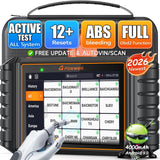 FOXWELL NT726 Bidirectional Scanner
$368.99Bidirectional scan tool for reading knock retard and every module on the truck.
FOXWELL NT726 Bidirectional Scanner
$368.99Bidirectional scan tool for reading knock retard and every module on the truck.
 FOXWELL NT614 Elite Scanner
$233.69Engine, ABS, SRS and transmission code reader with live data.
FOXWELL NT614 Elite Scanner
$233.69Engine, ABS, SRS and transmission code reader with live data.

Two Different Failures — Water on Gen III/IV, Chafing on Gen V
Most pages on this code describe one failure mode. There are really two, and they call for different fixes.
| Gen III / IV (4.8, 5.3, 6.0 — roughly 1999–2013) | Gen V (L83 5.3, L86 6.2 — 2014 onward) | |
|---|---|---|
| Mechanism | Water and coolant intrusion. The valley is a low point under a large cover; moisture collects and corrodes the sensors and connectors | Sub-harness chafing. The harness rubs against the intake valley pan and eventually shorts |
| What you find | Visible corrosion, green deposits, moisture or coolant in the valley | Worn insulation at a rub point; sensors themselves often fine |
| Preventing recurrence | Fix the leak, and build an RTV dam around the sensors to divert water — GM's own bulletin recommends the RTV step | Route the harness away from the contact point. Extended sub-harnesses are sold specifically to relocate the wiring |
Why this matters: on a Gen V truck, hunting for water you will not find can lead a diagnosis astray, and a like-for-like harness put back in the same position will chafe through again. On a Gen III/IV truck, relocating a harness without fixing the leak leaves the water still pooling. Identify which engine you have before deciding what "fixing the cause" means.
P0325 and P0330 setting together is extremely common on the Gen V engines specifically — common enough that the aftermarket built a product category around it.
Why the Code Comes Back After New Sensors
This is the single most common failure of this repair, and it is worth stating bluntly.
A frequently reported pattern: an owner replaces both knock sensors with genuine parts, reassembles everything, and the code returns within a few hundred miles. The reason is almost always the same — the original wiring harness was reused.
The sensor pigtail and sub-harness have been sitting in the same valley as the sensors, for the same number of years, exposed to the same water or rubbing on the same pan. The damage that killed the sensors is in the connectors and wiring too.
GM's response is telling: the company is reported to sell a complete knock sensor kit — commonly cited as part 12601822 — containing new sensors, the harness, and grommets together, rather than selling sensors alone. That packaging is an acknowledgement that the harness is part of the repair.
The practical rule: if the sensors live in the valley and you have gone to the trouble of removing the intake manifold, replace the harness and grommets at the same time. Doing it twice costs far more than the harness does.
One further wiring note from the field: bare or chafed wires touching each other inside the sensor connector have been found to cause this code with otherwise healthy sensors. When the connector is accessible, peel back the insulation and look before assuming the sensor is at fault.
Torque — the Detail That Ruins the Repair
A knock sensor is not a normal fastener. It works by picking up vibration transmitted through the block, so the clamping force is part of the calibration.
- Under-torqued and the sensor is not coupled properly to the block. It cannot hear what it should, and P0325 returns.
- Over-torqued and the sensor is stressed and over-coupled, producing false knock readings. The module then retards timing for detonation that is not happening, and you lose power for no reason.
There is also no anti-seize or thread sealant to be applied casually here, since anything that changes how the sensor sits changes what it hears.
An honest note on the specification: published figures for GM V8 knock sensor torque vary between sources — values around 15 lb-ft and around 18 lb-ft both appear in circulation. We are not going to pick one and present it as authoritative when they conflict. Use the figure in the service information for your specific engine, and use a torque wrench rather than feel. This is one of the few fasteners where "snug" is a genuine failure.
A Note on Sourcing for This Code
We publish specifications and part numbers from GM's own documents wherever possible, and we say so when we cannot.
There is a GM bulletin behind the water intrusion story, though it does not name P0325. GM TSB 02-06-04-023A addresses water and moisture intrusion at the rear bank knock sensor on 4.8L, 5.3L and 6.0L engines. Its procedure is the one described on this page: remove the upper intake manifold, replace the sensor, and apply RTV to divert water away from the sensor cavity. Repair kits built to it include ACDelco gasket kit 89060413.
Two qualifications, stated plainly. That bulletin is written around DTC P0332 — the rear bank circuit-low code — rather than P0325, and we are reporting it from parts and technician sources rather than from the GM PDF, which we could not open. What it does establish is that the RTV dam is GM's own recommendation, not merely a field workaround, and that GM formally recognised valley water intrusion as a failure mode on these engines.
A software cause is also reported: bulletin 19-NA-032 is cited as addressing a software anomaly capable of setting P0325 on a 2018 Malibu. Treat that as a last resort after hardware tests pass, and as corroborated rather than verified.
One specific correction while we are here. Some sources cite 16-NA-175 as a GM knock sensor diagnostic bulletin. In our own research on GM transmission bulletins, that number appears as an earlier torque converter clutch shudder bulletin superseded by the 18-NA-355 fluid procedure. We cannot reconcile those two claims, so we are not citing 16-NA-175 as a knock sensor document — and if a shop quotes it to you for this code, it is worth asking them to show you the bulletin.
If your vehicle is within its powertrain or emissions warranty, have the dealer check your VIN for applicable bulletins directly. That is free and definitive in a way that secondary sources are not.
What the Companion Codes Tell You
| Alongside P0325 | What it suggests |
|---|---|
| P0330 (knock sensor 2, Bank 2) | Both sensors affected. On a valley-mounted V8 this strongly implicates the shared environment — water, chafing, or the harness — rather than two coincidental sensor failures |
| P0327 / P0332 (circuit low) | Signal below expected range — often corrosion or a partial short. P0332 is the code named in GM's rear-bank water intrusion bulletin |
| P0328 / P0333 (circuit high) | Signal above expected range |
| P0300-series misfires | Consider whether genuine detonation or a mechanical issue is present, not just a sensor fault |
| P0420 | Long-term uncorrected knock, or unburnt fuel reaching the converter |
| Coolant loss with either knock code | Look hard at the valley cover and intake gaskets — coolant in the valley explains both |
P0325 and P0330 together is the characteristic GM V8 pattern, and it is good news of a sort: it points at one shared cause rather than two failures, and it means the single manifold removal addresses everything.
Symptoms of P0325
- Check engine light on
- Noticeably reduced power, especially under load, towing or climbing — the module has retarded timing
- Sluggish acceleration
- Reduced fuel economy
- Audible pinging or knocking under load in some cases
- Rough running or hesitation
- Sometimes no driveability symptom at all beyond the light
- Coolant loss, where the valley leak that corroded the sensors is also losing fluid
The power loss is the giveaway. If a truck has gone flat and a knock sensor code is stored, the timing strategy is the reason — not a failing engine.
What Causes P0325 — and How Do You Confirm Each One?
| Cause | How to confirm it | Notes |
|---|---|---|
| Corroded knock sensor from water in the valley | Inspect once the intake manifold is off. Corrosion is usually visible | The dominant cause on Gen III/IV valley-mounted V8s. GM TSB 02-06-04-023A covers the rear bank case |
| Sub-harness chafing on the intake valley pan | Inspect the harness where it contacts the pan for worn insulation | The dominant cause on Gen V L83 and L86 engines |
| Corroded or damaged sensor harness | Inspect the pigtail and connectors. Bare wires touching inside the connector have been found | The reason the code returns after new sensors |
| Coolant intrusion from valley cover or intake gaskets | Look for coolant in the valley and check the level. Inspect gaskets while the manifold is off | Fix this or the new parts corrode too |
| Failed sensor | Resistance testing — piezo sensors are commonly in the 90k–150k ohm region, but check the spec for your engine. A tap test near the sensor should produce a small AC voltage output | Test rather than assume |
| Incorrect installation torque | Establish what it was tightened to. Under-torque causes the code; over-torque causes false knock | Use the SI figure and a torque wrench |
| Oil contamination on the sensors | Inspect while the manifold is off, particularly on AFM-equipped engines | Inspect the lifters at the same time on those engines |
| Poor engine ground or general electrical fault | Check grounds and supply, particularly if other unrelated codes are stored | See our P0562 guide on how a bad ground scatters codes |
| Genuine detonation from fuel quality or carbon | Consider octane used and engine condition where the circuit tests good | The sensor may be reporting accurately |
| Software anomaly | Ask the dealer to check for calibration updates against your VIN | Reported via 19-NA-032 on a 2018 Malibu. Last resort after hardware tests pass |
| Aftermarket sensor of poor quality | Establish what was fitted, particularly if the code returned quickly | These are calibrated devices, not generic switches |
Parts for the wiring and sensor causes
 Nomex Split Loom, 1 in. x 10 ft
$105.66Heat-resistant split loom to protect a repaired knock sensor harness from rubbing.
Nomex Split Loom, 1 in. x 10 ft
$105.66Heat-resistant split loom to protect a repaired knock sensor harness from rubbing.
 GM Genuine 12589867 Knock Sensor
$66.15GM Genuine knock sensor — the last step, after the wiring tests good. Confirm fitment by VIN before ordering.
GM Genuine 12589867 Knock Sensor
$66.15GM Genuine knock sensor — the last step, after the wiring tests good. Confirm fitment by VIN before ordering.
 Intake Manifold Gasket Set, 2014–2020 5.3L/6.2L
$16.99Intake gaskets for 2014–2020 5.3L and 6.2L engines if intake removal is needed.
Intake Manifold Gasket Set, 2014–2020 5.3L/6.2L
$16.99Intake gaskets for 2014–2020 5.3L and 6.2L engines if intake removal is needed.


How Is P0325 Diagnosed?
- Record every stored code. P0330 alongside points at a shared cause; P0332 points specifically at the rear bank case GM documented.
- Identify your engine generation. Gen III/IV points at water; Gen V points at harness chafing. This decides what "fixing the cause" means.
- Establish where your sensors actually are for your engine and year, before accepting any labour estimate.
- Check the coolant level and look for loss — that hints at the valley leak.
- Inspect the sensor connector and harness wherever accessible, including peeling back insulation to look for chafed or touching wires.
- Test sensor resistance against the specification for your engine, and check for a small AC output when tapping the block near the sensor.
- If the sensors are in the valley, plan the job around removing the intake manifold once and doing everything while it is off.
- With the manifold off, address the actual cause — find the water or coolant source on Gen III/IV, or reroute the harness away from the pan on Gen V.
- Replace sensors, harness and grommets together rather than sensors alone, and apply the RTV dam where water intrusion is the mechanism.
- Torque the sensors to the SI specification with a torque wrench, no substitutions.
- Clear the codes and road test under load, confirming power has returned and the code stays away over several hundred miles.
Parts and Cost
| Repair | What it involves | Cost picture |
|---|---|---|
| Connector or wiring repair | Where accessible chafe or corrosion is the whole fault | The cheapest outcome |
| Knock sensor, externally mounted | Single sensor, accessible from outside the engine | Inexpensive part and modest labour |
| Knock sensor kit, valley-mounted V8 | Complete kit with sensors, harness and grommets — reported as part 12601822 on applicable engines. Intake manifold removal required | Part is modest; labour dominates, commonly quoted at several hours |
| Extended / relocated sub-harness (Gen V) | Routes the wiring away from the valley pan chafe point | Modest, and the difference between fixing it and repeating it |
| Intake and valley cover gaskets | Fitted while the manifold is off, addressing the leak that caused the corrosion. Kits to GM's bulletin include ACDelco gasket kit 89060413 | Small addition to a job you are already doing |
| AFM lifter inspection | Done in the same access on equipped engines | Labour already committed — worth using |
| Doing it a second time | What happens when sensors are replaced but the harness and cause are not | The full labour cost again. This is the outcome to avoid |
The economics here are unusual: the parts are cheap and the access is expensive. That inverts the normal advice. Because the labour is the cost, replace everything in the valley while you are in there — sensors, harness, grommets, gaskets — rather than the minimum that might work.
For under-intake sensor replacement
 Fel-Pro MS96057 Intake Gaskets (2001–2007)
$150.99Intake gaskets for 2001–2007 Chevy and GMC V8s with sensors under the intake.
Fel-Pro MS96057 Intake Gaskets (2001–2007)
$150.99Intake gaskets for 2001–2007 Chevy and GMC V8s with sensors under the intake.
 ACDelco 10-2010 RTV Engine Sealant
$22.35GM RTV engine sealant for sealing around the sensor on the valley cover.
ACDelco 10-2010 RTV Engine Sealant
$22.35GM RTV engine sealant for sealing around the sensor on the valley cover.
 ACDelco Digital Torque Wrench, 3/8 in. (5–99.5 ft-lb)
$249.99Digital torque wrench for setting knock sensor torque correctly.
ACDelco Digital Torque Wrench, 3/8 in. (5–99.5 ft-lb)
$249.99Digital torque wrench for setting knock sensor torque correctly.


GM Documents Relevant to Knock Sensor Faults
| Document | Subject | Status |
|---|---|---|
| 02-06-04-023A | Water and moisture intrusion at the rear bank knock sensor. Procedure: remove the upper intake manifold, replace the sensor, and apply RTV to divert water from the sensor cavity. Associated kits include ACDelco gasket kit 89060413 | 4.8L, 5.3L, 6.0L V8. Written around DTC P0332, not P0325 — corroborated from parts and technician sources, not opened |
| 19-NA-032 | Software anomaly reported as capable of setting P0325 | Cited for a 2018 Malibu — corroborated, not opened. Last resort after hardware tests |
| 16-NA-175 | Cited elsewhere as a knock sensor bulletin. We are not citing it — that number appears in our research as a torque converter clutch shudder bulletin superseded by 18-NA-355 | Disputed — ask to see it |
We could not verify a GM bulletin naming P0325 directly on the truck platforms. Have a dealer check your VIN against current bulletins rather than relying on any article, including this one.
What Other P0325 Pages Get Wrong
- Treating every GM V8 as the same failure. Gen III/IV engines fail from water and corrosion in the valley; Gen V L83 and L86 engines fail from the sub-harness chafing on the intake valley pan. Different causes, different preventions — and looking for the wrong one wastes the access you paid for.
- Calling it a quick sensor swap. On many GM V8s the sensors are under the intake manifold in the lifter valley. That is a multi-hour job, and quoting it like an external sensor sets false expectations.
- Not telling people to replace the harness. The wiring has sat in the same valley as the sensors for the same years. Reusing it is the leading reason this code returns within a few hundred miles — and GM's own complete kit exists because of it.
- Presenting the RTV dam as a shade-tree trick. GM's own bulletin on rear bank water intrusion includes applying RTV to divert water away from the sensor. It is manufacturer guidance, not folklore.
- Ignoring the water source. Corrosion in the valley came from somewhere. Fit new parts without addressing the valley cover or intake gaskets and you have scheduled the same repair again.
- Treating torque as an afterthought. Clamping force is part of how the sensor works. Under-torque brings the code back; over-torque produces false knock and lost power.
- Publishing a single torque figure with false confidence. Sources circulate conflicting numbers for GM V8 knock sensors. Use the service information for your engine rather than a figure copied from a page about a different one.
- Missing that the power loss is deliberate. The module retards timing because it has lost its knock protection. The engine is being run conservatively on purpose, which is reassuring once you understand it.
Frequently Asked Questions
Is it safe to drive with P0325?
Generally yes in the short term. The module retards ignition timing as a precaution, so the engine is being protected — you just lose power and fuel economy. The concern is longer term: with the circuit faulty, a genuine detonation condition would go undetected, and sustained knock damages pistons and rings.
Why did my truck lose power?
Because the module cannot trust the knock sensor signal, so it retards timing across the board rather than risk detonation. That is a deliberate protective default. Power returns once the circuit is repaired.
Where are the knock sensors on a GM V8?
On many of them they are in the lifter valley, under the intake manifold — which is why replacement is a multi-hour job. Not every generation is the same, and some are mounted externally on the block. Verify for your specific engine and year before accepting a labour quote, because the difference is substantial.
Is the cause the same on a 2016 Silverado as a 2006 one?
No, and this is the distinction most pages miss. On the older Gen III and IV engines the failure is water and coolant collecting in the valley and corroding the sensors. On the Gen V L83 and L86 engines it is typically the sub-harness chafing against the intake valley pan until it shorts. Fixing a chafe problem by hunting for water, or vice versa, leaves the cause in place.
I replaced the sensors and the code came back. Why?
Almost certainly the harness. The sensor wiring and connectors sat in the same valley for the same years and carry the same damage. Fitting new sensors to an old harness reproduces the fault. GM is reported to sell a complete kit with sensors, harness and grommets for exactly this reason.
Should I put RTV around the new sensors?
Where water intrusion is the mechanism, yes — and it is not merely a field trick. GM's bulletin on rear bank knock sensor water intrusion includes applying RTV to divert water away from the sensor cavity. On a Gen V engine with a chafing harness, rerouting the wiring matters more than sealing against water.
Do I need to replace both sensors?
If they are valley-mounted and you have removed the intake manifold, yes — do both, plus the harness. The parts are inexpensive relative to the access, and returning for the second sensor means paying the labour twice.
Why does torque matter so much?
Because the sensor works by picking up vibration through the block, so how tightly it is clamped changes what it hears. Too loose and it misses knock, bringing the code back. Too tight and it reports knock that is not happening, so the module retards timing and you lose power for nothing.
Can bad fuel cause this?
Low-octane fuel can cause genuine detonation, which the sensor would correctly report. That is different from a circuit fault. If the circuit and sensors test good, consider fuel quality and carbon build-up before concluding the sensor is lying.
Should I just unplug the knock sensor?
No. The sensor exists to protect the engine from detonation damage, and disabling it removes that protection entirely while still leaving the module in a conservative timing strategy. You would get the power loss without the safety net.
Shop Related Parts & Tools
The labour dominates this repair, so the useful items are the ones that confirm the diagnosis before the manifold comes off. Always confirm fitment against your VIN before ordering.
-
 MOTOPOWER MP69033 OBD2 Scanner — confirms whether P0330 or P0332 is stored alongside, which points at a shared cause and, in the case of P0332, at the rear bank failure GM documented.
-
 95-Piece Mechanics Tool Set (Metric & SAE) — covers the intake manifold and sensor fasteners for a valley job.
-
 3-In-1 Cordless Impact Wrench & Screwdriver Kit — speeds up intake manifold removal, which is the bulk of the work on a valley-mounted sensor.
-
 ACDelco GM OE dexos1 GEN 2 Full Synthetic 5W-30 Motor Oil (1 qt) — worth a change after major intake work, particularly on AFM-equipped engines where the lifters get inspected in the same access.