
P0171 means "System Too Lean, Bank 1" — the engine control module has been adding fuel to compensate for a mixture with too much air or too little fuel, and it has run out of room to compensate. It is one of the most common codes across GM's lineup, and the single most useful thing to know is that the right diagnosis depends almost entirely on which engine you have. GM has published different documents naming P0171 for the small turbo fours, the 3.6L V6 and the truck V8s, and they point at genuinely different parts.
Jump to a section: What P0171 means · Read the fuel trims first · Which engine do you have? · The small turbo path · The 3.6L V6 path · The truck V8 gasket story · Crankcase pressure specs are engine-specific · Symptoms · Causes and how to confirm each · How it's diagnosed · Parts and cost · GM documents · What other pages get wrong · FAQ
What Does P0171 Actually Mean?
The ECM uses the upstream oxygen sensor to check whether combustion is happening at the mixture it intended. When the exhaust reads lean, the ECM adds fuel — that correction is fuel trim. Short term fuel trim is the immediate adjustment; long term fuel trim is the learned correction it carries forward.
P0171 sets when the ECM has pushed long term fuel trim as far positive as it is allowed and the mixture is still lean on Bank 1 — the side containing cylinder number one. On an inline four, Bank 1 is the only bank.
Two things follow. First, the oxygen sensor is usually the messenger, not the culprit — it is accurately reporting a lean condition somebody else created. Replacing it first is the most common wasted purchase on this code. Second, "lean" has only two possible sources: extra air the ECM did not measure, or less fuel than it commanded. Every cause below is one of those two.
Read the Fuel Trims Before You Touch Anything
This costs nothing and narrows the field faster than any part swap. Look at long term fuel trim at idle, then at around 2,000 rpm or steady cruise.
| What the trims do | What it points at |
|---|---|
| High at idle, much better at cruise | A vacuum leak. Unmetered air is a large proportion of total airflow at idle and a small one at speed, so the correction shrinks as revs rise |
| High at idle and at cruise, fairly constant | A measurement or fuel supply problem — MAF sensor reading low, or fuel delivery falling short across the range |
| Fine at idle, worse under load | Fuel delivery — weak pump, restricted filter, failing injectors. The shortfall only shows when demand is high |
| P0171 and P0174 together | Something affecting both banks — MAF, a large common vacuum leak, PCV, or fuel supply. Not a bank-specific gasket |
| P0171 alone on a V6 or V8 | Something on one side only — an intake gasket, a bank-specific leak or injector |
That table is most of the diagnosis. A technician who starts here rarely ends up replacing the wrong part.
Which Engine Do You Have?
GM's own documents split by engine family, and so should your approach.
| Engine family | Typical vehicles | Where GM points |
|---|---|---|
| 1.4L turbo (LUJ / LUV) | Encore, Cruze, Sonic, Trax | PCV orifice diaphragm in the camshaft cover, and a missing intake manifold non-return valve — PIP5197H |
| 3.6L V6 (LGZ and relatives) | Colorado, Canyon, Traverse, Acadia, Enclave | Cracked air intake duct, loose oil fill cap or unseated dipstick, and an ECM calibration |
| Truck V8 (4.8 / 5.3 / 6.0) | Silverado, Sierra, Tahoe, Suburban, Yukon | Intake manifold gaskets, PCV tube cracks, MAF sensor and air filter housing issues |
| 2.4L Ecotec | Equinox, Terrain, Malibu | Intake and PCV leaks; also incorrect injectors after engine work |
| 1.5L turbo (LYX) | Equinox, Terrain, Malibu | Charge air ducting and crankcase ventilation — see our P1101 guide |
The Small Turbo Path — a Diaphragm Most People Never Check
This is the best-documented P0171 cause GM publishes, and almost nobody writes about it.
Preliminary information PIP5197H covers 2013–2019 Buick Encore, 2011–2016 Chevrolet Cruze, 2012–2019 Sonic and 2013–2019 Trax with the 1.4L LUJ and LUV engines. Its title alone is instructive: oil consumption, oil leaks, blue smoke, whistle noise, MIL on, DTC P0171. GM notes P0300 or P0299 may also be current or in history.
GM's inspection sequence, in order:
- Check the dipstick and oil fill cap seal first. A poorly sealing cap or an unseated dipstick is an unmetered air path straight into the crankcase.
- Check for air leaks into the intake system.
- Check the PCV orifice for leaking oil or drawing vacuum at idle through its external port. GM notes the orifice is an integral part of the camshaft cover. If that external port is leaking oil or vacuum, replace the camshaft cover assembly.
- Check for a missing intake manifold non-return valve, which can damage the PCV orifice diaphragm. If it is missing, replace the intake manifold assembly. If it is present, reinstall the manifold — do not replace it.
- Then measure crankcase pressure (see the section below).
- Clean oil from all induction system components and retest.
The detail worth pausing on: GM states that a weak or broken piston ring land can cause a P0300, and can also damage the PCV orifice diaphragm, causing a P0171. So on these engines a lean code and a misfire code together are not necessarily two problems — they can be one mechanical failure showing up twice.
And that whistle in the title is a real diagnostic clue. A whistling noise with a lean code on a 1.4L turbo is worth taking straight to the PCV orifice port.
The 3.6L V6 Path — Check the Cheap Things First
On the 3.6L, the reported GM guidance starts with things that cost nothing.
Bulletin 21-NA-105 addresses an ECM calibration for P0171 and P0174 on these engines — a dealer software update rather than a part. Before reprogramming, it reportedly directs technicians to confirm the oil filler cap is tight and the engine oil dipstick is fully seated, because a poor seal at either is itself an unmetered air path.
Separately, 22-NA-171 is reported to cover cracked air intake ducting — the rubber bellows between the air filter box and the throttle body, which cracks with age, often on the underside where you will not see it without flexing it by hand. On the 3.6L that duct is the most common physical fault behind these codes.
Also worth knowing on this family: the PCV orifice is integrated into the passenger-side (Bank 1) valve cover, which is one reason P0171 can appear alone on a V6 rather than paired with P0174.
We could not open 21-NA-105 or 22-NA-171 ourselves. Multiple technician-facing sources describe them consistently, so we are reporting them as corroborated rather than verified — but the practical instruction is free to follow either way: check the oil cap, seat the dipstick, and flex the intake duct before buying anything.
The Truck V8 Gasket Story
On the 4.8L, 5.3L and 6.0L V8s, P0171 with P0174 is a long-running pattern tied to intake manifold gaskets. The original gaskets used a plastic carrier that becomes brittle with heat cycling and contracts in the cold — which is why owners so often report the code appearing during the first cold snap and easing in warm weather.
GM addressed this with a revised gasket material on the 1999–2005 4.8L, 5.3L and 6.0L engines, and technicians describe the updated gaskets as visually distinguishable from the originals by colour. Later EcoTec3 engines saw the same basic complaint, with upgraded metal-carrier gasket sets widely preferred over the original plastic-carrier design.
Two further V8-specific items reported in GM preliminary information:
- A cracked PCV tube on the driver's side of the engine — a specific, findable part rather than a general "check for vacuum leaks."
- Excess casting flash inside the air filter housing disrupting airflow across the MAF sensor and producing erratic fuel trims. The remedy is inspecting and, if flash is found, replacing the housing lid — not the sensor.
These are corroborated from technician sources rather than documents we opened. The V8 material in this section should be treated as the strong field consensus it is.
One more V8 note that saves money: a healthy 5.3L typically shows a MAF reading in the region of 5 to 5.3 g/s at a warm, stable idle. A significantly lower reading while fuel trims sit high is the signature of a MAF under-reporting airflow — and aftermarket MAF sensors reading low are a widely reported cause of exactly that.
MAF sensors and gaskets
 ACDelco MAF Sensor, GM OE, Stock 23366103
$115.99MAF sensors and intake gaskets. Confirm engine. Confirm fitment by VIN before ordering.
ACDelco MAF Sensor, GM OE, Stock 23366103
$115.99MAF sensors and intake gaskets. Confirm engine. Confirm fitment by VIN before ordering.
 ACDelco MAF Sensor, GM OE, Stock 12671625
$162.99MAF sensors and intake gaskets. Confirm engine. Confirm fitment by VIN before ordering.
ACDelco MAF Sensor, GM OE, Stock 12671625
$162.99MAF sensors and intake gaskets. Confirm engine. Confirm fitment by VIN before ordering.
 Fel-Pro Intake Manifold Gaskets MS96057 for 2001-2007 Chevy
$150.99MAF sensors and intake gaskets. Confirm engine. Confirm fitment by VIN before ordering.
Fel-Pro Intake Manifold Gaskets MS96057 for 2001-2007 Chevy
$150.99MAF sensors and intake gaskets. Confirm engine. Confirm fitment by VIN before ordering.


Crankcase Pressure Specs Are Engine-Specific
A crankcase pressure test is one of the more useful measurements for a lean code, because a restricted or leaking ventilation system produces one. But the specification is not the same across engines, and applying the wrong one will send you badly astray.
| Engine family | Normal crankcase pressure, hot idle in park | Source |
|---|---|---|
| 1.4L LUJ / LUV | −11 to −18 inches of water | PIP5197H |
| L3A, LE2, LFV, LYX (1.4L / 1.5L) | −1 to −5 inches of water | 20-NA-047 |
Those are both GM figures, from documents we read, and they are wildly different. Measure against the spec for your engine.
PIP5197H also gives a fault interpretation for the LUJ/LUV that is worth knowing: if crankcase pressure reads between −10 and 0 inches of water, a cylinder leakage or crankcase pressure concern exists, likely caused by a weak or broken piston ring land, and GM's instruction is to replace all four piston assemblies. Connect the gauge with the engine off, start it, and record at hot idle in park and under snap throttle.
That turns a vague lean complaint into a measurement that distinguishes a camshaft cover from an engine rebuild.
PCV parts
 ACDelco Gold 19313320 PCV Valve
$6.88PCV leaks cause lean codes. Confirm engine. Confirm fitment by VIN before ordering.
ACDelco Gold 19313320 PCV Valve
$6.88PCV leaks cause lean codes. Confirm engine. Confirm fitment by VIN before ordering.
 ACDelco PCV Valve Hose
$84.99PCV leaks cause lean codes. Confirm engine. Confirm fitment by VIN before ordering.
ACDelco PCV Valve Hose
$84.99PCV leaks cause lean codes. Confirm engine. Confirm fitment by VIN before ordering.
 GM Genuine Parts 12597774 PCV Tube
$24.67PCV leaks cause lean codes. Confirm engine. Confirm fitment by VIN before ordering.
GM Genuine Parts 12597774 PCV Tube
$24.67PCV leaks cause lean codes. Confirm engine. Confirm fitment by VIN before ordering.


Symptoms of P0171
- Check engine light on
- Rough idle, sometimes improving as revs rise
- Hesitation, stumbling or stalling
- Reduced power
- Poor fuel economy
- Lean-related misfire, and P0300 alongside
- Exhaust popping on deceleration
- A hissing or whistling noise — particularly telling on the 1.4L turbo, where GM names it in the bulletin title
- Oil consumption or blue smoke alongside the lean code, which points at the crankcase ventilation path rather than a simple vacuum leak
What Causes P0171 — and How Do You Confirm Each One?
| Cause | How to confirm it | Notes |
|---|---|---|
| Loose oil fill cap or unseated dipstick | Check by hand. Thirty seconds, free | GM directs this first on the 3.6L and the 1.4L turbo |
| Cracked air intake duct or resonator | Flex the rubber bellows by hand and inspect the underside. Cracks hide where you cannot see them | The leading physical fault on the 3.6L |
| Vacuum leak — intake gasket, PCV hose, brake booster line | Smoke test the intake tract. Trims high at idle and better at cruise supports this | The classic cause across the lineup |
| PCV orifice diaphragm damaged, or orifice port leaking | Check the external port for leaking oil or drawing vacuum at idle. Whistle noise is a clue | 1.4L LUJ / LUV — PIP5197H. Remedy is the camshaft cover assembly |
| Missing intake manifold non-return valve | Inspect; wipe excess oil with a long cotton swab to see it. If still not visible, manifold removal is required to confirm | If missing, replace the manifold; if present, reinstall — do not replace |
| MAF sensor reading low | Compare g/s at idle against expectation. Trims high at both idle and cruise supports this | Aftermarket sensors reading low are a well-reported cause |
| Casting flash in the air filter housing | Inspect the housing and lid | Replace the lid, not the sensor |
| Weak fuel pump, restricted filter, dirty injectors | Test fuel pressure against the spec for your engine, and check it under load | Trims worsening under load supports this |
| Exhaust leak upstream of the oxygen sensor | Inspect manifold and gasket joints | Extra oxygen reaching the sensor reads as lean |
| Weak or broken piston ring land | Crankcase pressure test against the spec for your engine | Can set P0300 and damage the PCV diaphragm, causing P0171 too |
| Incorrect injectors fitted during a previous repair | Establish what was installed and when | GM notes this on the 2.4L after engine or camshaft work |
| Outdated ECM calibration | Ask the dealer to check against your VIN | Reported for P0171 / P0174 on the 3.6L |
Fuel parts
 ACDelco Fuel Injector, GM OE
$104.99Clogged injectors run lean. Confirm engine. Confirm fitment by VIN before ordering.
ACDelco Fuel Injector, GM OE
$104.99Clogged injectors run lean. Confirm engine. Confirm fitment by VIN before ordering.
 BG 44K Fuel System Cleaner Power Enhancer 11oz.
$24.95Cleaner for dirty injectors.
BG 44K Fuel System Cleaner Power Enhancer 11oz.
$24.95Cleaner for dirty injectors.


How Is P0171 Diagnosed?
- Record all stored codes. P0174 alongside means both banks. P0300 alongside may mean one mechanical fault causing both.
- Read long term fuel trim at idle and at cruise and compare against the table above. This shapes everything that follows.
- Check the oil fill cap and dipstick seal. Free, and GM asks for it first on two engine families.
- Flex the air intake duct and inspect the underside for cracks.
- Smoke test the intake tract for vacuum leaks, including PCV hoses and the brake booster line.
- Inspect the PCV system for the engine you actually have — on the small turbos that means the orifice port on the camshaft cover, not a screw-in valve.
- Check MAF readings against expectation at warm idle, and establish whether an aftermarket sensor has been fitted.
- Test fuel pressure against the specification for your engine, at idle and under load.
- Measure crankcase pressure against the spec for your engine family — not a figure borrowed from another one.
- Clear codes and verify on a road test, watching trims return toward zero. Do not declare victory on a cleared light alone.
Scan tools and fuel tests
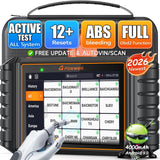 FOXWELL NT726 Bidirectional OBD2 Scanner
$368.99Read fuel trims and test pressure.
FOXWELL NT726 Bidirectional OBD2 Scanner
$368.99Read fuel trims and test pressure.
 FOXWELL NT614 Elite OBD2 Scanner
$233.69Read fuel trims and test pressure.
FOXWELL NT614 Elite OBD2 Scanner
$233.69Read fuel trims and test pressure.
 AUTOWN 45-Piece Pro Fuel Pressure Tester Kit, 0-140 PSI
$44.99Read fuel trims and test pressure.
AUTOWN 45-Piece Pro Fuel Pressure Tester Kit, 0-140 PSI
$44.99Read fuel trims and test pressure.


Parts and Cost
Parts vary by engine family, so order against your VIN rather than a generic listing. The labor codes below come from PIP5197H, which we read directly; other figures are typical ranges rather than GM-published times.
| Repair | What it involves | Cost picture |
|---|---|---|
| Tighten oil cap / seat dipstick | Nothing | $0 |
| Air intake duct or resonator | Single moulded part, usually clamps and clips | Modest; a realistic DIY job |
| PCV hose or tube | Individual hose replacement | Modest |
| MAF sensor cleaning | Dedicated MAF cleaner only — never brake cleaner or a rag | Cost of a can |
| Air filter housing lid (casting flash) | Inspect and replace the lid | Cheaper than the sensor people usually buy instead |
| Camshaft cover assembly (1.4L PCV orifice) | GM labor code 4060930, camshaft cover replacement | Moderate — and the correct fix where the orifice port leaks |
| Intake manifold assembly (missing non-return valve) | GM labor code 4060450, intake manifold replacement | Higher; only where the valve is confirmed missing |
| Intake manifold gaskets (V8) | Upgraded metal-carrier sets preferred over original plastic-carrier design | Gasket set plus several hours labour |
| Fuel pump or filter | Confirm with a pressure test under load first | Significant; do not guess at it |
| Piston, connecting rod and bearing replacement | GM labor code 4066890, where crankcase pressure confirms a ring land failure | The largest bill available here |
The pattern across every engine family is the same: the free checks sit at the top and the engine work sits at the bottom, and the measurements in between decide which one you need.
GM Documents That Name P0171
| Document | Subject | Coverage |
|---|---|---|
| PIP5197H | Oil consumption, oil leaks, blue smoke, whistle noise, MIL on, DTC P0171 — PCV orifice diaphragm, intake manifold non-return valve, crankcase pressure test with piston ring land interpretation | Encore 2013–2019, Cruze 2011–2016, Sonic 2012–2019, Trax 2013–2019, 1.4L LUJ / LUV |
| 20-NA-047 | Plugged PCV orifice raising crankcase pressure; gives the −1 to −5 inches of water spec for these engines | Equinox, Terrain, Malibu, Cruze, Trax, Volt — L3A / LE2 / LFV / LYX |
| 21-NA-105 | ECM calibration for P0171 / P0174; check oil fill cap and dipstick seating before reprogramming | 3.6L V6 — corroborated, not opened |
| 22-NA-171 | Cracked air intake duct | 3.6L V6 — corroborated, not opened |
| 05-06-04-029A | Intake manifold gasket revision for lean codes | 1999–2005 4.8L / 5.3L / 6.0L V8 — corroborated, not opened |
What Other P0171 Pages Get Wrong
- Replacing the oxygen sensor first. The sensor is reporting the lean condition accurately. It is the messenger. Unless its response is genuinely slow or lazy on live data, it is not the fault.
- Giving one answer for every GM engine. GM points at a PCV orifice diaphragm on the 1.4L turbo, an intake duct and a calibration on the 3.6L, and manifold gaskets on the truck V8s. A single generic checklist misses whichever one applies to you.
- Borrowing crankcase pressure specs across engines. Normal is −11 to −18 inches of water on the 1.4L LUJ/LUV and −1 to −5 on the LYX family. Both are GM figures. Using the wrong one turns a healthy engine into a suspected rebuild, or the reverse.
- "Replace the PCV valve." On several of these engines the PCV function is an orifice integral to the camshaft cover, with no screw-in valve to replace at all.
- Missing that P0171 and P0300 can be one fault. GM states a weak or broken piston ring land can cause the misfire and damage the PCV orifice diaphragm that causes the lean code.
- Skipping the free checks. A loose oil fill cap and an unseated dipstick are unmetered air paths, and GM asks technicians to verify both before reprogramming or replacing anything.
We publish specifications, labor codes and coverage only where we could read them in GM's own documentation, and we say plainly where we are relying on corroborated secondary sources instead.
Frequently Asked Questions
What's the most common real-world cause of P0171?
Unmetered air — a vacuum leak, a cracked intake duct, or a crankcase ventilation fault. Which specific one depends on your engine, but the category is consistent. A smoke test plus reading fuel trims at idle versus cruise identifies it faster than anything else, and both are cheaper than the parts people usually buy first.
Should I replace the oxygen sensor?
Almost certainly not as a first step. The sensor is telling the truth about a lean mixture created elsewhere. Check its response on live data if you like, but fix the cause of the lean condition first and see whether the code returns.
Is P0171 always paired with P0174?
No, and the difference is diagnostic. P0174 is the same condition on Bank 2. Both together points at something affecting the whole engine — MAF, a large common vacuum leak, PCV, or fuel supply. P0171 alone on a V6 or V8 points at one side: a gasket, a bank-specific leak, or an injector.
Can a dirty air filter cause a lean code?
Indirectly. A restricted or badly seated filter, or debris and casting flash in the housing, disturbs airflow across the MAF sensor and skews its reading. GM documents casting flash in the air filter housing as a cause on the truck V8s, where the fix is the housing lid rather than the sensor.
Why does my P0171 only appear in cold weather?
Because plastic contracts. The original intake manifold gaskets on the truck V8s use a plastic carrier that becomes brittle with heat cycling and shrinks when cold, opening a leak that seals up again as things warm. Aging rubber ducting and hoses behave the same way.
How urgent is P0171?
Not an emergency in most cases, but not something to leave for months either. A sustained lean condition raises combustion temperatures, can produce misfires, and accelerates catalytic converter wear. Diagnose it within a few weeks rather than driving on it indefinitely.
I have P0171 and a whistling noise. What is that?
On a 1.4L turbo, take that combination seriously — GM names whistle noise in the title of PIP5197H alongside P0171, oil consumption and blue smoke, and points at the PCV orifice on the camshaft cover. Check the orifice's external port for leaking oil or drawing vacuum at idle.
My oil consumption and my lean code appeared together. Related?
Very likely. Both point at the crankcase ventilation path. On the small turbos GM ties oil consumption, blue smoke and P0171 to the same PCV orifice diaphragm, and adds that a broken piston ring land can cause both the misfire and the diaphragm damage. Measure crankcase pressure against your engine's spec rather than treating them as separate problems.
Shop Related Parts & Accessories
A leaking PCV valve, a worn intake manifold gasket, or a lazy upstream O2 sensor are the most common real causes behind a P0171 lean code — these parts address each.
-
 Crankcase Ventilation Valve with PCV Vent — $26.39
-
 MAP Manifold Pressure Sensor (GM Family) — $27.83
-
 MOTOPOWER MP69033 OBD2 Scanner — reads live fuel trim data at idle and cruise
-
 ACDelco dexos1 5W-30 Full Synthetic Motor Oil (1 qt) — $15.99