
P1101 is GM's code for "Intake Air Flow System Performance" — the engine computer measured airflow that doesn't agree with what throttle position and manifold pressure say it should be. On the Chevrolet Equinox it is overwhelmingly a 1.5L turbo (RPO LYX) problem, and GM has documented two specific mechanical causes for it. If you own a 2019 Equinox with that engine, there is an open emission recall that fixes one of them free of charge, regardless of mileage or how many owners the vehicle has had.
Jump to a section: What P1101 means · The free recall first · The two-part code form · Symptoms · Causes and how to confirm each · Affected Equinox years · How it's diagnosed · Parts, labor and cost · Service bulletins · What other pages get wrong · FAQ
What Does P1101 Mean on a Chevy Equinox?
GM's own wording, consistent across every GM document that contains the code, is "Intake Air Flow System Performance." The engine control module cross-checks the mass airflow sensor reading against what it expects from throttle position and manifold absolute pressure. When those two pictures disagree by more than the allowed margin, it sets P1101.
That is a plausibility code, not a component code. It does not say the MAF sensor is bad. It says the air actually reaching the engine doesn't match the air the computer thinks should be reaching it — which is exactly what happens when unmetered air gets in after the sensor, or when crankcase pressure backs up into the intake tract.
On the Equinox 1.5L turbo, GM has documented two specific mechanical faults that produce that mismatch: a charge air cooler outlet tube that separates from the throttle body, and a positive crankcase ventilation orifice that plugs up. Both are covered below with the GM document that names them.
Check the Recall Before You Spend Anything
If your Equinox is a 2019 with the 1.5L LYX engine, GM issued Emission Recall N192271200 in December 2019 that names P1101 by code. The remedy is an improved charge air cooler retainer, part 13434668, and GM's recall document states dealers are to service involved vehicles at no charge to customers, regardless of mileage, age of vehicle, or ownership. In California a Proof of Correction certificate is issued with it.
The recall's own model table lists three vehicles: 2019 Chevrolet Equinox (LYX), 2019 Chevrolet Malibu (LFV) and 2019 GMC Terrain (LYX). GM's description of the condition names the codes it can set — P0172, P0299, P0101, P1101 and P0506.
Check your VIN before authorising any paid diagnosis. A separate service update, N192266090, covered the same retainer remedy on the same 2019 vehicles but applied to dealer inventory only and has expired — that one is closed, the recall is not.
One important limit: the recall covers the 2019 model year only. If you have a 2018, 2020, 2021 or 2022 Equinox with the same failure, the repair is the same but you are paying for it unless it falls inside your emissions or powertrain warranty.
Tools for reading airflow
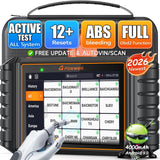 FOXWELL NT726 Bidirectional OBD2 Scanner
$368.99Compare MAF, MAP and throttle readings.
FOXWELL NT726 Bidirectional OBD2 Scanner
$368.99Compare MAF, MAP and throttle readings.
 FOXWELL NT614 Elite OBD2 Scanner
$233.69Compare MAF, MAP and throttle readings.
FOXWELL NT614 Elite OBD2 Scanner
$233.69Compare MAF, MAP and throttle readings.

Is There a P1101-00 or P1101-04 Sub-Code?
GM usually writes trouble codes in two parts — a five-character base code, then a two-digit failure type byte after a dash. For P1101, no GM-documented sub-types exist.
We checked every GM bulletin and field action that contains this code — N192271200, N192266090, 22-NA-224, 20-NA-047, PIP5651A through PIP5651G, PIP5710A, PIP5402C, PIP5947C and more. GM writes it as a bare five-character DTC in all of them, with no suffix. If a site shows you a table of P1101 sub-types with distinct meanings, that is a generic template stamped onto every code on that site, not GM documentation.
What Are the Symptoms of P1101 on an Equinox?
- Check engine light on
- Reduced Engine Power message — the most reported symptom, and the signature of a separated charge air cooler tube, because the turbo is pushing boost into the engine bay instead of the engine
- Sluggish acceleration and hesitation, worst under load or climbing a grade
- Rough or unstable idle
- A loud hiss or whoosh under acceleration — the sound of pressurised charge air escaping at the disconnected joint
- Higher fuel consumption
- Stalling at low speed or idle — GM's own recall wording says the engine could stall when the vehicle reaches low speed or idle
- On the PCV path, an oil leak at the front or rear crankshaft seal. GM's bulletin title for that failure is literally "Front or Rear Crankshaft Oil Leak, Malfunction Indicator Lamp (MIL) Illuminated — DTC P1101 Set," because trapped crankcase pressure pushes oil past the seals
That last one is worth dwelling on. If you have P1101 and a fresh oil leak on a 1.5L Equinox, do not treat them as two separate problems. GM documents them as one condition with one root cause.
Companion codes are also a strong clue. P0299 (underboost), P0101 (MAF performance), P0172 (system too rich) and P0506 (idle speed low) all appear in GM's list for the charge air cooler failure. Seeing P0299 or P0172 alongside P1101 points at unmetered air or lost boost, not at a failed sensor.
What Causes P1101 — and How Do You Confirm Each One?
These are the causes GM itself has documented in field bulletins covering the Equinox. We've deliberately not ranked them by "probability," because no GM document ranks them and the rankings you see elsewhere are invented.
| Cause | How to confirm it | Applies to | GM document |
|---|---|---|---|
| Charge air cooler outlet tube separated from the throttle body | Open the hood and look. It is the large-diameter tube running to the metal throttle body. It will be visibly popped off or loose. Often reconnects by hand — but it will separate again without the improved retainer | Equinox 2018–2022, 1.5L LYX | 22-NA-224 (supersedes PIP5651G) |
| Missing or damaged O-ring in the CAC tube end | Separate the joint and inspect inside the tube end. GM's instruction is to check the tube end for contact damage or a missing O-ring seal from blowing off, and replace the tube if either is found | Equinox 2018–2022, 1.5L LYX | PIP5651F |
| Plugged PCV orifice raising crankcase pressure | Crankcase pressure test at the dipstick port with the engine running. GM's spec: normal is −1 to −5 inches of water in park at hot idle. Anything above 0 inches of water is a positive crankcase pressure concern. Look for a crankshaft seal oil leak alongside the code | Equinox 2018–2022, 1.5L LYX | 20-NA-047 |
| Camshaft cover failure causing oil consumption and blue smoke | Check for oil consumption and blue exhaust smoke at low mileage. GM's preliminary information notes this can set P1101 among other codes and advises inspecting the camshaft cover | Equinox, 1.5L | PIP5947C |
| Air induction restriction — nesting material, water intrusion, ice, a kinked PCV tube or intake modifications | GM directs you to inspect the front air intake duct and air cleaner housing for these before condemning the PCV orifice | Equinox 2018–2022, 1.5L LYX | 20-NA-047 |
| Cracked or loose intake ducting elsewhere in the tract | Smoke test the intake between the MAF sensor and the throttle body. Any unmetered air after the sensor produces the same mismatch | General | — |
| Contaminated or failed MAF sensor element | Inspect the hot-wire element for an oil or dirt film. Clean with a dedicated MAF cleaner only — never brake cleaner, never a rag or brush on the element. If cleaning does not restore normal readings, the sensor for the 2018–2022 1.5L Equinox is GM Genuine Parts 23366103 | General | — |
| Restricted or badly seated engine air filter | Pull the filter and check both its condition and that the housing is sealing all the way round | General | — |
| Cause still under investigation (2020 models) | GM released an Engineering Information document in May 2020 for loss of power, hesitation and stalling with P1101 on 2020 Equinox and Terrain 1.5L, with root cause not yet determined and a data-collection labor operation attached | Equinox 2020, 1.5L LYX | EI, May 2020 |
There is one more condition worth knowing about that we can describe but not number honestly: GM published a service update for 2019 Equinox covering ice or sludge accumulating in the charge air cooler or closed crankcase ventilation system when driving in extreme cold — around −18°C (0°F) or below — with a thermal wrap and, where applicable, an ECM reprogram as the remedy. We could not open that document to verify its bulletin number, so we are not printing one.
Airflow parts
 ACDelco MAF Sensor, GM OE, Stock 23366103
$115.99MAF and MAP sensors — confirm year and engine. Confirm fitment by VIN before ordering.
ACDelco MAF Sensor, GM OE, Stock 23366103
$115.99MAF and MAP sensors — confirm year and engine. Confirm fitment by VIN before ordering.
 ACDelco MAF Sensor, GM OE, Stock 12671625
$162.99MAF and MAP sensors — confirm year and engine. Confirm fitment by VIN before ordering.
ACDelco MAF Sensor, GM OE, Stock 12671625
$162.99MAF and MAP sensors — confirm year and engine. Confirm fitment by VIN before ordering.


Which Equinox Models Actually Get P1101?
Every GM document we could open that contains P1101 lists turbocharged engines only — 1.4L, 1.5L and 2.0L. Here is the Equinox-specific picture:
| Vehicle | Years | Engine | Documented issue |
|---|---|---|---|
| Chevrolet Equinox | 2018–2022 | 1.5L turbo (LYX) | CAC outlet tube separation from throttle body |
| Chevrolet Equinox | 2018–2022 | 1.5L turbo (LYX) | Plugged PCV orifice, with crankshaft seal oil leak |
| Chevrolet Equinox | 2019 | 1.5L turbo (LYX) | Emission recall N192271200 — free remedy |
| Chevrolet Equinox | 2020 | 1.5L turbo (LYX) | Loss of power / stalling, root cause under investigation |
A correction worth making plainly: a number of pages state that P1101 affects the 2.4L Ecotec in the 2010–2017 Equinox. We could not find a single GM document supporting that, and both of GM's documented mechanisms are structurally impossible on a naturally aspirated 2.4L — it has no charge air cooler and no CAC tube to disconnect. If you have a 2.4L Equinox with a rough idle and a lean condition, you are almost certainly looking at a different code.
How Is P1101 Diagnosed?
- Check the VIN for open recalls first. On a 2019 Equinox 1.5L this can end the job at zero cost. GM's involved vehicles are flagged "open" in its warranty system, so any dealer can tell you in a minute.
- Open the hood and look at the charge air cooler outlet tube where it meets the throttle body. This is a visual check that takes under a minute and is the single most-documented cause. If it has separated, that is your answer — but reattaching it alone is not the repair; it needs the improved retainer or it will part again.
- Inspect the tube end and its O-ring if the tube is attached but you suspect a leak at the joint. GM specifically calls for checking the tube end for contact damage and a missing O-ring, and replacing the tube if either is present.
- Scan for companion codes. P0172, P0299, P0101 and P0506 alongside P1101 all point toward unmetered air or boost loss rather than a sensor fault.
- Check the engine air filter for condition and that it is seated and sealing, and inspect the intake duct and air cleaner housing for nesting material, water, ice or a kinked PCV tube.
- Remove and inspect the MAF sensor element. Clean it with dedicated MAF cleaner if it is filmed with oil or dirt.
- Smoke test the intake tract from the MAF sensor to the throttle body.
- Run a crankcase pressure test if the tube and ducting check out — especially if there is any oil leak at a crankshaft seal. Connect the tester at the oil dipstick port with the engine off, then start the engine and read. Normal is −1 to −5 inches of water at hot idle in park; above 0 inches of water means positive crankcase pressure and further diagnosis.
- Review live MAF data and fuel trims to confirm the repair before returning the vehicle.
What Does a P1101 Repair Cost on an Equinox?
Every part number and labor time below comes from a GM bulletin or GM's own parts catalogue. Where GM does not publish a number, we say so rather than filling the gap.
| Repair | GM part number | GM labor operation | Labor time |
|---|---|---|---|
| Install charge air tube retainer kit | 13434668 retainer | 4086948 | 0.4 hr |
| Replace charge air cooler outlet air tube | Order by VIN — GM directs you to the electronic parts catalogue rather than publishing one number | 4022880 (add) | Published SI time |
| Throttle body replacement | Order by VIN | 4087138 | 0.2 hr |
| Crankcase pressure test | — | 4087348 | 0.3 hr |
| Camshaft cover inspection, cleaning and PCV orifice replacement (Equinox) | 12641875 PCV orifice, plus gaskets 12636176, 12636177, 12636384, 12665421, 12668429, 12676587 and fuel feed pipe 12707219 as required | (add) | 3.3 hrs |
| Mass airflow sensor replacement | 23366103 (GM Genuine Parts, 2018–2022 Equinox 1.5L) | — | — |
Note the spread, because it is the whole argument for diagnosing before ordering parts:
| Scenario | DIY | Independent shop | Dealer |
|---|---|---|---|
| 2019 Equinox, recall applies | n/a — take it in | n/a | $0 under N192271200 |
| Reattach CAC tube, fit retainer kit | Retainer part only, roughly $15–25 | 0.4 hr labor plus part | 0.4 hr labor plus part |
| Clean MAF sensor | Cost of a can of MAF cleaner | Usually folded into diagnosis | Usually folded into diagnosis |
| Replace MAF sensor | Part 23366103, $88.41 | Part plus roughly 0.3 hr | Part plus roughly 0.3 hr |
| PCV orifice and camshaft cover job | Not a beginner job — cover off, gaskets, fuel rail hardware | 3.3 hrs labor plus orifice and full gasket set | 3.3 hrs labor plus orifice and full gasket set |
The retainer job is 0.4 hours. The PCV orifice job on an Equinox is 3.3 hours, because the camshaft cover has to come off and be cleaned and the gaskets replaced. Those are two very different repair bills behind one identical code.
Warranty coverage code E applies to the crankcase pressure test operation under the base emission warranty, and labor operation 4086948 is written for vehicles repaired under powertrain coverage. Your dealer checks which applies against your VIN.
Leak and filter parts
 ACDelco Gold 19313320 Positive Crankcase Ventilation (PCV)
$6.88PCV parts and air filter. Confirm fitment by VIN before ordering.
ACDelco Gold 19313320 Positive Crankcase Ventilation (PCV)
$6.88PCV parts and air filter. Confirm fitment by VIN before ordering.
 ACDelco PCV Valve Hose, GM OE, Plastic/Rubber
$84.99PCV parts and air filter. Confirm fitment by VIN before ordering.
ACDelco PCV Valve Hose, GM OE, Plastic/Rubber
$84.99PCV parts and air filter. Confirm fitment by VIN before ordering.


GM Bulletins and Field Actions That Name P1101
| Document | Date | Subject | Equinox coverage |
|---|---|---|---|
| N192271200 — Emission Recall | Dec 2019 | Improved charge air cooler retainer, free of charge | Equinox 2019, 1.5L LYX |
| 22-NA-224 | Nov 2022 | CAC outlet tube to throttle body separated (supersedes PIP5651G) | Equinox 2018–2022, 1.5L |
| 20-NA-047 | Feb 2020, rev. Jan 2023 | Front or rear crankshaft oil leak, MIL on — plugged PCV orifice | Equinox 2018–2022, 1.5L LYX |
| PIP5651B / PIP5651D / PIP5651F | 2019–2021 | Charge air cooler outlet hose disconnected from throttle body with P0172, P0299, P0101, P0506, P1101 | Equinox 2019 (early versions), 2018–2022 (PIP5651F) |
| PIP5947C | — | Failed camshaft cover causing oil consumption and blue smoke; may set P1101 | Equinox, 1.5L |
| N192266090 — Service Update | Aug 2019 | Same retainer remedy — dealer inventory only, now expired | Equinox 2019, 1.5L |
| Engineering Information | May 2020 | Loss of power, hesitation, stalls — root cause under investigation | Equinox 2020, 1.5L |
What Other P1101 Pages Get Wrong
We checked the widely-republished claims about this code against GM's own documents. Several do not survive:
- "P1101 means the MAF sensor is bad." It does not. It is a plausibility comparison between the MAF reading and what throttle position and manifold pressure predict. On a 1.5L Equinox, GM's two documented root causes are both mechanical and neither is the sensor.
- "Part 55351452 is the valve cover for the PCV fix." GM's catalogue has that as a camshaft cover for the 1999–2001 Cadillac Catera and 2003–2004 CTS. It appears nowhere in 20-NA-047. The part 20-NA-047 actually names as the causal part is the PCV orifice, 12641875.
- "Part 84940481 is the CAC tube for a 2018–2022 Equinox." The number is real and it is a charge air cooler outlet tube — but GM's catalogue lists it for the 2023–2024 Equinox and Terrain. Order it for a 2019 and it will not fit.
- "The whole camshaft cover has to be replaced because the orifice isn't serviceable." 20-NA-047's procedure says to remove the camshaft cover, remove the PCV orifice, inspect it for blockage, and replace the orifice as necessary along with the cover gaskets. GM lists the orifice as the causal part with its own number.
- "P1101 on the 2.4L Equinox." No GM source, and mechanically impossible for both documented causes.
- "There's a P1101-00 sub-code table." There isn't. GM writes P1101 bare in every document that contains it.
We publish part numbers only where we could open GM's own catalogue or bulletin and read them. Where GM says "order by VIN," we say that too.
Frequently Asked Questions
Can I still drive with P1101?
Short trips, cautiously — but not indefinitely. If the charge air cooler tube has separated you will have obvious power loss, and GM's own recall wording notes the engine could stall at low speed or idle, which is a real hazard in traffic. Sustained running well outside intended fuelling risks the catalytic converter over months. If you have a Reduced Engine Power message, get it looked at rather than driving on it.
Is P1101 covered under warranty on my Equinox?
On a 2019 Equinox with the 1.5L LYX engine, emission recall N192271200 covers the charge air cooler retainer repair at no charge regardless of mileage, vehicle age or how many owners it has had. Check your VIN first. Outside that model year, P1101 repairs fall under normal powertrain or base emission warranty terms depending on the part and your mileage — 20-NA-047's crankcase pressure test is written under coverage code E.
Will cleaning the MAF sensor fix P1101?
Sometimes, and it is cheap enough to try — but on a 1.5L turbo Equinox it is not where the odds are. GM's documented causes are the charge air cooler tube separating and the PCV orifice plugging, neither of which a can of MAF cleaner touches. Look at the CAC tube before you buy anything.
Why does my Equinox have P1101 and an oil leak at the same time?
Because they are one problem. A plugged PCV orifice raises crankcase pressure, and that pressure pushes oil past the front or rear crankshaft seal while also upsetting the airflow the ECM is checking. GM's bulletin 20-NA-047 titles the condition exactly that way. Replacing the seals without fixing the orifice will just push oil past the new ones. If your Equinox is also using oil between changes, see our guide on 1.5L turbo oil consumption.
What is a normal crankcase pressure reading on a 1.5L Equinox?
GM specifies −1 to −5 inches of water, measured at the oil dipstick port in park at hot idle, for the L3A, LE2, LFV and LYX engines. Connect the tester with the engine off, then start it and record. Anything above 0 inches of water is a positive crankcase pressure concern.
Does this code only affect turbocharged models?
On the Equinox, in practice yes. Every GM document containing P1101 lists turbocharged engines — 1.4L, 1.5L and 2.0L. The underlying airflow-plausibility check exists on any engine with a MAF sensor, but the documented failures behind it on this platform are turbo-specific hardware.
What does the -00 mean in P1101-00?
Nothing specific. GM has no documented failure type sub-types for P1101 — it is written as a bare five-character DTC in every GM bulletin containing the code. Any table of P1101 sub-types you find online is a generic template, not GM data.
My CAC tube popped off and I pushed it back on. Am I done?
Not quite. Check inside the tube end for contact damage and confirm the O-ring seal is still there — GM says to replace the tube if the end is damaged or the O-ring is missing. And unless the improved retainer 13434668 is fitted, the joint that let go once under boost is likely to let go again.
The MAF Sensor That Fits a 2018–2022 Equinox 1.5L
If cleaning does not restore normal readings, the GM Genuine Parts sensor for the 2018–2022 Equinox with the 1.5L turbo (LYX) engine is 23366103, $88.41. The same part covers the GMC Terrain 1.5L over the same years and the 2016–2024 Malibu 1.5L. It supersedes the older 23197633. For a 2022 Equinox, check the VIN first — 2022 is an overlap year with the next-generation sensor.
Do not order a 2.4L Equinox sensor, or vice versa. They are different parts and both listings show "Equinox."
Shop the Parts Mentioned
-
 MOTOPOWER MP69033 OBD2 Scanner — $49, reads and clears P1101 and graphs live engine load and RPM.
-
 T300 OBD2 Scanner (Mode 6 & Mode 8) — $70.52, a step up that adds Mode 6 on-board monitoring test results, so you can see the comprehensive-component monitor values behind a MAF self-test failure.
-
 VDIAGTOOL BT500 Battery Tester — $57.53, tests battery health, cranking and charging on 6V/12V/24V systems with ripple analysis and a voltage waveform — confirms the battery and charging system are healthy before you chase a sensor or circuit fault.
-
 Carburetor & Throttle Body Cleaning Tool Kit — useful for cleaning surrounding intake components.
-
 95-Piece Mechanics Tool Set (Metric & SAE) — covers clamps and fasteners in the intake tract.
-
 ACDelco GM OE CF185 Cabin Air Filter — note this is the cabin filter, not the engine air filter this code concerns; worth refreshing while you are servicing filtration.