
A direct-injection Chevrolet Equinox has two fuel pressure sensors, not one — and a third sensor with a confusingly similar name that has nothing to do with either. The high-pressure fuel rail sensor sits on the fuel rail at the back of the engine, behind the intake manifold. The low-pressure sensor is underneath the vehicle, in the supply line between the in-tank pump and the high-pressure pump. Knowing which one your code refers to is the difference between a twenty-minute job and lifting the car for nothing.
Jump to a section: Which sensor do you mean? · The high-pressure rail sensor · The low-pressure sensor · The third sensor people confuse · What the sensor actually does · The numbers it should report · Which codes point here — and the order to fix them · Symptoms · Before you touch it · Test before replacing · What other pages get wrong · FAQ
Which Sensor Do You Actually Mean?
Three different parts get called "the fuel pressure sensor" on this vehicle. They live in different places, do different jobs, and set different codes.
| Sensor | Where it is | What it measures | Typical codes |
|---|---|---|---|
| Fuel rail pressure sensor (high side) | On the high-pressure fuel rail, back of the engine behind the intake manifold | Thousands of PSI in the rail feeding the injectors | P0089, P0087, P0088, P0191, P228C, P228D, P00C6 |
| Fuel line pressure sensor (low side) | Underneath the vehicle, in the supply pipe between the in-tank pump and the high-pressure pump | Tens of PSI in the supply line | Low-pressure fuel system codes, and it feeds the diagnosis for the high-side codes |
| Fuel tank pressure sensor (EVAP) | On or near the fuel tank, part of the evaporative emissions system | Vapour pressure in the tank — not fuel delivery at all | P0450-series evaporative emission codes |
If your scan tool shows a P0089 or P0191 and a parts site sells you something described as a "fuel tank pressure sensor," you are about to fit an EVAP component to a fuel delivery problem. That mix-up is common enough to be worth the paragraph.
Where the High-Pressure Fuel Rail Sensor Is
This is the one most codes refer to, and its position follows from how the engine is built.
GM's description of the 2.4L is that the high-pressure fuel pump is mounted on the rear of the engine and driven by a three-lobe cam on the intake camshaft. Since the pump lives at the back, so does the high-pressure rail it feeds — which puts the fuel rail pressure sensor on the fuel rail along the back of the engine, behind and below the intake manifold, toward the firewall.
Practical notes for finding it:
- You are looking at the back of the engine, not the front. On a transverse layout that means the firewall side.
- It threads into the rail itself and has a small electrical connector — commonly described as pointing toward the passenger side.
- It looks a lot like an oil pressure sensor. If you are unsure, follow the rigid steel line from the pump to the rail rather than trusting appearance.
- Access is usually the hard part, not the removal. Intake plumbing and the cowl area are in the way on most of these.
On the 1.5L and 2.0L turbo engines the architecture is the same — a camshaft-driven high-pressure pump feeding a high-pressure rail, with the pressure sensor on that rail. The packaging differs, so the exact reach and orientation vary, but the principle for locating it does not: find the high-pressure pump, follow the hard line, and the sensor is on the rail at the other end.
Fuel pressure sensors
 ACDelco Fuel Rail Pressure Sensor
$98.99GM fuel pressure sensors — confirm engine. Confirm fitment by VIN before ordering.
ACDelco Fuel Rail Pressure Sensor
$98.99GM fuel pressure sensors — confirm engine. Confirm fitment by VIN before ordering.
 ACDelco Fuel Pressure Sensors, GM Genuine Parts
$138.99GM fuel pressure sensors — confirm engine. Confirm fitment by VIN before ordering.
ACDelco Fuel Pressure Sensors, GM Genuine Parts
$138.99GM fuel pressure sensors — confirm engine. Confirm fitment by VIN before ordering.


Where the Low-Pressure Sensor Is
The second sensor is the one people miss, and it is not in the engine bay.
It sits underneath the vehicle, in the low-pressure fuel supply pipe, between the in-tank lift pump and the engine-mounted high-pressure pump. On a second-generation Equinox it is commonly described as being under the engine area toward the driver's side.
Its job is to tell the ECM what the in-tank pump is delivering to the high-pressure pump. That matters more than it sounds, because a high-pressure pump being starved by a weak low-side supply produces high-side codes. Replacing the rail sensor, or even the high-pressure pump, will not fix a supply problem originating under the car.
If you are chasing a fuel pressure code and everything on the high side checks out, this sensor and the supply it monitors are the next place to look — not the last.
The Third Sensor People Confuse
The fuel tank pressure sensor is part of the evaporative emissions system. It monitors vapour pressure inside the tank so the ECM can run leak tests on the EVAP system. It has nothing to do with delivering fuel to the injectors.
It sets evaporative emission codes in the P0450 range. If those are what you have, you are in a different system entirely, and none of the high-pressure work described on this page applies. Our EVAP leak code guide covers that side.
What the Sensor Actually Does
GM's circuit description is short and worth knowing before you test anything: the fuel rail pressure sensor detects fuel pressure within the fuel rail. The ECM provides a 5-volt reference voltage on the 5-volt reference circuit and ground on the low reference circuit, and receives a varying signal voltage on the signal circuit.
So it is a three-wire sensor: 5V reference in, low reference (ground), and a signal that varies with pressure. That tells you what to check at the connector, and it tells you what can go wrong without the sensor itself failing — a corroded pin on any of those three circuits produces a wrong reading from a perfectly good sensor.
It also explains a diagnostic shortcut: with the key on and the engine off, there is no meaningful rail pressure, so the sensor should report a low value. If it reports high with the engine not running, the sensor or its circuit is lying rather than the fuel system misbehaving.
The Numbers It Should Report
These are the figures from GM's service information for the 2.4L. Treat them as the right shape for the turbo engines rather than exact values, since those run different pressures.
| Condition | Expected fuel rail pressure |
|---|---|
| Engine idling (verification figure) | Approximately 1.9–2.1 MPa (279–305 psi) |
| Acceptable band during checks | 1.9–5.0 MPa (276–725 psi) |
| Full operating range the ECM requests | 2 to 15 MPa (290 to 2,176 psi), depending on engine speed and load |
| Key on, engine off | Should read low — a high reading here implicates the sensor or its circuit |
Two things to take from that table. First, the working range is enormous — the ECM asks for anywhere between roughly 290 and 2,176 psi depending on what the engine is doing, so a single spot reading tells you very little. Watch desired against actual across idle, revs and load. Second, that top figure is why the safety section below is not boilerplate.
On the 2023-onward 1.5L LSD, the fuel system runs at substantially higher pressure again than the LYX it replaced — reported as a step up from roughly 20 MPa to 35 MPa maximum. We have not been able to confirm that from a GM document, so treat it as an indication that older figures do not carry across rather than as a specification.
Which Codes Point Here — and the Order to Fix Them
This is the most useful thing on the page if you have several codes stored, and almost nobody publishes it.
GM's conditions for running the P0089, P228C and P228D diagnostics include a list of codes that must not already be set — and that list contains P0191, P0192 and P0193, the fuel rail pressure sensor circuit codes.
The consequence is direct: if a sensor circuit code is set, the pressure regulation diagnostics do not run at all. The ECM will not evaluate whether fuel pressure is being regulated correctly while it does not trust the sensor telling it the pressure.
So the repair order is:
- Fix any P0191, P0192 or P0193 first. These are sensor and circuit codes — connector, wiring, 5V reference, or the sensor itself.
- Clear the codes and drive the vehicle so the suppressed diagnostics can run again.
- Then see what comes back. A P0089 or P228D that reappears is a genuine regulation problem. One that does not was never diagnosable while the sensor code was active.
Working the other way round — replacing a high-pressure pump while a sensor circuit code is stored — means spending the largest amount of money available on a symptom the ECM could not properly evaluate.
| Code | What it says about this sensor |
|---|---|
| P0191 | Fuel rail pressure sensor circuit range/performance — the sensor's reading is implausible |
| P0192 / P0193 | Sensor circuit low / high — an electrical fault on its circuits |
| P0089 | Regulation effort out of range — uses this sensor's reading, so it depends on it being honest |
| P228D / P228C | Actual pressure above or below desired by 3 MPa (435 psi) — measured by this sensor |
| P0087 / P0088 | Rail pressure too low or too high |
| P00C6 | Rail pressure low during cranking |
Symptoms of a Failing Fuel Pressure Sensor
- Check engine light with any of the codes above
- Hard starting or extended cranking
- Rough idle and hesitation on acceleration
- Reduced Engine Power message and limp mode
- Stalling
- Poor fuel economy
- Readings that make no physical sense — high pressure reported with the engine off is the clearest example
- Intermittent behaviour, which on a three-wire sensor usually means the connector rather than the sensor
A caution worth stating: several other faults mimic a failed rail pressure sensor, including a failing high-pressure pump, a weak low-side supply, and even a stuck-open injector making pressure behave erratically. The symptoms alone will not tell you which. The data will.
Before You Touch It
The rail this sensor threads into can hold well over two thousand PSI on the 2.4L, and more on the newer turbo engines. That is not a fuel line you crack open casually.
- Relieve the fuel system pressure following the service procedure for your vehicle before disconnecting anything.
- Disable the fuel pump — pulling its relay or fuse and running the engine until it stalls is the usual method — and then disconnect the battery to prevent accidental arcing near open fuel.
- Expect residual fuel even after relieving pressure. Have rags and a container ready, and no ignition sources anywhere near.
- Let a hot engine cool. Fuel onto a hot exhaust manifold is exactly the scenario to avoid.
- If any of that reads as beyond what you want to take on, this is a reasonable job to hand to a shop. High-pressure fuel work carries genuine fire risk, and there is no shame in that call.
Connectors and seals
 ACDelco Wire Connectors, Replacement, 2 Pins
$90.99Connector and seal kits. Confirm fitment by VIN before ordering.
ACDelco Wire Connectors, Replacement, 2 Pins
$90.99Connector and seal kits. Confirm fitment by VIN before ordering.
 ACDelco Fuel Injector O-Rings, ACDelco GM Genuine Parts Fuel
$120.99Connector and seal kits. Confirm fitment by VIN before ordering.
ACDelco Fuel Injector O-Rings, ACDelco GM Genuine Parts Fuel
$120.99Connector and seal kits. Confirm fitment by VIN before ordering.
 Nomex Split Loom, 1 in. x 10 ft
$105.66Connector and seal kits. Confirm fitment by VIN before ordering.
Nomex Split Loom, 1 in. x 10 ft
$105.66Connector and seal kits. Confirm fitment by VIN before ordering.


Test Before You Replace
The sensor is cheaper than the pump, which makes it tempting to fit one speculatively. Three checks make that unnecessary.
- Key on, engine off. Actual rail pressure should read low. A high reading with the engine stopped points at the sensor or its circuit rather than the fuel system.
- Inspect the connector. Three circuits — 5V reference, low reference, signal. Check all three for corrosion, oil intrusion and terminal tension. A wandering reading while you wiggle the connector implicates the connector, not the sensor.
- Compare desired against actual across the range. At idle they should track closely. Raise the revs and load the engine: if actual cannot keep up with desired, you have a delivery problem, not a reporting problem. Where a bidirectional scan tool is available, commanding a pressure change and watching the rail follow is the cleanest test of all.
And if a sensor circuit code is stored, fix that first — per the ordering rule above, the regulation diagnostics were not even running.
On parts: GM lists the rail pressure sensor by VIN rather than publishing a single number that covers every engine and year, so order against your VIN rather than a model-year table. We are not going to print a part number we could not verify in GM's own catalogue.
Tools for testing
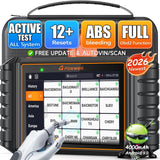 FOXWELL NT726 Bidirectional OBD2 Scanner
$368.99Scan tool and pressure gauge.
FOXWELL NT726 Bidirectional OBD2 Scanner
$368.99Scan tool and pressure gauge.
 FOXWELL NT614 Elite OBD2 Scanner
$233.69Scan tool and pressure gauge.
FOXWELL NT614 Elite OBD2 Scanner
$233.69Scan tool and pressure gauge.

What Other Pages Get Wrong
- Treating it as one sensor. A GDI Equinox has a high-side rail sensor in the engine bay and a low-side sensor under the vehicle. Telling someone "it's on the fuel rail" when their code concerns the supply side sends them to the wrong end of the car.
- Confusing it with the fuel tank pressure sensor. That is an EVAP component setting P0450-series codes. Different system, different job, different repair.
- "Consult your manual for the 1.5L." The architecture is the same across these direct-injection engines — camshaft-driven high-pressure pump, high-pressure rail, sensor on the rail. Packaging differs; the method for locating it does not.
- Skipping the diagnostic ordering. GM's own run conditions mean P0191, P0192 and P0193 suppress the P0089, P228C and P228D diagnostics. Fixing the sensor code first is not optional sequencing — the other tests were not running.
- Quoting a single pressure figure. The ECM requests anywhere from 2 to 15 MPa depending on speed and load. One spot reading proves very little on its own.
- Understating the safety. This is a rail that can hold over 2,000 psi. Relieve pressure, disable the pump, disconnect the battery, and let it cool.
We publish specifications only where we could read them in GM's own service information, and we flag figures we could not verify — as with the 2023-onward pressure step above.
Frequently Asked Questions
Where exactly is the fuel rail pressure sensor on a 2.4L Equinox?
On the high-pressure fuel rail along the back of the engine, behind and below the intake manifold toward the firewall. The high-pressure pump is mounted on the rear of the engine and driven by a three-lobe cam on the intake camshaft, so the rail it feeds — and the sensor on that rail — are at the back too. Follow the rigid line from the pump if you are unsure which component you are looking at.
My Equinox has two fuel pressure sensors. Which one failed?
The codes tell you. High-side codes like P0089, P0191, P228C, P228D and P00C6 concern the rail sensor in the engine bay. Low-pressure fuel system codes concern the sensor under the vehicle in the supply line. And if a weak low-side supply is starving the high-pressure pump, you can get high-side codes with a perfectly good rail sensor — which is why the supply gets tested rather than assumed.
Can a bad fuel pressure sensor cause a no-start?
It can contribute to hard starting and extended cranking, and P00C6 exists specifically for rail pressure failing to rise during cranking. A complete no-start is more often the pump or the supply side than the sensor alone. Check whether the sensor reports something physically impossible with the key on and the engine off before assuming.
Is replacing it a DIY job?
Mechanically it is not complex — it threads into the rail with one connector. The complications are access, and the fact that you are opening a high-pressure fuel circuit. Relieve the pressure, disable the pump, disconnect the battery, and let the engine cool. If that sounds like more risk than you want, handing it to a shop is a sensible call rather than a defeat.
Do both sensors need replacing if one fails?
No. They are independent components in different parts of the system, monitoring different pressures. Replace only the one confirmed faulty by testing.
What should the rail pressure read at idle?
GM's verification figure for the 2.4L is approximately 1.9–2.1 MPa, or 279–305 psi, at idle, within a wider acceptable band of 1.9–5.0 MPa. Across the full operating range the ECM requests between 2 and 15 MPa depending on speed and load, so watch desired against actual rather than judging a single number.
I have P0191 and P0089 together. Where do I start?
P0191. GM's run conditions for the P0089 diagnostic require that P0191, P0192 and P0193 are not set, so the regulation test was not running while the sensor code was active. Fix the sensor circuit, clear the codes, drive it, and then see whether P0089 returns. It may not.
How do I know it's the sensor and not the pump?
Key on with the engine off, actual pressure should read low — if it reads high, the sensor or circuit is at fault, because there is no pressure to report. Then compare desired against actual under load: a gap that opens up when you ask for power is a delivery problem, which points at the pump or the supply rather than at the sensor.
Shop the Parts Mentioned
-
 MOTOPOWER MP69033 OBD2 Scanner — $49, reads the stored fuel-side codes and shows live engine data while you test.
-
 VDIAGTOOL BT500 Battery Tester — $57.53, tests battery health, cranking and charging on 6V/12V/24V systems with ripple analysis and a voltage waveform — confirms the battery and charging system are healthy before you chase a sensor or circuit fault.
-
 95-Piece Mechanics Tool Set (Metric & SAE) — covers the fasteners involved in this job.
-
 ACDelco GM OE dexos1 GEN 2 Full Synthetic 5W-30 Motor Oil (1 qt) — good practice while the engine bay is open for repairs.
-
 ACDelco Gold Negative Battery Cable — for replacing a corroded or damaged negative cable, a common source of intermittent electrical faults.