
P228D is "Fuel Pressure Regulator 1 Control Performance — High Pressure." The engine control module compares the fuel rail pressure it asked for against what the fuel rail pressure sensor actually reports, and P228D sets when actual pressure runs 3 MPa (435 psi) above desired for a sustained period. On a Chevrolet Equinox this is a Type A code, which means the check engine light comes on at the first failure and you will usually get a Reduced Engine Power message with it. There is no separate regulator to bolt on — the regulating valve lives inside the high-pressure fuel pump.
Jump to a section: What P228D means · The exact threshold · Why it's more serious than it looks · There is no separate regulator · Symptoms · Causes and how to confirm each · The after-a-repair case · How it's diagnosed · Parts and cost · Service bulletins · What other pages get wrong · FAQ
What Does P228D Mean on a Chevy Equinox?
Direct injection needs far more fuel pressure than a port-injected engine. GM's description of the system on the 2.4L is specific: the high-pressure fuel pump is mounted on the rear of the engine and driven by a three-lobe cam on the intake camshaft, and it regulates pressure itself using an actuator in the form of an internal solenoid-controlled valve.
The ECM does not simply switch that pump on. It uses the camshaft and crankshaft position sensor inputs to synchronise the actuator with each camshaft lobe, then regulates pressure by adjusting what portion of each pump stroke actually delivers fuel to the rail. Depending on engine speed and load it requests anywhere from 2 to 15 MPa (290 to 2,176 psi).
P228D means that control has failed in the upward direction. The rail is holding more pressure than the ECM asked for, and the ECM cannot bring it down. That is different from P0089, which is about the effort the actuator command is having to make, and different from P228C, which is the same failure in the low direction.
The Exact Threshold That Sets P228D
| Code | Descriptor | Set condition | Type |
|---|---|---|---|
| P228D | Fuel Pressure Regulator 1 Control Performance — High Pressure | Actual fuel rail pressure is 3 MPa (435 psi) greater than desired, sustained | A |
| P228C | Fuel Pressure Regulator 1 Control Performance — Low Pressure | Actual rail pressure is 3 MPa (435 psi) less than desired, sustained | A |
| P0089 | Fuel Pressure Regulator Performance | The high-pressure pump actuator command sits outside its control limits — GM's wording varies by revision between a command of 0° or beyond roughly 240°, and a deviation of ±2,500 kPa (363 psi) from the expected command | B |
| P00C6 | Fuel Rail Pressure Low During Engine Cranking | Rail pressure fails to rise above 3 MPa (435 psi), or falls below 2 MPa (290 psi), during cranking | B |
One honest note on the duration. GM's service information has been revised across model years, and the qualifying window for P228D appears as more than 5 seconds in some versions and more than 10 seconds in others. Some revisions express it as a counter instead — 750 out of 938 counts, which works out to roughly 30 seconds at idle or 7 seconds at 2,700 RPM. The 435 psi figure is consistent across all of them; the timing is not, so we are not going to print a single number as though it were universal. What matters practically is the same either way: a stored P228D is a sustained condition, not a momentary spike.
Tools for fuel pressure data
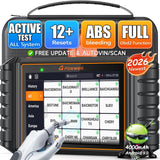 FOXWELL NT726 Bidirectional OBD2 Scanner
$368.99Compare rail pressure with desired.
FOXWELL NT726 Bidirectional OBD2 Scanner
$368.99Compare rail pressure with desired.
 FOXWELL NT614 Elite OBD2 Scanner
$233.69Compare rail pressure with desired.
FOXWELL NT614 Elite OBD2 Scanner
$233.69Compare rail pressure with desired.

Why P228D Is More Serious Than It Looks
GM classifies diagnostic trouble codes by type, and that classification tells you how the vehicle treats them. P228D is a Type A DTC. P0089 and P00C6, by contrast, are Type B.
The practical difference is that a Type A code illuminates the malfunction indicator lamp on the first failure rather than waiting for the fault to repeat on a second drive cycle. GM's own documentation for this code group adds that a message centre or indicator displays Reduced Engine Power when these codes set.
So P228D is not a code that crept up on you over weeks of intermittent behaviour. The engine hit the condition, GM's calibration treated it as significant enough to warn you immediately, and it pulled power to protect the engine. Excess rail pressure affects injector spray patterns and combustion, and the components holding that pressure are not designed to hold more of it indefinitely. This one deserves prompt diagnosis rather than a few months of driving around it.
There Is No Separate Fuel Pressure Regulator to Replace
This deserves its own section because it is the single most common misunderstanding about this code, and it leads people to shop for a part that does not exist on their vehicle.
On the Equinox's direct-injection engines, the regulating function is performed by an actuator that is part of the high-pressure fuel pump — a solenoid-controlled valve inside the pump housing. It is not separately serviceable. If the regulating function has genuinely failed, the pump is the assembly that gets replaced.
That is why "test the fuel pressure regulator and replace if faulty" is not actionable advice here. What you can test is the pump's response: command a pressure change with a bidirectional scan tool and watch whether the rail follows. What you cannot do is unbolt a regulator.
Worth knowing: some other GM engines genuinely do have fuel pressure regulator 1 and regulator 2 as distinct controlled devices, and P228D exists on those platforms too. Advice written for those vehicles reads as though a discrete regulator is in play. On an Equinox, it is not.
What Are the Symptoms of P228D on an Equinox?
- Check engine light on at the first occurrence — this is a Type A code
- Reduced Engine Power message and limp mode
- Delayed or flat acceleration; a plateau in the mid-range before power returns
- Rough idle, and in some cases the fault appearing only at idle or in gear once the engine is fully warm
- Hesitation, stumbling or stalling
- A whine from the high-pressure fuel pump — significant when it appears alongside P0089 after recent engine work
- Hard starting, particularly where P00C6 is stored too
- Intermittent behaviour tied to a tank of fuel, which points at contamination or water rather than hardware
- Companion codes: P0089, P228C, P00C6, P0191, P0087, P0088
What Causes P228D — and How Do You Confirm Each One?
| Cause | How to confirm it | Notes |
|---|---|---|
| Faulty valve, plunger or solenoid inside the high-pressure fuel pump | Command an increase and decrease in rail pressure with a scan tool and watch whether actual pressure follows. GM's own diagnostic aid warns that high-pressure pump damage will most likely be undetectable on visual inspection | The regulating actuator is internal to the pump |
| Fuel rail pressure sensor reporting inaccurately, or a corroded connector | Key on, engine off, actual pressure should read low. Inspect the connector for corrosion, moisture and terminal tension before condemning anything | Cheapest item on the list. A sensor over-reporting makes fine pressure look excessive |
| Water or contaminated fuel | GM notes this can set the DTC intermittently. Consider it strongly if the fault began after a particular fill-up | Below 0°C (32°F), GM also flags the fuel tank pickup screen icing over from water in the tank |
| Restricted fuel feed pipe between the high-pressure pump and the fuel rail pressure sensor | Inspect the high-pressure feed line for kinks, crush damage or restriction | Named directly in GM's diagnostic aids for this code group |
| Leak in the high-pressure section | Inspect the high-pressure circuit; a leak upsets regulation and can set codes in either direction | Also named in GM's diagnostic aids |
| Incorrect intake camshaft or actuator sprocket fitted during a previous repair | High side pressure at idle around 2,000–2,500 PSI, a pump whine, and P228D with P0089 following engine or camshaft work | GM preliminary information PIP5203A — see below |
| Camshaft timing out of position | The pump is driven by the intake camshaft and synchronised to it. Look for P0016, P0017, P0011 or P0014 in the same scan | A stretched chain shifts when the pump delivers |
| Too much or too little fuel in the low-pressure line | Check low-pressure supply behaviour rather than assuming the fault is entirely on the high side | GM lists low-side volume issues among the causes |
Fuel system parts
 ACDelco Fuel Rail Pressure Sensor
$98.99Pressure sensor, pump and injectors. Confirm fitment by VIN before ordering.
ACDelco Fuel Rail Pressure Sensor
$98.99Pressure sensor, pump and injectors. Confirm fitment by VIN before ordering.
 ACDelco Fuel Pressure Sensors, GM Genuine Parts
$138.99Pressure sensor, pump and injectors. Confirm fitment by VIN before ordering.
ACDelco Fuel Pressure Sensors, GM Genuine Parts
$138.99Pressure sensor, pump and injectors. Confirm fitment by VIN before ordering.


The After-a-Repair Case Worth Ruling Out First
If your Equinox started throwing P228D shortly after engine work, read this before authorising anything.
GM preliminary information PIP5203A covers 2010–2011 Chevrolet Equinox, GMC Terrain, Buick LaCrosse and Buick Regal with the 2.4L LAF engine. It describes technicians finding P0089 and P228D set together after replacing the engine, the intake camshaft, or the intake camshaft actuator. The signature is high side fuel pressure at idle of roughly 2,000–2,500 PSI, often with a whine from the high-pressure pump. GM adds that P0171 may also appear if incorrect injectors were installed.
The cause is not a component that has failed. It is that the intake camshaft and actuator sprocket fitted are not the correct parts for that vehicle's build. GM's confirmation step is to remove the camshaft cover and check the parts against the build.
That reframes the conversation entirely. It is a comeback on the previous repair, not a new fault, and it is worth taking the bulletin number to whoever did the work.
How Is P228D Diagnosed?
- Record every stored code and the freeze frame. P228C, P0089 and P00C6 alongside P228D each point somewhere different, and the freeze frame tells you the conditions when it set.
- Ask what work the vehicle has had. Recent engine or camshaft work makes PIP5203A the leading candidate on a 2.4L.
- Ask about the fuel. Onset after a specific fill-up, or in freezing weather, points at contamination, water or an iced tank pickup screen rather than hardware.
- Inspect the fuel rail pressure sensor connector for corrosion and terminal tension.
- Check rail pressure at idle. GM's verification figure on the 2.4L is approximately 1.9–2.1 MPa (279–305 psi) at idle, within a broader acceptable band of 1.9–5.0 MPa (276–725 psi). Pressure well above that at idle is your confirmation.
- Command an increase and decrease in fuel rail pressure with a scan tool and watch the sensor parameter move with each commanded state. This is the isolating test — it separates a pump that cannot regulate from a sensor that is misreporting.
- Inspect the high-pressure feed pipe between the pump and the rail pressure sensor for restriction, and check the high-pressure section for leaks.
- Check for timing codes. If P0016, P0017, P0011 or P0014 are present, resolve timing before touching the fuel system.
- Do not condemn the pump on appearance. GM says the damage is most likely undetectable visually — the pressure response test is what makes the call.
- Verify with a road test under the conditions from the freeze frame data before calling it fixed.
Parts and Cost
| Scenario | What it involves | Cost picture |
|---|---|---|
| Contaminated or watered fuel | Drain and refill; address the tank pickup screen if iced | The cheapest outcome, and genuinely possible |
| Sensor connector cleaning or repair | Contact cleaner, terminal work | Often folded into diagnosis |
| Fuel rail pressure sensor | Order by VIN | Sensor plus modest labour |
| Restricted or damaged high-pressure feed pipe | Inspect and replace the pipe between pump and rail | Moderate; far cheaper than a pump |
| High-pressure fuel pump, 2.4L | GM 12641847 — the regulating actuator comes with it | Pump plus labour |
| Correcting incorrect camshaft or actuator parts | Camshaft cover off, verify against build, fit correct parts | Depends on what was fitted — and arguably on who fitted it |
| High-pressure fuel pump, 1.5L or 2.0L turbo | Order by VIN | High-pressure fuel work carries real fire risk — not a beginner job |
The order above is deliberate. Three of the cheapest possibilities — bad fuel, a corroded connector and a restricted feed pipe — are all named in GM's own diagnostic aids for this code, and all three get skipped by a diagnosis that jumps straight to the pump.
Service items
 ACDelco Fuel Injector O-Rings, ACDelco GM Genuine Parts Fuel
$120.99Seals, cleaner and connector repair. Confirm fitment by VIN before ordering.
ACDelco Fuel Injector O-Rings, ACDelco GM Genuine Parts Fuel
$120.99Seals, cleaner and connector repair. Confirm fitment by VIN before ordering.
 BG 44K Fuel System Cleaner Power Enhancer 11oz.
$24.95Seals, cleaner and connector repair. Confirm fitment by VIN before ordering.
BG 44K Fuel System Cleaner Power Enhancer 11oz.
$24.95Seals, cleaner and connector repair. Confirm fitment by VIN before ordering.
 ACDelco Wire Connectors, Replacement, 2 Pins
$90.99Seals, cleaner and connector repair. Confirm fitment by VIN before ordering.
ACDelco Wire Connectors, Replacement, 2 Pins
$90.99Seals, cleaner and connector repair. Confirm fitment by VIN before ordering.


GM Documents Behind P228D on the Equinox
| Document | Date | Subject | Equinox coverage |
|---|---|---|---|
| PIP5203A | Jul 2014 | Poor engine performance, P0089, P228D, P0171, whine from the high-pressure fuel pump — incorrect intake camshaft or actuator sprocket fitted | Equinox 2010–2011, 2.4L LAF |
| PIP5385 | Mar 2016 | Repeat P228C on High Feature V6 engines while using E85, where the vehicle has a prior history of high-pressure fuel pump replacement | Equinox 2011–2014, V6 (LF1 / LFW / LFX) with E85 capability |
| 12313A — Special Coverage | Jul 2013 | Balance chain wear and fuel pump seal failure; names pump part 12641847. 10 yrs / 120,000 mi, now expired | Equinox 2010–2011, 2.4L LAF |
| 43180 — Emission Recall | — | High-pressure pump plunger shaft and seal wear letting fuel into the crankcase | Equinox 2010–2011, 2.4L |
PIP5385 is worth a note even though it names P228C rather than P228D: if you run E85 in a V6 Equinox that has already had a high-pressure pump replaced, GM has documented repeat pressure-regulation codes in exactly that combination. It is a narrow case, but it is a real one and it is not a hardware fault to chase indefinitely.
What Other P228D Pages Get Wrong
- "A clogged fuel filter causes P228D." This one is backwards, and it appears everywhere. A restriction in the fuel supply reduces the fuel available to the pump — it pushes pressure down, toward P228C or P0087. It does not create 435 psi of excess pressure the ECM cannot bleed off. A filter is worth inspecting as general maintenance; it is not a mechanism for this code.
- "Test the fuel pressure regulator and replace it if faulty." There is no separately serviceable regulator on the Equinox's direct-injection engines. The regulating actuator is a solenoid valve inside the high-pressure pump. Advice naming a discrete regulator has been carried over from GM platforms that genuinely have one.
- "Inspect the pump for damage." GM's own diagnostic aid states that high-pressure fuel pump damage will most likely be undetectable on visual inspection. Looking at it proves nothing either way; commanding a pressure change and watching the response is the test.
- Quoting a single duration as though it were universal. The 435 psi deviation is consistent, but the qualifying time appears as 5 seconds, 10 seconds, or a 750-of-938-count window depending on which service information revision applies to your vehicle.
- Skipping fuel quality. GM explicitly names water and contaminated fuel as an intermittent cause, and an iced tank pickup screen below freezing. If the code arrived with a tank of fuel, start there.
- Treating P228D as interchangeable with P0089. P228D is Type A and lights the lamp immediately; P0089 is Type B. They also measure different things — actual pressure versus actuator control effort.
We publish thresholds, part numbers and code classifications only where we could read them in GM's own documentation, and we say so where GM's own revisions disagree.
Frequently Asked Questions
Is it safe to drive with P228D active?
Not for long. This is a Type A code, so the light came on at the first failure, and GM's documentation notes a Reduced Engine Power message accompanies this code group. Between the power limitation itself and the risk to injectors and high-pressure components from sustained excess pressure, get it diagnosed rather than driving on it for weeks.
Could this be a false code with no real problem?
It can be a sensor problem rather than a pressure problem, which is not quite the same thing as a false code. A fuel rail pressure sensor over-reporting, or a corroded connector, produces a genuine mismatch from perfectly normal pressure. Water or contaminated fuel can also set it intermittently. Confirm with actual pressure readings before assuming either way.
Does this always mean the fuel pump needs replacing?
No. GM's own diagnostic aids for this code name contaminated fuel, a restricted feed pipe between the pump and the rail sensor, and a leak in the high-pressure section — all before you get to internal pump failure. And on a 2010–2011 2.4L that has had recent engine work, PIP5203A points at incorrect camshaft parts rather than any pump fault.
What should fuel rail pressure read at idle?
GM's verification figure on the 2.4L is approximately 1.9–2.1 MPa (279–305 psi) with the engine idling, within a wider acceptable band of 1.9–5.0 MPa. Across the full operating range the ECM requests between 2 and 15 MPa (290 to 2,176 psi) depending on speed and load. Readings around 2,000–2,500 PSI at idle are the specific signature GM ties to incorrect camshaft parts.
Why does my Equinox only do this once it's warmed up, or only at idle?
That pattern has been reported on this platform, and it fits a regulation fault that only exceeds the threshold under a narrow set of conditions — which is exactly why the freeze frame data matters. Note the conditions when it sets and reproduce them during verification rather than testing at a fast idle where the fault disappears.
Can bad fuel really cause this?
Yes, and GM says so. Water or contaminated fuel is listed as an intermittent cause, and in ambient temperatures below 0°C (32°F) GM also flags the fuel tank pickup screen icing over from water in the tank. If the code appeared right after a fill-up or the first hard freeze, that is a real lead.
What does the Type A classification actually mean?
It determines how quickly the vehicle warns you. A Type A DTC illuminates the malfunction indicator lamp on the first failed drive cycle rather than requiring the fault to repeat. P228D and P228C are Type A; P0089 and P00C6 are Type B. It is a reasonable proxy for how seriously GM's calibration treats the condition.
Does P228D affect the turbo engines too?
Yes — the 1.5L and 2.0L turbo engines use the same architecture, a camshaft-driven high-pressure pump with an integrated regulating actuator, so the code means the same thing. The specific figures quoted above come from GM's 2.4L service information, so treat them as the correct shape rather than as exact values for a different engine, and note that the 2023-onward 1.5L LSD runs a substantially higher-pressure system again.
Shop the Parts Mentioned
-
 MOTOPOWER MP69033 OBD2 Scanner — $49, reads and clears P228D and shows freeze-frame data from when the fault set.
-
 VDIAGTOOL BT500 Battery Tester — $57.53, tests battery health, cranking and charging on 6V/12V/24V systems with ripple analysis and a voltage waveform — confirms the battery and charging system are healthy before you chase a sensor or circuit fault.
-
 95-Piece Mechanics Tool Set (Metric & SAE) — covers fasteners for fuel system component access.
-
 ACDelco Gold Negative Battery Cable — for replacing a corroded or damaged negative cable, a common source of intermittent electrical faults.
-
 ACDelco GM OE dexos1 GEN 2 Full Synthetic 5W-30 Motor Oil (1 qt) — good practice while doing broader engine bay work.