
Short version: PF63 is the tall spin-on for GM's 3.6L V6 and the Gen V 5.3L/6.2L EcoTec3 V8. PF64 is the short spin-on for 2.0L turbo, 2.5L four-cylinder and the LT1 6.2L. PF48E covers the older 4.8L–6.2L V8s. PF66 is the newest one, for the 2.7L turbo, 2.0L turbo and 3.0L Duramax.
Those four numbers cover the overwhelming majority of GM engines built in the last twenty years, and the reason people get them wrong is that three of them look nearly identical on a shelf. They are not interchangeable. Below is the cross-reference chart nobody has bothered to publish, the physical differences that matter, and how to confirm the number for your specific VIN before you buy oil filters and fluids for your GM.
Parts and tools you'll need
- Oil filters, engine oil and maintenance parts for your GM — filter by engine, not just model
- A cap-style filter wrench sized to your filter's can diameter (a strap wrench will crush a thin-shell filter)
- Full-synthetic oil to your engine's specification — most modern GM gas engines call for dexos-approved oil
- A replacement drain plug gasket, and a few shop rags for the filter mount
ACDelco oil filters
 ACDelco PF63 Oil Filter 19363567 2-Pack for GM 5.3L/6.2L V8
$13.89ACDelco PF-series oil filters. Confirm fitment by VIN before ordering.
ACDelco PF63 Oil Filter 19363567 2-Pack for GM 5.3L/6.2L V8
$13.89ACDelco PF-series oil filters. Confirm fitment by VIN before ordering.
 ACDelco GM Original Equipment PF64 (25206966) Oil Filter
$13.89ACDelco PF-series oil filters. Confirm fitment by VIN before ordering.
ACDelco GM Original Equipment PF64 (25206966) Oil Filter
$13.89ACDelco PF-series oil filters. Confirm fitment by VIN before ordering.
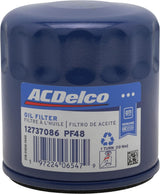 ACDelco PF48 Oil Filter 12737086
$19.49ACDelco PF-series oil filters. Confirm fitment by VIN before ordering.
ACDelco PF48 Oil Filter 12737086
$19.49ACDelco PF-series oil filters. Confirm fitment by VIN before ordering.
 ACDelco dexosD 0W-20 Diesel Oil Change Kit
$125.46ACDelco PF-series oil filters. Confirm fitment by VIN before ordering.
ACDelco dexosD 0W-20 Diesel Oil Change Kit
$125.46ACDelco PF-series oil filters. Confirm fitment by VIN before ordering.


What do the ACDelco PF numbers actually mean?
PF is simply ACDelco's prefix for engine oil filters. The number after it is a catalog sequence, not a size code — PF64 is not "one bigger" than PF63. An E suffix, as in PF48E or PF46E, appears on the current service part numbers for several of these filters and you will see both forms in listings for the same application.
That is the whole naming logic. There is no pattern you can reason from, which is exactly why forum threads about this topic run forty pages long and why the safest move is a chart plus a VIN lookup.
What does carry over between them is construction. ACDelco lists a 30-micron rating on PF63, PF46E and PF48E, with an anti-drain-back valve and a bypass relief valve on all of them. The differences that matter are physical: thread size, gasket diameter, and can height.
Which ACDelco filter fits a 5.3L V8?
It depends on the generation, and "5.3L" alone is not enough. The Gen V EcoTec3 5.3L (2014 and up trucks and SUVs) takes PF63. Older Gen III and Gen IV 5.3L engines take PF46E or PF48E depending on year and application. Same displacement, three different filters.
ACDelco's catalog lists PF63 across Chevrolet Silverado 1500 from 2014 through 2025 and Cadillac Escalade from 2015 through 2024, alongside the 3.6L V6 applications. PF46E is listed for 5.3L, 5.7L and 6.0L V8s across roughly 1996 to 2012, including Silverado 1500, Sierra 1500, Escalade, Envoy and the LS-powered Corvette and Camaro. PF48E is listed for 4.8L through 6.2L V8s spanning roughly 2006 to 2024, covering Tahoe, Suburban, Silverado 1500/2500HD/3500HD, Express and Savana vans, Yukon and Sierra.
Those windows overlap on purpose — GM changed filter mounts and service numbers mid-generation on several engine families, and the vans in particular kept older hardware long after the pickups moved on. Do not assume that because your neighbor's 5.3L takes one number, yours does. Look yours up.
What is the difference between PF63 and PF64?
Height, mostly. PF63 is a tall filter — ACDelco lists a 4.44 in (112.8 mm) filter height with an M22 x 1.5 thread, a 2.77 in (70.4 mm) gasket outside diameter and a 2.46 in (62.4 mm) gasket inside diameter. PF64 is a short can; catalog listings put its overall packaged length at about 3.38 in.
That difference is not cosmetic. A taller can holds more media and more oil, and on engines where the filter mounts horizontally near a crossmember, the taller filter physically will not fit. Threading a PF64 onto an engine that wants a PF63 will seal and run, and you will simply have less filtration capacity than the engine was designed around.
The applications split cleanly. PF63 covers LFW and LF1 3.0L V6, LFX 3.6L V6, LF3 twin-turbo 3.6L V6, the 5.3L and 6.2L EcoTec3 V8s, and the 4.4L V8 from the Cadillac XLR. PF64 — GM cross-reference 12670058 — covers 2.0L turbo four-cylinders, the 2.5L four, some 3.6L V6 applications and the 6.2L LT1, roughly 2013 through 2019, across Cruze, Malibu, Impala, Equinox, Colorado, Corvette, Encore, Regal, Envision, LaCrosse, Terrain, ATS and CTS.
Notice that both lists include a 3.6L V6 and both include a 6.2L V8. This is the single most common cross-reference mistake in the GM catalog. The 6.2L in a truck is not the 6.2L in a Corvette, and the 3.6L that takes PF63 is not necessarily the 3.6L in your car. Engine code, not displacement.
Where does PF48 fit?
PF48E is the current service number for the older pushrod V8 family, listed by ACDelco for 4.8L through 6.2L engines across model years roughly 2006 to 2024. GM cross-references include 12690386, 19303975 and 12710960. It carries 30-micron polyester media with an anti-drain-back valve and a bypass relief valve.
You will see both PF48 and PF48E in listings, often for the same vehicle. Buy the number that ACDelco's own lookup returns for your VIN rather than the one in the listing title, and if a seller shows no ACDelco number at all, skip the listing.
The application list for PF48E is long and includes several non-GM vehicles — Ram, Charger, 300, Compass and others — because the filter's thread and gasket dimensions are common. That is worth knowing, because it means availability is excellent, but it also means the listing you land on may have been written for a Dodge.
What is PF66 for?
PF66 is the newest filter in this group and covers GM's current small-displacement engines: the 2.7L turbo four in the 2019–2025 Silverado 1500 and Sierra, the 2.0L turbo in Blazer, XT4, CT4 and CT5, and the 3.0L Duramax inline-six diesel in the 2021–2024 Escalade. Encore GX, Envision, Enclave and Acadia applications also appear.
If you bought a half-ton with the 2.7L four-cylinder expecting it to share filters with the 5.3L, it does not. Same truck, same year, different filter entirely. This trips up shops as often as it trips up owners.
The 6.6L Duramax V8 in the heavy-duty trucks is a separate case again — it uses a much larger filter in the PF2232 family, and the correct number varies by engine generation (LB7, LLY, LBZ, LMM, LML, L5P). Look that one up by engine code specifically; do not order it off a year-and-model filter.
Oil for the change
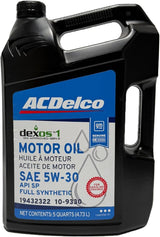 ACDelco 10-9330 dexos1 Gen 3 Full Synthetic 5W-30 Oil
$58.95dexos-approved oil to go with the filter.
ACDelco 10-9330 dexos1 Gen 3 Full Synthetic 5W-30 Oil
$58.95dexos-approved oil to go with the filter.
 GM ACDelco 109326 0W-20 dexos1 Gen 3 Full Synthetic Motor Oil
$109.99dexos-approved oil to go with the filter.
GM ACDelco 109326 0W-20 dexos1 Gen 3 Full Synthetic Motor Oil
$109.99dexos-approved oil to go with the filter.
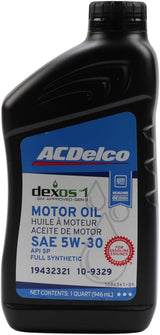 ACDelco 10-9329 dexos1 Gen 3 5W-30 Oil, 1 Qt
$16.99dexos-approved oil to go with the filter.
ACDelco 10-9329 dexos1 Gen 3 5W-30 Oil, 1 Qt
$16.99dexos-approved oil to go with the filter.
 ACDelco dexos1 Gen 3 0W-20 Full Synthetic Oil 10-9322
$79.99dexos-approved oil to go with the filter.
ACDelco dexos1 Gen 3 0W-20 Full Synthetic Oil 10-9322
$79.99dexos-approved oil to go with the filter.


ACDelco oil filter cross-reference chart
Every entry below comes from ACDelco catalog listings. Where a specification is not published, the cell says so rather than filling in a plausible-looking number.
| ACDelco number | GM cross-reference | Engines covered | Typical years | Key specs |
|---|---|---|---|---|
| PF63 | Not published on retail listings | 3.0L V6 (LFW, LF1), 3.6L V6 (LFX), 3.6L twin-turbo (LF3), 5.3L and 6.2L EcoTec3 V8, 4.4L V8 (XLR) | 2006–2025 depending on application | M22 x 1.5 thread; 30 micron; gasket OD 2.77 in (70.4 mm), ID 2.46 in (62.4 mm); height 4.44 in (112.8 mm) |
| PF64 | 12670058 | 2.0L turbo, 2.5L I4, 3.6L V6 (select), 6.2L LT1 V8 | Approx. 2013–2019 | Spin-on; short can, approx. 3.38 in packaged length; thread and micron rating not published |
| PF46E | 19210283 | 2.4L I4, 5.3L, 5.7L and 6.0L V8 (Gen III / Gen IV) | Approx. 1996–2012 | Spin-on; 30 micron; anti-drain-back valve |
| PF48E | 12690386, 19303975, 12710960 | 4.8L, 5.3L, 6.0L and 6.2L V8 | Approx. 2006–2024 | Spin-on; 30 micron polyester media; anti-drain-back and bypass relief valves |
| PF66 | Not published on retail listings | 2.7L turbo I4 (L3B), 2.0L turbo I4, 3.0L Duramax I6 diesel | 2019–2025 | Spin-on; dimensions not published |
| PF2232 family | Varies by engine generation | 6.6L Duramax V8 diesel | 2001–2019 and later, by engine code | Large-body diesel filter; confirm by LB7 / LLY / LBZ / LMM / LML / L5P |
How do you confirm the right filter for your exact vehicle?
Use three checks, in this order, and stop when two of them agree. First, the eighth character of your VIN identifies the engine. Second, the RPO label in your glovebox lists the engine code directly. Third, ACDelco's own online catalog will return the current service number for that combination.
If the chart above and your VIN lookup disagree, trust the VIN lookup. Catalogs get revised, engines get swapped, and a truck that has had an engine replacement may need the filter for the engine that is actually in it rather than the one it left the factory with.
One more practical check: pull your old filter and read it. If the previous owner or shop used an ACDelco filter, the number is printed on the can, and that is a data point worth more than any listing. It is not proof — people install the wrong filter all the time — but combined with the VIN it usually settles the question.
Can you use a Fram, Wix or Mobil 1 equivalent instead?
Yes, and for most drivers on a normal interval it will be fine. Every major filter brand publishes a cross-reference to the ACDelco number, and the mainstream options from Wix, Purolator, Bosch and Mobil 1 meet or exceed the OE construction on the specs that matter: media area, bypass valve setting and anti-drain-back valve material.
Two cautions. First, cross-reference charts from filter manufacturers are built around thread and gasket dimensions, which means a chart can tell you a filter will thread on when it is physically too tall for your engine bay. Check the can height, not just the cross-reference. Second, the cheapest tier from any brand typically uses a rubber-flap anti-drain-back valve that hardens over time, and that shows up as a rattle at cold start on engines with a horizontal filter mount.
If you are running extended oil change intervals based on the oil life monitor, the filter matters more than it does on a fixed 3,000-mile schedule. That is the one case where paying for the OE filter or a premium aftermarket equivalent is straightforwardly worth it. Our breakdown of what GM actually specifies for the 5.3L covers the oil side of the same decision, and our guide to dexos1 Gen 3, dexos2 and dexosD explains which specification your engine actually requires.
How do you change a GM spin-on filter cleanly?
The filter mounts near the front of the block on most of these engines, and on trucks it sits directly above the frame rail. Half of the mess people make is avoidable with two minutes of setup.
- Run the engine for three or four minutes so the oil flows, then shut it off and let it sit for ten so the filter drains back down.
- Position the drain pan under the drain plug, remove the plug, and let the oil drain fully.
- Slide a piece of cardboard or a shallow secondary pan under the filter before you break it loose — the filter will dump down the side of the block, not straight into your main pan.
- Loosen the filter with a cap wrench sized to the can. Once it breaks free, turn it by hand and keep it upright as it comes off.
- Check that the old gasket came off with the filter. A gasket left stuck to the mount will double up against the new one and blow out on the first start.
- Wipe the mounting surface clean with a lint-free rag.
- Smear a film of fresh oil on the new filter's gasket. Do not fill the filter with oil on a horizontal mount — it will just spill.
- Thread the new filter on by hand until the gasket contacts, then tighten by the amount printed on the filter can. Most are hand-tight plus roughly three quarters of a turn; follow the can, not a generic figure.
- Fit a new drain plug gasket and torque the plug to your engine's specification — check your owner's manual, because the aluminum pans on newer engines are easy to strip.
- Refill with the correct quantity and grade of oil, start the engine, and watch for the oil pressure light to go out within a couple of seconds.
- Shut it off, wait a minute, check the level and check the filter for leaks.
- Reset the oil life monitor.
The full sequence, including the reset procedure for different GM instrument clusters, is in our GM oil change walkthrough. While the engine is cool and you are already under the hood, it is worth checking coolant condition too — our guide to GM coolant types and what not to mix covers the one fluid mistake that is genuinely expensive.
Tools for the oil change
 ACDelco Tools Torque Wrenches, Digital LCD Display, 1/2 in.
$162.99Torque and hand tools for the oil change.
ACDelco Tools Torque Wrenches, Digital LCD Display, 1/2 in.
$162.99Torque and hand tools for the oil change.
 ACDelco Tools Torque Wrenches, Digital LCD Display, 3/8 in.
$249.99Torque and hand tools for the oil change.
ACDelco Tools Torque Wrenches, Digital LCD Display, 3/8 in.
$249.99Torque and hand tools for the oil change.
 APOLLO TOOLS - DT0004-50 Piece ¼” Drive Socket Set
$54.99Torque and hand tools for the oil change.
APOLLO TOOLS - DT0004-50 Piece ¼” Drive Socket Set
$54.99Torque and hand tools for the oil change.


What to check before you order
Filters are cheap, which makes people careless about them. Four checks and you will not be one of them.
- Engine code, not displacement. Read the eighth VIN character or the RPO label. A 5.3L takes three different filters depending on generation, and a 6.2L takes two.
- Model year against the application window. The 2014 model year is the hinge for GM's V8 trucks; 2019 is the hinge for the small turbo engines.
- Can height, if you are cross-referencing to another brand. A cross-reference confirms the thread. It does not confirm clearance.
- Buy the drain plug gasket with the filter. It costs almost nothing and it is the part you notice missing when the truck is already on stands.
Also worth saying plainly: if the engine has been apart, or the vehicle has an engine that did not come with it, none of the year-and-model lookups apply. Match the filter to the engine in front of you.
Frequently Asked Questions
What oil filter does a 5.3L V8 take?
It depends on the generation, and displacement alone is not enough. The Gen V EcoTec3 5.3L in 2014-and-newer trucks and SUVs takes PF63. Older Gen III and Gen IV 5.3L engines take PF46E or PF48E depending on year and application. Same displacement, three different filters.
What is the difference between PF63 and PF64?
Height, mainly. PF63 is a tall can at 4.44 in with an M22 x 1.5 thread; PF64 is a short can at roughly 3.38 in packaged length. A PF64 will thread onto an engine that wants a PF63 and run — you simply get less filtration capacity than the engine was designed around.
Why do PF63 and PF64 both list a 3.6L V6 and a 6.2L V8?
Because displacement is not the identifier. The 6.2L in a truck is not the 6.2L in a Corvette, and the 3.6L taking PF63 is not necessarily the 3.6L in your car. This is the most common cross-reference mistake in the GM catalogue — match on engine code, not litres.
Does the 2.7L turbo use the same filter as the 5.3L?
No. The 2.7L turbo four in 2019-2025 Silverado and Sierra takes PF66, while the 5.3L takes PF63. Same truck, same model year, entirely different filter. This catches shops as often as owners.
What do the ACDelco PF numbers mean?
PF is just ACDelco's oil filter prefix, and the number is a catalogue sequence rather than a size code — PF64 is not one size larger than PF63. An E suffix appears on current service numbers for several filters, so you will see both PF48 and PF48E for the same application.
How do I confirm the right filter for my vehicle?
Three checks: the eighth character of your VIN identifies the engine, the RPO label in your glovebox lists the engine code, and ACDelco's catalogue returns the current service number for that combination. If a chart and your VIN lookup disagree, trust the VIN.
Can I use a Fram, Wix or Mobil 1 filter instead?
Yes, and on a normal interval it will be fine — mainstream options from the major brands meet or exceed OE construction. Two cautions: cross-references are built on thread and gasket dimensions, so check can height for clearance, and the cheapest tier often uses an anti-drain-back valve that hardens and rattles at cold start.
Does the filter matter more on extended oil change intervals?
Yes. If you run to the oil life monitor rather than a fixed 3,000 miles, the filter is working considerably longer, and that is the one case where the OE filter or a premium equivalent is straightforwardly worth the money.
How tight should a spin-on oil filter be?
Follow the instruction printed on the can, not a generic figure. Most call for hand-tight until the gasket contacts, then roughly three quarters of a turn. Check the old gasket came off with the old filter — one left stuck on the mount will double up and blow out on the first start.
What filter does the 6.6L Duramax take?
Not any of the four covered here — it uses a much larger filter in the PF2232 family, and the correct number varies by engine generation (LB7, LLY, LBZ, LMM, LML, L5P). Look it up by engine code specifically rather than by year and model.
A Note on Sourcing
Part numbers, application ranges and published dimensions come from ACDelco catalogue listings. Where a specification is not published — PF64's thread and micron rating, PF66's dimensions, GM cross-references for PF63 and PF66 — the chart says so rather than filling in a plausible-looking figure. An unsourced number in a cross-reference chart is worse than a blank cell.
Application year ranges overlap because GM changed filter mounts and service numbers mid-generation on several engine families, and the vans in particular retained older hardware after the pickups moved on. That is why this page insists on engine code rather than year and model.
Part numbers supersede. If ACDelco's own VIN lookup disagrees with the chart above, the lookup is current and the chart is not.
The filter brand guidance and the note about anti-drain-back valve quality are our own assessment, based on how these filters behave in service rather than on manufacturer claims. We sell filters, and the position here is that a mainstream aftermarket filter is fine for most drivers on a normal interval.
Will this filter fit your GM?
Check your year, model and engine code before you order — on GM's V8s especially, displacement alone will send you the wrong part. Pull the RPO label from your glovebox, confirm the engine, then match it to the chart above.
When you have the number, filter oil filters and maintenance fluids for your engine by application and buy the oil in the same order so you are not making two trips. There are more GM maintenance guides covering the rest of the service schedule.