
Modern GM vehicles use four main bolt patterns: 6x139.7 (6x5.5 in) on half-ton trucks and full-size SUVs, 6x120 on the 2015–2022 Colorado and several crossovers, 8x180 on 2011-and-newer HD trucks, and 5x120 or 5x10⁵ on cars and compact crossovers. They are not interchangeable, and two of them are close enough to be dangerous.
Bolt pattern alone does not make a wheel fit. Offset, center bore, brake caliper clearance and load rating all have to line up too. Before you order wheels and tires for your Chevrolet, GMC, Buick or Cadillac, get all four numbers for your specific vehicle rather than just the lug count.
Parts and tools you'll need
- Wheels, tires, hub rings, lug nuts and TPMS sensors — hub-centric rings and the correct seat-style lug nuts are not optional extras
- Chevrolet-specific parts and accessories or the GMC equivalent for model-specific hardware
- A tape measure or caliper, and a straightedge if you are measuring backspacing on a wheel you already own
- A torque wrench. Not an impact gun, and not a breaker bar and your best guess
Wheels and hub parts
 KMC KM545 Trek 17x9 Satin Black Wheel 54579077418
$351.99Check bolt pattern, offset and center bore before you order. Confirm fitment by VIN before ordering.
KMC KM545 Trek 17x9 Satin Black Wheel 54579077418
$351.99Check bolt pattern, offset and center bore before you order. Confirm fitment by VIN before ordering.
 KMC KM549 GRS 18x8.5 Silver Machined Wheel 54988580500
$514.99Check bolt pattern, offset and center bore before you order. Confirm fitment by VIN before ordering.
KMC KM549 GRS 18x8.5 Silver Machined Wheel 54988580500
$514.99Check bolt pattern, offset and center bore before you order. Confirm fitment by VIN before ordering.
 KMC KM552 IMS 18x9 Matte Black Simulated Beadlock Wheel S1710
$514.99Check bolt pattern, offset and center bore before you order. Confirm fitment by VIN before ordering.
KMC KM552 IMS 18x9 Matte Black Simulated Beadlock Wheel S1710
$514.99Check bolt pattern, offset and center bore before you order. Confirm fitment by VIN before ordering.
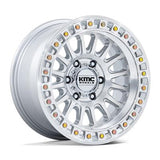 KMC KM552 IMS 17x8.5 Gloss Silver Machined Simulated Beadlock
$544.99Check bolt pattern, offset and center bore before you order. Confirm fitment by VIN before ordering.
KMC KM552 IMS 17x8.5 Gloss Silver Machined Simulated Beadlock
$544.99Check bolt pattern, offset and center bore before you order. Confirm fitment by VIN before ordering.


What do the numbers in a bolt pattern mean?
The first number is how many studs. The second is the diameter of the circle their centers sit on, in millimeters or inches. So 6x139.7 means six studs on a 139.7 mm circle, which is the same thing as 6x5.5 in. A 6x120 wheel has the same stud count and a smaller circle, and it will not bolt on.
Patterns with an even number of studs are easy to measure: go center to center across the circle, directly opposite. Five-lug patterns are harder because no two studs are directly across from each other, which is why people misread them.
This matters most with GM specifically, because GM used both 5x120.65 — the old imperial 5x4.75 in pattern — and the metric 5x120 on different vehicles. Those two are 0.65 mm apart. A wheel can be forced onto the wrong one and the studs will not center in the wheel's holes, which loads them in shear instead of clamping the wheel flat. That is a wheel-off failure waiting for a highway on-ramp.
Which GM vehicles use which bolt pattern?
Trucks and full-size SUVs use 6x139.7. HD trucks from 2011 on use 8x180. The mid-size Colorado moved between patterns across generations. Compact cars and small crossovers use 5x10⁵, and a range of GM cars and crossovers use 5x120. Always verify against your own vehicle before ordering.
| Bolt pattern | Imperial | Common GM applications | Typical center bore | Stud thread |
|---|---|---|---|---|
| 6x139.7 | 6x5.5 in | Silverado 1500 2014–2026, Colorado 2004–2012 and 2023 on, Avalanche, older K1500, full-size SUVs | 78.1 mm is common on GM half-tons | Verify by vehicle |
| 6x120 | — | Colorado 2015–2023, Blazer 2019–2026, Traverse 2018–2026, Equinox EV 2024–2026, Cadillac XT5, XT6, SRX | 66.9 mm on most, 74.5 mm on some | Verify by vehicle |
| 8x180 | — | Silverado and Sierra 2500HD and 3500HD, 2011 and newer | 124.1 mm | M14 x 1.5 |
| 5x120 | — | A range of GM cars and crossovers, including the 2010-and-newer Camaro | 72.6 mm most common; 64.1 and 67.1 mm also used | Verify by vehicle |
| 5x120.65 | 5x4.75 in | Corvette 1953–1982 and 1984–2019, Camaro 1967–2002, classic Impala, Nova, Malibu, El Camino | 70.3 mm on the large majority | 7/16 in-20 UNF or M12 x 1.5 |
| 5x10⁵ | — | Cruze, Sonic, Aveo, Cavalier, Trax 2013–2022, Volt, Bolt EV and Bolt EUV, Buick Encore 2012–2024 | 56.6 mm | M12 x 1.5 |
The Colorado is the one that catches people out. The first-generation truck used the six-on-5.5-inch truck pattern, the second generation moved to 6x120, and the current generation went back to 6x139.7. A set of takeoffs from a 2019 Colorado does not fit a 2024 Colorado, even though it is the same nameplate and looks similar in the bed.
The Corvette is the other. GM ran the imperial 5x4.75 in pattern on the Corvette for decades, right through 2019. If you are shopping wheels for a C7 and a listing says 5x120, stop and confirm — 5x120 and 5x120.65 are different patterns and the difference does not show up in a photo.
What is wheel offset, and how much can you change it?
Offset is the distance in millimeters from the wheel's mounting face to its centerline. Positive offset moves the mounting face outboard, tucking the wheel further under the vehicle. Negative offset pushes the wheel out. GM factory offsets on trucks and SUVs generally sit in the mid-20s.
| Vehicle | Factory wheel | Factory offset |
|---|---|---|
| 2024 Silverado 1500 | 8Jx17 | ET24 |
| 2024 Silverado 1500 | 8.5Jx18 | ET26 |
| 2024 Silverado 1500 | 9Jx20 and 9Jx22 | ET28 |
| 2024 Tahoe | 8.5Jx18 | ET26 |
| 2024 Tahoe | 9Jx20 and 9Jx22 | ET28 |
| 2024 Colorado | Factory sizes | Roughly ET22 to ET30 |
| 2023 Camaro | 8.5Jx18 | ET32 |
| 2023 Camaro | 8.5Jx20 | ET25 |
| 2024 Corvette Z06 | 10Jx20 front | ET35 |
| 2024 Corvette Z06 | 13Jx21 rear | ET40 |
Those are the numbers to measure your aftermarket choice against. A 20-inch wheel at ET28 sits where the factory intended. The same wheel at ET-12 pushes the tire outward by 40 mm — about an inch and a half — which changes scrub radius, loads the wheel bearing differently, and puts the tread outside the fender on most trucks.
How far you can go before something bad happens depends on the vehicle, the tire, the suspension and how much you care. A modest reduction of 10 to 15 mm is usually tolerable on a truck. Dropping 40 mm or more is a deliberate style choice with real mechanical consequences, not a free change.
What actually goes wrong with aggressive offsets: rubbing at full lock or over bumps, accelerated wheel bearing wear from the increased lever arm, steering that pulls under braking or on grooved pavement, and stones thrown into the fender liner. None of it happens the day you install them. All of it happens eventually.
Offset is also the single biggest reason people get contradictory answers about tire fitment, since the same size can tuck neatly on factory wheels and rub badly on aggressive ones. If a larger tire is the actual goal, our guide to which tire sizes fit a Silverado by generation works through the clearance math alongside these offset figures.
Offset or backspacing — which number should you use?
Use offset if you are buying new wheels, because that is how they are marked. Use backspacing if you are measuring a wheel you already have or checking clearance to a suspension component. Backspacing is measured from the mounting face to the inboard rim edge, so it includes wheel width.
The practical difference: two wheels can share the same offset and have very different backspacing if their widths differ, and it is backspacing that determines whether the inner edge of the tire hits your upper control arm. If you are running a lift, larger tires, or aftermarket suspension, backspacing is the number that decides whether you have a problem.
Wider is not automatically better. A 10-inch wheel at the factory offset moves the inner edge inward by an inch compared with a 9-inch wheel at the same offset. That inch is often where the sway bar end link lives.
What is center bore, and does it matter?
Center bore is the diameter of the hole in the middle of the wheel. On a hub-centric setup the hub's machined flange carries the wheel's weight and centers it precisely. GM vehicles are hub-centric from the factory: 78.1 mm is common on half-ton trucks, 124.1 mm on HD trucks, 66.9 mm on many 6x120 crossovers, 56.6 mm on the 5x10⁵ cars.
Aftermarket wheels are usually made with an oversized bore so one casting can fit several vehicles. That is fine as long as you use hub-centric rings — plastic or aluminum sleeves that take up the difference and let the hub do the centering. Skipping them means the lug nuts are centering the wheel, which they can do, but not as precisely.
If you have a persistent vibration after new wheels that balancing will not cure, missing or wrong-sized hub rings are one of the first things to check. Our guide on why GM vehicles shake at highway speeds walks through the rest of the causes in order.
What about lug nuts and seat type?
Lug nuts have to match both the stud thread and the wheel's seat. GM uses M14 x 1.5 studs on HD trucks and M12 x 1.5 on the 5x10⁵ cars; other lines vary, so check yours. The seat can be conical, ball or flat with a washer, and the wrong one will not clamp properly no matter how hard you torque it.
Factory GM lug nuts on many models are two-piece with a stainless cap over a steel body. Those caps swell when moisture gets under them, and then your socket no longer fits. If yours are swollen, replace them rather than hammering a smaller socket on — you will round the cap and end up cutting the nut off at the side of the road.
Aftermarket wheels almost always need different lug nuts than the factory wheels, because the seat and the shank length change. Buy them with the wheels, not after you discover the old ones bottom out.
What torque should you use?
Lug torque varies by wheel type, stud size and model year, and GM publishes different figures for different vehicles. Check the placard on your driver's door jamb or your owner's manual before you tighten anything, and do not rely on a generic figure you found on a forum. A torque wrench is the cheapest tool on this list.
As a sense of scale rather than a specification for your vehicle: full-size GM trucks and SUVs commonly call for 140 lb-ft on M14 x 1.5 studs with a 22 mm socket. Cars and compact crossovers on M12 studs are considerably lower. Your placard governs — the point of the comparison is that these are not close enough to interchange by feel.
Safety note: tighten in a star pattern in at least two passes, and re-check torque after 50 to 100 miles on a newly installed set of wheels. Aluminum wheels settle, and a lug that felt right in the driveway can be loose after the first heat cycle. Over-torquing is just as bad as under-torquing: it stretches studs and warps rotors.
Do not use an impact gun for final tightening. A mid-range cordless impact can deliver well over 400 lb-ft on burst, against a target that may be a third of that. Use it to run the nuts down if you must, then finish with a torque wrench — our torque wrench buying guide covers which drive size and range suits the job. Torque sticks are better than nothing and worse than a wrench.
Torque tools
 ACDelco Tools Torque Wrenches, Digital LCD Display, 1/2 in.
$162.99Torque wheels to the spec for your vehicle.
ACDelco Tools Torque Wrenches, Digital LCD Display, 1/2 in.
$162.99Torque wheels to the spec for your vehicle.
 ACDelco Tools Torque Wrenches, Digital LCD Display, 1/2 in.
$312.99Torque wheels to the spec for your vehicle.
ACDelco Tools Torque Wrenches, Digital LCD Display, 1/2 in.
$312.99Torque wheels to the spec for your vehicle.
 ACDelco Tools Digital Torque Adapters, 1/2 in. Square Drive
$94.99Torque wheels to the spec for your vehicle.
ACDelco Tools Digital Torque Adapters, 1/2 in. Square Drive
$94.99Torque wheels to the spec for your vehicle.


Are wheel spacers a good idea?
They are a legitimate tool used badly most of the time. A quality hub-centric bolt-on spacer with its own studs, correctly torqued, is mechanically sound. A thin slip-on spacer that leaves too few threads engaged on the original studs is not, and neither is a spacer used to make a wrong bolt pattern work.
The two rules worth holding to: keep full thread engagement on the studs, and never use an adapter to convert one bolt pattern to another on a vehicle you drive on the road. Pattern adapters stack tolerances and add a second joint that has to be inspected and re-torqued, and most people never do either.
If you are only trying to clear a brake caliper by a few millimeters, a spacer is a reasonable fix. If you are trying to move the wheel out two inches for looks, buy wheels with the offset you actually want and skip the extra joint. Our guide to wheel spacers, hub rings and extended lugs goes through the thread engagement math in detail.
What else has to match?
Load rating first. A wheel intended for a crossover can share a bolt pattern with a half-ton truck and be nowhere near strong enough for it. Check the wheel's rated load per corner against your vehicle's gross axle weight rating, especially if you tow or haul.
Brake caliper clearance second. Larger front brakes on performance and HD models will not clear every wheel design, and the failure shows up as a wheel that will not seat flat or a spoke that touches under load. Reputable wheel sellers publish clearance data or a template.
TPMS third. Every one of these vehicles has tire pressure monitoring, and the sensors have to move to the new wheels or be bought new and relearned. Budget for it up front.
Tire diameter fourth. Changing overall diameter changes your speedometer, your odometer, and on some vehicles your transmission shift behavior. Staying within a few percent of stock diameter avoids all of that.
How to verify your own bolt pattern
- Start with the placard on your driver's door jamb and your owner's manual for the factory wheel and tire sizes.
- Look up your vehicle's RPO codes for the exact factory wheel that came on it.
- For a six- or eight-lug wheel, measure center to center across two directly opposite studs. That is your circle diameter.
- For a five-lug wheel, measure from the center of one stud to the far edge of the second stud around the circle, or use a five-lug gauge. Do not guess between 5x120 and 5x120.65.
- Measure your hub's centering flange diameter for center bore.
- Check the stud thread size and count the exposed threads so you can spec lug nuts and any spacer correctly.
- Note the factory offset stamped on the back of your current wheel, usually as ET followed by a number.
- Compare all five numbers — pattern, bore, offset, width, load rating — against the wheel you intend to buy.
What does not fit
A few scope statements worth stating plainly. A 6x120 Colorado wheel does not fit a 2023-and-newer Colorado or a Silverado 1500. A half-ton 6x139.7 wheel does not fit an HD truck, which is 8x180. A 5x120.65 Corvette or classic Camaro wheel does not fit a modern 5x120 vehicle, and forcing it is unsafe.
Also: a wheel that fits mechanically may still be wrong. A 5x10⁵ pattern is shared between the Bolt EV and a Cruze, but the two have different weights, different brake packages and different load requirements. Shared pattern is a starting point for a search, not the end of one.
What to check before you order
- Bolt pattern, measured or verified for your exact year and generation — not the nameplate.
- Center bore, and hub-centric rings if the aftermarket wheel is oversized.
- Offset, compared against your factory ET, and backspacing if you have suspension modifications.
- Load rating per wheel against your axle ratings, especially on trucks.
- Caliper clearance for your brake package.
- Lug nuts matched to stud thread and wheel seat type.
- TPMS sensors transferred or replaced and relearned.
- Torque spec from your door jamb or manual, applied with a torque wrench.
Hub and spacer parts
 ACDelco Wheel Spacers, GM Genuine Parts Wheel Hub Extensions
$208.99Spacers, hubs and TPMS parts for wheel swaps. Confirm fitment by VIN before ordering.
ACDelco Wheel Spacers, GM Genuine Parts Wheel Hub Extensions
$208.99Spacers, hubs and TPMS parts for wheel swaps. Confirm fitment by VIN before ordering.
 ACDelco Wheel Bearing and Hub Assembly, Gold
$317.99Spacers, hubs and TPMS parts for wheel swaps. Confirm fitment by VIN before ordering.
ACDelco Wheel Bearing and Hub Assembly, Gold
$317.99Spacers, hubs and TPMS parts for wheel swaps. Confirm fitment by VIN before ordering.
 ACDelco Wheel Bearing and Hub Assembly, GM Genuine Part
$177.99Spacers, hubs and TPMS parts for wheel swaps. Confirm fitment by VIN before ordering.
ACDelco Wheel Bearing and Hub Assembly, GM Genuine Part
$177.99Spacers, hubs and TPMS parts for wheel swaps. Confirm fitment by VIN before ordering.
 ACDelco Wheel Bearing and Hub Assemblies
$237.99Spacers, hubs and TPMS parts for wheel swaps. Confirm fitment by VIN before ordering.
ACDelco Wheel Bearing and Hub Assemblies
$237.99Spacers, hubs and TPMS parts for wheel swaps. Confirm fitment by VIN before ordering.
 ACDelco Wheel Bearing and Hub Assemblies
$277.99Spacers, hubs and TPMS parts for wheel swaps. Confirm fitment by VIN before ordering.
ACDelco Wheel Bearing and Hub Assemblies
$277.99Spacers, hubs and TPMS parts for wheel swaps. Confirm fitment by VIN before ordering.


Frequently Asked Questions
What bolt pattern does a Chevy Silverado 1500 use?
6x139.7, also written 6x5.5 inches, on 2014–2026 trucks and full-size SUVs, typically with a 78.1 mm centre bore. HD trucks are different — 2011-and-newer 2500HD and 3500HD models use 8x180, and half-ton wheels will not fit them.
Are 5x120 and 5x120.65 the same?
No, and this is the dangerous one. They are 0.65 mm apart, which is invisible in a photo. GM used the imperial 5x120.65 (5x4.75 in) on the Corvette through 2019 and on classic Camaro, Impala, Nova and Chevelle. Forcing a wheel onto the wrong pattern loads the studs in shear instead of clamping the wheel flat.
Do Colorado wheels fit across generations?
No. The first generation used 6x139.7, the 2015–2023 second generation moved to 6x120, and the current truck went back to 6x139.7. Takeoffs from a 2019 Colorado will not fit a 2024, despite the same nameplate.
What is wheel offset and how much can I change it?
Offset is the distance from the wheel's mounting face to its centreline. GM truck and SUV factory offsets sit in the mid-20s — ET24 to ET28 on most current Silverado and Tahoe wheels. A 10 to 15 mm reduction is usually tolerable; going to ET-12 pushes the tire out about 1.5 inches and brings real consequences for bearings and steering.
What is the difference between offset and backspacing?
Offset is measured from the mounting face to the wheel centreline; backspacing is measured from the mounting face to the inboard rim edge, so it includes wheel width. Buy by offset, but check backspacing when clearance to suspension components matters — two wheels with identical offset can have very different inner clearance.
Do I need hub-centric rings?
If your aftermarket wheels have an oversized centre bore, yes. GM vehicles are hub-centric from the factory, meaning the hub flange carries the load and centres the wheel. Without rings the lug nuts do the centring, which is less precise — and missing rings are a common cause of vibration that balancing will not cure.
Why won't my socket fit my GM lug nuts any more?
Because the factory two-piece nuts have a stainless cap over a steel body, and the cap swells when moisture gets under it. Replace them rather than hammering a smaller socket on — that rounds the cap and ends with cutting the nut off at the roadside.
Are wheel spacers safe?
A quality hub-centric bolt-on spacer with its own studs, correctly torqued, is mechanically sound. A thin slip-on spacer that leaves too few threads engaged is not. And never use an adapter to convert one bolt pattern to another on a road vehicle — it stacks tolerances and adds a joint that needs regular re-torquing.
Can I use any wheel that shares my bolt pattern?
No. Load rating, centre bore and caliper clearance all have to match as well. A 5x10⁵ wheel fits both a Bolt EV and a Cruze, but those vehicles have different weights and brake packages. Shared pattern is where a search starts, not where it ends.
What torque should my lug nuts be?
Whatever the placard in your driver's door jamb says — it varies by wheel type, stud size and model year. As a sense of scale, full-size GM trucks and SUVs commonly call for 140 lb-ft on M14 studs while cars on M12 studs are much lower. Star pattern, two passes, and re-check after 50 to 100 miles.
A Note on Sourcing
Bolt patterns, centre bores, stud threads and factory wheel offsets are from GM fitment data. Where a figure varies across a range — stud thread on the 6x139.7 and 6x120 groups, centre bore on 5x120 vehicles — this page says "verify by vehicle" rather than publishing one number that would be wrong for some readers.
The lug torque figure is given as a sense of scale, not a specification. Values vary by wheel type, stud size and model year, and the placard in your driver's door jamb governs for your vehicle.
The guidance on how far offset can be changed, and on spacers and adapters, is our own judgement, based on the mechanical consequences rather than on manufacturer instruction. We sell wheels and spacers, and the position stated here is that a pattern adapter on a road car is not a good idea regardless.
Measure rather than trust any chart, including this one. Five-lug patterns in particular are easy to misread, and 5x120 against 5x120.65 is a difference of 0.65 mm with a wheel-off failure at the end of it.
For more parts and fitment guides across the GM range, see the rest of our GM parts and accessories articles.
Will these fit your vehicle?
Check your year, model, engine and factory wheel size before you order. Bolt pattern gets you into the right aisle; center bore, offset, load rating and caliper clearance decide whether the wheel actually works on your truck or car. If any one of those four is wrong, the set will either not mount or will cause problems you will spend months chasing.
Wheels, tires, hub rings, lug hardware and TPMS sensors are all in the wheels and tires collection. Filter to your vehicle first, then confirm the pattern and bore against your own measurements. Model-specific hardware is in the Chevrolet range and the GMC range.