
The C8's top speed figures contain two facts that sound wrong and are not. The 670 hp Z06 tops out at 195 mph — one mile per hour faster than the 490 hp Stingray. And ticking the Z07 performance package makes the Z06 slower, dropping it to around 188 mph. Both come down to the same thing: downforce costs drag, and drag caps top speed.
Jump to a section: Every trim, by the numbers · Why 180 extra horsepower buys 1 mph · The packages that slow the car down · The ZR1 and its 233 mph run · GM underestimated its own car · How it compares to older Corvettes · What any of this means for owners · What other pages get wrong · FAQ
Every Trim, by the Numbers
| Trim | Power | Top speed | Note |
|---|---|---|---|
| Stingray, non-Z51 | 490–495 hp | 194 mph | GM confirmed |
| Stingray with Z51 | 490–495 hp | ~192 mph | Independently timed at 191.7 mph; added downforce costs speed |
| Z06, base aero | 670 hp | 195 mph | Confirmed by GM's Corvette chief engineer |
| Z06 with Z07 package | 670 hp | ~188 mph | Slower than the base Z06, and slower than a Stingray |
| ZR1 | 1,064 hp | 233 mph | 233.5 mph on the second run at Papenburg, Germany |
Read that table twice. Between the Stingray and the Z06 there is a 180 horsepower gap and a one mile per hour difference. Between the Z06 and the ZR1 there is a 394 horsepower gap and 38 mph.
Why 180 Extra Horsepower Buys One Mile Per Hour
The Z06 is not aerodynamically the same car as the Stingray. It is substantially wider, with a wide-body shell and far broader tyres — 275 section at the front and 345 at the rear.
That width does two things. It increases frontal area, and it increases drag. Both are working directly against top speed, and at 190-plus mph aerodynamic drag rises steeply enough to swallow most of what the extra power provides.
GM's own chief engineer characterised the Z06 as not being a numbers car, and the aerodynamic development bears that out — it was optimised for the track, not for a long straight. The design brief was cornering and stability, and top speed was a consequence rather than a target.
This is also why the C8 Z06's 195 mph sits roughly where the C7 Z06 landed with nearly the same output. The power went up; the aerodynamics did not get easier.
The Packages That Make the Car Slower
This trips people up more than anything else on this page, because performance packages are marketed as making cars faster — and they do, in the way that matters on a circuit.
Z07 on the Z06. Base aero gives 195 mph. With the Z07 package the figure drops to around 188 mph. That is a seven mph loss, and it is the point of the package rather than a flaw in it: the aero produces downforce, downforce is generated by drag, and drag limits terminal velocity.
Z51 on the Stingray. Same principle, smaller magnitude. GM's 194 mph figure was set with a non-Z51 car, and a Z51 with the low-profile spoiler has been independently timed at 191.7 mph on a three-mile runway.
So the fastest Stingray in a straight line is the one without the performance package, and the fastest Z06 is the one without the track aero. If your priority is a number on a speedometer, you want less aero. If it is lap times, you want more. They pull in opposite directions and no package gives you both.
C8 aero parts
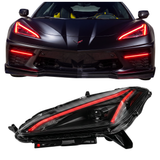 Chevrolet Corvette C8 RGBW+A DRL Boards (2020–2026)
$350.00Front lips and diffusers for the C8. Confirm fitment by VIN before ordering.
Chevrolet Corvette C8 RGBW+A DRL Boards (2020–2026)
$350.00Front lips and diffusers for the C8. Confirm fitment by VIN before ordering.
 2020-2025 Chevy Corvette C8 5VM Style Front Lip 5PCS ABS
$135.99Front lips and diffusers for the C8. Confirm fitment by VIN before ordering.
2020-2025 Chevy Corvette C8 5VM Style Front Lip 5PCS ABS
$135.99Front lips and diffusers for the C8. Confirm fitment by VIN before ordering.
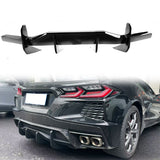 2020-2025 Chevy Corvette C8 Gloss Black Rear Bumper Diffuser
$329.99Front lips and diffusers for the C8. Confirm fitment by VIN before ordering.
2020-2025 Chevy Corvette C8 Gloss Black Rear Bumper Diffuser
$329.99Front lips and diffusers for the C8. Confirm fitment by VIN before ordering.

The ZR1 and Its 233 mph Run
Chevrolet took the ZR1 to the Papenburg test track in Germany and recorded 233 mph flat on the first run and 233.5 mph on the second. That makes it the fastest production Corvette ever built and the fastest car General Motors has produced.
The engine behind it is the LT7, a twin-turbocharged version of the Z06's 5.5L architecture, producing 1,064 hp and 828 lb-ft. Car and Driver recorded 2.2 seconds to 60 mph.
Worth noting what the ZR1 does that the Z06 does not: it pairs the enormous power increase with aerodynamics that permit it to be used. The Z06's problem was never engine output.
GM Underestimated Its Own Car by 18 mph
A detail worth knowing if you are comparing published figures across sources. In the ZR1's initial press release Chevrolet quoted a GM-estimated top speed of over 215 mph. The tested figure came back at 233 mph.
That is an 18 mph gap between the launch estimate and the verified run, which means any article written from the press release is quoting a number GM itself has since superseded. If you see 215 mph attributed to the ZR1, it is not wrong exactly — it is just out of date.
How It Compares to Older Corvettes
| Car | Top speed |
|---|---|
| C6 Z06 (7.0L LS7) | ~198 mph |
| C7 Stingray | ~190 mph |
| C7 ZR1 | ~212 mph |
| C8 Stingray | 194 mph |
| C8 Z06 | 195 mph |
| C8 ZR1 | 233 mph |
The curiosity in that table is the C6 Z06, which at around 198 mph remains quicker flat out than the C8 Z06 despite giving away 165 horsepower. Narrower body, less downforce, less drag. The same physics that explains the Z07 result.
Tools
 FOXWELL NT726 Bidirectional OBD2 Scanner
$368.99Scan and torque tools.
FOXWELL NT726 Bidirectional OBD2 Scanner
$368.99Scan and torque tools.
 ACDelco Tools Torque Wrenches, Digital LCD Display, 1/2 in.
$162.99Scan and torque tools.
ACDelco Tools Torque Wrenches, Digital LCD Display, 1/2 in.
$162.99Scan and torque tools.
 ACDelco Tools Torque Wrenches, Digital LCD Display, 3/8 in.
$249.99Scan and torque tools.
ACDelco Tools Torque Wrenches, Digital LCD Display, 3/8 in.
$249.99Scan and torque tools.


What Any of This Means for Owners
Practically, very little, and it is worth being honest about that.
These figures are set on closed courses — a German proving ground, a three-mile Space Shuttle runway — with speed-rated tyres, controlled conditions and experienced drivers. They are demonstrations of engineering, not benchmarks for a road.
What is genuinely useful is the underlying principle, because it applies at speeds you will actually see. Downforce packages trade straight-line speed for cornering grip and high-speed stability. If you track your car, that trade is worth making. If you do not, you are carrying drag you never benefit from.
The one practical item at any speed is tyre pressure. Every one of these figures was set on correctly inflated, appropriately rated tyres, and pressure affects handling, wear and safety far more than it affects a top speed you will never approach.
-
 DTI-13G Digital Tyre Inflator
Check pressures cold against the door placard rather than the sidewall figure, which is a maximum rather than a recommendation. -
 20–26 C8 Corvette Radar Detector Harness
From $115.99. Plug and play switched power, so no cord across a cabin the factory styled carefully. -
 Corvette Windshield Wiper Blades
From $39.99. Selected by year, make and model.
Prices are starting prices at time of writing and vary by variant and availability.
Oil
 Mobil 1 ESP X3 0W-40 Motor Oil (6 Quarts)
$137.89Full synthetic 0W-40 — confirm the spec for your engine.
Mobil 1 ESP X3 0W-40 Motor Oil (6 Quarts)
$137.89Full synthetic 0W-40 — confirm the spec for your engine.
 Mobil 1 Supercar 0W-40 Full Synthetic (4-Pack)
$0.00Full synthetic 0W-40 — confirm the spec for your engine.
Mobil 1 Supercar 0W-40 Full Synthetic (4-Pack)
$0.00Full synthetic 0W-40 — confirm the spec for your engine.
 Mobil 1 Supercar 0W-40 Full Synthetic, 1 Qt (6-Pack)
$83.89Full synthetic 0W-40 — confirm the spec for your engine.
Mobil 1 Supercar 0W-40 Full Synthetic, 1 Qt (6-Pack)
$83.89Full synthetic 0W-40 — confirm the spec for your engine.


What Other Pages Get Wrong
Hedging on the Z06 figure. An earlier version of this page said the Z06's top speed was "high, though lower than the ZR1 given the power gap." There is a published number — 195 mph base, around 188 mph with Z07 — and the interesting part is that it is barely above the Stingray, not below the ZR1.
Assuming power sets top speed. The Stingray-to-Z06 comparison disproves it outright: 180 more horsepower, one more mile per hour. Aerodynamics and frontal area dominate at these speeds.
Quoting the ZR1 at 215 mph. That was GM's pre-launch estimate. The tested figure is 233 mph, 18 mph higher.
Treating performance packages as universally faster. Z07 and Z51 both reduce top speed. That is a deliberate trade, and describing them as making the car faster without qualification is misleading.
Assuming newer is always faster. The C6 Z06 remains quicker flat out than the C8 Z06 despite 165 fewer horsepower, for exactly the same aerodynamic reasons.
Frequently Asked Questions
Is the Z06 really barely faster than a Stingray?
In top speed, yes — 195 mph against 194 mph. The Z06's wide body and 275/345 tyres add frontal area and drag, and its aerodynamics were developed for track performance rather than terminal velocity. In acceleration and on a circuit the gap is enormous.
Why does the Z07 package make the car slower?
Downforce is produced by drag. The Z07 aero generates the downforce that improves cornering grip and high-speed stability, and the drag that comes with it caps top speed around 188 mph rather than 195 mph. That is the package working as intended.
What's the fastest Corvette ever made?
The C8 ZR1, at 233 mph, recorded at the Papenburg test track in Germany. It is also the fastest car General Motors has built.
Should I skip Z51 if I want the fastest Stingray?
For pure top speed, yes — GM's 194 mph figure was set on a non-Z51 car and a Z51 has been timed at 191.7 mph. But that is the wrong reason to choose. Z51 improves braking, cooling and cornering, all of which you will use, and top speed is something you will not.
Does tyre choice affect top speed?
Yes. These runs use specific speed-rated tyres appropriate to the car's capability, and a different tyre changes both the achievable maximum and the safety margin. Speed rating is not a detail to economise on.
Can I reach these speeds on a public road?
No, and you should not try. Every figure here was set on a closed course under controlled conditions. Treat them as engineering data rather than as targets.