
The 2026 Chevrolet Corvette continues to hit a rare sweet spot: exotic styling, real-world usability, and performance that feels accessible without losing its edge. For shoppers comparing the 2026 Corvette Stingray against pricier Corvette siblings, the Stingray remains the model that makes the strongest everyday case. It works as a weekend toy, a confident daily coupe, and a serious value play for drivers who want mid-engine balance without jumping straight to Z06 or ZR1 territory.
2026 Corvette Stingray Specs at a Glance
| Specification | 2026 Corvette Stingray |
|---|---|
| Engine | 6.2L LT2 naturally aspirated V8, direct injection |
| Horsepower | 490 hp @ 6,450 rpm (495 hp with performance exhaust) |
| Torque | 465 lb-ft (470 lb-ft with performance exhaust) |
| Transmission | 8-speed dual-clutch (DCT), rear-wheel drive |
| Layout | Mid-engine, two-seat coupe or convertible |
| 0-60 mph | 2.9 seconds (with Z51 Performance Package) |
| Quarter mile | 11.2 seconds |
| Top track speed | 194 mph |
| Curb weight | 3,535 lb (coupe) |
| EPA fuel economy | 16 city / 25 highway / 19 combined mpg |
| Fuel tank | 18.5 gallons, premium required |
| Cargo volume | 12.6 cu ft (front and rear trunks combined) |
| Length / width / height | 182.3 in / 76.1 in / 48.6 in |
| Wheelbase | 107.2 in |
| Starting MSRP | $70,000 (1LT coupe, before destination) |
Power, acceleration, top speed and pricing are Chevrolet's published 2026 figures; weight, dimensions and EPA economy are for the Stingray coupe.
2026 Corvette Stingray Overview
The 2026 Corvette Stingray sits at the center of the Corvette lineup as the refined, approachable core of the car's identity. It delivers supercar presence, a mid-engine layout, and performance that feels special without becoming hard to live with. That balance makes it a strong fit for commuting, road trips, and spirited backroad drives. For many buyers, the Stingray offers the most complete blend of style, speed, and attainable pricing in the lineup, which is exactly why it remains such a popular entry point.
2026 Chevrolet Corvette Lineup at a Glance
The Corvette lineup gives shoppers a clear path from balanced performance to extreme speed. The Stingray is the all-around choice, while the E-Ray adds electrified all-wheel-drive traction, the Z06 leans hard into track precision with its high-revving LT6 V8, and the ZR1 is the no-compromise flagship built for maximum output. That spread helps buyers shop by use case instead of badge alone.
| Model | Focus | Best For |
|---|---|---|
| Stingray | Balanced performance | Daily driving and weekend fun |
| E-Ray | Electrified traction | All-weather confidence |
| Z06 | Track intensity | High-speed cornering and lap days |
| ZR1 | Peak performance | Maximum power and prestige |
2026 Corvette Stingray Performance Specs
At the heart of the 2026 Corvette Stingray is the 6.2L LT2 V8, a naturally aspirated engine rated at 490 horsepower at 6,450 rpm and 465 lb-ft of torque. Add the performance exhaust — standard with the Z51 package — and those figures rise to 495 hp and 470 lb-ft. Rear-wheel drive keeps the setup classic and engaging, while the 8-speed dual-clutch transmission launches the car hard and shifts quickly without the drama of an old-school automatic. With Z51, Chevrolet quotes 0-60 mph in 2.9 seconds, an 11.2-second quarter mile, and a 194 mph top track speed. At 3,535 lb for the coupe, that works out to roughly 7.2 pounds per horsepower.
Engine and Exhaust Details
The LT2 V8 has a muscular, clean character that suits the Stingray's mission. It does not need turbochargers or hybrid assist to feel quick; it builds power in a smooth, linear way that gives the driver confidence. The performance exhaust system sharpens the soundtrack and helps the engine breathe more freely. With the mid-engine layout, weight sits closer to the center of the car, which improves balance and makes turn-in feel more controlled.
One ownership note that catches people out: the LT2 is a dry-sump engine with its own oil specification, and it is not the same oil as a Silverado or Tahoe 6.2L. Do not assume a dexos1 0W-20 or 5W-30 that suits a truck V8 is correct here. Our C8 horsepower and oil guide covers which oil applies to which trim and model year.
Coupe Design and Exterior Styling
The coupe body gives the 2026 Corvette Stingray its low, stretched stance and unmistakable supercar profile. Sharp vents, wide rear haunches, and prominent rear wheels all hint at the car's performance-first purpose. The removable roof panel adds an open-air experience without requiring a full convertible. Aerodynamic details are not just for show; they help manage airflow and stability.
If you are shopping exterior parts, mind the generation. C7 body components — 2014–2019 — do not fit a C8, and the two are frequently listed side by side under "Corvette." Confirm any body or aero part names the C8 and your model year.
C8 exterior
 Corvette C8 5VM-Style Front Lip (2020-2025)
$135.99Lip, diffuser and mirror caps for the C8. Confirm year. Confirm fitment by VIN before ordering.
Corvette C8 5VM-Style Front Lip (2020-2025)
$135.99Lip, diffuser and mirror caps for the C8. Confirm year. Confirm fitment by VIN before ordering.
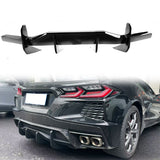 Corvette C8 Gloss Black Rear Diffuser (2020-2025)
$329.99Lip, diffuser and mirror caps for the C8. Confirm year. Confirm fitment by VIN before ordering.
Corvette C8 Gloss Black Rear Diffuser (2020-2025)
$329.99Lip, diffuser and mirror caps for the C8. Confirm year. Confirm fitment by VIN before ordering.
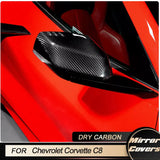 Corvette C8 Dry Carbon Mirror Cover Caps
$168.54Lip, diffuser and mirror caps for the C8. Confirm year. Confirm fitment by VIN before ordering.
Corvette C8 Dry Carbon Mirror Cover Caps
$168.54Lip, diffuser and mirror caps for the C8. Confirm year. Confirm fitment by VIN before ordering.

What Changed for 2026
The 2026 model year brings the biggest interior revision since the C8 launched, so a 2026 Stingray is not a carry-over 2025 car with a newer build date. If you are cross-shopping a used 2024 or 2025 against a new 2026, the cabin is the clearest difference.
| Area | 2020-2025 | 2026 |
|---|---|---|
| Center display | Angled console touchscreen | 12.7-inch center console display |
| Driver display | 12-inch cluster | 14-inch driver information center |
| Third screen | None | New 6.6-inch auxiliary touchscreen left of the wheel |
| Climate controls | The "button wall" spine between the seats | Relocated under the center display; the spine is gone |
| Drive mode selector | On the console spine | Moved in line with the gear selector |
| Wireless charging | Console bin | Charging pad below the infotainment stack |
| Passenger side | Divided by the button wall | Integrated grab handle plus a USB-C port |
Chevrolet also added an Ultimate Suede interior that wraps sueded microfiber over nearly every surface, with accent stitching in Adrenaline Red, Santorini Blue, or Competition Yellow, plus five new interior colorways — including the brand's first asymmetrical scheme, in Jet Black and Adrenaline Red.
C8 lighting
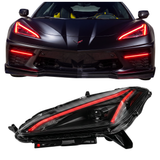 Chevrolet Corvette C8 RGBW+A DRL Boards (2020–2026)
$350.00DRL boards. Confirm year. Confirm fitment by VIN before ordering.
Chevrolet Corvette C8 RGBW+A DRL Boards (2020–2026)
$350.00DRL boards. Confirm year. Confirm fitment by VIN before ordering.
2026 Corvette Stingray Interior and Tech
Inside, the 2026 Corvette Stingray feels far more polished than early mid-engine sports cars in this price range. The cabin now centers the driver with a three-screen layout: a 14-inch driver information center, a 12.7-inch center console display, and a 6.6-inch auxiliary touchscreen to the left of the steering wheel. Google built-in brings a familiar interface for maps, voice commands, and apps, while Android Auto handles phone integration; a wireless charging pad sits below the infotainment stack, and 5G connectivity is on board.
Driver-Focused Comfort and Controls
The Stingray's cockpit is built around the driver, with a seating position that feels low, secure, and purposefully athletic. Controls are arranged to reduce distraction, and the cabin design minimizes the visual clutter found in many performance cars. Visibility is improved by the layout, though the car still feels compact and focused from behind the wheel.
Keys and key cases
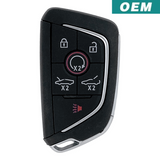 Chevrolet Corvette 2020-2026 OEM 6-Button Smart Key
$105.14C8 smart key and cases. Confirm year. Confirm fitment by VIN before ordering.
Chevrolet Corvette 2020-2026 OEM 6-Button Smart Key
$105.14C8 smart key and cases. Confirm year. Confirm fitment by VIN before ordering.
 Corvette C8 Zinc Alloy Key Case
$12.60C8 smart key and cases. Confirm year. Confirm fitment by VIN before ordering.
Corvette C8 Zinc Alloy Key Case
$12.60C8 smart key and cases. Confirm year. Confirm fitment by VIN before ordering.

Trim Levels and Customization Options
Trim choice matters on the Stingray because Chevrolet offers several ways to shape the car around different priorities. Entry trims focus on core performance, while higher trims bring more technology, upgraded materials, and additional comfort features.
| Trim | Starting MSRP (coupe) | Main appeal |
|---|---|---|
| 1LT | $70,000 | The full LT2 powertrain and chassis at the lowest entry point |
| 2LT | $77,100 | Adds comfort, audio and convenience equipment for daily driving |
| 3LT | $81,750 | Premium materials and the widest personalization choices |
Every Stingray trim uses the same 490-hp LT2 V8 and 8-speed DCT, so moving up buys equipment, not speed. Chevrolet lists a well-equipped 3LT coupe around $84,030 and a 3LT convertible around $91,725, with a destination charge added on top of every figure above. The Z51 Performance Package is the one option that changes how the car actually drives.
Z51 Performance Package Explained
The Z51 performance package is the most important decision on a Stingray build sheet, because it is the only option that changes the car's performance envelope rather than its equipment list — and it is what unlocks Chevrolet's 2.9-second 0-60 claim. Z51 adds:
- Z51 performance Brembo brakes
- Z51 performance suspension
- Performance exhaust (+5 hp and +5 lb-ft, to 495 hp / 470 lb-ft)
- Performance rear axle ratio
- Electronic limited-slip differential
- Z51-specific front splitter and rear spoiler
- Michelin Pilot Sport 4S summer-only tires
- Heavy-duty cooling system
For spirited street drivers it delivers a more complete sports-car feel; for occasional track users it provides real confidence without pushing the car into Z06 territory. The one genuine trade-off is the summer-only tire — buyers who drive year-round in cold climates will want a second set of wheels.
Ride Quality, Handling, and Magnetic Ride Control
One reason the Stingray appeals to so many shoppers is that it can feel calm in normal use and sharp when the road opens up. Available magnetic selective ride control helps bridge that gap by adjusting damping quickly, so the car can settle into a comfortable ride or tighten up for harder cornering. Steering feels immediate, and the chassis responds with the kind of stability that makes confidence grow fast.
Practicality, Cargo Space, and Daily Use
Practicality is not usually the first thing shoppers expect from a Corvette, but the Stingray handles it better than most performance coupes. Front and rear cargo areas combine for 12.6 cubic feet — more usable storage than many exotic alternatives, and enough for a pair of carry-on bags in the rear trunk plus a soft bag up front. The 18.5-gallon tank and 25 mpg highway rating make real road trips practical rather than theoretical.
Care
 Chevrolet Corvette Windshield Wiper Blades
$39.99Corvette blades. Confirm year. Confirm fitment by VIN before ordering.
Chevrolet Corvette Windshield Wiper Blades
$39.99Corvette blades. Confirm year. Confirm fitment by VIN before ordering.
 High-End Microfiber Auto Wash Towel for Car Detailing
$15.50Detailing basics.
High-End Microfiber Auto Wash Towel for Car Detailing
$15.50Detailing basics.
 CERAKOTE Ceramic Headlight Restoration Kit
$22.08Detailing basics.
CERAKOTE Ceramic Headlight Restoration Kit
$22.08Detailing basics.


Safety and Driver Assistance Features
The 2026 Corvette Stingray includes useful safety and driver-assist technology that supports everyday driving without turning the car into a full commuter appliance. Available systems can assist with parking, lane confidence, and low-speed awareness, which helps when the car is in tight spaces or urban traffic. Rearview and visibility aids matter here because the Stingray sits low and wide.
2026 Corvette Stingray Pricing and Value
Pricing is one of the Stingray's strongest selling points, because it brings genuine mid-engine performance into a range that feels reachable next to exotic rivals. A 2026 Stingray 1LT coupe starts at $70,000 before destination, and even a loaded 3LT coupe lands around $84,030 — figures that buy 490 horsepower, a 2.9-second 0-60 time with Z51, and a mid-engine chassis. That works out to roughly $143 per horsepower.
2026 Corvette Stingray FAQs
How much horsepower does the 2026 Corvette Stingray make?
490 horsepower at 6,450 rpm and 465 lb-ft of torque from the 6.2L LT2 V8. With the optional performance exhaust, which is included with the Z51 package, output rises to 495 horsepower and 470 lb-ft.
How fast is the 2026 Corvette Stingray 0-60?
2.9 seconds with the Z51 Performance Package, and 11.2 seconds through the quarter mile. Cars without Z51 are marginally slower because of the axle ratio and tires rather than the engine itself.
What is the top speed of the 2026 Corvette Stingray?
194 mph top track speed, per Chevrolet.
How much does a 2026 Corvette Stingray cost?
$70,000 for a 1LT coupe, $77,100 for a 2LT and $81,750 for a 3LT, all before destination. A well-equipped 3LT coupe runs about $84,030 and a 3LT convertible about $91,725.
What gas mileage does the 2026 Corvette Stingray get?
EPA ratings are 16 mpg city, 25 mpg highway and 19 mpg combined, from an 18.5-gallon tank. Premium fuel is required.
How much does a 2026 Corvette Stingray weigh?
3,535 pounds for the coupe, or roughly 7.2 pounds per horsepower.
Does it seat two people?
Yes. The Stingray is strictly a two-seater in both coupe and convertible form, with 12.6 cubic feet of cargo space split between the front and rear trunks.
Is it available as a convertible?
Yes. The coupe's removable roof panel covers most of the open-air appeal, but a full retractable hardtop convertible is offered on every trim for roughly $7,700 more.
Will C7 parts fit a C8 Stingray?
No. The C7 ran 2014–2019 and is a front-engine car; the C8 is mid-engine and shares essentially no body or aero components with it. Listings frequently sit side by side under "Corvette," so confirm the generation before ordering.
How is it different from the Z06?
The Z06 swaps the pushrod LT2 for the flat-plane-crank 5.5L LT6, revs to 8,600 rpm and is engineered around track work. The Stingray is the balanced choice: less peak capability, far more usable on the street, and tens of thousands of dollars cheaper.
Should You Buy the 2026 Corvette Stingray?
If the goal is a Corvette that feels fast, stylish, and usable every day, the 2026 Corvette Stingray makes a very strong case. It gives shoppers the core Corvette experience with mid-engine balance, modern tech, and a price that leaves room for options. If you're weighing the Stingray against a work truck like the 2026 Silverado 1500, or want to keep any GM vehicle in top shape, check out our Complete GM & Chevrolet Owner's Guide.
A Note on Sourcing
Performance, pricing, dimension and economy figures are Chevrolet's published 2026 numbers for the Stingray coupe unless stated otherwise.
Several products were removed from this page in revision. It previously advertised a C7 rear bumper diffuser (2014–2019) and a C7 fender air outlet on a guide to the 2026 C8 — parts from a different, front-engine generation. It also advertised an eight-piece spark plug wire set, which belongs to older pushrod GM V8s rather than the LT2, and two dexos1 truck oils. The LT2 is a dry-sump engine with its own oil specification; recommending a Silverado viscosity here contradicted our own Corvette oil guidance.
No oil part number is published on this page. Corvette oil specification varies by trim and model year, and the C8 guide linked above is the place we keep that current.