
Whether you just drove a new Chevrolet Silverado off the lot or you have been loyal to GM for decades, this guide is the front door to everything we cover — maintenance intervals, warning lights, warranty coverage, technology features and the model-specific guides that go deeper.
Corrections and updates to this page.
- The E-Ray is its own Corvette model, not a Stingray configuration. The current lineup runs Stingray, E-Ray, Z06 and ZR1 — they are different cars, not trim choices on one.
- A claim that the Suburban has "16% more cargo space" than the Tahoe was removed. The real difference depends entirely on which measurement you use, and behind the third row it is far larger than 16%.
- Tyre replacement guidance updated. 2/32" is the legal minimum, not the point at which tyres should be replaced. Wet and winter grip fall off well before that.
- The oil recommendation now flags viscosity, including the 6.2L L87 recall exception below.
- Three shorter maintenance pages have been consolidated into this guide so the interval and wear-item guidance lives in one place rather than three overlapping ones.
Table of Contents
- Maintenance schedules and oil changes
- Warning signs your GM vehicle needs service
- Battery and electrical questions
- Driver assistance and technology
- Warranties: factory vs extended
- Tyres and wheels
- Popular GM models
- DIY tips and common fixes
- Finding the right parts
- Frequently asked questions
1. Maintenance Schedules & Oil Changes
The most common question GM owners ask is how often the oil really needs changing. The Oil Life Monitor should be your primary guide — it calculates degradation from engine revolutions, temperature and load rather than mileage alone, which is why short city trips trigger a change sooner than highway miles.
In practice that usually lands between 5,000 and 7,500 miles, shorter under severe use, and never beyond 12 months regardless of mileage. The monitor is a model, not a measurement — it does not know you towed a trailer over a mountain pass last weekend.
Get the viscosity right, not just the brand. Many modern GM V8s — including the 5.3L and 6.2L EcoTec3 — take 0W-20, while older engines and some current four-cylinders take 5W-30, and diesels need dexosD rather than dexos1. The label on your oil cap settles it.
One important exception on the 6.2L. GM recalled 6.2L L87 engines produced between 1 March 2021 and 31 May 2024 over connecting rod and crankshaft manufacturing defects. Vehicles that passed inspection and kept their original engine move from 0W-20 to a dexos R 0W-40 oil, with a new fill cap showing the revised specification. Whether it applies depends on your VIN — and where an engine was replaced under warranty, on that engine's build date. Confirm with your dealer before buying a case.
Service intervals for most GM vehicles
A planning framework, not a substitute for your own schedule. Severe service — towing, short trips, dust, extended idling — shortens several of these.
| Interval | Service item |
|---|---|
| Per Oil Life Monitor (typically 5,000–7,500 mi) | Engine oil and filter; reset the monitor afterwards |
| Every oil change | Tyre pressure and tread, wiper condition, fluid levels, visual check of belts and hoses |
| ~7,500 miles | Tyre rotation |
| ~15,000 miles | Cabin air filter inspection, engine air filter inspection, brake pad thickness, battery terminals and voltage |
| ~30,000 miles | Engine air filter, brake fluid, coolant test, full suspension inspection |
| ~45,000 miles | Transmission fluid and filter, transfer case fluid, differential fluid — sooner if you tow |
| Per manual | Spark plugs — the interval varies widely by engine |
| Long interval | Coolant flush, serpentine belt, four-wheel alignment check |
| Seasonally | Before winter: battery load test, coolant freeze point, tread depth. Before summer: A/C performance and coolant level |
Transmission fluid is the item GM owners under-service most, and it is among the most expensive to ignore. Many newer GM transmissions are sealed with no dipstick, and checking the level requires a specific fluid temperature and procedure — not a driveway job on those.
Beyond the schedule: what actually wears out
Plenty of GM vehicles cross 200,000 miles without a major repair, and it is rarely luck. Three things do most of the work, and none of them appear as a line on a service schedule.
- Suspension sags before you notice it. Front coil springs settle gradually, so owners register it as "the truck does not ride like it used to" rather than as a fault. Sagged springs change alignment geometry, which accelerates tyre wear and loads ball joints and control arm bushings that were not designed to compensate.
- Rust starts from the inside. Salt, mud and moisture trapped under carpet or ill-fitting mats attack the floor pan where you cannot see it, which is far harder to catch early than exterior rust. Fitted liners that channel water away do more for long-term structural health than they get credit for.
- Every platform has known weak points. On mid-2000s to early-2010s Silverado, Sierra, Tahoe, Avalanche and Suburban trucks, the exterior door handles are a documented failure — internal plastic clips crack with age and temperature swings. Replacing a known-weak part before it strands you is cheaper than replacing it afterwards.
Two habits that cost people money: going by feel instead of a torque specification, and splicing into factory wiring to add accessories. Every major fastener has a published figure, and too tight stretches or shears while too loose backs out. And cutting into factory wiring to fit a dash cam or light is the most common way owners create electrical faults that take hours to trace — a plug-and-play harness taps power the way the vehicle expects.
Read more: Complete Maintenance Schedule Guide · Silverado 5.3L oil guide · GM lug nut sizes and torque specs
Oil and filters
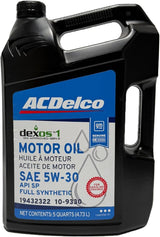 ACDelco 10-9330 dexos1 Gen 3 Full Synthetic 5W-30 Oil
$58.95Oil, oil filter and air filter. Confirm spec. Confirm fitment by VIN before ordering.
ACDelco 10-9330 dexos1 Gen 3 Full Synthetic 5W-30 Oil
$58.95Oil, oil filter and air filter. Confirm spec. Confirm fitment by VIN before ordering.
 ACDelco GM Original Equipment PF64 (25206966) Oil Filter
$13.89Oil, oil filter and air filter. Confirm spec. Confirm fitment by VIN before ordering.
ACDelco GM Original Equipment PF64 (25206966) Oil Filter
$13.89Oil, oil filter and air filter. Confirm spec. Confirm fitment by VIN before ordering.
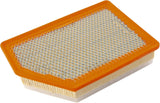 ACDelco A3459C Air Cleaner Element 85614334
$37.98Oil, oil filter and air filter. Confirm spec. Confirm fitment by VIN before ordering.
ACDelco A3459C Air Cleaner Element 85614334
$37.98Oil, oil filter and air filter. Confirm spec. Confirm fitment by VIN before ordering.

2. Warning Signs Your GM Vehicle Needs Service
Dashboard warning lights
- Check engine light: anything from a loose fuel cap to a misfire. If it is flashing, stop driving — that means a misfire severe enough to damage the catalytic converter.
- Battery/charging light: the charging system is not keeping up. Get it tested promptly.
- Oil pressure light: pull over and shut the engine off. Low oil pressure destroys engines in minutes.
- Tyre pressure light: at least one tyre is significantly under-inflated.
- Service StabiliTrak: commonly a wheel speed signal problem — and often debris on the encoder ring rather than a failed sensor.
- Airbag light: a restraint may be disabled even though the vehicle drives perfectly. Do not clear the code.
Signs that never light a lamp
- Sweet smell near the engine — coolant leak
- Grinding when braking — worn pads
- Vibration at speed — balance or alignment
- Rough idle or hesitation — fuel or ignition
Read more: GM Check Engine Light Codes · Service StabiliTrak Light On? · 5 Signs Your Car Needs Immediate Service
3. Battery & Electrical System Questions
Electrical faults are among the most frustrating problems GM owners face, and most trace back to the battery, the charging system, or a module that lost power.
- Resting voltage: a healthy battery sits around 12.4–12.6V. But resting voltage only shows state of charge — a battery can read 12.6V and still collapse under load, so a load test is what actually settles it. Running voltage should be roughly 13.7–14.7V.
- OnStar dead after a battery replacement: the telematics module may need re-provisioning or reprogramming. GM's Service Update N262547330 covers a related condition on many 2024–2026 vehicles.
- Accessories misbehaving after battery work: some modules need to relearn after a disconnection.
A naming warning: you will see the telematics module abbreviated "TCM" in places, but TCM normally means Transmission Control Module. Two completely different modules, two completely different diagnostics.
Read more: OnStar Not Working? · Battery Replacement Guide · Silverado Won't Start
Battery tools
 TOPDON BT200 12V Car Battery Tester Digital Automotive
$103.99Test and charge.
TOPDON BT200 12V Car Battery Tester Digital Automotive
$103.99Test and charge.
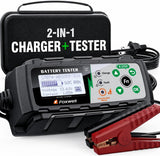 FOXWELL BC521 Battery Charger & Tester
$162.35Test and charge.
FOXWELL BC521 Battery Charger & Tester
$162.35Test and charge.
4. Driver Assistance & Technology
- Automatic Emergency Braking: detects an imminent collision and brakes.
- Adaptive Cruise Control: holds your speed while adjusting to traffic ahead.
- Lane Keep Assist and Lane Departure Warning: alerts or nudges when you drift.
- Rear Cross-Traffic Alert: warns of vehicles approaching as you reverse.
- Super Cruise: GM's hands-free highway driving system, on compatible roads and equipped vehicles.
Availability varies by model year, trim and package, so check the window sticker for your specific vehicle rather than assuming a feature is fitted.
Read more: How to Turn Off Buckle to Shift · ADAS Real-World Safety Results · Google Gemini in GM Vehicles
Chargers
 Speedboost Quad PD Car Charger
$39.99Keep phones charged for CarPlay and Android Auto.
Speedboost Quad PD Car Charger
$39.99Keep phones charged for CarPlay and Android Auto.

5. Warranties: Factory vs Extended
GM factory warranty on new vehicles
- Bumper-to-bumper: 3 years / 36,000 miles
- Powertrain: 5 years / 60,000 miles
- Roadside assistance: 5 years / 60,000 miles
- Corrosion: 3 years / 36,000 miles for sheet metal, 6 years / 100,000 miles for rust-through
Coverage varies by model year and for EVs, which carry separate battery and component coverage. Confirm against your own warranty booklet.
Worth knowing beyond the warranty: GM also runs Special Coverages — warranty extensions on specific components that can run to 15 years or 150,000 miles. They do not appear in a NHTSA VIN lookup, so owners routinely pay for repairs GM would have covered. Ask a dealer to check the Applicable Warranties section of Investigate Vehicle History for your VIN.
Read more: Extended Car Warranties: Worth It? · How to Check GM Recalls by VIN
6. Tyres & Wheels
- Match the size on your door jamb sticker, not just the wheel diameter
- Rotate roughly every 7,500 miles
- Check pressure monthly, cold, before driving
- 2/32" is the legal minimum, not the replacement point. Wet braking and snow traction deteriorate substantially before that — many technicians suggest planning replacement around 4/32" if you drive in rain or snow.
Oversized tyres affect speedometer accuracy, fuel economy, effective towing capacity and sometimes the conditions your tow rating assumes.
Read more: Installing Oversized Tyres on Your GM Vehicle
Tire pressure
 DTI-13G Digital Tire Inflator
$85.99Gauges and inflators.
DTI-13G Digital Tire Inflator
$85.99Gauges and inflators.
 Portable Corded Tire Inflator Pump
$64.99Gauges and inflators.
Portable Corded Tire Inflator Pump
$64.99Gauges and inflators.


7. Popular GM Models
Chevrolet Silverado 1500
Available with the 2.7L TurboMax, 5.3L V8, 6.2L V8 and 3.0L Duramax diesel. Tow ratings vary enormously by configuration — on the 5.3L alone the spread exceeds 2,000 lbs depending on cab, bed and drivetrain — so the badge tells you much less than the window sticker.
Read more: Towing Capacity by Year, Engine & Trim · Complete Silverado 1500 How-To Guide · 2026 Silverado 1500 Review
Chevrolet Tahoe & Suburban
Full-size SUV siblings sharing the Silverado's platform, both offering third-row seating and strong towing. The Suburban is the longer vehicle and carries substantially more cargo, particularly behind the third row where the difference is dramatic rather than marginal. Which matters depends on whether you routinely carry people and luggage at the same time.
Read more: Tahoe vs Suburban · 5.3L vs 6.2L
Chevrolet Equinox
GM's best-selling compact SUV, now offered alongside the Equinox EV. Note the transmission change: earlier Equinox models used conventional automatics, and the CVT arrived only with the fourth-generation car in front-wheel-drive form. GM has announced it is moving back to an eight-speed automatic for 2027.
Chevrolet Corvette
The mid-engine C8 lineup consists of several distinct models, not trims of one car: the Stingray, the electrified all-wheel-drive E-Ray, the high-revving Z06 and the ZR1. Body styles include coupe and convertible.
Read more: 2026 Corvette Stingray Guide
8. DIY Tips & Common Fixes
- Wiper blades: driver and passenger sides are often different lengths on the same vehicle — check both rather than buying a matched pair.
- Cabin air filter: usually behind the glovebox, and a genuinely easy job that shops charge real money for.
- Oil Life Monitor reset: the procedure varies by model and year — some use the driver information centre menus, others a pedal sequence. Check the method for your vehicle rather than following a generic one.
- Transmission fluid: many newer GM transmissions are sealed with no dipstick, and checking the level requires a specific temperature and procedure. Not a driveway job on those.
- Spark plugs: modern OE iridium plugs are pre-gapped and should not be hand-gapped, and anti-seize on the threads causes over-torquing in aluminium heads. Thread by hand, finish with a torque wrench.
- Before buying any sensor: confirm the diagnosis. A trouble code names a circuit, not a part.
Read more: How to Reset the Oil Life · How to Program a Key Fob · GM Transmission Problems
Tools
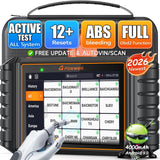 FOXWELL NT726 Bidirectional OBD2 Scanner
$368.99Basic tools for DIY jobs.
FOXWELL NT726 Bidirectional OBD2 Scanner
$368.99Basic tools for DIY jobs.
 ACDelco Digital Torque Wrench, 1/2 in. Drive
$162.99Basic tools for DIY jobs.
ACDelco Digital Torque Wrench, 1/2 in. Drive
$162.99Basic tools for DIY jobs.

9. Finding the Right Parts
- OEM GM parts: correct fit, highest cost
- OE-equivalent aftermarket: ACDelco and similar — often the same suppliers at lower cost
- Budget aftermarket: use caution on brakes, steering and anything safety-critical
Check part numbers against your VIN rather than your model name. GM uses different components across the same model line, and a part that fits a 2019 may not fit a 2021.
Browse our GM parts and accessories
Frequently Asked Questions
How often should I change the oil in my GM vehicle?
Follow the Oil Life Monitor, which typically lands between 5,000 and 7,500 miles depending on how you drive, and never exceed 12 months regardless of mileage. Short trips degrade oil faster than the monitor sometimes accounts for, so shorten the interval if most of your driving is under five miles.
What oil viscosity does my GM engine take?
It depends on the engine, not the brand. Many modern GM V8s including the 5.3L and 6.2L EcoTec3 take 0W-20 to the dexos1 specification. Some four-cylinders and older engines take 5W-30, and the 3.0L Duramax diesel requires dexosD. One exception: 6.2L L87 engines built 1 March 2021 – 31 May 2024 fall under a GM recall whose remedy moves them to dexos R 0W-40. The label on your oil cap is authoritative.
Which maintenance item do GM owners most often neglect?
Transmission fluid. It is usually the last thing checked and among the most expensive to ignore, and many newer GM transmissions are sealed with no dipstick, so it gets skipped by default rather than by decision.
What does a flashing check engine light mean?
A misfire severe enough to damage the catalytic converter, happening right now. That is different from a steady light, which can wait for a scan. Pull over when safe rather than driving on.
My airbag light is on but the car drives fine. Can I ignore it?
No, and do not clear the code either. Airbag faults are body codes, and when one sets, the affected restraint is typically disabled. The vehicle drives normally because nothing about the drivetrain is affected, which is exactly why this warning gets ignored. Clearing it removes the warning without repairing anything.
Is my GM vehicle covered by anything beyond the warranty?
Possibly. GM runs Special Coverage programmes that extend warranty on specific components, sometimes to 15 years or 150,000 miles, and Customer Satisfaction Programs that fix known faults at no charge. Neither appears in a NHTSA VIN lookup, so owners frequently pay for repairs GM would have covered. Ask a dealer to check Investigate Vehicle History against your VIN.
When should I replace my tyres?
2/32 of an inch is the legal minimum, not the recommended replacement point. Wet braking distances and snow traction fall off well before tread reaches that depth, so if you drive in rain or snow, planning replacement nearer 4/32 is the safer approach.
What is the difference between a Corvette Stingray and an E-Ray?
They are separate models rather than trims. The Stingray is the rear-wheel-drive V8 car; the E-Ray adds an electrified front axle for all-wheel drive. The Z06 and ZR1 are further distinct models above them. An earlier version of this page described the E-Ray as a Stingray configuration, which was wrong.
Why does my cheap scanner show no codes when a warning light is on?
Because inexpensive OBD-II readers generally only display powertrain P-codes. Airbag faults are B-codes, ABS and StabiliTrak faults are C-codes, and module communication faults are U-codes. A basic scanner cannot see any of those and will report a clean scan on a vehicle with an obvious fault.
A Note on Sourcing
This page is a hub. The detailed figures live in the linked guides, several of which cite GM's own published documents — the oil guide uses GM's engine oil capacity charts, and the OnStar guide uses GM's service update bulletins as published by NHTSA.
The 6.2L L87 recall details — the 1 March 2021 to 31 May 2024 production window and the move from 0W-20 to dexos R 0W-40 — come from NHTSA campaign 25V-274 and the associated GM dealer bulletin.
Service intervals in the table above are a planning framework rather than a manufacturer specification. GM publishes intervals per vehicle and engine, and severe service shortens several of them. Your owner's manual governs.
Corrections in earlier revisions: the E-Ray was described as a Stingray configuration when it is a separate model; a specific cargo-space percentage for the Suburban was removed as unsupportable; tyre replacement guidance conflated the legal minimum with the recommended replacement point; and the oil section did not distinguish viscosities.
Warranty terms, feature availability and specifications vary by model year, trim and region. Your window sticker, owner's manual and warranty booklet are authoritative for your vehicle.
Explore Our Guide Hubs
- Complete Maintenance Schedule Guide
- GM Check Engine Light Codes
- The Complete Silverado 1500 How-To Guide
- How to Check GM Recalls by VIN
- GM AFM/DFM Lifter Failure
- How Long Do GM Transmissions Last?
Have a specific question about your GM vehicle? Contact us.
Shop Essential GM Parts & Accessories
Check viscosity and fitment against your own vehicle before ordering — GM uses different specifications across the same model line.
-
 ACDelco dexos1 5W-30 Full Synthetic Motor Oil (8-pack) — 5W-30; check your oil cap, many GM V8s take 0W-20 instead.
-
 ACDelco Gold Cabin Air Filter CF1184C — confirm the part number suits your model.
-
 Metal Key Fob Cover & Case
-
 Buture Beta04 Heavy Duty Car Jump Starter 6000A