
There is no single GM lug nut torque spec. It changes by model, model year, wheel material and fastener type, and using a generic chart is how people end up with warped rotors or a wheel that comes loose. Your real number is printed in the Capacities and Specifications section of your owner's manual. Look it up once, write it on a piece of tape inside your toolbox lid, and torque to that.
The socket question has the same answer. GM has used more than one lug nut hex size across trucks, SUVs and cars, and factory capped nuts complicate it further. Confirm the size on your own vehicle before you buy anything from sockets, torque wrenches and wheel service tools.
Parts and tools you'll need
- A 1/2" drive click-type torque wrench and a 6-point impact socket in the correct size
- Replacement lug nuts, wheel locks and wheel hardware if yours are swollen or rounded
- A breaker bar for removal — never use a torque wrench to break nuts loose
- A wire brush and a thread chaser for cleaning studs
Torque wrenches
 ACDelco Tools Torque Wrenches, Digital LCD Display, 1/2 in.
$162.99Click to spec, not by feel — a digital torque wrench takes the guesswork out.
ACDelco Tools Torque Wrenches, Digital LCD Display, 1/2 in.
$162.99Click to spec, not by feel — a digital torque wrench takes the guesswork out.
 ACDelco Tools Torque Wrenches, Digital LCD Display, 3/8 in.
$249.99Click to spec, not by feel — a digital torque wrench takes the guesswork out.
ACDelco Tools Torque Wrenches, Digital LCD Display, 3/8 in.
$249.99Click to spec, not by feel — a digital torque wrench takes the guesswork out.


Why isn't there one GM torque number?
Because a torque figure is a property of the fastener and the joint, not the brand. A half-ton truck with steel wheels, a full-size SUV with 22-inch aluminum wheels, and a compact crossover with 17-inch alloys have different stud diameters, different clamping loads, and in some cases different lug nut designs. GM publishes the correct figure per vehicle, and it does change across generations of the same nameplate.
Charts that give you a single Chevy number are averaging across that variety. Sometimes they land on the right number for your truck. Sometimes they are quoting a heavy-duty figure at a half-ton, or a current-generation figure at a truck two generations older. You have no way to tell which from the chart itself.
Overtightening is not a harmless error. It stretches studs past their elastic range, distorts the rotor hat, and produces the pulsation people mistake for warped rotors. Undertightening is worse — a loose wheel destroys the studs, the wheel and often the hub before it separates.
Where do you find the real number?
Four reliable sources, in order of preference. Notice that a search result is not on the list.
| Source | What it gives you | Where to look |
|---|---|---|
| Owner's manual | Wheel nut torque for your exact vehicle as built | Capacities and Specifications section, near the end |
| Factory service information | Torque plus tightening sequence and stud service notes | Wheels and tires section of the service manual |
| Aftermarket wheel manufacturer | The correct spec for their wheel and their lug nuts | Installation sheet in the box, or their tech page |
| Aftermarket lug nut manufacturer | Spec for that specific nut, which may differ from stock | Packaging or product documentation |
If you run aftermarket wheels, the wheel and lug nut specs override the vehicle spec when they conflict. A wheel with a different seat design or a thicker mounting pad can have a different requirement, and the wheel manufacturer is the authority on their own part.
Do not use the tire pressure placard on your driver's door jamb for this. That placard gives tire sizes and cold inflation pressures — useful, but not the wheel nut torque. The torque figure lives in the manual.
What socket size do you need?
Rather than trusting a chart, identify it on the vehicle. It takes two minutes and it is definitive.
- Remove a wheel cover or center cap if one hides the nuts.
- Try metric sockets in sequence until one seats fully with no rocking. A socket that fits but wobbles is one size too large and will round the nut.
- If a metric size fits perfectly, that is your size. If a fractional-inch socket seats better, note that instead.
- Buy a 6-point socket in that size — not 12-point. Six points grip the flats instead of the corners.
- If your wheels are aluminum with recessed lug pockets, buy a thin-wall socket so it clears the pocket without scarring the finish.
- If your nuts sit deep in the wheel, you also need a deep socket or an extension.
Buy the socket in impact-rated chrome-moly even if you only use hand tools. Impact sockets have thicker walls at the drive end and survive being used with a breaker bar on a seized nut, which chrome sockets sometimes do not.
Sockets and tool sets
 APOLLO TOOLS - DT0004-50 Piece ¼” Drive Socket Set
$54.99Socket sets for lug and wheel work.
APOLLO TOOLS - DT0004-50 Piece ¼” Drive Socket Set
$54.99Socket sets for lug and wheel work.
 95 Piece Mechanics Tool Set in Metric and SAE for Small
$99.99Socket sets for lug and wheel work.
95 Piece Mechanics Tool Set in Metric and SAE for Small
$99.99Socket sets for lug and wheel work.
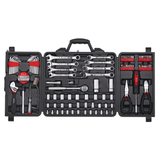 101 Piece Mechanic Tool Set for Vehicle and Home Maintenance
$69.99Socket sets for lug and wheel work.
101 Piece Mechanic Tool Set for Vehicle and Home Maintenance
$69.99Socket sets for lug and wheel work.
 ACDelco Tools Digital Torque Adapters, 1/2 in. Square Drive
$94.99Socket sets for lug and wheel work.
ACDelco Tools Digital Torque Adapters, 1/2 in. Square Drive
$94.99Socket sets for lug and wheel work.


Why does my socket suddenly not fit?
Because of two-piece capped lug nuts. Many GM trucks and SUVs were built with a steel lug nut wearing a thin stainless or chrome cap crimped over it. Water gets between the cap and the nut body, corrosion swells the cap, and the effective hex grows. The socket that fit at 20,000 miles will not go on at 80,000.
This is one of the most common complaints on GM trucks and it has a predictable outcome: someone forces a slightly larger socket on, rounds the cap, and now the nut has to be cut or extracted at the roadside. If your socket is getting tight, that is your warning, not a fluke.
The fix is to replace the swollen nuts. Two options:
- Solid one-piece nuts in the correct thread and seat type. They cannot swell because there is no cap. This is the durable answer.
- New factory-style capped nuts if you want the original appearance. They will eventually do the same thing, but they will look right until they do.
Whichever you choose, the thread size and the seat design have to match your wheels exactly. Get replacements from wheel and tire accessories and verify the specification against your wheel, not just against your vehicle. Also carry a lug wrench or socket that actually fits — a swollen nut plus the wrong tool at the roadside is how a flat becomes a tow.
What torque wrench should you buy?
A 1/2-inch drive click-type wrench covers wheel work on every GM vehicle and is the right first torque wrench for almost everyone. The important thing is that your vehicle's spec falls comfortably inside the wrench's range rather than at either end.
| Type | Strengths | Weaknesses | Good for wheels? |
|---|---|---|---|
| Click-type (micrometer) | Affordable, accurate in the middle of its range, audible click | Needs periodic calibration; must be wound down after use | Yes — the default choice |
| Beam | Cheap, nearly indestructible, never goes out of calibration | Must be read at eye level; awkward under a fender | Workable, not pleasant |
| Digital / electronic | Precise readout, angle mode, audible and visual alerts | Batteries, cost, more fragile | Yes, if you want the extra features |
| Split-beam | No need to wind down for storage, holds calibration well | Costs more than a basic click wrench | Yes — good long-term buy |
| Torque stick + impact gun | Fast for shops doing volume | Approximate at best; depends on gun and air pressure | Only as a first pass, never as the final step |
Two habits keep a click wrench honest. Wind it back to its lowest setting before you put it away, and never use it as a breaker bar. Both of those do more damage to accuracy than years of normal use. Our torque wrench buying guide goes further into range, accuracy and calibration.
How do you torque wheels properly?
- Clean the studs and the mating surfaces. Rust scale between the hub face and the wheel will let the joint relax after you drive.
- Leave the threads dry unless the manufacturer specifically says otherwise. Torque specs are given for clean, dry threads, and oil or anti-seize on the threads causes overclamping at the same reading.
- Mount the wheel and start every nut by hand to confirm the threads are clean and straight.
- Snug all nuts lightly in a star pattern, working across the wheel rather than around it.
- Lower the vehicle until the tire just touches the ground and takes light load.
- Torque to your vehicle's specification in the same star pattern, in one smooth pull per nut, stopping at the click.
- Go around once more in the same pattern to confirm nothing moves.
- Lower the vehicle completely and remove the jack stands.
Do not stand on the wrench or use a cheater bar. A torque wrench works because you apply a steady force to the handle at its designed length; anything else invalidates the reading.
Can you just use an impact gun?
For removal, yes. For final tightening, no. A cordless impact's output varies with battery charge, trigger position, tool temperature and how long you hold it, so two nuts on the same wheel can end up hundreds of foot-pounds apart without you knowing.
Torque sticks help but they are a limiter, not a measurement. They flex to shed energy above a nominal value, and their real-world accuracy depends on the gun driving them and on running the gun long enough for the stick to work. Shops use them to get close quickly and then finish by hand with a torque wrench. That is the correct workflow at home too: gun to snug, wrench to spec.
Should you re-torque after driving?
Yes, and it costs you five minutes. New wheels, new lug nuts, or a wheel that has just been off will often settle slightly as the mating surfaces seat under load. Re-checking after a short distance catches that before it becomes a problem.
Tire shops and wheel manufacturers commonly specify re-checking within the first 50 to 100 miles after a wheel is installed. Follow whatever interval your wheel manufacturer or owner's manual gives, and treat it as mandatory on aftermarket wheels rather than optional.
Safety note: never get under a vehicle supported only by a jack. Use rated jack stands on a hard level surface, chock the wheels that stay on the ground, and check that the stand saddles are on a structural lift point — our guide to jack and jack stand capacity covers sizing them to your truck. For roadside work, the step-by-step flat tire guide covers what to do when you cannot torque properly at the side of the road.
What changes when you go to aftermarket wheels?
Three things, and all three are fitment questions rather than torque questions.
- Seat type. Lug nuts come in conical (tapered), ball/radius, and flat-with-washer seat designs. The nut seat must match the wheel's lug seat exactly. A conical nut in a ball-seat wheel contacts on a thin ring and will loosen.
- Thread size and length. The thread must match your studs, and the nut must engage enough thread. If the new wheel's mounting pad is thicker, factory nuts may not have enough engagement.
- Hub centric versus lug centric. Factory wheels locate on the hub bore. Many aftermarket wheels have a larger bore and need centering rings so the wheel is not centered by the lug nuts alone.
If you add spacers or adapters, all of the above applies twice — once at the hub and once at the wheel — and the spacer manufacturer will have its own torque specification for the hardware that holds the spacer on. Follow theirs for the spacer and the wheel manufacturer's for the wheel.
What about wheel locks?
Wheel locks use a keyed pattern instead of a hex, so the socket rules do not apply to them. Keep the key with the vehicle, and know where it is before you need it — most are in the glove box, center console or the spare tire kit. Torque them exactly like the other nuts.
One practical warning: lock keys wear and break, and a worn key on a corroded lock is a genuinely difficult removal. If your key is chewed up, replace the lock set before it strands you rather than after.
What to check before you order
- Your torque spec from the owner's manual, or from the wheel manufacturer if the wheels are aftermarket.
- Your actual socket size, confirmed by test-fitting on the vehicle, not from a chart.
- Whether your nuts are swollen. If the socket is getting tight, plan on replacing them.
- Seat type and thread on any replacement lug nuts — match the wheel, not just the vehicle.
- Torque wrench range that puts your spec near the middle rather than at the top of the scale.
- Six-point, thin-wall socket if your wheels have recessed lug pockets.
Wheel and hub parts
 ACDelco Wheel Bearing and Hub Assembly, Gold
$317.99Parts you may need once the wheel is off. Confirm fitment by VIN before ordering.
ACDelco Wheel Bearing and Hub Assembly, Gold
$317.99Parts you may need once the wheel is off. Confirm fitment by VIN before ordering.
 ACDelco Wheel Bearing and Hub Assembly, GM Genuine Part
$177.99Parts you may need once the wheel is off. Confirm fitment by VIN before ordering.
ACDelco Wheel Bearing and Hub Assembly, GM Genuine Part
$177.99Parts you may need once the wheel is off. Confirm fitment by VIN before ordering.
 ACDelco Wheel Bearing and Hub Assemblies
$237.99Parts you may need once the wheel is off. Confirm fitment by VIN before ordering.
ACDelco Wheel Bearing and Hub Assemblies
$237.99Parts you may need once the wheel is off. Confirm fitment by VIN before ordering.
 ACDelco Wheel Bearing and Hub Assemblies
$277.99Parts you may need once the wheel is off. Confirm fitment by VIN before ordering.
ACDelco Wheel Bearing and Hub Assemblies
$277.99Parts you may need once the wheel is off. Confirm fitment by VIN before ordering.


Frequently Asked Questions
What is the lug nut torque spec for a Chevy Silverado?
There isn't one universal figure, and that is the point of this page. Torque varies by model, model year, wheel material and fastener type. Your number is in the Capacities and Specifications section of your owner's manual. A chart giving a single Chevy number is averaging across that variety, and you cannot tell from the chart whether it landed on your truck.
Is the torque spec on the door jamb sticker?
No. That placard gives tire sizes and cold inflation pressures. The wheel nut torque figure lives in the owner's manual.
Why won't my lug nut socket fit anymore?
Swollen capped lug nuts. Many GM trucks were built with a steel nut wearing a thin crimped-on cap; water gets underneath, corrosion swells the cap, and the effective hex grows. The socket that fit at 20,000 miles will not go on at 80,000. A socket getting tight is a warning, not a fluke — forcing a larger one rounds the cap.
Should I replace swollen lug nuts with capped or solid ones?
Solid one-piece nuts are the durable answer, because there is no cap to swell. Factory-style capped nuts will look correct and will eventually do the same thing again. Either way, the thread size and seat design must match your wheels exactly.
Can I use an impact gun to tighten lug nuts?
For removal yes, for final tightening no. A cordless impact's output varies with battery charge, trigger position, tool temperature and how long you hold it, so two nuts on the same wheel can differ by hundreds of foot-pounds. Torque sticks are a limiter, not a measurement — gun to snug, wrench to spec.
Should I put anti-seize on the wheel studs?
No, unless the manufacturer specifically says otherwise. Torque specs are given for clean dry threads, and lubricant on the threads causes overclamping at the same wrench reading. Clean the studs and the mating surfaces instead — rust scale between hub face and wheel is what lets a joint relax after you drive.
What socket do I need for GM lug nuts?
Identify it on the vehicle rather than from a chart: try sockets until one seats fully with no rocking. A socket that fits but wobbles is one size too big and will round the nut. Buy 6-point rather than 12-point, impact-rated, and thin-wall if your wheels have recessed lug pockets.
Do I need to re-torque wheels after driving?
Yes. New wheels, new nuts or a wheel that has just been off will settle slightly as the mating surfaces seat under load. Tire shops and wheel manufacturers commonly specify re-checking within the first 50 to 100 miles. Treat it as mandatory on aftermarket wheels.
What happens if I overtighten lug nuts?
You stretch the studs past their elastic range, distort the rotor hat, and produce the pulsation people mistake for warped rotors. Undertightening is worse — a loose wheel destroys the studs, the wheel and often the hub before it separates.
Do aftermarket wheels change the torque spec?
They can, and the wheel and lug nut specs override the vehicle spec when they conflict. Seat type must match exactly — a conical nut in a ball-seat wheel contacts on a thin ring and will loosen. Check thread engagement too, since a thicker mounting pad can leave factory nuts short.
A Note on Sourcing
No torque figure is published on this page, and that is deliberate. Wheel nut torque is a property of the specific fastener and joint, and it varies across models, model years, wheel materials and fastener designs. Publishing a single number would be the exact error this page exists to warn against. Your owner's manual, or the wheel manufacturer for aftermarket wheels, is authoritative.
Socket sizes are also not tabulated here. GM has used more than one hex size, and swollen capped nuts change the effective size on an individual vehicle regardless of what it left the factory with. Test-fitting on your own truck is the only definitive check.
The capped lug nut swelling failure is a well-documented pattern on GM trucks rather than a manufacturer statement, and the recommendation to move to solid one-piece nuts is our own.
The 50-to-100-mile re-torque interval reflects common tire shop and wheel manufacturer practice. Where your wheel manufacturer or owner's manual specifies a different interval, follow theirs.
For more tool selection and shop technique guides, browse more shop tools guides.
Everything in this guide, in one place
Torque wrench, 6-point thin-wall socket, breaker bar, jack stands and replacement lug nuts — the whole wheel service kit is in automotive tools and equipment. Look up your vehicle's torque figure first, then buy a wrench whose range brackets it comfortably.