
For a half-ton Silverado, Tahoe or Suburban, buy a 3-ton floor jack and 3-ton jack stands. For a Colorado or Canyon, 2 tons is technically enough but 3 tons costs almost nothing more. For a 2500HD or 3500HD, step up to 4 tons. The number that drives this is your truck's GVWR, not its curb weight.
The reasoning below matters more than the recommendation, because a jack that is rated high enough can still be the wrong jack — wrong lift height, wrong saddle, wrong reach under a lifted truck. If you want to skip ahead, the jacks, stands and shop equipment collection is where the hardware lives. If you want to buy once, read the math first.
Parts and tools you'll need
- Floor jacks, jack stands and garage equipment — filter by capacity and lift height
- Silverado and Colorado parts for whatever job put the truck in the air
- A pair of wheel chocks, and a second pair if the driveway is not dead level
- A torque wrench for putting the wheels back on properly
Floor jacks
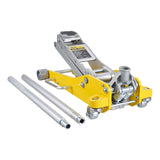 SucceBuy 3T/2T Floor Jack Aluminum Hydraulic Racing Jack
$145.36Floor jacks for GM cars and trucks — check capacity and lift height.
SucceBuy 3T/2T Floor Jack Aluminum Hydraulic Racing Jack
$145.36Floor jacks for GM cars and trucks — check capacity and lift height.
How much floor jack capacity does a Silverado actually need?
A floor jack only ever lifts one end of the vehicle, so it never sees the full weight. A 2025 Silverado 1500 crew cab 4WD has a curb weight around 4,950 lb and a GVWR of 7,000 lb. The heavier end carries roughly 55 percent of that. Even fully loaded, one end of the truck is under 4,000 lb.
By raw arithmetic, a 2-ton jack clears it. Nobody who has actually done the job recommends that, and the reason is not the arithmetic. It is that a jack rated exactly at the load runs at the top of its stroke and the top of its pressure, seals leak under sustained maximum load, and a jack working at 100 percent of rating creeps down more than one working at 60 percent.
The rule of thumb most people land on is to size the jack for at least three-quarters of the vehicle's GVWR. Run that for a half-ton truck at 7,000 lb GVWR and you get 5,250 lb, which is a 3-ton jack. Run it for a 2500HD at 10,450 lb and you get about 7,840 lb, which is a 4-ton jack. The rule builds in the margin that raw axle math throws away.
Buying capacity is also cheap. The gap between a 2-ton and a 3-ton jack in the same product line is small, and the 3-ton usually comes with a longer chassis, a wider saddle and more lift. You are paying a little for stability you will use on every job.
What jack and stand rating does each GM truck and SUV need?
Match the capacity to the GVWR, not the curb weight, because you may end up lifting a loaded truck. Half-ton trucks and full-size SUVs land on 3 tons. Midsize trucks are fine at 2 but better at 3. Heavy duty pickups need 4 tons and enough lift height to clear a taller ride height.
| Vehicle | Representative curb weight | GVWR | Floor jack | Jack stands |
|---|---|---|---|---|
| Chevrolet Colorado / GMC Canyon, crew cab 4WD | 4,650 lb | 6,250 lb | 2 ton minimum, 3 ton preferred | 3 ton |
| Chevrolet Silverado 1500 / GMC Sierra 1500, crew cab 4WD | 4,950 lb | 7,000 lb | 3 ton | 3 ton |
| Chevrolet Tahoe / GMC Yukon | 5,705 lb | 7,600 lb | 3 ton | 3 ton |
| Chevrolet Suburban / Yukon XL | 5,873 lb | 7,700 lb | 3 ton | 3 ton |
| Chevrolet Silverado 2500HD / Sierra 2500HD, crew cab 4WD | 6,686 lb | 10,450 lb | 4 ton | 4 ton, tall pin-style |
| 3500HD and dually configurations | Heavier still | Check your door jamb placard | 4 ton minimum | 4 ton or 6 ton |
| Equinox, Traverse, Blazer and other unibody crossovers | Lighter than the trucks above | Check your door jamb placard | 2–3 ton | 3 ton |
| Camaro, Corvette and lowered cars | Varies | Check your door jamb placard | 2–3 ton low-profile | 2–3 ton with a low minimum height |
Curb weights in that table are single representative configurations, not the whole range. A regular cab 2WD half-ton is lighter than a crew cab 4WD, a diesel is heavier than a gas engine, and a Duramax 3500 dually is in another category entirely. Your exact GVWR is printed on the certification placard on the driver's door jamb, and that is the number to trust.
Notice that the stand column never drops below 3 tons even where the jack column does. Stands are what stand between you and the vehicle. They cost less than the jack and there is no reason to economize on them.
Are jack stands rated per stand or per pair?
Both conventions exist, which is exactly why this trips people up. Some manufacturers publish the ton rating as the capacity of the pair working together. Others publish it as the capacity of each individual stand. Read the label stamped on the stand itself and the manufacturer's own specification sheet before you assume you have twice the capacity you actually have.
This is not a small distinction. A pair marketed as 3 ton could mean 6,000 lb total or 12,000 lb total depending on whose stands you bought, and if you assume the generous reading on a set that used the conservative one, you have eliminated your safety margin without knowing it.
The practical answer: buy stands rated at or above the same capacity as your jack, and interpret the rating as the per-stand figure unless the manufacturer clearly says otherwise. Sizing conservatively costs a few dollars. Sizing optimistically costs something else.
While you are reading the label, look for a certification mark. Reputable stands are tested and certified to the current North American standard for portable automotive service equipment. A stand with no rating information stamped anywhere on it is not a stand, it is a piece of scrap steel shaped like one.
Where do you jack up a Chevy Silverado?
On a body-on-frame truck or SUV, the load-bearing points are the frame rails and the axles. Front: the frame rail behind the front wheel, or the front crossmember if your jack saddle is wide enough to sit flat. Rear: the rear axle tube, close in to the differential rather than out near the wheel. Your owner's manual shows the exact designated points for your truck.
That last sentence is not a hedge for its own sake. GM changes lift points between generations, and 2019-and-later Silverado and Sierra frames are not identical to the 2014–2018 trucks underneath. The manual has a diagram. Look at it once.
What you must not do is lift on a suspension component that moves, on the oil pan, on the transmission pan, on a plastic aero shield, or on a fuel or brake line. Lifting on the lower control arm in particular puts the load through a bushing that was never designed to carry the vehicle vertically.
Placement for the stands follows the same logic but with one addition: the stand needs a flat, hard surface under it. Asphalt on a hot day is not a hard surface. A driveway with a slope is not a flat surface. If you are on anything soft, put a steel plate or a thick, solid piece of hardwood under each stand — never a stack of loose boards or a cinder block, which fails without warning.
What lift height do you actually need?
More than you think, and this is the specification most people forget to check. A stock half-ton needs modest lift to get a wheel off, but a truck on 33s with a leveling kit sits high enough that a low-profile jack may bottom out before the tire clears the ground. Check the jack's maximum lift height and the stand's maximum extended height against your ride height before buying.
Run the check with a tape measure, not by eye. Measure from the ground to the frame rail at the lift point with the truck sitting normally. Then add the amount you need the tire off the ground — two or three inches is plenty for a wheel job, more if you are dropping a transfer case. That total is the extended height your stands need to reach.
The opposite problem exists on the other end of the GM lineup. A Corvette or a lowered Camaro may not have enough clearance for a standard jack to slide under at all, which is why low-profile jacks exist and why puck adapters are worth buying. Minimum saddle height is the specification to read on that end.
Ramp-style pin stands with a locking pin generally give you more usable height range than ratcheting pawl stands and remove the failure mode where a worn pawl slips. If you own a heavy duty truck, they are the easier recommendation.
How do you get a GM truck safely on stands?
The order of operations matters as much as the equipment. Loosen fasteners on the ground, lift at a designated point, transfer the load to stands immediately, and never let any part of your body go under the vehicle while a hydraulic jack is the only thing holding it.
- Park on level concrete. Not a slope, not gravel, not soft asphalt in July.
- Put the transmission in park and set the parking brake.
- Chock both sides of a wheel on the end of the vehicle you are not lifting.
- Loosen the lug nuts a quarter turn while the tire is still carrying weight.
- Position the jack squarely under a designated lift point and check that the saddle is sitting flat, not on an edge.
- Raise the vehicle slowly and watch the jack for any tendency to lean. A floor jack is supposed to roll slightly as the arc of the arm changes — do not block the wheels of the jack.
- Lift only as high as you need, plus enough to slide the stands in.
- Place a stand under a solid frame point on each side, set to the same height, and lock the pin or engage the pawl fully.
- Lower the jack slowly until the vehicle settles onto the stands. Leave the jack in place, snug but not carrying the load, as a backup.
- Push firmly on the fender or bumper to confirm the vehicle is stable before anything goes underneath it.
- Do the work. Keep the removed wheel under the rocker panel as a third layer of backup.
- To lower, raise slightly off the stands, remove the stands completely, then lower slowly and evenly.
- Torque the lug nuts in a star pattern with a torque wrench to the value in your owner's manual, then re-check them after a short drive.
Safety note, plainly stated: a hydraulic jack is a lifting device, not a holding device. Seals fail, release valves get bumped, and a jack that has held for an hour can drop in a second. Stands are not optional and neither are chocks. If you are changing a wheel at the roadside rather than working in a driveway, our step-by-step flat tire change guide covers the different tradeoffs that come with doing it on a shoulder.
Tools for the job
 ACDelco Tools Torque Wrenches, Digital LCD Display, 1/2 in.
$162.99Torque and hand tools for work under the truck.
ACDelco Tools Torque Wrenches, Digital LCD Display, 1/2 in.
$162.99Torque and hand tools for work under the truck.
 ACDelco Tools Torque Wrenches, Digital LCD Display, 3/8 in.
$249.99Torque and hand tools for work under the truck.
ACDelco Tools Torque Wrenches, Digital LCD Display, 3/8 in.
$249.99Torque and hand tools for work under the truck.
 95 Piece Mechanics Tool Set in Metric and SAE for Small
$99.99Torque and hand tools for work under the truck.
95 Piece Mechanics Tool Set in Metric and SAE for Small
$99.99Torque and hand tools for work under the truck.
 APOLLO TOOLS - DT0004-50 Piece ¼” Drive Socket Set
$54.99Torque and hand tools for work under the truck.
APOLLO TOOLS - DT0004-50 Piece ¼” Drive Socket Set
$54.99Torque and hand tools for work under the truck.


Is a 2-ton jack ever the right answer for a truck owner?
Rarely, and only if you already own it. A 2-ton jack will physically lift the front of a Colorado, and plenty of people have used one for years without incident. The argument against is not that it will fail catastrophically; it is that it works harder, has a shorter chassis, less lift and a smaller saddle, and gives you no margin when you eventually put a bigger vehicle on it.
The place a 2-ton genuinely makes sense is as a second, lighter jack for car work — a low-profile aluminum unit for a Camaro that you can carry with one hand. As a truck owner's only jack, it is a false economy.
Aluminum versus steel is a similar tradeoff. Aluminum jacks are dramatically easier to move around and to lift into a truck bed, and they cost more for the same rating. Steel is heavier, cheaper and generally more durable to abuse. If the jack lives in one garage bay and never moves, steel is fine.
What else belongs in the kit?
Wheel chocks, first. They are the cheapest item on this list and the one most often skipped. A pair on the opposite axle, on both sides of the tire, takes ten seconds.
A proper torque wrench comes second. The most common damage from a driveway wheel job is not a dropped truck — it is warped rotors and stretched studs from an impact gun. Torque to the specification in your owner's manual, in a star pattern, and re-check after driving. Our torque wrench buying guide covers picking one that reads accurately in the range wheel work needs, and the GM lug nut size and socket guide covers which socket fits your truck.
A creeper, a work light and a decent pair of gloves round it out. If your truck spends time away from home, a battery jump starter is worth carrying too; our guide to choosing a jump starter for a GM truck or SUV walks through the ratings that actually matter for a V8.
What to check before you order
- Read the GVWR off the certification placard on your driver's door jamb and size the jack to at least three-quarters of it.
- Buy jack stands rated at or above your jack's capacity, and read the label to see whether that rating is per stand or per pair.
- Measure ground-to-frame height at your lift point and compare it to the jack's maximum lift and the stands' maximum height.
- If you have a lowered car, check the jack's minimum saddle height too.
- Confirm your truck's designated lift points in the owner's manual before the first use.
- Add wheel chocks and a torque wrench to the same order.
- Make sure you have level concrete to work on. No equipment fixes a sloped driveway.
Roadside and garage kit
 DTI-13G Digital Tire Inflator
$85.99Tire and battery gear worth keeping with your jack.
DTI-13G Digital Tire Inflator
$85.99Tire and battery gear worth keeping with your jack.
 Car Tire Inflator Pump Portable Car Air Compressor Corded
$64.99Tire and battery gear worth keeping with your jack.
Car Tire Inflator Pump Portable Car Air Compressor Corded
$64.99Tire and battery gear worth keeping with your jack.
 Tire Inflator 12V DC 100W 150PSI Digital Tire Pump w/LCD
$60.99Tire and battery gear worth keeping with your jack.
Tire Inflator 12V DC 100W 150PSI Digital Tire Pump w/LCD
$60.99Tire and battery gear worth keeping with your jack.
 150PSI Cordless Car Tire Pump 6000mAh Rechargeable Tire
$91.99Tire and battery gear worth keeping with your jack.
150PSI Cordless Car Tire Pump 6000mAh Rechargeable Tire
$91.99Tire and battery gear worth keeping with your jack.
 150PSI Cordless Car Tire Pump 6000mAh Rechargeable Tire
$117.99Tire and battery gear worth keeping with your jack.
150PSI Cordless Car Tire Pump 6000mAh Rechargeable Tire
$117.99Tire and battery gear worth keeping with your jack.


Frequently Asked Questions
What size floor jack do I need for a Silverado 1500?
A 3-ton jack and 3-ton stands. A half-ton crew cab 4WD has a GVWR around 7,000 lb, and sizing the jack to at least three-quarters of GVWR puts you at 5,250 lb. A 2-ton would lift it by raw arithmetic, but it would be working at the top of its stroke and pressure with no margin.
Should I size the jack to curb weight or GVWR?
GVWR, from the certification placard on your driver's door jamb. Curb weight is what the truck weighs empty, and you may well end up lifting it loaded. Curb weights published for a model are also single configurations — a regular cab 2WD is lighter than a crew cab 4WD, and a diesel is heavier again.
Are jack stands rated per stand or per pair?
Both conventions exist, which is exactly the trap. A pair marketed as 3 ton could mean 6,000 lb total or 12,000 lb total depending on the manufacturer. Read the label stamped on the stand and the specification sheet, and assume the per-stand reading unless it clearly says otherwise.
Where do I jack up a GM truck or SUV?
The frame rails and the axles. Front: the frame rail behind the front wheel, or the crossmember if your saddle sits flat on it. Rear: the axle tube close in to the differential. Check your owner's manual diagram — GM changed lift points between generations, and 2019-and-later Silverado frames differ from 2014–2018 underneath.
Where should I never place a jack?
On any suspension component that moves, the oil pan, the transmission pan, a plastic aero shield, or a fuel or brake line. Lifting on a lower control arm puts the vehicle's weight through a bushing never designed to carry it vertically.
Can I work under a vehicle held up by a floor jack?
No. A hydraulic jack is a lifting device, not a holding device — seals fail, release valves get bumped, and a jack that has held for an hour can drop in a second. Transfer the load to stands, leave the jack snug underneath as a backup, and slide the removed wheel under the rocker panel as a third layer.
What lift height do I need for a lifted truck?
Measure it rather than guessing. Take ground-to-frame height at the lift point with the truck sitting normally, then add two or three inches to get the tire clear. That total is the extended height your stands must reach. A truck on 33s with a leveling kit can bottom out a low-profile jack before the tire leaves the ground.
Can I put jack stands on asphalt?
Not on a hot day, and never on anything soft or sloped. Stands need flat, hard ground — level concrete. If you have no choice, use a steel plate or a thick solid piece of hardwood under each stand. Never a stack of loose boards or a cinder block, which fails without warning.
Is a 2-ton jack ever enough for a truck owner?
Only as a second, lighter jack for car work — a low-profile aluminium unit you can carry one-handed. As a truck owner's only jack it is a false economy: shorter chassis, less lift, smaller saddle, and no margin when you eventually put something heavier on it.
What size jack do I need for a 2500HD?
4 tons, with tall pin-style stands. A 2500HD crew cab 4WD carries a GVWR around 10,450 lb, which puts the three-quarters figure near 7,840 lb. Heavy duty trucks also sit higher, so check the stands' maximum extended height as well as the rating.
A Note on Sourcing
Curb weights and GVWR figures are manufacturer-published for single representative configurations — typically crew cab 4WD. They are included to show the scale of the numbers, not as your truck's figures. The certification placard on your driver's door jamb is authoritative, and it is the number this page tells you to size from.
The three-quarters-of-GVWR sizing rule is a working convention rather than a manufacturer specification. It exists to build back the margin that one-end-only axle arithmetic throws away, and this page shows the arithmetic both ways so you can see why the raw calculation is misleading.
Jack stand ratings genuinely differ in convention between manufacturers, per-stand versus per-pair. This page does not resolve that ambiguity because it cannot be resolved generically — it can only be read off the specific product you are buying.
Lift points changed between GM truck generations, which is why no lift point diagram is reproduced here. Your owner's manual has the correct one for your vehicle.
Torque figures are deliberately omitted. Lug nut torque varies by model, year and wheel type; the placard in your door jamb and your owner's manual govern.
More garage equipment write-ups and DIY procedures are collected in our shop tools guides.
Everything in this guide, in one place
Jacks, stands, chocks and the rest of the lifting kit are grouped together so you can size the whole set to your truck in one pass. Check the capacity and the lift height on each item against the numbers you took off your door jamb placard.