
If you're buying a used GM truck or SUV — or you've got a higher-mileage vehicle and you're wondering how much life is left in the transmission — this guide is for you.
The short answer: a well-maintained GM automatic can comfortably pass 200,000 miles. The longer answer depends on which transmission you have, how you drive it, and whether the fluid has been looked after.
Corrections — two errors on this page could have cost someone a transmission.
- The ten-speed takes DEXRON-ULV, not DEXRON-HP. An earlier version listed the 10L80 and 10L90 as taking DEXRON-HP. They require DEXRON-ULV, an ultra-low-viscosity fluid. This affects every 2019 and newer Silverado and Sierra 1500 with the 5.3L or 6.2L — a very large number of readers — and putting the wrong fluid in a modern automatic is one of the few mistakes that causes damage immediately rather than eventually.
- The 6T30 is a six-speed automatic, not a CVT. It was listed in a row headed "CVT," two rows below the 6T40 and 6T45 which were correctly described as automatics — they are all members of the same six-speed family. The Equinox 1.5T referenced there uses a conventional six-speed, not a CVT.
Average GM Transmission Lifespan by Type
These are our own service-experience ranges, not manufacturer figures, and they assume regular fluid changes and normal use.
| Transmission | Vehicles | Expected Lifespan (Maintained) |
|---|---|---|
| 4L60E / 4L65E | 1993–2013 Silverado, Tahoe, Suburban | 130,000–200,000 miles |
| 4L80E | Heavy-duty trucks and vans | 200,000–300,000+ miles |
| 6L80 / 6L90 | 2007+ Silverado, Tahoe, Suburban (V8) | 180,000–250,000 miles |
| 6T30 / 6T40 / 6T45 | Equinox, Malibu, Cruze and similar — all six-speed automatics | 120,000–180,000 miles |
| 8L90 / 8L45 | 2015+ Silverado, Sierra, Corvette | 150,000–200,000+ miles with the correct fluid |
| 10L80 / 10L90 | 2019+ Silverado, Sierra (V8) | 150,000–200,000+ miles (newer, less field data) |
| CVT | Malibu, front-wheel-drive Trailblazer, 2025+ front-wheel-drive Equinox | 100,000–150,000 miles, more variable |
Note the CVT row. GM's CVT is a genuinely different device from the 6T-family automatics, and it appears in a much narrower set of vehicles than is commonly assumed. If you have a 2018–2022 Equinox, you have a six-speed automatic.
Fluid Is the Single Biggest Factor
Transmission fluid lubricates, carries away heat, and operates the hydraulic circuits that actually change gear. When it degrades, all three jobs suffer at once.
Which fluid, by transmission
| Transmission | Fluid |
|---|---|
| 4L60E, 4L80E, 6L80, 6L90, 6T-family | DEXRON-VI |
| 8L90, 8L45 | DEXRON-HP |
| 10L80, 10L90 | DEXRON-ULV — not HP, not VI |
| CVT | GM-approved CVT fluid only |
These are not interchangeable. DEXRON-ULV is an ultra-low-viscosity fluid developed for the ten-speed, and the eight-speed's DEXRON-HP is a different specification again. Substituting one for another is a well-documented route to shudder and premature wear.
Check the RPO codes on your glovebox label to confirm which transmission you have before buying fluid. Two trucks of the same year and model can carry different units.
The "lifetime fluid" question
Some GM transmissions were marketed as having fluid that never needed changing. In practice "lifetime" is best understood as the lifetime of the warranty, not of the vehicle.
Our recommendation — deliberately shorter than GM's normal-service schedule:
- Normal driving: every 45,000 miles
- Towing or severe duty: every 30,000 miles
- Used purchase with unknown history: change it on acquisition, whatever the odometer says
Transmission fluid
 ACDelco 10-9243 Dexron VI Full Synthetic ATF 88865549, 1 Qt
$16.99Dexron VI. Confirm the spec for your transmission. Confirm fitment by VIN before ordering.
ACDelco 10-9243 Dexron VI Full Synthetic ATF 88865549, 1 Qt
$16.99Dexron VI. Confirm the spec for your transmission. Confirm fitment by VIN before ordering.
 ACDelco 10-9244 Dexron VI Full Synthetic ATF 88865618, 1 Gal
$49.99Dexron VI. Confirm the spec for your transmission. Confirm fitment by VIN before ordering.
ACDelco 10-9244 Dexron VI Full Synthetic ATF 88865618, 1 Gal
$49.99Dexron VI. Confirm the spec for your transmission. Confirm fitment by VIN before ordering.
 ACDelco 10-9395 Dexron VI Automatic Transmission Fluid
$41.99Dexron VI. Confirm the spec for your transmission. Confirm fitment by VIN before ordering.
ACDelco 10-9395 Dexron VI Automatic Transmission Fluid
$41.99Dexron VI. Confirm the spec for your transmission. Confirm fitment by VIN before ordering.


How Towing Affects Transmission Life
Heat is what kills automatic transmissions, and towing generates it faster than anything else you can do to one. A widely used rule of thumb among transmission specialists holds that fluid life roughly halves for every 20°F above about 200°F — a heuristic rather than a manufacturer specification, but a useful way to think about why one hard summer of towing can age a transmission more than years of commuting.
If you tow regularly:
- Consider an auxiliary transmission cooler. One of the better longevity investments for a truck that works.
- Shorten the fluid interval to roughly every 30,000 miles.
- Use Tow/Haul mode. It changes shift points and keeps the torque converter locked longer, which reduces heat generation rather than just managing it.
- Watch the transmission temperature readout in the driver information centre and back off if it climbs and stays there.
Cooler lines
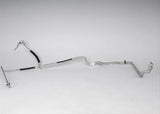 ACDelco Automatic Transmission Cooler Line 25999420
$190.99Cooler lines. Confirm fitment by VIN before ordering.
ACDelco Automatic Transmission Cooler Line 25999420
$190.99Cooler lines. Confirm fitment by VIN before ordering.
 ACDelco Automatic Transmission Cooler Line 25999419
$169.99Cooler lines. Confirm fitment by VIN before ordering.
ACDelco Automatic Transmission Cooler Line 25999419
$169.99Cooler lines. Confirm fitment by VIN before ordering.

Signs a GM Transmission Is Nearing the End
- Slipping between gears, or engine speed flaring on shifts
- Shudder during light acceleration — though on eight-speeds this is often the fluid rather than the converter, so do not assume the worst
- Delayed engagement from Park to Drive
- Dark brown or burnt-smelling fluid
- "Service Transmission" in the driver information centre
- Metal particles in the pan, found during a fluid service
The last one is the most informative and the most overlooked. A fluid change is also an inspection: fine grey sludge on the magnet is normal wear, but visible metal flakes or chunks mean something is coming apart inside. That is worth knowing before you spend money on a fluid service that will not save it.
Scan tools
 FOXWELL NT726 Bidirectional OBD2 Scanner
$368.99Watch transmission temperature and codes.
FOXWELL NT726 Bidirectional OBD2 Scanner
$368.99Watch transmission temperature and codes.
 FOXWELL NT614 Elite OBD2 Scanner
$233.69Watch transmission temperature and codes.
FOXWELL NT614 Elite OBD2 Scanner
$233.69Watch transmission temperature and codes.

Rebuild, Remanufacture or Used?
Costs are our estimates and vary widely.
Rebuild
A shop disassembles your unit and replaces worn parts. Quality varies enormously by shop — ask specifically what warranty they offer and get it in writing.
Typical cost: $1,800–$4,000
Remanufactured
A unit rebuilt to a production standard, often incorporating updated parts that address known weaknesses in the original design. Usually carries a meaningful warranty, which is the main argument for it over a rebuild.
Typical cost: $1,500–$3,500 plus installation
Used
Cheapest and riskiest — you inherit someone else's unknown maintenance history. Only sensible with a warranty from the supplier and documented mileage.
Typical cost: $400–$1,500 plus installation
Making Yours Last
- Change the fluid every 45,000 miles, or 30,000 if you tow
- Use the correct fluid for your specific transmission — see the table above
- Fit an auxiliary cooler if you tow regularly
- Use Tow/Haul mode with a trailer
- Let the vehicle warm before driving hard in cold weather
- Deal with shift quality complaints early, and ask about a calibration update before agreeing to mechanical work
- Keep the engine healthy — misfires load the transmission
- Inspect fluid condition annually, and look at what comes out of the pan
Filter kits and pans
 CARQUEST 85976 Transmission Filter Kit
$22.00Filters and pans. Confirm transmission. Confirm fitment by VIN before ordering.
CARQUEST 85976 Transmission Filter Kit
$22.00Filters and pans. Confirm transmission. Confirm fitment by VIN before ordering.
 CARQUEST 96080 Transmission Filter Kit
$13.00Filters and pans. Confirm transmission. Confirm fitment by VIN before ordering.
CARQUEST 96080 Transmission Filter Kit
$13.00Filters and pans. Confirm transmission. Confirm fitment by VIN before ordering.
 ACDelco Automatic Transmission Pan, Stock Style
$83.99Filters and pans. Confirm transmission. Confirm fitment by VIN before ordering.
ACDelco Automatic Transmission Pan, Stock Style
$83.99Filters and pans. Confirm transmission. Confirm fitment by VIN before ordering.


Frequently Asked Questions
How long does a GM transmission last?
A well-maintained GM automatic commonly reaches 150,000 to 250,000 miles depending on the unit. The 4L80E in heavy-duty applications and the 6L80 in full-size trucks are among the most durable. Transverse six-speeds in smaller cars tend toward the lower end. Those ranges assume the fluid has been changed and the correct specification used.
What fluid does the GM ten-speed take?
DEXRON-ULV, an ultra-low-viscosity fluid. It is not DEXRON-HP, which the eight-speed uses, and not DEXRON-VI, which the six-speeds use. This matters for every 2019 and newer Silverado and Sierra 1500 with a V8. An earlier version of this page listed the ten-speed as taking HP, which was wrong.
Is the 6T30 a CVT?
No. The 6T30 is a six-speed automatic, part of the same family as the 6T40 and 6T45. It was listed on this page under a CVT heading, which was an error. GM's actual CVT appears in the Malibu, the front-wheel-drive Trailblazer, and the fourth-generation Equinox from 2025 in front-wheel-drive form.
Can I use DEXRON-VI in any GM transmission?
No. DEXRON-VI covers the older four-speeds, the 6L-series and the transverse six-speeds, but eight-speeds require DEXRON-HP and ten-speeds require DEXRON-ULV. CVTs use their own dedicated fluid. Using the wrong specification is one of the few maintenance mistakes that can cause symptoms immediately rather than gradually.
Does towing really shorten transmission life that much?
Yes, because of heat. A common rule of thumb among transmission specialists is that fluid life roughly halves for every 20°F above around 200°F. That is a heuristic rather than a published figure, but it explains why a truck that tows heavy in summer can need fluid far sooner than the mileage suggests. An auxiliary cooler and a shorter fluid interval are the two practical answers.
Should I change the fluid on a high-mileage transmission that has never been serviced?
Change it, and have someone look at what comes out of the pan. The old warning that fresh fluid causes a neglected transmission to fail is largely a myth — what actually happens is that a transmission already close to failure fails soon afterwards regardless. The pan contents tell you which situation you are in: fine grey residue on the magnet is normal, visible metal flakes are not.
Is a remanufactured transmission better than a rebuild?
Often, mainly because of the warranty and because reman units frequently incorporate updated parts that address known weaknesses in the original design. A good local rebuilder can match that, but quality varies far more between shops than between reman suppliers. Ask for the warranty terms in writing either way.
What does metal in the transmission pan mean?
Fine grey paste clinging to the pan magnet is normal clutch and gear wear on any transmission with miles on it. Visible flakes, chips or chunks mean hard parts are breaking down internally, and no fluid service will reverse that. If that is what comes out, spend the money on a diagnosis of what failed rather than on fresh fluid.
A Note on Sourcing
Two errors were corrected in this revision. The ten-speed fluid specification was given as DEXRON-HP; it is DEXRON-ULV. And the 6T30 was listed as a CVT when it is a six-speed automatic from the same family as the 6T40 and 6T45.
The second error had spread across our own coverage, appearing on this page and on our GM transmission problems guide, which described a CVT in the 2016–2022 Equinox. Both have now been corrected, and the fluid tables on the two pages agree.
The lifespan ranges, the fluid intervals and the cost estimates are ours, based on service experience rather than GM publications. The fluid intervals are deliberately shorter than GM's normal-service schedule.
The heat-versus-fluid-life relationship is an industry rule of thumb, not a manufacturer specification, and is labelled as such where it appears.
Fluid specifications and transmission fitment vary by model year, engine and drivetrain. Confirm the transmission in your vehicle from its RPO codes before buying anything.
Bottom Line
A GM transmission treated properly will usually outlast the rest of the vehicle. The threats are not design flaws so much as neglected fluid, the wrong fluid, and heat from towing — all three of which are within your control.
If you take one thing from this page: confirm which transmission you have and buy the fluid that matches it. Six-speed, eight-speed and ten-speed all take different specifications, and getting it wrong is the fastest way to create the problem you were trying to prevent.
See also our GM Transmission Problems guide and the Complete GM & Chevrolet Owner's Guide.
Shop Related Parts & Accessories
DEXRON-VI suits the four-speeds, 6L-series and transverse six-speeds. If you have an eight-speed, ten-speed or CVT, this is not your fluid — check the table above before ordering.
-
 ACDelco DEXRON-VI Full Synthetic ATF (6-pack qt) — $73.07
-
 ACDelco DEXRON-VI ATF (1 gal) — $36.88. A gallon covers a typical drain-and-fill on a six-speed.
-
 ACDelco DEXRON-VI ATF (1 qt) — $14.99