
The C8 spans four genuinely different engine philosophies, from a 490 hp naturally aspirated V8 to a 1,064 hp twin-turbo. The ZR1 is the most powerful, by an enormous margin. But the more useful thing to know as an owner is that these engines do not share an oil specification — and getting that wrong is a far more expensive mistake than picking the wrong trim.
Jump to a section: A correction to this page · Every trim compared · Stingray · E-Ray · Z06 · ZR1 · The oil each engine takes · Exactly what to buy · Filter and drain plug · Why power doesn't set top speed · Choosing between them · What other pages get wrong · FAQ
A Correction to This Page
Earlier versions of this article recommended a dexos1 Gen 2 5W-30 motor oil alongside these engines. That is wrong for every C8 in the lineup, on both counts.
The C8 does not use dexos1, and it does not use 5W-30. The 6.2L LT2 in the Stingray and E-Ray takes 0W-40 to the dexos2 specification on 2020–2022 cars and dexosR from 2023 onward. The 5.5L LT6 in the Z06 takes 5W-50 to dexosR. These are dry-sump engines with 7.5 quarts of capacity including the tank, and they are not forgiving of a generic fill.
The recommendation has been removed and replaced with the correct products below.
Every Trim Compared
| Trim | Engine | Power | Torque | 0–60 |
|---|---|---|---|---|
| Stingray | 6.2L LT2 V8, naturally aspirated | 490 hp (495 with performance exhaust) | 465 lb-ft | ~2.9 s |
| E-Ray | 6.2L LT2 + 160 hp front electric motor | 655 hp combined | — | ~2.5 s |
| Z06 | 5.5L LT6 V8, flat-plane, naturally aspirated | 670 hp @ 8,400 rpm | 460 lb-ft @ 6,300 rpm | ~2.95 s |
| ZR1 | 5.5L LT7 V8, twin-turbocharged | 1,064 hp @ 7,000 rpm | 828 lb-ft @ 6,000 rpm | ~2.2 s |
Stingray: The LT2
A naturally aspirated 6.2L making 490 hp and 465 lb-ft, or 495 hp with the optional performance exhaust. Conventional cross-plane V8 architecture, and the most accessible way into the C8.
It is worth resisting the instinct to treat this as the lesser engine. A sub-three-second car with 490 hp was flagship territory a generation ago, and the Stingray remains the C8 that most owners will use most of the time.
E-Ray: The Hybrid
The E-Ray pairs the LT2 with a 160 hp electric motor driving the front axle through a 1.9 kWh battery, giving 655 hp combined and, uniquely in the lineup, all-wheel drive.
That traction is the point. Its roughly 2.5-second 0–60 makes it quicker off the line than the more powerful Z06, because the Z06 has to put 670 hp through the rear tyres alone. Power and acceleration are not the same thing, and the E-Ray is the clearest illustration in the range.
For servicing it takes the same 0W-40 as the Stingray, since the combustion engine is the same LT2.
Z06: The LT6
A completely separate engine rather than a tuned LT2 — a purpose-built naturally aspirated 5.5L with a flat-plane crankshaft, producing 670 hp at 8,400 rpm against a redline of 8,600.
Note where that power arrives. Peak torque of 460 lb-ft comes at 6,300 rpm, which is above the LT2's entire useful range. This is an engine that asks to be revved, and the flat-plane design borrowed from motorsport is what allows it. It is also why the Z06 feels so different from a Stingray rather than merely faster.
It is also why it takes a different oil. Do not fill an LT6 with 0W-40.
ZR1: The LT7
The Z06's LT6 architecture with two turbochargers bolted to it, producing 1,064 hp at 7,000 rpm and 828 lb-ft at 6,000 rpm. The most powerful production Corvette ever built, and by a wide margin — nearly 400 hp clear of the Z06 within the same model range.
Car and Driver recorded 2.2 seconds to 60 mph, and Chevrolet's own testing put the top speed at 233 mph.
The Oil Each Engine Takes
This is the most practically useful section on the page, and the one most often got wrong.
| Engine | Viscosity | Specification |
|---|---|---|
| 6.2L LT2 — Stingray, E-Ray, 2020–2022 | 0W-40 | dexos2 |
| 6.2L LT2 — Stingray, E-Ray, 2023 onward | 0W-40 | dexosR |
| 5.5L LT6 — Z06 | 5W-50 | dexosR |
dexosR superseded dexos2 in high-performance gasoline applications, and Mobil has confirmed the substitution is permitted in that direction. So a 2023-onward car needs dexosR, while a 2020–2022 car whose manual specifies dexos2 can use either.
The Z06 is a different viscosity entirely. In the 2025 owner's manual the Z06 engine oil section and the non-Z06 section sit several pages apart, which is exactly how owners end up reading the wrong one. If you have an LT6, the number you want is 5W-50.
Capacity is 7.5 quarts including the dry-sump tank on the LT2 — well above what most people expect, and the reason six-quart packs alone will not complete a change.
Oil
 Mobil 1 Supercar 0W-40 Full Synthetic (4-Pack)
$0.00Full synthetic 0W-40 — confirm the spec for your engine.
Mobil 1 Supercar 0W-40 Full Synthetic (4-Pack)
$0.00Full synthetic 0W-40 — confirm the spec for your engine.

Exactly What to Buy
Match your engine and model year to one of these three. They are not interchangeable.
-
 Mobil 1 Supercar 0W-40 — 6 qt
From $83.89. Stingray and E-Ray, 2023 onward. This is the dexosR-licensed 0W-40, and it is the oil GM uses as factory fill on these cars. Formerly sold as Mobil 1 ESP Formula 0W-40 before the rebrand. -
 Mobil 1 ESP X3 0W-40 — 6 qt
From $137.89. Stingray and E-Ray, 2020–2022. Carries the dexos2 approval those manuals call for. If your car is 2023 or newer, the Supercar 0W-40 above is the one to use. -
 Mobil 1 ESP 5W-50 Supercar — 6 qt (127372)
From $98.99. Z06 only. The LT6's 5W-50. Putting this in a Stingray, or 0W-40 in a Z06, is the single most common C8 servicing error.
A note on quantity: at 7.5 quarts total capacity on the LT2, a six-quart pack does not cover a full change on its own. Plan for the extra rather than being short with the sump open.
Filter and Drain Plug
The C8 uses an ACDelco PF64. Three versions are available and the difference is worth understanding before you pick on price.
-
 ACDelco GM OE PF64 — 25206966
From $13.89. The GM Original Equipment part, and the exact number the C8 service procedure calls for. The default choice. -
 ACDelco Silver PF64A — 19533697
From $19.99. The Silver-line equivalent. -
 ACDelco Oil Filter PF64
From $24.89. A third PF64 option. Confirm the version against what is currently fitted — the PF64 has been revised over the C8's production run, so an earlier car may have a previous version installed.
One more part worth having on the bench: the drain plug O-ring, GM 12695700. It is a few dollars, it is designed to be replaced rather than reused, and finding out it was perished after refilling seven and a half quarts is an annoying way to spend an afternoon.
Filter removal takes a 74 mm, 15-flute filter wrench and the drain plug is a 15 mm. Warm the engine briefly before draining, and allow 20 to 30 minutes for it to drain fully on a dry-sump system.
Torque tools
 ACDelco Tools Torque Wrenches, Digital LCD Display, 1/2 in.
$162.99Torque the drain plug and filter to spec.
ACDelco Tools Torque Wrenches, Digital LCD Display, 1/2 in.
$162.99Torque the drain plug and filter to spec.
 ACDelco Tools Torque Wrenches, Digital LCD Display, 3/8 in.
$249.99Torque the drain plug and filter to spec.
ACDelco Tools Torque Wrenches, Digital LCD Display, 3/8 in.
$249.99Torque the drain plug and filter to spec.


Why More Power Doesn't Mean More Top Speed
The horsepower table above does not predict the top speed table, and the gap between them is instructive.
The 670 hp Z06 tops out at 195 mph. The 490 hp Stingray reaches 194 mph. One hundred and eighty extra horsepower buys a single mile per hour, because the Z06's wide body and 275/345 tyres add frontal area and drag that cancel most of the benefit.
It goes further: specifying the Z07 package drops the Z06 to around 188 mph, making it slower flat out than a Stingray. Downforce is produced by drag, and drag caps terminal velocity.
Only the ZR1 escapes this, at 233 mph, because it pairs a 394 hp increase with aerodynamics that let it be used.
Choosing Between Them
- Stingray if you want a C8 you will drive often. The best value in the range, and quick by any reasonable standard.
- E-Ray if all-weather traction and instant launch matter more than peak output. The all-wheel drive is the differentiator, not the horsepower.
- Z06 if the experience of a high-revving naturally aspirated engine is what you are buying. It is a different car in character, not just a faster Stingray.
- ZR1 if you want the outright numbers and will use them somewhere legal.
Whichever you choose, running costs scale with the trim and so do consumables. A Z06 on track eats tyres and brakes at a rate a Stingray does not — and its oil costs more per change too.
C8 aero
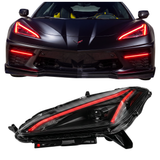 Chevrolet Corvette C8 RGBW+A DRL Boards (2020–2026)
$350.00Lips and diffusers. Confirm fitment by VIN before ordering.
Chevrolet Corvette C8 RGBW+A DRL Boards (2020–2026)
$350.00Lips and diffusers. Confirm fitment by VIN before ordering.
 2020-2025 Chevy Corvette C8 5VM Style Front Lip 5PCS ABS
$135.99Lips and diffusers. Confirm fitment by VIN before ordering.
2020-2025 Chevy Corvette C8 5VM Style Front Lip 5PCS ABS
$135.99Lips and diffusers. Confirm fitment by VIN before ordering.

What Other C8 Power Pages Get Wrong
Recommending dexos1 5W-30. This page did it. It is the wrong specification family and the wrong viscosity for every C8 engine, and on a dry-sump high-revving V8 that matters.
Treating the LT6 as a tuned LT2. They share almost nothing. Different displacement, different crankshaft design, different rev ceiling, different oil.
Quoting one oil for the whole lineup. There are three correct answers depending on engine and model year, and the manual splits them across sections several pages apart.
Equating horsepower with acceleration. The 655 hp E-Ray reaches 60 mph quicker than the 670 hp Z06, because it drives all four wheels. Traction is doing that work, not output.
Assuming power predicts top speed. It does not, and the Stingray-to-Z06 comparison disproves it by 180 horsepower and one mile per hour.
Quoting the ZR1 at 215 mph. That was GM's pre-launch estimate. The verified figure is 233 mph.
Frequently Asked Questions
Which C8 has the most horsepower?
The ZR1, at 1,064 hp from the twin-turbocharged 5.5L LT7. It is the most powerful production Corvette ever built, nearly 400 hp clear of the Z06.
What oil does my C8 take?
Stingray and E-Ray with the 6.2L LT2 take 0W-40 — dexosR from 2023, dexos2 on 2020–2022 cars. The Z06's 5.5L LT6 takes 5W-50 dexosR. Never a dexos1 5W-30.
Can I use dexos2 oil if my manual says dexosR?
dexosR superseded dexos2 for high-performance gasoline engines and the substitution is permitted in that direction, so a 2020–2022 car can run either. A 2023-onward car should use the dexosR product.
How much oil does a C8 take?
7.5 quarts including the dry-sump tank on the LT2. A six-quart pack will not complete a change on its own, so buy accordingly.
Which PF64 should I buy?
The GM Original Equipment 25206966 is the part the service procedure specifies and the cheapest of the three. Check which version is currently fitted, since the PF64 has been revised during the C8's production run.
Is the E-Ray faster than the Z06?
To 60 mph, yes — roughly 2.5 seconds against 2.95 — because its all-wheel drive puts power down that the rear-drive Z06 cannot. Over a lap or at higher speeds the Z06's extra output and track-focused setup tell.
Why does the Z06 use a completely different engine?
The LT6 was purpose-built for high-rpm performance with a flat-plane crankshaft, letting it rev to 8,600 rpm and make peak power at 8,400. The LT2's cross-plane architecture is not designed to do that.
Does the performance exhaust actually add power?
Yes, though modestly — 495 hp against 490 hp on the Stingray. Most owners choose it for the sound rather than the five horsepower.
Related Guides
- Top Speed of the C8 by Trim — why the Z06 is only 1 mph faster than a Stingray
- 2026 Corvette Stingray Guide: Specs, Features and Trims
- Corvette Accessories: What's Worth Adding, C5 to C8
- Can You Tune the C8 Corvette?