
A basic OBD2 code reader will not read ABS, SRS or BCM codes on any GM vehicle. Generic OBD-II only covers emissions-related powertrain data — the P0 codes. Anything with a B, C or U prefix lives in a module the generic protocol never talks to. To read those you need a scanner with GM enhanced (OEM-level) coverage, which starts at the second tier up from a parts-store code reader.
That is the whole decision in one paragraph. The rest of this guide covers which tier does what, how to verify a tool actually supports your year and model, and where the money stops buying anything you will use. Browse diagnostic scan tools and shop equipment alongside this if you want to compare as you read.
Parts and tools you'll need
- Scan tools, code readers and diagnostic equipment
- Popular GM tools and parts if you want the shortlist rather than the full catalog
- A battery maintainer — module-heavy diagnostics with the key on will flatten a marginal battery
- Your VIN and model year, so you can check a tool's coverage list before buying
Code readers
 FOXWELL NT301 OBD2 Scanner Live Data Professional Mechanic
$68.82Entry-level code readers for engine codes.
FOXWELL NT301 OBD2 Scanner Live Data Professional Mechanic
$68.82Entry-level code readers for engine codes.
 FOXWELL NT301 Plus 2-in-1 OBD2 Scanner & 12V Car Battery
$110.69Entry-level code readers for engine codes.
FOXWELL NT301 Plus 2-in-1 OBD2 Scanner & 12V Car Battery
$110.69Entry-level code readers for engine codes.
 MOTOPOWER MP69033 OBD2 Scanner Universal Car Engine Fault
$49.00Entry-level code readers for engine codes.
MOTOPOWER MP69033 OBD2 Scanner Universal Car Engine Fault
$49.00Entry-level code readers for engine codes.


Why won't a cheap code reader show ABS or airbag codes?
Because those modules were never part of the OBD-II mandate. OBD-II was created for emissions compliance, so the standardized part of the system only guarantees access to powertrain data that affects emissions. ABS, airbag, body control, transfer case and transmission-specific data are outside that mandate and are read through manufacturer-defined protocols.
You can see this in the code itself. A five-character DTC starts with a letter: P is powertrain, C is chassis (which includes ABS), B is body (which includes airbag and HVAC), and U is network communication. The second character tells you whether the code is SAE-generic or manufacturer-specific — a 0 generally means generic, a 1 means an OEM-defined code.
So a tool advertised as reading all OBD2 codes is telling the truth and still not doing what you want. It reads all the codes OBD-II defines. Your C0561 or B0081 is not one of them. If you are unsure what a given code prefix means for your truck, our walkthrough on reading and interpreting GM trouble codes covers the format in detail.
What are the actual scanner tiers?
Four tiers, and the jump that matters most is from tier 1 to tier 2. Everything above tier 2 is buying speed, bidirectional control, and service functions rather than fundamentally new access.
| Tier | Reads P codes | Reads ABS / SRS / BCM | Bidirectional tests | Service functions | Module programming |
|---|---|---|---|---|---|
| 1. Basic code reader / dongle | Yes | No | No | No | No |
| 2. All-system (OEM-enhanced) scanner | Yes | Yes | Limited or none | Some (oil reset, TPMS, EPB) | No |
| 3. Bidirectional scan tool | Yes | Yes | Yes | Broad | No |
| 4. Pro / J2534 pass-thru platform | Yes | Yes | Yes | Broad | Yes, with OEM subscription |
Tier 1 is a check-engine-light reader. It is genuinely useful for a quick answer about why the light is on, and for verifying emissions readiness before a test, and it is the right tool for a lot of people. It is not a diagnostic tool.
Tier 2 is where most GM DIY owners should land. Full module scan, live data from more than just the engine, and the common reset functions. If your goal is to read your ABS light, read your airbag light, see BCM codes and reset service reminders, this tier does all of it.
Tier 3 adds bidirectional control — commanding a component instead of just watching it. Cycle the ABS pump to bleed brakes, command a cooling fan on, actuate an injector, run an EVAP purge test. This is the difference between guessing which part failed and proving it.
Tier 4 adds SAE J2534 pass-thru programming, which lets the tool act as an interface for the manufacturer's own software. That is how modules get reflashed or replaced. It requires a paid subscription to GM's service programming environment and a stable power supply, and it is well beyond what a home mechanic needs unless you are replacing modules regularly.
Which tier do you actually need?
Match the tier to the jobs you expect to do, not to the feature list you find impressive. Most people overbuy on features they never touch and underbuy on coverage for their specific model year.
| What you want to do | Minimum tier | Why |
|---|---|---|
| Read and clear a check engine light | 1 | P codes are generic OBD-II |
| Check emissions readiness monitors | 1 | Part of the OBD-II standard |
| Read an ABS or traction control light | 2 | C codes require enhanced GM coverage |
| Read or clear an airbag (SRS) light | 2 | B codes require enhanced GM coverage |
| Diagnose BCM, door modules, lighting faults | 2 | Body network modules are OEM-specific |
| Retract electronic parking brake for pad service | 2 or 3 | Service function; some tier 2 tools include it |
| ABS automated bleed after a brake job | 3 | Requires commanding the ABS pump |
| Test a suspected bad fuel injector or fan | 3 | Requires actuator commands |
| Relearn crank position or throttle position | 2 or 3 | Varies by tool and by model year |
| Replace and program a module | 4 | Needs J2534 plus a GM software subscription |
The honest recommendation for a Silverado, Tahoe or Equinox owner who does their own brakes and suspension: tier 2 covers you for years. Move to tier 3 only if you are doing brake jobs on ABS-equipped vehicles often enough that a manual two-person bleed has become annoying, or if you are chasing intermittent electrical faults.
One caveat if rear brakes are on your list: on vehicles with an electronic parking brake, the caliper piston is driven by a motor and has to be retracted with a scan tool rather than a C-clamp. Our guide to rear brake jobs on EPB-equipped GM vehicles covers what the tool has to be able to do.
ABS, SRS and transmission scanners
 FOXWELL NT604 OBD2 Scanner
$209.09Mid-tier scanners that read ABS, SRS and transmission modules.
FOXWELL NT604 OBD2 Scanner
$209.09Mid-tier scanners that read ABS, SRS and transmission modules.
 FOXWELL NT614 Elite OBD2 Scanner
$233.69Mid-tier scanners that read ABS, SRS and transmission modules.
FOXWELL NT614 Elite OBD2 Scanner
$233.69Mid-tier scanners that read ABS, SRS and transmission modules.
 FOXWELL NT630 Plus OBD2 Scanner with ABS and SRS, ABS Auto
$147.56Mid-tier scanners that read ABS, SRS and transmission modules.
FOXWELL NT630 Plus OBD2 Scanner with ABS and SRS, ABS Auto
$147.56Mid-tier scanners that read ABS, SRS and transmission modules.
 Launch CRE 2.0 for Buick/Chevrolet/Cadillac All System
$159.00Mid-tier scanners that read ABS, SRS and transmission modules.
Launch CRE 2.0 for Buick/Chevrolet/Cadillac All System
$159.00Mid-tier scanners that read ABS, SRS and transmission modules.


What is bidirectional control and is it worth the money?
Bidirectional means the tool sends commands to a module rather than only reading from it. Instead of watching a sensor value and inferring, you tell the module to turn something on and watch what happens. It converts a lot of parts-cannon guessing into a five-minute test.
The three places it earns its keep on GM vehicles:
- ABS automated bleed. After replacing a master cylinder, ABS module or any line that let air into the modulator, the pump has to be cycled to purge the unit. Without it you can bleed all afternoon and still have a soft pedal.
- Component testing. Command a cooling fan, a fuel pump, an EVAP vent solenoid or an injector and confirm it responds before you buy the part.
- Relearns and calibrations. Steering angle sensor, throttle position, crankshaft variation and TPMS relearns are frequently required after common repairs.
If none of those three describe your next twelve months, tier 3 is a tool you will use twice. It is fine to buy tier 2 now and upgrade later.
Does the tool support your specific GM model year?
This is where people get burned, and it is the one thing you must verify yourself rather than trust from a product title. Scan tool coverage is per-manufacturer, per-model, per-year, and per-system — a tool can support ABS on your truck but not SRS, or support your 2015 and not your 2023.
GM's electrical architecture has changed substantially over the last two decades. Older GM vehicles used SAE J1850 VPW as their OBD-II signaling protocol; since 2008, every vehicle sold in the US has been required to use ISO 15765 CAN. Newer GM vehicles use a more centralized architecture with more modules on faster networks, and on some recent models a security gateway restricts what an unauthorized tool can command.
Do this before buying:
- Find the tool maker's online coverage or compatibility checker.
- Enter your exact year, make, model and engine — not just Chevrolet Silverado, but the specific year and trim.
- Confirm each system you care about is listed individually: engine, transmission, ABS, SRS, BCM.
- Check whether bidirectional functions are listed for your model or only for the tool in general.
- Check whether your model year requires a gateway authorization or a paid subscription for full function.
- Check what software updates cost after the first year, and whether the tool still works without them.
If a seller cannot produce a per-vehicle coverage list, treat the coverage claim as marketing. Any serious tool maker publishes one.
What about the security gateway on newer GM vehicles?
Some recent GM models include a gateway module that sits between the diagnostic connector and the vehicle's internal networks and restricts write access — meaning bidirectional commands and programming — to tools that authenticate. Reading codes is generally unaffected; commanding things may not be.
This is model-year and model specific and it changes, so do not take a blanket answer from a forum post. Check the tool maker's current statement about GM gateway support for your exact year and model before you buy a tool specifically for bidirectional work on a late-model vehicle. If a tool's documentation is vague on this point, that vagueness is your answer.
Wired handheld, tablet, or Bluetooth dongle?
All three form factors exist at multiple tiers, so the form factor is a usability decision, not a capability decision. Choose based on how you work.
| Form factor | Strengths | Weaknesses |
|---|---|---|
| Bluetooth dongle + phone app | Compact, cheap, good live-data graphing, easy to leave in the truck | Depends on the app and its subscription; connection drops; phone battery |
| Handheld wired scanner | Self-contained, no phone needed, rugged, powered by the vehicle | Small screen, slower text entry, cable management under the dash |
| Tablet-style scan tool | Best interface for live data and bidirectional menus, fastest to navigate | Bulkier, its own battery to charge, higher cost, more to damage |
One practical note about dongles: leaving one plugged into the DLC full time can keep modules awake on some vehicles and contribute to a parasitic draw. If you leave one in, get in the habit of unplugging it when the truck sits for more than a few days.
What does a scanner not tell you?
A code is a starting point, not a diagnosis. P0171 does not mean replace the oxygen sensor — it means the fuel trim on that bank ran lean enough to trip a threshold, which could be a vacuum leak, a dirty MAF, a fuel delivery problem or an exhaust leak upstream of the sensor.
The same is true for chassis and body codes. A C-code for a wheel speed sensor circuit is as likely to be a chewed harness at the knuckle or a corroded connector as it is a failed sensor. The scanner narrows the search; a meter, a wiring diagram and a visual inspection close it.
Freeze frame data is the most underused feature on every tier. It captures engine conditions at the moment the code set — RPM, coolant temperature, load, speed — and tells you whether the fault happens cold, hot, at idle or under load. That context is worth more than the code text. Our rundown of the most common GM check engine light codes and what they really mean goes through the frequent ones and their actual causes.
What features are worth paying for, and which are noise?
Worth it:
- Full-system scan across all modules — the reason to move past tier 1.
- Live data with graphing and multiple PIDs at once — comparing two sensors on one screen finds problems a single value hides.
- Freeze frame and mode 6 test data — the context that makes codes actionable.
- Free or cheap software updates — coverage for new model years is the thing that ages a tool.
- A replaceable OBD cable — the cable fails first on every wired tool.
Mostly noise:
- Built-in repair databases that duplicate what a service manual subscription does better.
- Huge claimed vehicle counts without per-system coverage detail behind them.
- Onboard printers and gimmick accessories.
- Claims of reading all makes — coverage depth for the brand you own matters far more than breadth.
A note on clearing airbag codes
Safety note, briefly: an SRS light usually means the system is disabled and will not deploy in a crash. Clearing the code without fixing the fault turns the light off and leaves the system inoperative, which is worse than the light. Some crash-related codes are permanent and will not clear until the module is replaced or reprogrammed. Fix the cause, then clear.
Also disconnect the battery and wait per the manual before working on any airbag connector, and never probe an airbag circuit with a test light.
What to check before you order
- Per-vehicle coverage list. Your exact year, model and each system you need — not a general claim.
- Enhanced GM coverage, explicitly. OBD2 compliant alone means powertrain only.
- Bidirectional scope. Confirm the specific functions you want are supported on your model, not just on the tool.
- Update policy. How long updates are included, what they cost after, and what the tool does without them.
- Gateway requirements if your vehicle is a recent model year.
- Cable and connector quality. The weakest link on any wired tool.
Full-system and bidirectional tools
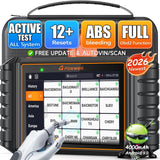 FOXWELL NT726 Bidirectional OBD2 Scanner
$368.99All-system and bidirectional scanners for GM BCM work.
FOXWELL NT726 Bidirectional OBD2 Scanner
$368.99All-system and bidirectional scanners for GM BCM work.
 FOXWELL NT624 Elite OBD2 Scanner, All-System Scan Tool
$332.09All-system and bidirectional scanners for GM BCM work.
FOXWELL NT624 Elite OBD2 Scanner, All-System Scan Tool
$332.09All-system and bidirectional scanners for GM BCM work.
 2026 KONNWEI KW850 Full OBD2 Car Scanner Professional Auto
$100.69All-system and bidirectional scanners for GM BCM work.
2026 KONNWEI KW850 Full OBD2 Car Scanner Professional Auto
$100.69All-system and bidirectional scanners for GM BCM work.
 FOXWELL Car Scanner NT604 Elite OBD2 Scanner ABS SRS
$172.19All-system and bidirectional scanners for GM BCM work.
FOXWELL Car Scanner NT604 Elite OBD2 Scanner ABS SRS
$172.19All-system and bidirectional scanners for GM BCM work.
 VDIAGTOOL BT500 6V 12V 24V Car Battery Tester with Waveform
$66.99All-system and bidirectional scanners for GM BCM work.
VDIAGTOOL BT500 6V 12V 24V Car Battery Tester with Waveform
$66.99All-system and bidirectional scanners for GM BCM work.


Frequently Asked Questions
Will a cheap OBD2 reader show my ABS or airbag light?
No. OBD-II was created for emissions compliance, so the standardised part of the system only guarantees access to powertrain data. ABS, airbag, body control and transmission-specific data sit outside that mandate and are read through manufacturer-defined protocols. You need a scanner with GM enhanced coverage.
What do the letters at the start of a trouble code mean?
P is powertrain, C is chassis (including ABS), B is body (including airbag and HVAC), and U is network communication. The second character indicates whether the code is SAE-generic or manufacturer-specific — a 0 generally means generic, a 1 means OEM-defined.
Which scanner tier do most GM owners need?
Tier 2, an all-system scanner with GM enhanced coverage. It reads every module, gives live data beyond the engine, and includes common reset functions. For someone doing their own brakes and suspension, it covers years of work. Tier 3 only pays off if you are bleeding ABS systems or chasing intermittent electrical faults.
What is bidirectional control good for?
Commanding a component instead of just watching it. The three places it earns its money on GM vehicles are ABS automated bleeding after a master cylinder or modulator job, component testing (fans, fuel pumps, injectors, EVAP solenoids) before buying the part, and relearns like steering angle and throttle position.
Do I need a scan tool to do rear brakes?
On a vehicle with an electronic parking brake, yes — the caliper piston is motor-driven and has to be retracted electronically rather than with a C-clamp. Some tier 2 tools include that service function; confirm it is listed for your model.
How do I know a scanner supports my truck?
Use the tool maker's coverage checker with your exact year, model and engine, and confirm each system separately — engine, transmission, ABS, SRS, BCM. Coverage is per-model, per-year and per-system, so a tool can support ABS on your truck but not SRS. If a seller cannot produce a per-vehicle list, treat the claim as marketing.
What is the security gateway on newer GM vehicles?
A module between the diagnostic connector and the vehicle's internal networks that restricts write access — bidirectional commands and programming — to tools that authenticate. Reading codes is generally unaffected. It is model-year specific and changes, so check the tool maker's current statement rather than a forum post.
Should I clear an airbag code myself?
Only after fixing the cause. An SRS light usually means the system is disabled and will not deploy in a crash, so clearing the code without repairing the fault leaves it inoperative with no warning — worse than the light. Some crash-related codes are permanent until the module is replaced or reprogrammed.
Does a code tell me which part to replace?
No, it is a starting point. P0171 means fuel trim on that bank ran lean enough to trip a threshold — a vacuum leak, dirty MAF, fuel delivery problem or an exhaust leak upstream. A wheel speed sensor C-code is as often a chewed harness or corroded connector as a failed sensor.
What scanner feature is most underused?
Freeze frame data, available at every tier. It captures RPM, coolant temperature, load and speed at the moment the code set, telling you whether the fault happens cold, hot, at idle or under load. That context is worth more than the code text itself.
A Note on Sourcing
The scope of the OBD-II mandate, the DTC letter-prefix convention, and the protocol history are established standards — including the requirement that all vehicles sold in the US from 2008 use ISO 15765 CAN, where older GM vehicles used SAE J1850 VPW.
No specific scan tools are named or recommended on this page. Coverage is per-model, per-year and per-system, it changes with every software release, and a recommendation that was accurate at the time of writing would mislead a reader a year later. The page tells you to verify coverage against the tool maker's own checker for your exact vehicle instead.
GM security gateway behaviour is deliberately described in general terms. It varies by model and model year and continues to change, so this page points you to the tool maker's current statement rather than publishing a list that would go stale.
The tier framework and the assessment of which features are worth paying for are our own. We sell diagnostic tools, and the position stated here is that most owners should buy tier 2 and that tier 3 is a tool many people would use twice.
For more shop equipment and tool buying guides, browse more shop tools guides.
Still deciding?
Pick the tier by the job, not the spec sheet. If you only need to know why the light is on, tier 1 is enough. If you want ABS, SRS and BCM codes, you need tier 2 at minimum. If you are bleeding ABS systems or testing actuators, go tier 3 and verify bidirectional coverage for your exact vehicle first.
Compare options in automotive tools and diagnostic equipment and check the coverage list for your year and model before you order.