
Abrasive blasting is one of the few shop processes where the tool is the cheap part. The gun matters far less than the media you feed it, the air you supply it, and whether you have somewhere to contain the mess. Buy the gun first and you will discover the compressor cannot keep up.
This guide covers the two gun designs, how to pick media for the job, the air supply requirement that catches most people out, and the safety issue that genuinely matters on rust removal work.
On this page
- Gravity-feed or dual-feed: what is the difference?
- Choosing media for the job
- Air supply is the real constraint
- Blasting sheet metal without warping it
- Safety: silica, lead and containment
- Frequently Asked Questions
Gravity-feed or dual-feed: what is the difference?
A gravity-feed handheld gun carries media in a small hopper above the nozzle. It is light, quick to set up, and suited to spot work: a seized bolt head, a bracket, a patch of surface rust, glass etching. The hopper is small, so you refill often.
A dual-feed gun draws media from both a hopper and a siphon line, which lets it run continuously from a bulk container. That is what you want when the job is a whole fender rather than a bracket, because stopping to refill every few minutes is the actual limit on a gravity gun.
| Design | Best for | Limitation |
|---|---|---|
| Handheld gravity feed | Spot rust, fasteners, etching, small parts | Small hopper, frequent refills |
| Dual-feed with 18oz hopper | Panels, sustained restoration work | Higher continuous air demand |
| Multi-media kit with control valve | Varying media and flow rate | More setup |
The ceramic tip on the dual-feed unit is worth noting. Steel nozzles wear fast under abrasive flow and the bore opens up as they do, which quietly increases air consumption and drops working pressure. Ceramic holds its bore far longer. Nozzle wear is the most overlooked consumable in blasting.
Blasters and guns
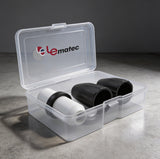 LE LEMATEC AS118-2C Professional Sandblaster Gun Accessory
$14.69Sandblaster kits and guns.
LE LEMATEC AS118-2C Professional Sandblaster Gun Accessory
$14.69Sandblaster kits and guns.
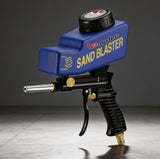 Professional Soda Blaster Kit
$37.45Sandblaster kits and guns.
Professional Soda Blaster Kit
$37.45Sandblaster kits and guns.
Choosing media for the job
Media choice does more to determine the result than the gun does. Match hardness to the substrate, not to the contaminant.
- Silicon carbide, 100 grit — the hardest common media. Cuts heavy rust and scale fast, and etches glass. Aggressive enough to damage soft substrates, so keep it off aluminium and thin panel steel.
- Brown corundum, 220 grit — finer aluminium oxide. The general-purpose choice for surface prep before primer, where you want a clean profile without deep cutting.
- Soda — soft enough to strip paint without touching the metal underneath, which makes it the option for panels and for work near glass or trim. It does not remove rust. Residue must be washed off thoroughly before priming or adhesion suffers.
The general rule: start with the least aggressive media that will do the job and step up only if it will not. Going straight to silicon carbide on a door skin removes the rust and the panel's flatness at the same time.
Air supply is the real constraint
This is where most home blasting projects fail. A blast gun is a continuous-draw tool. Unlike an impact wrench that fires in bursts and lets the tank recover, a blaster runs steadily and will outpace a small compressor within a minute or two.
When supply falls behind, pressure at the nozzle drops, cutting slows, and the natural response is to hold the gun closer — which is exactly what warps panels. The symptom looks like a media problem and is actually an air problem.
Practical implications:
- Size the compressor to the gun's continuous demand, not its peak. A pancake compressor will not run a blaster.
- Use 3/8" line rather than 1/4" where the run is long. Line restriction shows up as pressure drop under exactly this kind of sustained load.
- Moisture control is not optional. Damp media clumps and blocks the nozzle mid-job. A water separator upstream is the difference between working and clearing blockages — see our guide on what order to install air filters, separators and dryers.
Air supply
 Professional Analog Air Compressor Regulator
$21.99Air filters, regulators and dryers for clean, dry blasting air.
Professional Analog Air Compressor Regulator
$21.99Air filters, regulators and dryers for clean, dry blasting air.
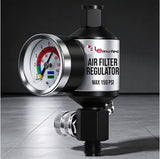 Professional 2-in-1 Air Compressor Regulator & Filter
$23.89Air filters, regulators and dryers for clean, dry blasting air.
Professional 2-in-1 Air Compressor Regulator & Filter
$23.89Air filters, regulators and dryers for clean, dry blasting air.

Blasting sheet metal without warping it
Warping is heat and impact energy concentrated in one spot. Body panels are thin and unsupported across their span, so they distort long before they look damaged.
Keep the nozzle moving constantly, work at a shallow angle rather than perpendicular, hold more distance than feels productive, and work in short passes with time between them. If the panel is warm to the touch, stop and let it cool.
For paint removal on a panel where the metal underneath is sound, soda is the safer choice precisely because it cannot deliver enough impact energy to distort the steel.
Safety: silica, lead and containment
Two hazards here are serious enough to be worth stating plainly.
Never blast with sand containing crystalline silica. Inhaling respirable crystalline silica causes silicosis, an irreversible lung disease, and OSHA regulates exposure to it specifically. Despite the word "sandblasting," use engineered media — aluminium oxide, silicon carbide, soda, glass bead — not builder's sand. A dust mask is not adequate protection; this requires proper respiratory protection.
Assume pre-1980 automotive paint may contain lead. Blasting aerosolises it. If you are stripping an older vehicle, that dust is a health hazard for you and anyone else in the building, and it is a contamination issue for the surrounding area.
Beyond that: eye protection rated for impact, hearing protection, gloves, and long sleeves. Media ricochets, and spent media plus whatever it removed has to go somewhere — blast into a cabinet or a contained area rather than an open driveway.
Frequently Asked Questions
What size air compressor do I need for a sandblaster?
Larger than most home garages have. Blasters draw air continuously rather than in bursts, so size to the gun's sustained demand rather than its peak figure. If the compressor cycles constantly and pressure sags, the tank is too small regardless of its pressure rating.
Can I use regular play sand as blasting media?
No. Sand containing crystalline silica causes silicosis when inhaled, and it is an irreversible lung disease. Use engineered media such as aluminium oxide, silicon carbide, soda or glass bead instead.
Which media should I use on a rusty body panel?
Start with a finer aluminium oxide such as 220 grit corundum, or soda if the goal is paint removal on sound metal. Reserve aggressive silicon carbide for heavy scale on thick sections. Aggressive media on thin panel steel risks warping and thinning the metal.
Why does my sandblaster keep clogging?
Almost always moisture in the air line. Damp media clumps and bridges in the hopper or nozzle. Install a water separator upstream of the gun and drain it regularly. Wet or old media that has absorbed humidity in storage causes the same symptom.
What is the difference between a gravity-feed and a dual-feed sandblaster?
A gravity-feed gun holds its media in a hopper above the nozzle and suits spot work. A dual-feed gun can also siphon from a bulk container, letting it run continuously for larger jobs without stopping to refill.
Does the nozzle wear out?
Yes, and it is the most overlooked consumable. Abrasive flow gradually opens up the bore, which increases air consumption and reduces working pressure without any obvious symptom. Ceramic tips last considerably longer than steel.
Can I blast aluminium?
Yes, but with soft media and low pressure. Aluminium is far softer than steel and aggressive media will pit and erode it quickly. Soda or fine glass bead at reduced pressure is the safer approach.
Shop Related Parts & Accessories
- Dual-feed sandblaster gun kit, ceramic tip, 18oz hopper
- Handheld portable sandblaster for etching and rust
- Silicon carbide blasting media, 100 grit
- Brown corundum blasting media, 220 grit
- Long nozzle attachment for precision blasting