
P1247 is a code with a problem: GM code references give it two entirely different definitions, and they are not variations on a theme. One has it as Fuel Injector 8 Control Circuit Shorted. The other has it as Turbo Boost Pressure Low. Those are different systems, different symptoms and different repairs — so before anything else, this page will help you work out which one your vehicle actually means. In most cases you can settle it in under a minute, without any tools.
Jump to a section: The two definitions · How to tell which one you have · Reading A: injector control circuit · Reading B: turbo boost pressure low · Why GM codes do this · A note on sourcing · Symptoms of each · Causes and how to confirm each · How it's diagnosed · Parts and cost · What other pages get wrong · FAQ
The Two Definitions
Here is the conflict laid out plainly, because most pages on this code pick one and never mention the other.
| Reading A | Reading B | |
|---|---|---|
| Definition | Fuel Injector 8 Control Circuit Shorted | Turbo Boost Pressure Low |
| System | Fuel injection control | Forced induction |
| Sits alongside | P1224, P1227, P1239, P1242 — the same fault on other cylinders | P1248 (boost pressure not detected), P1249 (wastegate control valve performance) |
| Typical symptom | Misfire, rough running | Loss of power, no boost |
| What you'd inspect | Injector wiring and control circuits | Turbo, boost plumbing, wastegate |
Notice that each definition sits inside a coherent family. That is the strongest evidence that both are real — neither is a typo. Reading A belongs to a run of per-cylinder injector circuit codes; Reading B belongs to a run of boost and wastegate codes. Two different code sets, both legitimate, both using the number 1247.
How to Tell Which One You Have
This is the useful part, and most people can settle it immediately.
Test 1: How many cylinders does your engine have?
This is decisive on its own for a great many vehicles. Reading A is Fuel Injector 8 Control Circuit Shorted.
If your engine has four or six cylinders, there is no injector 8. Reading A cannot apply. Your code means something else — very likely the boost reading if your engine is turbocharged.
That single question eliminates the ambiguity for every four-cylinder and V6 GM vehicle on the road.
Test 2: Does your engine have a turbocharger?
Equally decisive in the other direction. If your engine is naturally aspirated, Reading B cannot apply — there is no boost pressure to be low.
Between these first two questions, most vehicles are already resolved:
- Naturally aspirated V8 → Reading A is the only possibility
- Turbocharged four-cylinder → Reading B is the only possibility
- Turbocharged V8 diesel → both are technically possible; use the tests below
Test 3: What else is stored?
Companion codes are strong evidence because each definition has its own family.
- Codes for injector circuits on other cylinders alongside — that is Reading A, and it also tells you the fault is broader than one cylinder.
- Boost or wastegate codes alongside — that is Reading B.
Test 4: What is the vehicle actually doing?
The symptoms are quite different once you know what to listen for.
- Rough running, a misfire, an uneven idle — consistent with an injector not firing properly on one cylinder.
- Flat, gutless acceleration with the engine running smoothly — consistent with a boost problem. The engine is fine; it just is not being fed.
Test 5: Trust your scan tool
Above all of the above. Your scan tool reads the code and reports a description drawn from a database. Your vehicle's service information is better still. If either disagrees with this page, they are right and we are not.
Tools for sorting out the definition
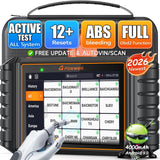 FOXWELL NT726 Bidirectional Scanner
$368.99Reads the code with its manufacturer definition and live data.
FOXWELL NT726 Bidirectional Scanner
$368.99Reads the code with its manufacturer definition and live data.
 FOXWELL NT614 Elite Scanner
$233.69Shows injector balance and boost data on supported vehicles.
FOXWELL NT614 Elite Scanner
$233.69Shows injector balance and boost data on supported vehicles.
 Compression Tester with Fuel/Vacuum Gauge
$25.65Vacuum/pressure gauge for checking boost.
Compression Tester with Fuel/Vacuum Gauge
$25.65Vacuum/pressure gauge for checking boost.


Reading A: Fuel Injector 8 Control Circuit Shorted
If your vehicle points this way, you are dealing with an injector control circuit — the wiring the module uses to command the injector, not the injector's spray quality.
This matters enormously, and there is a directly relevant precedent. GM's guidance on the closely related family of Duramax injector circuit codes is explicit: do not replace fuel injectors for those codes. The documented fault is chafed wiring between the engine control module and the fuel injection control module, at specific named connectors.
Our Duramax injector output circuit guide covers that in full, including a diagnostic rule worth borrowing here: the number of injector circuit codes stored indicates the type of fault. One code suggests an open circuit or poor connection; a group of four suggests a short to ground; more than four suggests a short to voltage.
The key principle transfers directly: a "control circuit shorted" code is a statement about wiring, not about the injector. Inspect the harness, the connectors and the terminals before anyone quotes a set of injectors — particularly on a diesel, where injector replacement is a major job.
Our P0612 guide covers the injector control module architecture that these circuits run through.
Reading B: Turbo Boost Pressure Low
If your vehicle points this way, the module commanded a level of boost and did not get it.
Start with the plumbing, not the turbocharger. Between the compressor and the engine there is a considerable amount of ducting, and every joint is a place boost can escape:
- Charge air pipes and couplers — hoses blowing off or splitting under pressure is common, and it is the first thing to look at. A pipe that has popped off is visible immediately.
- Clamps that have loosened with heat cycling and vibration
- The intercooler and its connections, including cracks in end tanks
- Split or perished hoses, which leak under pressure while looking fine at rest
Then the control side:
- The wastegate — stuck open means boost escapes past the turbine and never builds. Actuators seize, linkages corrode, and vacuum or electrical control can fail.
- The boost control solenoid and its hoses
- The boost pressure sensor itself, which may be reporting low boost that is not actually low
And only then the turbocharger:
- Worn bearings, damaged wheels, or a failed variable geometry mechanism where fitted
- A restricted exhaust ahead of or after the turbine, which limits how hard it can spin
- A restricted air filter or intake starving it on the inlet side
The order matters. A blown-off charge pipe and a failed turbocharger produce similar symptoms and wildly different bills. Check the cheap, visible things first — and note that a whistling or hissing under load is a strong clue pointing at a leak rather than the turbo itself.
Why GM Codes Do This
Worth understanding, because it explains the conflict and will help you with other codes in this range.
P1xxx codes are manufacturer-specific by definition. The generic P0xxx codes are standardised across all manufacturers, but the P1xxx range was left for each manufacturer to use as it saw fit.
GM then used that range across an enormous and varied product line — North American trucks and cars, medium-duty commercial vehicles, and platforms developed by its European operations — over decades. Published GM code lists carry an explicit caution that the same number may be used for different faults on different model years or models.
You can see the two lineages in the surrounding code numbers. One list places P1247 among per-cylinder injector circuit codes typical of North American diesel applications. Another places it among boost and wastegate codes, alongside terminology characteristic of GM's European-derived platforms.
Both lists are describing real GM vehicles. They are just describing different ones.
The practical lesson generalises well beyond this code: on any GM P1xxx code, confirm the definition against your specific year, model and engine rather than a general list. Our P1106 guide makes the same point about the MAP sensor range.
A Note on Sourcing for This Code
We cite documents we have read and label the rest, and here that means being unusually candid.
We could not verify a GM service bulletin naming P1247 on a specific GM platform, and we could not resolve which definition is correct in general — because there is no single correct answer. Both definitions appear in published GM code references, each within a coherent family of neighbouring codes.
We are not going to pick one and present it as settled. Doing so would give roughly half our readers a confident answer about the wrong system, which is worse than telling you the situation honestly.
What we can offer is the disambiguation above, which resolves most vehicles quickly, and the underlying reasoning for each reading once you know which applies.
Have a dealer check your VIN. On a code with two legitimate meanings, that is not a formality — it is the actual answer, and it is free.
Symptoms of Each Reading
| Reading A — injector circuit | Reading B — low boost |
|---|---|
| Misfire, particularly on one cylinder | Noticeable loss of power, especially under load |
| Rough running and uneven idle | Flat acceleration with the engine otherwise smooth |
| Surge or hesitation | Struggling on hills or when towing |
| Loss of power | Whistling or hissing under load, where there is a leak |
| Reduced fuel economy | Black smoke on some diesel applications |
| Rough or extended starting | Reduced power mode in some cases |
| Companion injector circuit codes | Companion boost or wastegate codes |
On urgency: moderate under either reading, and for different reasons. A misfiring cylinder sends unburnt fuel through the exhaust, which is hard on aftertreatment components. A boost leak means the engine is working harder for less, and a turbocharger problem left alone can progress. Neither is an emergency, but neither should be carried for months.
One exception worth flagging: if you have a significant loss of power in traffic, treat that as a safety consideration in its own right — merging and overtaking with an engine that will not deliver power is a genuine hazard.
Causes and How to Confirm Each
| Cause | How to confirm it | Which reading |
|---|---|---|
| Chafed or shorted injector control wiring | Inspect the harness and connectors; flex the harness while inspecting | A. The documented cause on the related code family |
| Corroded or backed-out terminal | Check terminal grip rather than appearance | A |
| Injector control module or driver fault | After the wiring between modules is proven good | A |
| Charge air pipe blown off or split | Look. A disconnected pipe is visible immediately | B. Check this first |
| Loose clamp or perished coupler | Inspect every joint between compressor and engine; pressure test | B |
| Wastegate stuck open | Inspect actuator and linkage for seizure; test its control | B. Boost never builds |
| Boost control solenoid or its hoses | Test the solenoid; inspect the control hoses | B |
| Intercooler leak or crack | Pressure test the charge air system | B |
| Restricted air filter or intake | Inspect the filter and ducting | B. Free to check |
| Restricted exhaust | Backpressure testing | B. Limits how hard the turbine can work |
| Boost pressure sensor fault | Compare the sensor reading against actual measured pressure | B. The boost may not really be low |
| Turbocharger failure | Last, after plumbing, wastegate and control are excluded | B. The expensive conclusion |
Injector and turbo parts
 ACDelco Fuel Injector 217-1626 (5.3L)
$139.99ACDelco fuel injector for 5.3L. Confirm fitment by VIN before ordering.
ACDelco Fuel Injector 217-1626 (5.3L)
$139.99ACDelco fuel injector for 5.3L. Confirm fitment by VIN before ordering.
 ACDelco Turbocharger 25201063
$702.99ACDelco stock replacement turbocharger. Confirm fitment by VIN before ordering.
ACDelco Turbocharger 25201063
$702.99ACDelco stock replacement turbocharger. Confirm fitment by VIN before ordering.
 ACDelco Air-to-Air Intercooler 23336319
$290.99ACDelco air-to-air intercooler. Confirm fitment by VIN before ordering.
ACDelco Air-to-Air Intercooler 23336319
$290.99ACDelco air-to-air intercooler. Confirm fitment by VIN before ordering.


How Is P1247 Diagnosed?
- Establish which definition applies. Cylinder count, turbocharger presence, companion codes, symptoms — and above all what your scan tool reports.
- Record all codes and freeze frame data before clearing anything.
- Confirm with a dealer against your VIN if the reading is still ambiguous. Free, and definitive.
If Reading A applies:
- Count the injector circuit codes. One suggests an open or poor connection; four suggests a short to ground; more suggests a short to voltage.
- Inspect the injector control wiring and connectors, flexing the harness as you go.
- Repair wiring and reroute it clear of whatever caused the damage, before considering modules or injectors.
If Reading B applies:
- Look at the charge air plumbing. A blown-off pipe is visible in seconds.
- Check the air filter and intake for restriction. Free.
- Pressure test the charge air system to find leaks that hide at rest.
- Inspect and test the wastegate and boost control for seizure or control faults.
- Verify the boost pressure sensor against an actual measurement.
- Assess the turbocharger last, once everything upstream and downstream is proven.
Parts and Cost
| Repair | Reading | Cost picture |
|---|---|---|
| Reconnecting a blown-off charge pipe | B | Free or near it. Check before any diagnosis is billed |
| Air filter | B | Minimal |
| Clamp or coupler | B | Minimal to modest |
| Wiring repair and reroute | A | The documented fix on the related family. Modest |
| Connector or terminal repair | A | Modest |
| Boost control solenoid or hoses | B | Modest |
| Wastegate actuator | B | Moderate |
| Intercooler | B | Moderate to significant |
| Injector control module | A | Significant — after wiring is proven |
| Turbocharger | B | Major. Make the diagnosis earn it |
| Fuel injectors | A | Major on a diesel — and a control circuit code does not implicate them |
Note the shape of that table. Under both readings, the cheapest outcomes sit at the top and the expensive ones at the bottom — and under both, the expensive item is the thing the code does not directly implicate. Order against your VIN.
Service parts
 ACDelco Injector O-Ring & Seal Kit
$120.99ACDelco fuel injector O-rings. Confirm fitment by VIN before ordering.
ACDelco Injector O-Ring & Seal Kit
$120.99ACDelco fuel injector O-rings. Confirm fitment by VIN before ordering.
 ACDelco 2-Pin Replacement Connector PT3739
$90.99Two-pin replacement connector for an injector connector. Confirm fitment by VIN before ordering.
ACDelco 2-Pin Replacement Connector PT3739
$90.99Two-pin replacement connector for an injector connector. Confirm fitment by VIN before ordering.
 BG 44K Fuel System Cleaner
$24.95BG 44K fuel system cleaner.
BG 44K Fuel System Cleaner
$24.95BG 44K fuel system cleaner.


What Other P1247 Pages Get Wrong
- Presenting one definition as the definition. Two legitimate readings exist, each within a coherent family of neighbouring codes. A page that picks one silently is confidently wrong for a large share of its readers.
- Not offering a way to disambiguate. Cylinder count alone settles it for every four-cylinder and V6 on the road — there is no injector 8 on a four-cylinder engine. That takes seconds and no tools.
- Treating "control circuit shorted" as an injector fault. It is a statement about wiring. GM's guidance on the closely related code family is explicitly not to replace injectors for them.
- Going to the turbocharger first on the boost reading. A charge pipe blown off its coupler produces the same symptom and is visible immediately. Plumbing, filter, wastegate and sensor all come first.
- Not mentioning the boost pressure sensor. A sensor reporting low boost that is not actually low sends people looking for a leak that does not exist.
- Ignoring the freeze frame. What the engine was doing when the code set is useful under either reading, and clearing the code discards it.
- Failing to say "trust your scan tool." On a code with two meanings, the tool and the service information outrank any article.
Frequently Asked Questions
Why do I keep finding two different definitions for P1247?
Because both are real. P1xxx codes are manufacturer-specific, and GM used that range across a very broad product line over decades — including platforms developed by its European operations. Published GM code lists carry an explicit warning that the same number may mean different faults on different models and model years. P1247 is one of those numbers.
How do I work out which applies to my vehicle?
Start with two questions. How many cylinders does your engine have — because there is no injector 8 on a four-cylinder or V6, which rules out that reading entirely. And does it have a turbocharger — because a naturally aspirated engine cannot have low boost pressure. Between those two, most vehicles are resolved immediately.
What if my vehicle could be either?
A turbocharged V8 diesel is the case where both are technically possible. Then look at companion codes — injector circuit codes on other cylinders point one way, boost and wastegate codes point the other — and at the symptoms. A misfire suggests the injector reading; smooth but gutless running suggests the boost reading. And check with a dealer against your VIN, which is free and definitive.
If it's the injector reading, do I need injectors?
Almost certainly not. "Control circuit shorted" describes the wiring the module uses to command the injector, not the injector's condition. GM's guidance on the closely related family of injector circuit codes is explicitly not to replace injectors for them, and to inspect the wiring between the modules instead. On a diesel that distinction is worth a great deal.
If it's the boost reading, do I need a turbocharger?
Check the plumbing first. A charge air pipe blown off its coupler, a split hose, or a loose clamp all produce low boost and are far more common than turbocharger failure. A whistling or hissing noise under load points at a leak. The turbo is the last conclusion, not the first.
Can I keep driving?
Under either reading it is not an emergency, but neither should be left for months. A misfiring cylinder sends unburnt fuel through the exhaust; a boost leak means the engine works harder for less. And if the power loss is significant, treat that as a safety matter in traffic — merging and overtaking without power is genuinely hazardous.
My scan tool shows a definition that isn't either of these.
Then trust your scan tool. That is not a disappointing answer — it is the correct one. Your tool and your vehicle's service information are reading your specific vehicle, and on a manufacturer-specific code that outranks any general reference, this page included.
Does this happen with other GM codes?
Yes, and it is worth knowing. Several codes in GM's P1xxx range carry more than one published definition, and other manufacturers use the same numbers for completely unrelated faults. Whenever you are looking at a P1xxx code, confirm the definition against your specific year, model and engine rather than a general list.
Shop Related Parts & Tools
Establish which definition applies before ordering anything — the two readings lead to entirely different parts. Confirm fitment against your VIN.
-
 MOTOPOWER MP69033 OBD2 Scanner — more important on this code than most, because reading the description your own vehicle reports is what settles which definition applies. It also shows the companion codes that point one way or the other.
-
 95-Piece Mechanics Tool Set (Metric & SAE) — for charge air clamps and couplers under the boost reading, or harness and connector access under the injector reading.
-
 3-In-1 Cordless Impact Wrench & Screwdriver Kit — speeds up intercooler and charge pipe fastener work, which is where the cheap fixes on the boost side usually are.
Related Guides
- P1223, P1226, P1229, P1238 & P1241: Duramax Injector Output Circuits — the injector circuit family, and GM's instruction not to replace injectors
- P0612 Code: Fuel Injector Control Module Relay Control
- P1106 Code: MAP Sensor Circuit Intermittent High Voltage — the same code-reuse problem in another range
- GM Check Engine Light Codes: Most Common & What They Mean