
P1682 is "Ignition 1 Switch Circuit 2." Despite the name, the ignition switch is usually not the problem. GM has published bulletins pointing at a single loose terminal inside the underhood fuse block — and on the Lambda platform they name the exact terminal: terminal 51 in the X3 connector. GM's repair for it can be a new terminated lead rather than a whole fuse block. This code also causes stalling, so it is one of the few where the honest answer on urgency is don't put it off.
Jump to a section: What P1682 means · Why this one is urgent · Terminal 51 — the named failure point · GM's millivolt test · Don't replace the MAF sensor · The five-minute relay swap · Fuses that look unseated · Codes that travel with it · Symptoms · Causes and how to confirm each · How it's diagnosed · Parts and cost · GM documents · What other pages get wrong · FAQ
What P1682 Means
The engine control module does not trust a single wire to tell it the ignition is on. It receives two separate ignition voltage feeds — one through the powertrain relay, one through the run/crank relay — and cross-checks them against each other.
P1682 sets when those two feeds disagree by more than about 3 volts, for as little as a second.
That design is why the code is so often misread. It does not say "the ignition switch failed." It says "these two power supplies no longer match" — and anything that adds resistance to either one will do that. A loose terminal. A corroded pin. A tired relay. A connection that is fine cold and marginal once everything expands with heat.
It also explains the maddening intermittency. A connection with poor tension can pass a static voltage check perfectly and still drop out over a bump or at operating temperature.
Why This One Is Urgent
Most code guides on this site tell you a stored code is not an emergency. This is the exception, and it is worth being direct about.
The failure P1682 describes is an interrupted power supply to the engine control module. When that happens while you are moving, the engine can stall — and a stall at speed means losing power steering assist and brake booster assist at the same moment. Owner complaints on the affected platforms describe exactly that, along with reduced-power events in traffic.
If your vehicle has stalled, dropped into reduced engine power, or failed to restart while hot, treat this as a repair to book now rather than at the next service. The intermittent no-start is the inconvenient symptom; the stall is the dangerous one, and they come from the same fault.
Terminal 51 — GM Names the Failure Point
This is the detail that turns an open-ended electrical hunt into a targeted inspection.
GM bulletin 19-NA-276 (December 2019) is titled "Potential Reduced Engine Power Message Displayed and/or Engine Stall With DTCs P1682 and/or P0689 Set." Its stated cause:
The cause of the condition may be poor terminal tension on terminal 51 in X50A fuse block Underhood X3.
And GM's instruction to dealers is to replace terminal 51 in the X50A fuse block Underhood X3 connector with a new terminated lead where needed.
Read that repair carefully, because it matters financially: GM's documented fix is a single terminal pigtail, not automatically the entire fuse block. A terminated lead is a small part. A complete underhood fuse block is a few hundred dollars. If you are quoted the whole assembly, it is reasonable to ask whether the terminal repair was evaluated first.
Preliminary information PIT5643 covers the same ground, describing arcing and corrosion on terminal 51 of the X3 connector at the underhood fuse block as the cause of P0689 and P1682.
What the damage looks like: not a dramatic burn. Reports consistently describe a subtle dark or brown discolouration on the pin and its matching terminal — the signature of micro-arcing across a connection with poor tension. It is easy to look straight at it and see nothing, so inspect closely and in good light.
Getting there means disconnecting the battery, unbolting the fuse block, and inspecting the connectors on its underside — which is why so many diagnoses miss it. The failure is on the face nobody looks at.
These bulletins concern the GM Lambda platform and related vehicles — Acadia, Traverse, Enclave, Outlook and others. This terminal failure became the subject of a class action over who pays for the repair, which is a reasonable thing to raise with a dealer if your vehicle is affected.
Battery parts
 ACDelco Battery Cables, Gold, Replacement
$82.99Battery cable and AGM battery. Confirm group size. Confirm fitment by VIN before ordering.
ACDelco Battery Cables, Gold, Replacement
$82.99Battery cable and AGM battery. Confirm group size. Confirm fitment by VIN before ordering.
 ACDelco Professional AGM Battery 65XAGM
$487.99Battery cable and AGM battery. Confirm group size. Confirm fitment by VIN before ordering.
ACDelco Professional AGM Battery 65XAGM
$487.99Battery cable and AGM battery. Confirm group size. Confirm fitment by VIN before ordering.


GM's Millivolt Test — an Actual Number
Most advice on this code amounts to "look for corrosion." GM publishes something better: a measurable pass/fail threshold.
Bulletin 19-NA-119 (June 2019, replacing PIE0513) covers 2019 Buick Enclave and Chevrolet Traverse with the 3.6L LFY built before 22 February 2019. It addresses intermittent no-crank and a MIL with DTCs P135A, P135B, P16A7 and P16AF — and its stated cause is the same underlying problem: loose terminal tension in the underhood fuse block.
GM's procedure is a voltage-drop test done with the engine running:
- Remove the underhood fuse block access cover.
- Set a DVOM to millivolts.
- Clip the positive lead to the positive cable (B+) stud.
- With the vehicle in PARK and the parking brake set, start the engine and let it idle.
- Apply the negative lead to the appropriate outboard terminal fuse test port for the code concerned.
- Record the reading.
GM's threshold:
| Reading | GM's instruction |
|---|---|
| Less than 200 mV | Proceed to check terminal tension with the specified test probe |
| More than 200 mV | Replace the X50A underhood fuse block |
For the terminal tension check itself, GM specifies diagnostic test probe J-35616-35 (VT) against the corresponding terminals in the X50A Fuse Block Underhood X4 connector, then repair or replace the terminal as needed.
Two honest qualifications. First, 19-NA-119 names P135A, P135B, P16A7 and P16AF — not P1682. We cite it because it documents the same root cause with a real, measurable procedure, and a voltage-drop test across fuse block terminals is exactly the right technique for a code defined by two feeds disagreeing. Second, the specific fuse test ports it names apply to those codes and that vehicle. Use the method; get the test point for your vehicle and code from current service information.
If You Also Have P0101, Don't Replace the MAF Sensor
This one saves a wasted part, and it is easy to miss.
GM bulletin 21-NA-032 is reported to warn technicians not to replace the mass air flow sensor when P1682 is also present, because the root cause may be a compromised wire connection in the underhood fuse block's X3 connector — at position H6 on the applications it covers.
The logic is straightforward once stated. If the module's power supply is dropping out intermittently, the sensor readings it captures around that event will look wrong — so it stores an airflow code describing a symptom of the electrical fault rather than a sensor problem.
The rule: when P1682 is stored alongside sensor codes, fix the power supply first and re-evaluate. Replacing sensors while the module's feed is intermittent is chasing shadows. Our P0101 guide covers that code on its own terms.
We could not open 21-NA-032 directly, so treat the specifics as corroborated — but the principle holds regardless of the bulletin.
The Five-Minute Relay Swap
Before any of the fuse block work, there is a check that costs nothing and takes minutes.
The engine controls ignition relay — reported as GM part 13595908, and identified in preliminary information PIT5253B as a known cause of P1682 with a crank/no-start — sits in the underhood fuse box alongside several identical relays.
Swap it with an identical relay from a non-critical circuit such as the horn, then see whether the behaviour changes or follows the relay. On the newer trucks this relay is often labelled KR75; on the Lambda vehicles, the run/crank and powertrain relays are the ones to try.
If the fault moves with the relay, you have found it for the price of a part that costs less than most diagnostic hours. If it does not move, you have eliminated a common cause and can move on to the fuse block with more confidence.
A related check reported from PIT5546G is to verify voltage at a specific group of fuses with the key off. Fuse numbering varies by vehicle, so pull the legend for yours rather than borrowing a list from an article about a different model.
Relays and connectors
 ACDelco Professional D1741C Multi-Purpose Relay
$19.99Relays and connector repair. Confirm fitment by VIN before ordering.
ACDelco Professional D1741C Multi-Purpose Relay
$19.99Relays and connector repair. Confirm fitment by VIN before ordering.
 ACDelco Wire Connectors, Replacement, 2 Pins
$90.99Relays and connector repair. Confirm fitment by VIN before ordering.
ACDelco Wire Connectors, Replacement, 2 Pins
$90.99Relays and connector repair. Confirm fitment by VIN before ordering.
 Nomex Split Loom, 1 in. x 10 ft
$105.66Relays and connector repair. Confirm fitment by VIN before ordering.
Nomex Split Loom, 1 in. x 10 ft
$105.66Relays and connector repair. Confirm fitment by VIN before ordering.


Fuses That Look Unseated Are Probably Fine
A small note from GM's own bulletin that prevents a wrong turn.
While working through the fuse block, GM cautions:
The fuses in the X50A Fuse Block may appear not fully seated as they will be able to be pressed down further into fuse block. This is normal and does not indicate a fuse block failure.
So if you open the box and the fuses look like they are sitting proud, that is not your fault and not a finding. Press on with the actual test rather than reseating everything and declaring victory.
Codes That Travel With It
| Code | What it adds |
|---|---|
| P0689 — ECM/PCM power relay sense circuit | The classic partner. GM names both P1682 and P0689 in the terminal 51 bulletin. Seeing them together strongly suggests the fuse block terminal |
| P0685 | ECM/PCM power relay control circuit open — same family of power supply faults |
| P16A7 / P16AF | Engine controls ignition relay feedback circuit codes — addressed by the millivolt procedure above |
| P135A / P135B | Ignition coil supply voltage circuits — also traced to loose fuse block terminals |
| P0101 and other sensor codes | Likely consequences of the power interruption. Fix the supply first |
P1682 plus P0689 on a Lambda vehicle is close to a signature. Inspect X3 terminal 51 before anything else.
Symptoms of P1682
- Engine stalling while driving — the serious one
- Reduced engine power message, often with traction control disabled
- Intermittent crank/no-start — cranks but will not fire
- Runs fine cold, then fails once hot and restarts after cooling — a classic marginal-connection signature
- Check engine light, sometimes only in history
- In some cases the engine will not shut off with the key
- Flickering gauges or electrical oddities
- Battery drain in some reports
The hot-fails-cold-works pattern is worth flagging to whoever diagnoses it. Metal expands with heat, a terminal with poor tension loses contact, and everything returns to normal once it cools — which is exactly why the vehicle behaves perfectly at the shop.
Causes and How to Confirm Each
| Cause | How to confirm it | Source |
|---|---|---|
| Poor terminal tension at X3 terminal 51 (Lambda platform) | Inspect the underside of the fuse block for subtle dark discolouration on pin 51 and its terminal | 19-NA-276 and PIT5643. GM's repair is a new terminated lead |
| Loose terminals elsewhere in the underhood fuse block | GM's millivolt drop test — over 200 mV means replace the fuse block | 19-NA-119 — verified, for related codes |
| Failed engine controls ignition relay | Swap with an identical relay from another circuit | PIT5253B — cheapest check available |
| Water intrusion into the fuse block | Inspect for moisture, corrosion, staining. Cowl and headlamp leaks are reported sources | A recurring theme on these platforms |
| Corroded or damaged ECM connector terminals | Inspect connector pins and harness pass-throughs | Heat and vibration |
| Low battery or charging system fault | Test battery state of charge and charging voltage first | Free, and a genuine cause of voltage disagreement |
| Aftermarket remote start or alarm wiring | Ask what has been added to the ignition circuits | Worth raising if the vehicle has add-ons |
| Faulty ignition switch | Only after the fuse block and relays are excluded | Named by the code, rarely the cause |
How Is P1682 Diagnosed?
- Record all codes, including history. P0689 alongside points hard at the fuse block terminal.
- Test the battery and charging system. Free, and it can produce the voltage disagreement on its own.
- Note the pattern. Hot-fails, cold-works suggests a marginal terminal rather than a dead component.
- Swap the ignition relay with an identical one from a non-critical circuit.
- Run GM's millivolt drop test at the fuse block with the engine idling, using the test point for your vehicle from current service information.
- Inspect the underside of the fuse block — on Lambda vehicles, X3 terminal 51 specifically. Look for subtle discolouration, not obvious burning.
- Check terminal tension with the correct test probe rather than by feel.
- Do not replace sensors whose codes appeared alongside this one until the power supply is sound.
- Repair the terminal where that is the finding — GM's documented repair is a new terminated lead.
- Verify over multiple hot and cold cycles, since a single successful start proves very little on an intermittent fault.
Battery testers and scan tools
 TOPDON BT200 12V Car Battery Tester Digital Automotive
$103.99Test voltage and read codes.
TOPDON BT200 12V Car Battery Tester Digital Automotive
$103.99Test voltage and read codes.
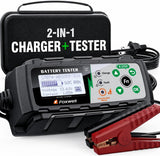 FOXWELL BC521 Battery Charger & Tester
$162.35Test voltage and read codes.
FOXWELL BC521 Battery Charger & Tester
$162.35Test voltage and read codes.
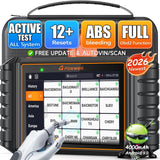 FOXWELL NT726 Bidirectional OBD2 Scanner
$368.99Test voltage and read codes.
FOXWELL NT726 Bidirectional OBD2 Scanner
$368.99Test voltage and read codes.
Parts and Cost
| Repair | What it involves | Cost picture |
|---|---|---|
| Relay swap test | Exchange with an identical relay from another circuit | Free to test |
| Engine controls ignition relay | Where the fault follows the relay | Inexpensive — the best possible outcome |
| Terminated lead / terminal pigtail | GM's documented repair for the terminal 51 failure | A small part. Ask about this before agreeing to a whole fuse block |
| Underhood fuse block (UBEC) | Where the millivolt test fails or internal damage is found. Access and re-pinning take time | Several hundred dollars plus labour |
| Wiring or connector repair | Where corrosion extends beyond one terminal | Varies with access |
| Ignition switch | Only where genuinely implicated | Often replaced unnecessarily on this code |
| Battery, alternator or MAF replaced in error | What happens when symptoms get treated instead of the supply fault | Money spent with the fault still present |
Fuse block part numbers differ by platform and have been superseded on some applications, so order against your VIN rather than a number from an article. It is also worth asking a dealer whether any coverage applies before paying.
GM Documents Relevant to P1682
| Document | Subject | Status |
|---|---|---|
| 19-NA-119 (Jun 2019) | Intermittent no crank and MIL with P135A, P135B, P16A7, P16AF. Cause: loose terminal tension in the underhood fuse block. Millivolt drop test at idle from the B+ stud; over 200 mV, replace the X50A fuse block; under, check terminal tension with probe J-35616-35 (VT). Notes that fuses appearing unseated is normal. Replaces PIE0513 | 2019 Enclave and Traverse, 3.6L LFY, built before 22 Feb 2019 — verified. Does not name P1682 |
| 19-NA-276 (Dec 2019) | "Potential Reduced Engine Power Message Displayed and/or Engine Stall With DTCs P1682 and/or P0689 Set." Cause: poor terminal tension on terminal 51 in X50A fuse block Underhood X3. Repair: replace that terminal with a new terminated lead | Lambda platform and related — corroborated with direct quotation, not opened |
| PIT5643 | Diagnosing P0689 and/or P1682 by inspecting for arcing and corrosion on terminal 51 of the X3 connector at the underhood fuse block | Corroborated — not opened |
| 21-NA-032 | Compromised wire connection in the UBEC X3 connector. Do not replace the MAF sensor when P1682 is also present | Corroborated — not opened |
| PIT5253B | Engine controls ignition relay as a cause of P1682 with crank/no-start | Corroborated — not opened |
| PIT5546G | Checking voltage at specified fuses with the key off | Corroborated — not opened |
Only 19-NA-119 was read in full here, and it addresses related codes rather than P1682 itself — we would rather say that than imply a stronger source than we have. Have a dealer check your VIN against current bulletins.
What Other P1682 Pages Get Wrong
- Blaming the ignition switch because the code says "ignition switch." GM's bulletins on this code point at fuse block terminals. Owners report replacing switches, batteries and alternators with the fault still present.
- Not naming terminal 51. GM identifies a specific terminal in a specific connector on a specific platform. That converts an open-ended electrical hunt into an inspection — and it is the single most actionable fact about this code.
- Jumping straight to a whole fuse block. GM's documented repair for the terminal 51 failure is a new terminated lead. That is a small part instead of a few hundred dollars, and it is worth asking about.
- Offering no measurable test. "Check for corrosion" is not a procedure. GM publishes a millivolt drop test with a 200 mV threshold for the related codes, which is a far better tool.
- Not looking underneath. The failure is on the underside of the fuse block, and the damage is often a faint dark spot rather than obvious burning.
- Missing the MAF warning. GM is reported to tell technicians not to replace the mass air flow sensor when P1682 is present. Sensor codes stored during a power dropout describe the symptom, not the fault.
- Treating it as a routine code. This one stalls vehicles in traffic. It deserves a different urgency than a catalyst or evaporative code, and saying otherwise does readers a disservice.
- Turning the page into a jump starter advertisement. An earlier version of this page listed three of them. A jump pack does not fix an intermittent ignition feed, and it is not the answer to a stalling complaint.
Frequently Asked Questions
Is P1682 the ignition switch?
Usually not, despite the name. GM's bulletins on this code point at the underhood fuse block — specifically poor terminal tension on terminal 51 of the X3 connector on the Lambda platform. Owners frequently report replacing the ignition switch without success before the fuse block is inspected.
Is it safe to drive?
We would not recommend it if the vehicle has stalled or dropped into reduced power. The fault interrupts power to the engine control module, and a stall at speed also costs you power steering and brake assist. The intermittent no-start is inconvenient; the stall is the reason to deal with this promptly.
What is terminal 51?
A specific terminal in the X3 connector on the underside of the X50A underhood fuse block. GM identifies poor tension there as a cause of stalling and reduced engine power with P1682 and P0689, with arcing and corrosion developing as a result.
Do I need a whole new fuse block?
Not necessarily. GM's documented repair for the terminal 51 condition is to replace that terminal with a new terminated lead. A full fuse block is warranted where the millivolt test fails or damage is more extensive — but it is fair to ask whether the terminal repair was considered.
How can I test it properly?
GM publishes a voltage drop test for the related codes: DVOM on millivolts, positive lead on the B+ stud, engine idling in park, negative lead at the appropriate fuse test port. Over 200 mV means replace the fuse block. Get the correct test point for your vehicle from current service information.
My truck starts fine cold but not when hot. Is that related?
That pattern fits this fault well. Metal expands as it heats, a terminal with poor tension loses contact, and everything works again once it cools. Mention it specifically to whoever diagnoses the vehicle — it is a useful clue and it explains why the fault hides at the shop.
I have P1682 and a MAF code. Should I replace the MAF sensor?
Not yet. GM is reported to warn technicians against replacing the mass air flow sensor when P1682 is present, because the airflow code can be a consequence of the power interruption rather than a sensor fault. Fix the supply problem, clear the codes, and see what returns.
What's the cheapest thing to try first?
Swap the engine controls ignition relay with an identical relay from a non-critical circuit such as the horn. It takes minutes, costs nothing to test, and is a documented cause of this code with a crank/no-start symptom.
Shop Related Parts & Tools
This is an electrical fault, and the useful items are the ones that help you find it. Confirm all part numbers against your VIN — fuse block numbers differ by platform and some have been superseded.
-
 MOTOPOWER MP69033 OBD2 Scanner — checks whether P0689 is stored alongside, which on Lambda vehicles points straight at the fuse block terminal.
-
 95-Piece Mechanics Tool Set (Metric & SAE) — for unbolting and lifting the underhood fuse block to inspect the connectors underneath, which is where the failure lives.
-
 Buture Beta09 Jump Starter with Air Compressor — useful roadside insurance while you get the fault diagnosed, though it treats the inconvenience rather than the cause.
Related Guides
- Chevy Silverado Won't Start: Common Causes & How to Fix It
- P0101 Code: Mass Air Flow Sensor Performance — the code you should not act on while P1682 is present
- GM Check Engine Light Codes: Most Common & What They Mean