
Your Silverado 1500's instrument cluster and Driver Information Centre display dozens of warning lights and messages. Knowing what each one means — and how urgently to act — saves engines, and occasionally more than that. Here is the reference.
One thing to know before you start: the colour is the priority system. Red means stop or act now. Amber means investigate. Blue and green are information. If you remember nothing else from this page, remember that and the two entries marked urgent below.
RED — Stop Driving or Act Immediately
Oil Pressure Warning (oil can icon)
Means: oil pressure has dropped below safe levels.
Do: pull over and shut the engine off. Do not continue driving — running without oil pressure destroys an engine in minutes. Check the level; if it is fine, do not restart, because the pump, pick-up or sensor may have failed. Have it towed.
Causes: low oil, failed pump, clogged pick-up, failed pressure sensor. A sensor fault is a real possibility, but treat the warning as genuine until proven otherwise — the cost of being wrong is the engine.
Charging System Warning (battery icon)
Means: the charging system is not keeping up. This is not a battery warning; it is a charging warning.
Do: shed electrical load — climate control, heated seats, rear defrost — and head for a shop or home. You are running on stored charge and the remaining time is limited and unpredictable, so do not plan around a specific number of minutes.
Causes: failed alternator, broken serpentine belt, failed battery, loose or corroded charging cable.
Coolant Temperature Warning (thermometer)
Means: the engine is overheating.
Do: pull over and shut down. Do not open the radiator cap or surge tank on a hot engine — the system is pressurised and the coolant is above its atmospheric boiling point, so opening it releases scalding steam and liquid. Let it cool fully, then check the reservoir.
Causes: low coolant, failed water pump, stuck thermostat, fan failure, blocked radiator, head gasket.
Brake System Warning
Means: with the parking brake released, brake fluid is low or a brake fault exists.
Do: check fluid level. If it is low, look for a leak before topping up — fluid does not disappear on its own. Sudden loss means a line or cylinder failure; do not drive.
Causes: worn pads dropping the level gradually, a leak, failed pressure switch. Note that gradually falling fluid with worn pads is normal-ish; a sudden drop never is.
Airbag / SRS Warning
Means: a fault in the supplemental restraint system.
Do: get it diagnosed, and do not clear the code to make the light go away. When an SRS fault sets, the affected restraint is typically disabled — the airbag may not deploy in a crash. The vehicle drives perfectly normally because nothing in the drivetrain is affected, which is exactly why this warning gets ignored more than any other on the cluster.
Causes: seat position or occupant sensor, clockspring in the steering column, connector under a seat disturbed by cleaning or cargo, or a deployed module never replaced.
Battery and charging
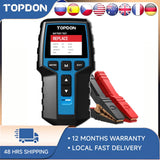 TOPDON BT200 12V Car Battery Tester Digital Automotive
$103.99Battery light: test the system.
TOPDON BT200 12V Car Battery Tester Digital Automotive
$103.99Battery light: test the system.
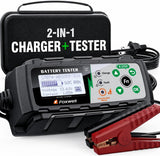 FOXWELL BC521 Battery Charger & Tester
$162.35Battery light: test the system.
FOXWELL BC521 Battery Charger & Tester
$162.35Battery light: test the system.
 FOXWELL BT705 Battery & Alternator Tester
$159.89Battery light: test the system.
FOXWELL BT705 Battery & Alternator Tester
$159.89Battery light: test the system.

AMBER — Investigate
Check Engine Light — solid
Means: the powertrain module has stored a fault code.
Do: get it scanned reasonably soon. Frequently emissions-related — oxygen sensor, MAF, EVAP. Not an emergency absent performance changes.
Check Engine Light — flashing (urgent)
Means: an active misfire severe enough to damage the catalytic converter, happening right now. Raw fuel is passing into the converter.
Do: stop driving. A converter costs considerably more than whatever caused the misfire, and the damage accumulates by the minute.
Causes: failed coil, spark plug, injector, or lifter failure.
Service StabiliTrak / Traction Control
Means: stability control has faulted and disabled itself.
Do: drive with extra caution — the electronic safety net is gone. Often a wheel speed signal problem, and often debris on the encoder ring rather than a failed sensor. See our StabiliTrak guide.
ABS Warning
Means: the anti-lock system has faulted. Base braking still works; anti-lock function does not.
Do: allow more stopping distance, especially in wet or ice, and get it scanned. ABS and StabiliTrak faults frequently share a root cause.
TPMS — Tyre Pressure Monitor
Means: at least one tyre is significantly below placard pressure.
Do: check all four with a gauge — including the position the system names, since the system can be wrong about which. Inflate to the door jamb figure. If it will not clear after inflating and driving, a relearn or a sensor may be needed.
Note: a light that flashes for a while at startup and then stays solid indicates a system fault rather than low pressure — a dead sensor battery is the usual cause.
Service 4WD
Means: a fault in the 4WD control system.
Do: 4WD may not engage. Safe to drive in 2H, but do not count on 4WD until it is diagnosed — finding out on an icy incline is the wrong time.
Reduced Engine Power
Means: the module has limited engine output to protect the drivetrain. Limp mode.
Do: get it scanned. It often clears on a restart and returns, which tempts people to ignore it. Common causes include throttle body, throttle position or pedal sensors, and wiring.
Transmission Temperature
Means: transmission fluid is overheating, typically from sustained towing on grades.
Do: pull over, shift to Park or Neutral and let it idle — do not shut the engine off, because the fluid cooler only circulates while the engine runs. Once temperature normalises, continue at reduced load or speed.
Security / Immobiliser
Means: the theft deterrent system has not recognised the key, or has faulted.
Do: the engine may crank without starting. Try the spare key — if that works, the first key or its transponder is the fault.
DEF Level (3.0L Duramax only)
Means: diesel exhaust fluid is low.
Do: refill promptly. Ignoring it leads to escalating warnings, then a speed limit, then a no-restart condition by regulatory design. This is not a fault to defer.
TPMS sensors
 TPMS Sensor for 2007–2014 Sierra/Yukon
$28.29Sensors for the tire pressure light. Confirm year. Confirm fitment by VIN before ordering.
TPMS Sensor for 2007–2014 Sierra/Yukon
$28.29Sensors for the tire pressure light. Confirm year. Confirm fitment by VIN before ordering.
 ACDelco Sensor, Valve Stem, TPMS
$86.99Sensors for the tire pressure light. Confirm year. Confirm fitment by VIN before ordering.
ACDelco Sensor, Valve Stem, TPMS
$86.99Sensors for the tire pressure light. Confirm year. Confirm fitment by VIN before ordering.


BLUE AND GREEN — Information
- High beam — high beams on.
- Tow/Haul — mode active. Use it when loaded or descending grades.
- 4WD (4Hi / 4Lo / Auto) — solid means engaged, flashing means transitioning. Flashing that persists suggests a fault.
- Cruise / adaptive cruise — system on or actively following.
Why Your Cheap Scanner Shows Nothing
This catches people out constantly. Inexpensive OBD-II readers generally display only powertrain P-codes. Airbag faults are B-codes, ABS and StabiliTrak faults are C-codes, and module communication faults are U-codes. A basic scanner cannot see any of those and will report a clean scan on a truck with an obvious warning light on the cluster.
If you have a light and a scanner showing nothing, the scanner is the limitation, not the truck.
Scan tools
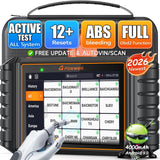 FOXWELL NT726 Bidirectional OBD2 Scanner
$368.99Scanners that read every module.
FOXWELL NT726 Bidirectional OBD2 Scanner
$368.99Scanners that read every module.
 FOXWELL NT614 Elite OBD2 Scanner
$233.69Scanners that read every module.
FOXWELL NT614 Elite OBD2 Scanner
$233.69Scanners that read every module.
 FOXWELL NT604 OBD2 Scanner
$209.09Scanners that read every module.
FOXWELL NT604 OBD2 Scanner
$209.09Scanners that read every module.


DIC Messages
| Message | Meaning | Urgency |
|---|---|---|
| Change Engine Oil Soon | Oil life monitor has run down | Soon |
| Oil Life Reset Required | Oil changed but monitor not reset | Reset now |
| Transmission Hot — Idle Engine | Fluid temperature critical | Stop and idle |
| Service Transmission | Transmission fault stored | This week |
| Check Fuel Cap | Loose cap, EVAP leak detected | Check now |
| Service Battery Charging System | Charging or battery monitoring fault | Investigate |
| No Remote Detected | Fob battery dead or fob absent | Hold fob to start button |
Oil and filter
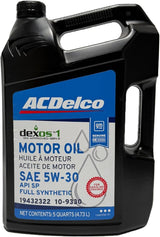 ACDelco 10-9330 dexos1 Gen 3 Full Synthetic 5W-30 Oil
$58.95Oil life and change oil messages. Confirm spec. Confirm fitment by VIN before ordering.
ACDelco 10-9330 dexos1 Gen 3 Full Synthetic 5W-30 Oil
$58.95Oil life and change oil messages. Confirm spec. Confirm fitment by VIN before ordering.
 ACDelco GM Original Equipment PF64 (25206966) Oil Filter
$13.89Oil life and change oil messages. Confirm spec. Confirm fitment by VIN before ordering.
ACDelco GM Original Equipment PF64 (25206966) Oil Filter
$13.89Oil life and change oil messages. Confirm spec. Confirm fitment by VIN before ordering.

A Note on Sourcing
The airbag / SRS entry was added in this revision. An earlier version of this page described itself as a complete guide to every icon and omitted the airbag light entirely — the one warning where ignoring it means a restraint may not deploy in a crash, and the one owners most often ignore because the truck drives normally.
ABS, security/immobiliser and DEF entries were also added, and the scanner limitation section, which explains why a basic code reader shows nothing on airbag, ABS and communication faults.
Specific running-time and threshold figures were removed. The page previously stated 20–60 minutes of driving on a charging fault; remaining time depends on battery condition and electrical load and is not predictable enough to plan around.
Symptoms and causes here are general guidance for a reference page. A warning light names a system, and a trouble code names a circuit — neither names a part. Diagnose before replacing anything.
📖 Back to: The Complete Silverado 1500 How-To Guide
Related: GM Check Engine Light Codes | Service StabiliTrak Light | MAF, MAP or O2: Which to Replace
— GM Service Guy
Shop Related Parts & Accessories
Confirm fitment against your VIN before ordering — and read a code before buying a part:
-
 TPMS Tire Pressure Sensor — for a TPMS light caused by a dead sensor rather than low pressure
-
 Buture Beta04 Heavy Duty Car Jump Starter 6000A — for the charging-system warning that has already stranded you
We have deliberately not listed sensors and modules here. Almost every light on this page can be caused by several different faults, and a code identifies a circuit rather than a component — buying the part named in the code description is how people end up with a box of parts and the same warning light.