
Before you replace an active grille shutter because of a U1501 code, read this: GM's own bulletins on this exact fault tell technicians not to replace parts until the shutters have been inspected and tested — and on the most heavily documented platform, the part that usually needs replacing is not the shutter at all. It is the ambient air temperature sensor wiring harness.
Jump to a section: What U1501 means · Three checks before you buy anything · The snow and ice condition · Which part actually needs replacing · The Cadillac procedure · Does your vehicle even have shutters? · Replacing the shutter · Testing the circuit · Confirming the fix · Parts and labor times · GM documents · What other pages get wrong · FAQ
What Does U1501 Actually Mean?
U1501 is a Local Interconnect Network no-communication code. GM's LIN Bus Diagnostic Information document, PIT5698 through revision PIT5698D covering 2013–2024 Buick, Cadillac, Chevrolet and GMC, lists U1501 among the family of codes a master control module sets when a smart device on its LIN bus stops responding.
On vehicles with active aero shutters, the ECM is the master and the shutter actuator is one of the smart devices. So U1501 is a legitimate shutter-related code — GM's own active shutter bulletins name it explicitly, alongside U1510, U1511 and P059F. That pairing is real and well documented.
What U1501 does not tell you is whether the shutter itself failed. The code reports a broken conversation. The break can be in the actuator, in the single LIN wire, in a connector, in the ECM's ability to power the bus, or in nothing electrical at all — ice packed into the grille will stop a shutter from moving and set the same code.
There is also a detail that catches people out: because the LIN bus is not wired to the diagnostic connector, your scan tool never speaks to the shutter directly. It reads what the ECM reports. You cannot ping the actuator, and without a bidirectional tool working through the ECM you cannot command it either.
Three Checks Before You Buy Anything
GM 17-NA-102 opens its service procedure with two steps that cost nothing:
- Verify nothing is obstructing the shutters. Road debris, a plastic bag, a bird's nest, collision damage, packed snow.
- Verify proper shutter operation. If testing finds no damage and there are signs of previous snow or ice in the shutter system, the bulletin says explicitly: do not proceed with the repair procedure.
The bulletin then adds a notice in its own words: do not replace the harness until inspection, diagnosis and testing of the shutters has been completed.
The third check is one the bulletins imply rather than state. Confirm the LIN circuit is healthy before condemning the device on the end of it. With the ECM connected and the shutter unplugged, look for a toggling reference voltage at the shutter connector. Steady full system voltage that never toggles points to a short to power. No voltage at all points to an open or a short to ground. Either result means the actuator is not your problem.
The Snow and Ice Condition, and Why the Light Clears Itself
Both major GM shutter bulletins name snow and ice buildup in the front lower grille area as a cause — conditions that prevent the shutters from opening or closing and set the codes as a result.
16-NA-051 tells technicians how to handle it: if inspection finds no corrosion or damaged seals, and there are signs of previous snow or ice in the active shutter system, explain to the customer that this can occur during certain weather conditions, that the MIL will clear when the shutters are back in proper working order, and that it will not impact the designed performance or reliability of the vehicle. GM even directs the technician to share a copy of the bulletin with the customer.
In plain terms: a U1501 that appears after a snowstorm and clears on its own once things thaw is a documented normal condition, not a failure. If your code came and went with the weather, you almost certainly do not need parts.
Which Part Actually Needs Replacing?
This is where most articles on this topic go wrong, and where GM is unusually specific.
GM 16-NA-051 covers 2016–2019 Chevrolet Malibu (VIN Z) and 2017–2019 Buick LaCrosse with RPOs VRI and WMI. Its January 2020 revision lists DTCs P05AE, P059F, P151F, P0071, P0072, P0073, P0074, P3056, U1345, U1501, U1510, U1511 and U0285.
The cause is moisture intrusion past damaged or missing seals in the B9, M60B and X119 connectors for the ambient air temperature sensor wiring harness. The correction is routed by which connector shows water or corrosion:
| Where the corrosion is found | What GM says to replace |
|---|---|
| Ambient air temperature sensor wiring harness | The harness |
| X119 connector | The main body wiring harness connector |
| B9 connector | The ambient air temperature sensor |
| M60B connector | The active shutter |
| No corrosion, signs of previous snow or ice | Nothing — explain the condition to the customer |
Only one of those five outcomes is a shutter replacement. GM also notes that whichever repair applies, the ambient air temperature sensor wiring harness must be replaced and dielectric grease applied to all of the connectors.
Parts GM lists for this bulletin: harness, ambient air temp sensor wiring, part 23258243; connector kit, wiring harness, part 13504371. Verify both against your VIN before ordering — GM warns in PIT5698D that smart device part numbers change from year to year while looking similar.
Grille shutter parts
 Dorman Active Grille Shutter 601374 for 2017-2019 Chevy & GMC
$311.99Active grille shutter assemblies — confirm year and engine. Confirm fitment by VIN before ordering.
Dorman Active Grille Shutter 601374 for 2017-2019 Chevy & GMC
$311.99Active grille shutter assemblies — confirm year and engine. Confirm fitment by VIN before ordering.

The Cadillac Procedure
GM 17-NA-102, dated April 2017, covers 2016–2017 Cadillac ATS and CTS with RPO XFE for DTCs P059F, U1501, U1510 and U1511. Here the causes are snow or ice in the front lower grille, a loose connection of the front fascia harness, or high resistance in that harness.
The service procedure runs: verify nothing is obstructing the shutters; verify proper shutter operation; follow SI diagnostics for the set DTC; remove the front bumper fascia; verify the condition and connection of the front fascia harness; replace it if required; reinstall the fascia; verify proper shutter operation. If the harness turns out not to be the cause, the bulletin sends you back to SI for further diagnosis rather than to a parts counter.
Note what the labor split tells you. GM allows 0.3 hour for active shutter operation validation and 1.7 hours to test and replace the front object alarm wiring harness. The validation step is budgeted separately because it is meant to happen first, on its own, before anything comes apart.
Does Your Vehicle Even Have Shutters?
On some vehicles this question has a surprising answer. GM PIT6052, published August 2023, documents that during 2019 Police Tahoe production (RPO 9C1) there was a mid-year change to remove the active grille air shutters entirely, to improve cooling performance. Vehicles built after that change and all 2020 production have no factory shutters, and the ECM calibrations were revised to turn off shutter DTCs and diagnostics.
The bulletin lists the complaints that bring these vehicles in: a check engine light with shutter-related ECM codes including P059F, P151E, U1510 and U0284; poor A/C performance from shutters stuck closed; engine or transmission overheating; inability to command the shutters with GDS2; shutters broken in an accident; and shutters no longer available as service parts.
For early-built 2019 units that still have working shutters, GM's correction is not to replace them. It is to remove the front bumper fascia, remove only the shutter louvers — explicitly not the complete shutter and frame assembly — by bowing each louver slightly in the middle to release it from each end of the frame, discard the louvers, reassemble the vehicle, leave the wiring in place, and recalibrate the ECM to turn off shutter diagnostics.
GM adds a note worth knowing before you chase a no-command condition: if the ECM was previously reprogrammed with current calibrations in TLC or SPS2, the shutters are already disabled and GDS2 shutter functions will no longer work. That is by design, not a fault.
Replacing the Active Grille Shutter
If diagnosis has actually landed on the shutter assembly, the job is straightforward in concept and awkward in practice. Model-specific fastener locations and fascia removal sequences vary enough that you should follow the service information for your exact vehicle rather than a generic sequence, but the shape of the work is consistent:
Access. The shutter assembly sits behind the front grille and generally requires removing the front bumper fascia. On most GM applications this is the bulk of the labor — the shutter itself is a handful of fasteners once you can reach it. Expect a mix of push-pin retainers, plastic clips and bolts, and expect at least one fastener you cannot see from either side.
Disconnect and inspect. Release the electrical connector and remove the mounting fasteners. While the connector is exposed and accessible, inspect it properly — this is your best and possibly only chance. Look for green or white corrosion on the terminals, a damaged or missing seal, spread terminals, and pushed-back pins. Check terminal tension with a proper test probe rather than by feel. GM's shutter bulletins name loose connections and high resistance in the harness as causes in their own right, and both bulletins treat connector condition as a finding that changes which part you replace.
Install. Mount the new assembly, route the harness the way the original was routed, and seat the connector until it latches positively. Apply dielectric grease to the connectors — 16-NA-051 makes this a requirement rather than a suggestion for its repairs, because moisture intrusion is the documented failure mode. Reinstall the fascia in reverse order.
Do not skip the reinspection. Before the fascia goes back on, confirm the shutter louvers move through their full travel without binding and that nothing is fouling them.
Install tools
 Car Trim Removal Tool Kit 5/11/41/161-Piece Auto Interior
$9.99Trim and torque tools for the job.
Car Trim Removal Tool Kit 5/11/41/161-Piece Auto Interior
$9.99Trim and torque tools for the job.
 Car Interior Trim Removal Tool Kit — Non-Scratch Pry Tools
$11.99Trim and torque tools for the job.
Car Interior Trim Removal Tool Kit — Non-Scratch Pry Tools
$11.99Trim and torque tools for the job.
 ACDelco Tools Torque Wrenches, Digital LCD Display, 1/2 in.
$162.99Trim and torque tools for the job.
ACDelco Tools Torque Wrenches, Digital LCD Display, 1/2 in.
$162.99Trim and torque tools for the job.


Testing the Circuit Before and After
PIT5698D gives the specifications for testing a LIN circuit, and they are worth applying on both sides of this job.
A healthy LIN bus reads a steady voltage of approximately 12 volts at rest — about one volt below system voltage — and toggles that voltage low during communication. It never reaches full system voltage and never reaches ground.
Two measurement details decide whether your readings mean anything. First, GM specifies a Fluke 87 set to peak min/max with a 1 ms record, on which a properly operating bus reads roughly 12 volts maximum and 1 volt minimum. Without that setting the meter typically reads between 7 and 9 volts — a healthy circuit measured wrong, and a common reason people condemn good parts. Second, install a GR8 or equivalent battery tender before testing, because the LIN bus operates across a 1 to 12 volt range and unstable system voltage produces false readings.
GM also flags a behavior that can look like a dead ECM: certain shorts on a LIN circuit cause the master module to shut down and stop outputting its reference voltage until the fault is gone and the ignition is cycled or the codes are cleared. If you find no reference voltage from the ECM, clear codes and cycle power before concluding the module has failed.
Circuit test tools
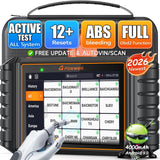 FOXWELL NT726 Bidirectional OBD2 Scanner
$368.99Scanners to command the shutter and read LIN data.
FOXWELL NT726 Bidirectional OBD2 Scanner
$368.99Scanners to command the shutter and read LIN data.
 FOXWELL NT614 Elite OBD2 Scanner
$233.69Scanners to command the shutter and read LIN data.
FOXWELL NT614 Elite OBD2 Scanner
$233.69Scanners to command the shutter and read LIN data.
 TOPDON BT200 12V Car Battery Tester Digital Automotive
$103.99Check battery voltage before condemning the shutter.
TOPDON BT200 12V Car Battery Tester Digital Automotive
$103.99Check battery voltage before condemning the shutter.

Confirming the Fix
Clear the stored codes and cycle the ignition. If U1501 returns immediately, the connector is the first suspect — a fresh part with a poorly seated connector reproduces the exact same fault.
With a bidirectional scan tool you can command the shutters open and closed through the ECM and watch them move, which is the only direct functional confirmation available. A basic code reader cannot do this, because the LIN bus is not wired to the DLC and the shutter is not addressable from the diagnostic connector.
Without a bidirectional tool, drive the vehicle through at least one full warm-up cycle and rescan. Shutter operation is temperature and load dependent, so a code that only returns under specific conditions will not show up on a cold idle in the driveway.
Parts and Labor Times GM Publishes
| Operation | Labor time | Applies to | Source |
|---|---|---|---|
| Active shutter operation validation (labor op 1480778) | 0.3 hr | 2016–2017 Cadillac ATS and CTS (XFE) | 17-NA-102 |
| Add: test and replace front object alarm wiring harness | 1.7 hrs | 2016–2017 Cadillac ATS and CTS (XFE) | 17-NA-102 |
| Ambient air temperature sensor wiring harness replacement (labor op 5480328) | 0.5 hr | Malibu VIN Z and LaCrosse per bulletin | 16-NA-051 |
| Connector kit replacement (labor op 5430860) | Published labor time | Malibu VIN Z and LaCrosse per bulletin | 16-NA-051 |
GM notes that 17-NA-102 repairs may fall under emission coverage and 16-NA-051 repairs under bumper-to-bumper coverage, and directs technicians to Investigate Vehicle History for the applicable warranty. If your vehicle is still in coverage, that is worth checking before paying out of pocket.
GM Documents Referenced Here
| Document | Subject | Coverage | Status |
|---|---|---|---|
| 17-NA-102 | Active shutters inoperative, MIL on — DTCs P059F, U1501, U1510, U1511 | 2016–2017 Cadillac ATS and CTS (XFE) | Verified — NHTSA 10114004 |
| 16-NA-051 (Jan 2020 rev) | Active shutters inoperative — connector-routed repair, ambient air temp harness | 2016–2019 Malibu VIN Z, 2017–2019 LaCrosse | Verified — NHTSA 10171876 |
| 16-NA-051 (Aug 2016 rev) | Original release of the same bulletin | 2016 Malibu | Verified — NHTSA 10116906 |
| PIT6052 | Active grille air shutter eliminated — remove louvers, recalibrate ECM | 2019–2020 Police Tahoe (RPO 9C1) | Verified — NHTSA 10242308 |
| PIT5698D | LIN Bus Diagnostic Information — reference voltage specs and test procedure | All GM 2013–2024 | Verified — NHTSA 10247778 |
| 15-NA-087 | Stop/Start inhibited with MIL on — lists U1501, U1510, U1511 | Buick, Cadillac, Chevrolet, GMC | Verified — NHTSA 10137607 |
Each document was opened and its text checked to confirm it names U1501 or the shutter condition described, rather than relying on a database association.
What Other Pages Get Wrong
A correction to an earlier version of this page. This article previously assumed that a confirmed U1501 meant replacing the active grille shutter assembly, and walked through that job as the default repair. That framing is wrong on the platform GM has documented most thoroughly. Under 16-NA-051, replacing the shutter is one of five possible outcomes and the least common of the four that involve parts — it applies only when corrosion is found specifically at the M60B connector. The usual part is the ambient air temperature sensor wiring harness. This page has been rewritten to lead with diagnosis rather than replacement.
"U1501 means the grille shutter is bad." U1501 means a LIN device stopped communicating. GM's shutter bulletins list it alongside snow, ice, loose connectors, corroded seals and damaged harnesses — all of which produce the same code with a perfectly good actuator.
"Replace the shutter, clear the code, done." 17-NA-102 explicitly instructs technicians not to replace parts until shutter inspection and testing are complete, and budgets a separate 0.3 hour validation step to make sure that happens first.
"If the scan tool can't command the shutters, they're bad." Not necessarily. A basic code reader cannot command a LIN device at all. And on a Police Tahoe with updated ECM calibrations, GDS2 shutter functions are disabled by design because the shutters were deleted from production.
"The code came back after the new part, so you got a bad part." Check the connector seating first, then check the part number. GM warns that smart device part numbers change from year to year while looking similar, and the wrong-year part will leave the fault in place.
Skipping the dielectric grease. 16-NA-051 requires dielectric grease on all connectors for its repairs, because the documented failure mode is moisture intrusion. A new harness installed dry into the same wet environment is a repeat visit.
Frequently Asked Questions
Is this a job I can do myself?
The fascia removal and mechanical replacement are within reach of a confident DIYer with hand tools and the correct service information. The part that is harder is the diagnosis that should come first — LIN reference voltage testing needs a meter with peak min/max recording and a wiring diagram for your specific vehicle. If you skip that step, you are buying a part on a guess.
What if the code comes back after replacement?
Check that the connector is fully latched, since a loose connection reproduces the identical fault with a brand new part. Then verify the part number against your VIN. If both are correct, the fault is upstream — in the wire, in a connector further back, or in the ECM's LIN output, and it was never the shutter.
Does the shutter need to be recalibrated after replacement?
GM's shutter replacement bulletins do not call for a calibration routine as part of the repair; they call for clearing codes and verifying proper shutter operation. Recalibration does appear in a different context — PIT6052 requires an ECM recalibration when shutter louvers are removed from a Police Tahoe, in order to turn the diagnostics off. Check the service information for your specific vehicle rather than assuming either way.
Can a damaged connector alone cause this code without a failed shutter?
Yes, and GM documents it directly. 17-NA-102 names a loose connection or high resistance in the front fascia harness as a cause. 16-NA-051 names moisture past damaged or missing connector seals. In both cases the actuator can be perfectly functional.
My code appeared during a cold snap. Do I need parts?
Probably not. 16-NA-051 treats snow and ice buildup as a normal weather condition, states that the MIL will clear once the shutters are working properly again, and confirms it does not affect the vehicle's designed performance or reliability. If no corrosion is present and there are signs of previous ice, GM's instruction is to explain the condition rather than repair it.
How much does an active grille shutter cost?
Enough that diagnosing first pays for itself. The assembly is the expensive end of the U1501 outcomes, and it sits behind a front fascia removal, so labor is significant on top of the part. Compare that to the alternatives on the same code: a 0.5 hour harness replacement, a connector reseat, or nothing at all in the ice case.
Why do U1501 and U1510 usually appear together?
They are no-communication codes for different devices on the same LIN architecture, and both appear in the same GM shutter bulletins alongside P059F. Seeing them together generally points to one circuit or one master module affecting several devices, rather than multiple parts failing at the same moment.
Shop the Parts and Tools Mentioned
-
 KONNWEI KW850 OBD2 Scanner — confirms and clears U1501 and shows the companion codes that tell you whether you are looking at a shutter, a harness, or a weather event. It is not bidirectional, so it cannot command the shutters for a functional test.
-
 95-Piece Mechanics Tool Set (Metric & SAE) — for the front fascia and grille panel removal that stands between you and the shutter assembly on most GM applications.
-
 3-In-1 Cordless Impact Wrench & Screwdriver Kit — speeds up the fascia fastener work, which is where most of the labor time in this job actually goes.
-
 Battery Terminal Cleaning Brush — corrosion is the documented failure mode in 16-NA-051, and connector and terminal condition decides which part you end up replacing.
-
 VDIAGTOOL BT500 Battery Tester — GM requires stable system voltage before LIN testing, since the bus operates across a 1 to 12 volt range and a weak battery produces false readings.