
P0128 means the engine did not reach its expected operating temperature within the time the module allows — almost always a thermostat stuck open. That part is simple. What makes this code worth a proper page is what GM vehicles do about it: the module triggers a cascade of fail-safe behaviours that look like several expensive failures at once. Owners lose the temperature gauge, lose the air conditioning, get a Steering Assist Reduced warning, and watch the cooling fans run flat out. GM published a bulletin specifically because technicians were replacing power steering gears over a thermostat code.
Jump to a section: What P0128 means · The fail-safe cascade · The steering gear warning · The "high engine temp" message on a cold engine · Thermostat housings and the 2.4L · How to confirm a stuck-open thermostat · Symptoms · Causes and how to confirm each · How it's diagnosed · Parts and cost · GM documents · What other pages get wrong · FAQ
What Does P0128 Mean?
The module does not simply read a temperature and complain. It builds an expectation. Using the intake air temperature at start-up, the coolant temperature, how long the engine has been running and how far the vehicle has travelled, it works out what the coolant temperature should be by now. If actual temperature falls short of that expectation, P0128 sets.
That is why the code is described as "coolant temperature below thermostat regulating temperature" — the thermostat is supposed to hold coolant back until the engine is warm, and it clearly is not doing so.
The thermostat's job is to block flow to the radiator during warm-up. When its internal seal degrades or the mechanism fails open, coolant circulates through the radiator constantly and the engine never gets properly warm. Most GM engines aim for somewhere around 195–220°F; a stuck-open thermostat can leave one sitting well below that indefinitely, and dropping further at highway speed as cold air passes through the radiator.
Two things make this more than an efficiency complaint. A cold-running engine uses a richer mixture, which wastes fuel and is hard on the catalytic converter over time. And on GM vehicles specifically, the module's response to the code causes symptoms far more alarming than the fault itself.
The Fail-Safe Cascade — Why It Looks Like Everything Broke
This is the part that sends people to a shop convinced the vehicle is falling apart, and it is the most useful thing to understand before spending money.
When P0128 sets, GM modules commonly respond with a set of protective defaults:
| What you see | What is actually happening |
|---|---|
| Temperature gauge drops to cold or stops working | The gauge is defaulted because the module no longer trusts the temperature picture |
| Air conditioning stops working | The module disables A/C compressor engagement as a protective measure |
| Cooling fans run constantly, often at high speed | Commanded on as a fail-safe, not because the fans or relays are faulty |
| "Steering Assist Reduced, Drive With Care" on the DIC | A consequence of the same fault condition — not a steering system failure |
| Cruise control disabled | Another protective default |
| Heater blowing lukewarm | Genuine — the engine really is not making heat |
Four alarming warnings, one cheap part. The temptation is to treat each as a separate problem, and that is exactly where money gets wasted — on fans, fan relays, A/C components and, as GM documents below, steering gears.
The rule: if the temperature gauge has defaulted and several unrelated systems have gone quiet at once, scan for P0128 before condemning any of them.
Tools for checking warm-up
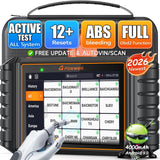 FOXWELL NT726 Bidirectional Scanner
$368.99Watch coolant temperature climb in live data to confirm a stuck-open thermostat.
FOXWELL NT726 Bidirectional Scanner
$368.99Watch coolant temperature climb in live data to confirm a stuck-open thermostat.
 FOXWELL NT614 Elite Scanner
$233.69Engine live data including coolant and intake air temperature.
FOXWELL NT614 Elite Scanner
$233.69Engine live data including coolant and intake air temperature.
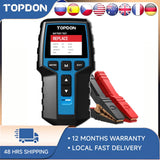 TOPDON BT200 Battery Tester
$103.99Battery tester — handy before any cooling-system repair on a high-mileage truck.
TOPDON BT200 Battery Tester
$103.99Battery tester — handy before any cooling-system repair on a high-mileage truck.

The Steering Gear Warning — GM Says Do Not Replace It
GM bulletin 17-NA-158 (May 2017) exists because this cascade was producing expensive misdiagnoses.
It covers the 2017 Cadillac XT5 and 2017 GMC Acadia (VIN N) with the 3.6L LGX engine. GM's described condition: customers commenting on the "Steering Assist Reduced, Drive With Care" message displayed on the Driver Information Center, with DTCs P0128 and U0401 set. GM notes that some technicians may find the steering gear has already been replaced.
The instruction is unambiguous, and GM flags it as Important:
"Do Not replace the power steering gear for DTC U0401:71."
GM explains why: after about 20 minutes of driving, customers may get the Steering Assist Reduced message — and this has led to replacements of steering gears that do not correct the issue.
That is GM confirming, in its own document, that a steering component was being replaced over a cooling system fault. If you are looking at a quote for a steering gear on a 2017 XT5 or Acadia and P0128 is stored, that bulletin number is worth raising before you authorise anything.
A related bulletin, 17-NA-390 (February 2018), covers a similar-looking complaint — Power Steering Assist Reduced on the DIC with possible A/C inoperative — on 2018 Enclave, LaCrosse, Regal, XT5, Traverse and Acadia with the 3.6L LFY or LGX. That one concerns DTCs P111E, U0401 and/or U0422 rather than P0128, so it is a different fault with an overlapping symptom set. Worth knowing the distinction exists: the same dashboard message has more than one cause, and the stored codes decide which document applies.
The "High Engine Temp" Message on an Engine That Is Too Cold
This one is a genuine paradox, and GM documented it.
Preliminary information PI1027 (July 2013, replacing PIP5103A) covers the 2013 Chevrolet Cruze with the 1.4L LUV engine. Customers comment on a DIC message reading "AC Off Due to High Engine Temp." They may also find that cruise control is disabled and that the coolant temperature gauge has defaulted to COLD — with DTC P0128 set current or in history.
So the dashboard says the engine is too hot, the gauge says it is cold, and the stored code means it never got warm enough. Understandably confusing.
GM's instruction is sensible and worth following before assuming it is only the thermostat. Inspect for genuine signs of overheating first:
- Engine temperature gauge in the red overheat zone
- Coolant overflowing from the recovery reservoir or radiator cap while the engine runs
- Low coolant level in the reservoir
If the engine shows real signs of overheating, that is a different and more serious diagnostic path. If it does not, you are looking at the cold-running fault and its fail-safe messaging.
That check matters because low coolant can itself cause P0128 — an air pocket around the coolant temperature sensor gives a reading that has nothing to do with the actual coolant. Checking the level is free and rules in or out two things at once.
Thermostat Housings and the 2.4L
Which part you are replacing depends on the engine, and on several GM applications the thermostat is not a standalone disc you drop into a housing.
| Engine family | What tends to fail |
|---|---|
| 2.4L Ecotec (Equinox, Terrain, Malibu) | An integrated thermostat housing assembly. The internal seal degrades and the unit is replaced complete rather than as a separate thermostat |
| 1.4L turbo (Cruze, Sonic, Trax, Encore) | The plastic thermostat housing assembly is a well-known weak point — it cracks and leaks coolant as well as failing to regulate |
| 3.6L V6 (Acadia, Traverse, XT5, Enclave) | Thermostat failure producing the fail-safe cascade described above |
| 5.3L / 6.2L V8 | Thermostat, and separately a belt-driven water pump whose shaft seal weeps — check for coolant residue at the front of the engine |
Two purchasing notes that apply across the range. Use the correct temperature rating for your engine — a lower-rated thermostat fitted in the belief that "cooler is safer" will set this code by design. And on engines where GM supplies an integrated housing, buying a bare thermostat is not the equivalent repair.
Refill with the correct specification coolant and bleed the system properly. Trapped air causes both false readings and genuine warm-up problems.
How to Confirm a Stuck-Open Thermostat
You can get a long way with live data and a cold start, before removing anything.
- Start from properly cold — overnight is ideal.
- Watch coolant temperature on a scan tool as the engine idles and then as you drive.
- A healthy system climbs steadily to its regulating temperature, commonly in the region of 195–220°F, and then holds there.
- A stuck-open thermostat climbs very slowly, plateaus well short, or — the clearest sign — drops at highway speed as airflow through the radiator increases.
- Feel the upper radiator hose during warm-up. It should stay relatively cool until the thermostat opens, then warm quickly. A hose that is warm almost immediately suggests coolant is circulating when it should not be.
That highway-speed drop is the most telling single observation. A thermostat that is regulating will hold temperature against increased airflow; one that is stuck open cannot.
Before condemning the thermostat, check the coolant level, and compare the coolant temperature sensor reading against actual conditions — a sensor reading falsely low produces the same code with a perfectly good thermostat.
Symptoms of P0128
- Check engine light on
- Temperature gauge reading low, defaulted to cold, or not working at all
- Air conditioning inoperative
- Cooling fans running constantly
- "Steering Assist Reduced, Drive With Care" message on affected models
- Cruise control disabled
- "AC Off Due to High Engine Temp" message despite a cold engine
- Heater blowing lukewarm, worst in cold weather
- Noticeably worse fuel economy
- Coolant loss or visible leaks, particularly on plastic-housing engines
What Causes P0128 — and How Do You Confirm Each One?
| Cause | How to confirm it | Notes |
|---|---|---|
| Thermostat stuck open | Watch coolant temperature from cold. Slow climb, low plateau, or a drop at highway speed | By far the most common cause |
| Low coolant level | Check the reservoir against the cold fill line | Free, and GM's PI1027 asks for it. Air pockets skew the sensor |
| Cracked or leaking thermostat housing | Inspect for coolant residue around the housing | A known weak point on the 1.4L turbo engines |
| Faulty coolant temperature sensor | Compare the sensor reading against actual conditions and against a second temperature source | A sensor reading low produces the same code |
| Wrong-temperature thermostat fitted | Establish what was installed and its rating | A cooler-rated thermostat sets this code by design |
| Water pump leak lowering coolant level | Look for residue at the weep hole and the front of the engine | Reported on the 5.3L and 6.2L V8s |
| Air trapped in the cooling system | Bleed the system properly after any coolant work | A common cause of a code appearing right after a repair |
| Extreme ambient cold with short trips | Consider the drive pattern where everything else checks out | Genuinely cold conditions can extend warm-up beyond the expected window |
| Outdated ECM calibration | Ask the dealer to check for updates against your VIN | GM has issued software updates for false P0128 triggers on some platforms |
Thermostats and sensors
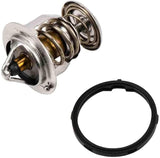 ACDelco 131-160 187° Thermostat
$45.36ACDelco 187° thermostat with seal. Confirm fitment by VIN before ordering.
ACDelco 131-160 187° Thermostat
$45.36ACDelco 187° thermostat with seal. Confirm fitment by VIN before ordering.
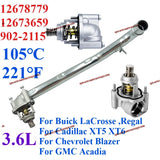 Thermostat 12678779 for Acadia 3.6L
$36.33Thermostat for the Acadia 3.6L V6. Confirm fitment by VIN before ordering.
Thermostat 12678779 for Acadia 3.6L
$36.33Thermostat for the Acadia 3.6L V6. Confirm fitment by VIN before ordering.
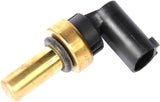 GM Genuine 55591401 Coolant Temp Sensor
$19.22GM Genuine coolant temperature sensor — a biased sensor can set P0128. Confirm fitment by VIN before ordering.
GM Genuine 55591401 Coolant Temp Sensor
$19.22GM Genuine coolant temperature sensor — a biased sensor can set P0128. Confirm fitment by VIN before ordering.
How Is P0128 Diagnosed?
- Scan before condemning anything else. If the gauge has defaulted and A/C, fans and steering messages have all misbehaved at once, confirm whether P0128 is stored — that single code explains all of it.
- Check the coolant level at the reservoir, cold.
- Inspect for genuine overheating signs as PI1027 directs — gauge in the red, coolant overflowing, low level. That splits a cold-running fault from a real cooling failure.
- Look for leaks, particularly around plastic thermostat housings and the water pump weep hole.
- Watch coolant temperature from a cold start on live data, through idle and then at road speed.
- Note whether temperature falls at highway speed — the clearest indicator of a thermostat stuck open.
- Feel the upper radiator hose during warm-up for early circulation.
- Verify the coolant temperature sensor reads plausibly before assuming the thermostat.
- Check for an available calibration against your VIN where the hardware all tests good.
- Replace the thermostat or housing assembly as appropriate for the engine, refill with the correct coolant, bleed thoroughly, then clear and verify warm-up on a road test.
Parts and Cost
| Repair | What it involves | Cost picture |
|---|---|---|
| Top up coolant and bleed the system | Correct specification coolant, proper bleed procedure | Minimal — and it can be the whole fix |
| Thermostat | Correct temperature rating for the engine, plus gasket or seal | An inexpensive part; a realistic DIY job on many engines |
| Integrated thermostat housing assembly | Required on engines where the thermostat is not separately serviceable, such as the 2.4L Ecotec | More than a bare thermostat, and not optional on those engines |
| Plastic thermostat housing | Where the housing has cracked and is leaking, common on the 1.4L turbo | Moderate; also resolves the coolant loss |
| Coolant temperature sensor | Where the sensor rather than the thermostat is misreading | Inexpensive; confirm before replacing |
| ECM calibration update | Dealer reprogramming where a software fix applies | Modest, and no parts |
| Water pump | Where a weeping pump is causing coolant loss | The larger repair in this group |
| Power steering gear | Not the repair. GM explicitly instructs against replacing it for the associated code | The expensive mistake this page exists to prevent |
Coolant and service parts
 ACDelco 10-101 DEX-COOL Coolant, 1 Gal
$31.95ACDelco DEX-COOL to refill after thermostat replacement.
ACDelco 10-101 DEX-COOL Coolant, 1 Gal
$31.95ACDelco DEX-COOL to refill after thermostat replacement.
 ACDelco RC85 15 PSI Radiator Cap
$17.99ACDelco 15 PSI radiator cap. Confirm fitment by VIN before ordering.
ACDelco RC85 15 PSI Radiator Cap
$17.99ACDelco 15 PSI radiator cap. Confirm fitment by VIN before ordering.


GM Documents Relevant to P0128
| Document | Date | Subject | Coverage |
|---|---|---|---|
| 17-NA-158 | May 2017 | Steering Assist Reduced displayed on DIC with DTCs P0128 and U0401 set. "Do Not replace the power steering gear for DTC U0401:71" — this has led to replacements that do not correct the issue | Cadillac XT5 2017 and GMC Acadia (VIN N) 2017, 3.6L LGX — verified |
| PI1027 | Jul 2013 | "AC Off Due to High Engine Temp" DIC message, cruise control disabled, coolant gauge defaulted to COLD, P0128 set. Inspect for genuine overheating signs first. Replaces PIP5103A | Chevrolet Cruze 2013, 1.4L LUV — verified |
| 17-NA-390 | Feb 2018 | Power Steering Assist Reduced on DIC, possible A/C inoperative, DTCs P111E, U0401 and/or U0422 — a different fault with an overlapping symptom set | Enclave, LaCrosse, Regal, XT5, Traverse, Acadia 2018, 3.6L LFY / LGX — verified, different codes |
What Other P0128 Pages Get Wrong
- Presenting it as a minor efficiency issue. Mechanically it is minor. But on GM vehicles the module's fail-safe response takes away the temperature gauge, the A/C and cruise control, and throws a steering warning — and those get diagnosed as separate expensive failures.
- Never mentioning the steering gear instruction. GM states plainly that the power steering gear should not be replaced for the code that accompanies this condition, because it has led to replacements that did not fix anything. That is the single most valuable line available on this topic.
- Not explaining the "high engine temp" message. A dashboard warning about heat, on an engine the code says is too cold, is bewildering without the explanation — and GM documented exactly that combination.
- Blaming the cooling fans. Fans running constantly is commanded fail-safe behaviour. Replacing fans or relays does not address the thermostat.
- Ignoring coolant level. An air pocket around the temperature sensor produces this code with a perfectly good thermostat, and checking the reservoir is free.
- Recommending a cooler thermostat. Fitting a lower-temperature-rated unit in the belief it protects the engine will set this code by design.
- Treating every engine the same. On several GM engines the thermostat comes as an integrated housing assembly and a bare thermostat is not the equivalent repair.
We publish coverage and instructions only where we could read them in GM's own documentation, and we note where a bulletin covers a related-but-different code rather than this one.
Frequently Asked Questions
Is it safe to drive with P0128?
Mechanically the cold-running condition is not urgent, but the consequences make it awkward — you may have no working temperature gauge, which means no warning if the engine later does overheat. That alone is a reason to fix it promptly rather than over months. Expect worse fuel economy and a poor heater in the meantime.
Why did my A/C stop working and my steering warning come on?
Because the module responds to this code with protective defaults. It disables A/C compressor engagement, defaults the temperature gauge, commands the fans on, and on some models displays a Steering Assist Reduced message. GM issued bulletin 17-NA-158 specifically because that steering message was leading to unnecessary steering gear replacements.
Do I really need to replace the power steering gear?
On the vehicles covered by 17-NA-158, GM says explicitly not to — the instruction is "Do Not replace the power steering gear for DTC U0401:71," and GM notes this had already led to replacements that did not correct the issue. If P0128 is stored alongside, address the cooling system first.
Can low coolant cause P0128?
Yes. If the level drops enough for an air pocket to form around the coolant temperature sensor, the sensor reports something unrelated to the actual coolant and the code sets with a healthy thermostat. Check the reservoir before buying parts, and find the leak if it is low.
How do I know the thermostat is stuck open?
Watch coolant temperature on a scan tool from a genuinely cold start. A healthy system climbs steadily to its regulating temperature and holds. A stuck-open thermostat climbs slowly, plateaus short, and — the clearest sign — loses temperature at highway speed as more air passes through the radiator.
Why does my dash say "AC Off Due to High Engine Temp" when the engine is cold?
GM documented that exact combination on the 2013 Cruze 1.4L: the message appears, cruise control is disabled, the coolant gauge defaults to cold, and P0128 is stored. It is fail-safe messaging rather than a real overheat — but GM still asks technicians to check for genuine overheating signs first, and so should you.
Will a new thermostat definitely fix it?
Usually, since a stuck-open thermostat is the dominant cause. But confirm the coolant level and the temperature sensor first, use the correct temperature rating, and on engines that use an integrated housing assembly, fit the assembly rather than a bare thermostat.
Can this damage my engine?
Not directly in the way overheating does. The longer-term concerns are fuel economy, incomplete combustion and the extra load a persistently rich mixture places on the catalytic converter. The more immediate risk is practical: without a working temperature gauge you have no warning of a genuine overheat.
Shop Related Parts & Tools
The diagnosis here rests on watching coolant temperature from a cold start, so live data is the key capability. Always confirm fitment against your VIN before ordering.
-
 MOTOPOWER MP69033 OBD2 Scanner — confirms P0128 is behind the gauge, A/C and steering warnings before anything gets replaced.
-
 95-Piece Mechanics Tool Set (Metric & SAE) — covers the housing bolts and hose clamps for a thermostat job.
-
 VDIAGTOOL BT500 Battery Tester — useful when several systems misbehave at once, to rule out a voltage problem before chasing sensors.
-
 ACDelco GM OE dexos1 GEN 2 Full Synthetic 5W-30 Motor Oil (1 qt) — a cold-running engine is hard on oil; worth a change once the thermostat is sorted.