
P0521 is "Engine Oil Pressure Sensor/Switch Range/Performance." The module is seeing an oil pressure reading that does not make sense for the engine speed and temperature. It might be a $30 sensor. It might be an engine about to destroy itself. And on GM V8s there is a third possibility most people never consider, which GM documented specifically: the code can be caused by the oil filter that was just fitted at the last oil change.
Jump to a section: What P0521 means · The rule that comes before everything · The oil filter bulletin · The screen under the sensor · Why a $30 part costs $400 to fit · When it really is the engine · A note on pressure specifications · Symptoms · Causes and how to confirm each · How it's diagnosed · Parts and cost · GM documents · What other pages get wrong · FAQ
What Does P0521 Mean?
The engine oil pressure sensor reports pressure to the control module, which compares it against what it expects for the current engine speed and temperature. P0521 sets when the reported value is implausible rather than simply absent.
That is different from its neighbours, and the distinction is useful:
| Code | Meaning |
|---|---|
| P0521 | Range/performance — the reading is present but does not correlate with conditions |
| P0522 | Circuit low voltage — often a short or a failed sensor |
| P0523 | Circuit high voltage — often an open circuit or a failed sensor |
Because P0521 is a plausibility complaint rather than an electrical one, it sits on a fork with two very different branches. Either the sensor is misreporting real pressure, or the pressure genuinely is wrong. Everything on this page is about telling those apart before spending money — because one branch is an afternoon and the other is an engine.
Oil pressure sensors
 GM Genuine Parts 12673134 Engine Oil Pressure Sensor
$63.69Sensors and switches. Confirm engine. Confirm fitment by VIN before ordering.
GM Genuine Parts 12673134 Engine Oil Pressure Sensor
$63.69Sensors and switches. Confirm engine. Confirm fitment by VIN before ordering.
 ACDelco Oil Pressure Sending Unit
$91.99Sensors and switches. Confirm engine. Confirm fitment by VIN before ordering.
ACDelco Oil Pressure Sending Unit
$91.99Sensors and switches. Confirm engine. Confirm fitment by VIN before ordering.
 ACDelco Gold D8050 (89057533) Engine Oil Pressure Switch
$15.98Sensors and switches. Confirm engine. Confirm fitment by VIN before ordering.
ACDelco Gold D8050 (89057533) Engine Oil Pressure Switch
$15.98Sensors and switches. Confirm engine. Confirm fitment by VIN before ordering.


The Rule That Comes Before Everything
Verify actual oil pressure with a mechanical gauge before replacing anything.
This is the single most important sentence on the page, and it is worth being blunt about why. The dash gauge and the scan tool are both reporting what the sensor says. If the sensor is the problem, every electronic reading you have is describing a fiction. A mechanical gauge screwed into the engine bypasses the sensor entirely and tells you what is actually happening at the oil galleries.
The two outcomes lead in opposite directions:
- Mechanical pressure is good, electronic reading is bad → the sensor, its screen, its wiring, or the filter. A manageable repair.
- Mechanical pressure is genuinely low → stop. This is a lubrication problem, and continuing to run the engine risks bearing damage that turns a moderate repair into a rebuild.
Skipping this step is how people replace an oil pressure sensor three times on an engine that was quietly wearing out — and it is also how people tear into an engine that only ever needed a $10 filter.
Two warning signs that push you toward the serious branch immediately: engine noise (ticking or knocking) and a low reading that is steady rather than erratic. An erratic gauge that swings from zero to maximum on an otherwise quiet engine leans toward a sensor fault. A quiet, consistent low reading with a noisy engine does not.
The Oil Filter Bulletin — Check What Was Just Fitted
This is the finding that makes P0521 unusual, and almost nothing else written about this code mentions it.
GM preliminary information in the PIP5276 series — revisions including PIP5276B, PIP5276F (March 2016) and PIP5276G — carries the subject "SES Lamp P0521 Setting After An Oil Change And/Or Low Oil Pressure Indicated On The Instrument Panel."
Read that subject line again. GM named the oil change in the title.
The described condition: customers may report an SES light or low oil pressure indicated on the instrument cluster with DTC P0521 stored, and in some instances this may have begun shortly after an oil change.
The bulletin is reported to focus on the ACDelco PF48E oil filter on Gen IV V8 engines, in cold or hot weather, and directs technicians working on such an engine to establish whether it has been properly repaired and cleaned per the latest version of bulletin 10-06-01-008 — the AFM oil consumption and sludge procedure.
The practical guidance that has grown around this is straightforward:
- Check which oil filter is actually fitted. It takes thirty seconds and costs nothing.
- The PF48E and the PF48 are not interchangeable for this purpose on the affected engines. Owners and technicians widely report switching from the PF48E to a PF48 or UPF48R, with the internal construction differing between them.
- Timing is diagnostic. If the code appeared within a few hundred miles of an oil change, look hard at the filter before ordering a sensor.
One field case captures the value of this: an owner replaced the oil pressure sensor three separate times and removed the filter screen, with no improvement. Switching to a different oil filter resolved it — suggesting the bypass or flow characteristics of the filter fitted were behind the readings all along.
A related document, PIP5294, is reported to address a blocked oil filter housing, which fits the same theme: restriction in the filtration path can produce this code with a healthy pump and a healthy sensor.
We could not open these preliminary information documents directly, so they are reported as corroborated. The PIP5276 subject line and condition text are quoted consistently across multiple independent technician-facing sources.
The Screen Under the Sensor
Underneath the oil pressure sensor on many GM V8s sits a small removable filter screen. Its job is to keep debris away from the sensor. Its failure mode is to clog with sludge, at which point the sensor is measuring pressure through a restriction and reporting nonsense.
Two rules follow, and both are cheap:
- Always replace the screen when you replace the sensor. It costs a few dollars. Fitting a new sensor above a clogged screen reproduces the fault, and you will have paid the labour twice — see the access section below for why that matters so much here.
- A clogged screen is a symptom, not a cause. Sludge came from somewhere: extended oil change intervals, the wrong viscosity, or oil consumption issues on AFM engines. That is precisely why the PIP5276 series points back at bulletin 10-06-01-008, the AFM oil consumption and sludge procedure.
On AFM-equipped engines there is a further wrinkle: the valve lifter oil manifold has its own screen. Problems there can produce oil pressure symptoms and codes alongside the main sensor circuit. Our AFM/DFM lifter failure guide covers that system.
Why a $30 Part Costs $400 to Fit
The economics of this repair surprise people, and it is worth knowing before you get a quote.
On most GM V8s the oil pressure sensor lives at the very back of the engine block, behind the intake manifold, tucked up against the firewall. It is one of the least accessible sensors on the engine.
Consequences:
- Labour is commonly quoted in hours, not minutes — reports of two to four hours are typical, against a part that costs a fraction of that.
- A special tool is effectively required. A deep socket in 1-1/16" (or 27mm) plus swivels and extensions is the usual approach; the Lisle 13250 is a commonly cited example.
- Some technicians remove the intake manifold entirely rather than fight it blind, which is slower but gives direct access.
The strategic consequence: because the access is the expense, do everything at once. Sensor, screen, and an inspection of the connector and wiring for oil saturation — all in the same visit. This is the same logic as the knock sensors in the lifter valley: cheap parts, expensive access, so never go in for the minimum. Our P0325 guide covers that parallel case.
When It Really Is the Engine
If the mechanical gauge confirms genuinely low pressure, the conversation changes completely, and GM has documentation for this branch too.
Bulletin 20-NA-161 is reported to address recurring P0521 with confirmed low pressure where the sensor and screen are known to be good. It points at a sticking oil pressure relief valve inside the oil pump, with pump replacement as the remedy. The reported inspection sequence for a low-pressure engine is worth having:
- Inspect for an incorrect or clogged oil filter — the cheap check, again, and it comes first.
- Remove the oil pan and inspect the oil pump pickup tube for a damaged O-ring or blockage.
- Inspect the oil pump relief valve for sticking.
- Inspect the number one main bearing for damage.
That last item is sobering and belongs in the open. If the relief valve has been sticking, the bearing nearest the pump can already have suffered. A related document, PIP5630D, is also reported to concern the oil pump relief valve.
The pickup tube O-ring deserves special mention because it is a small part with a large effect: when it hardens or splits, the pump draws air alongside oil and cannot build consistent pressure even though the pump itself is fine. Our oil pressure problems guide covers the mechanical side in full, including worn camshaft bearings, which are reported as roughly half of 5.3L low-pressure cases with the pickup tube O-ring accounting for much of the remainder.
Oil pumps
 Oil Pump 2014-2020 Chevrolet/GMC 4.3L-6.2L
$221.99Oil pump. Confirm engine. Confirm fitment by VIN before ordering.
Oil Pump 2014-2020 Chevrolet/GMC 4.3L-6.2L
$221.99Oil pump. Confirm engine. Confirm fitment by VIN before ordering.

A Note on Pressure Specifications
We are not going to publish a pressure specification for your engine, and we want to explain why rather than just leave it out.
The figures in circulation for GM V8 minimum hot oil pressure conflict sharply with one another. One widely repeated set gives roughly 24 psi at 1,000 rpm, 35 psi at 2,000 rpm and 38 psi at 4,000 rpm. Another equally widely repeated set gives roughly 6 psi at 1,000 rpm, 18 psi at 2,000 rpm and 24 psi at 4,000 rpm. Those are not small differences — an engine that passes one standard fails the other badly.
They likely describe different things (absolute minimums versus expected healthy values) or different engine families, but we cannot resolve which applies to your engine, and publishing the wrong one could either condemn a healthy engine or clear a dying one.
Use the specification in the service information for your specific engine and year, measured with a mechanical gauge at the temperatures and speeds it states. If a shop quotes you a figure, it is fair to ask which document it came from.
What is safe to say generally: a healthy engine holds steady pressure that rises with engine speed, and a reading that falls away as the engine gets hot, or that drops at highway speed, is a concern regardless of which table you use.
Symptoms of P0521
- Check engine light on
- Oil pressure gauge reading erratically — pegging high, dropping to zero, or fluctuating
- Low oil pressure warning light or message on the cluster
- Gauge stuck at zero or maxed out
- Often no other driveability symptom at all
- Engine ticking or knocking — this changes the urgency completely
- Rough running or stalling in some cases
- Symptoms beginning shortly after an oil change
On urgency: if the engine is quiet and the gauge is erratic, you likely have time to diagnose properly. If the engine is making noise, or a mechanical gauge confirms low pressure, stop driving and have it towed. Oil starvation damages bearings in minutes, not months, and it is one of the few faults where getting it to the shop under its own power is the wrong choice.
What Causes P0521 — and How Do You Confirm Each One?
| Cause | How to confirm it | Notes |
|---|---|---|
| Low oil level | Check the dipstick, cold and level | Free, and genuinely resolves cases |
| Incorrect or restrictive oil filter | Check which filter is fitted. Note whether the code began after an oil change | PIP5276 series names the oil change and the PF48E — corroborated |
| Blocked oil filter housing | Inspect the housing and filtration path | PIP5294 — corroborated |
| Clogged screen under the sensor | Remove the sensor and inspect the screen for sludge | Always replace it with the sensor |
| Failed oil pressure sensor | Mechanical gauge reads normal while the electronic reading does not | The common benign outcome |
| Wiring or connector fault, oil saturation | Inspect the connector and harness behind the intake manifold | Check while you have access |
| Sludge from extended intervals or oil consumption | Inspect oil condition; consider AFM oil consumption history | PIP5276 points back to bulletin 10-06-01-008 — corroborated |
| Sticking oil pump relief valve | Confirmed low mechanical pressure with good sensor and screen | 20-NA-161, PIP5630D — corroborated. Pump replacement |
| Damaged oil pump pickup tube O-ring | Drop the pan and inspect | Lets the pump draw air; pressure will not build |
| Damaged number one main bearing | Inspect during the low-pressure teardown | Named in the reported 20-NA-161 sequence |
| Worn camshaft or main bearings | Where pressure stays low after pickup and pump work | The major repair |
| VLOM screen issues on AFM engines | Consider alongside other AFM symptoms and codes | See our AFM/DFM guide |
| Wrong oil viscosity | Establish what was used against the specification | Particularly relevant in cold weather |
How Is P0521 Diagnosed?
- Listen to the engine. Ticking or knocking moves this to the urgent branch immediately.
- Check the oil level and condition. Free, and it can be the whole answer.
- Ask when it started. Shortly after an oil change points at the filter, per GM's own subject line.
- Check which oil filter is fitted and whether it is correct for the engine.
- Connect a mechanical oil pressure gauge. This is the fork in the road and nothing meaningful happens before it.
- If mechanical pressure is good, work the sensor path — screen, sensor, connector and wiring.
- If mechanical pressure is low, stop running the engine and work the mechanical path: filter, pickup tube O-ring, pump relief valve, number one main bearing.
- Replace sensor and screen together, given the access cost.
- Address the sludge source where the screen was clogged, rather than only the screen.
- Clear the codes and verify the gauge reads sensibly over several drive cycles, ideally cross-checked against a mechanical gauge once more.
Scan tools
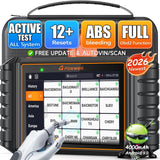 FOXWELL NT726 Bidirectional OBD2 Scanner
$368.99Compare live oil pressure to a gauge.
FOXWELL NT726 Bidirectional OBD2 Scanner
$368.99Compare live oil pressure to a gauge.
 FOXWELL NT614 Elite OBD2 Scanner
$233.69Compare live oil pressure to a gauge.
FOXWELL NT614 Elite OBD2 Scanner
$233.69Compare live oil pressure to a gauge.

Parts and Cost
| Repair | What it involves | Cost picture |
|---|---|---|
| Top up oil to the correct level | Correct viscosity for the engine | Minimal — and it resolves real cases |
| Correct oil filter | Fit the specified filter for the engine and check the housing | Around $10. GM's own bulletin subject names the oil change |
| Sensor filter screen | Fitted with the sensor, never on its own afterwards | A few dollars — never skip it |
| Oil pressure sensor | Behind the intake manifold at the rear of the block. Deep socket, swivels and extensions, or manifold removal | Part is inexpensive; labour commonly two to four hours |
| Connector or wiring repair | Where oil saturation or damage is found | Modest, and best done during the same access |
| Oil pump (sticking relief valve) | Where mechanical pressure is confirmed low and the sensor path is clear | Significant — pan and pump work |
| Pickup tube O-ring and pan gasket | Pan removal, O-ring and gasket replacement | Moderate; far cheaper than what it prevents |
| Bearing repair | Where wear is confirmed after the pump and pickup are addressed | The major repair — engine-out territory |
| Replacing the sensor repeatedly | What happens when the filter, screen or real pressure is never checked | The labour cost, several times over |
GM Documents Relevant to P0521
| Document | Reported subject | Status |
|---|---|---|
| PIP5276 series (incl. B, F, G) | "SES Lamp P0521 Setting After An Oil Change And/Or Low Oil Pressure Indicated On The Instrument Panel." Condition may begin shortly after an oil change. Focuses on the PF48E filter on Gen IV V8s and refers back to bulletin 10-06-01-008 | Corroborated across multiple sources — not opened |
| 20-NA-161 | Recurring P0521 with low pressure where sensor and screen are good — sticking oil pressure relief valve in the oil pump. Inspect filter, pickup tube O-ring, relief valve and number one main bearing | Corroborated — not opened |
| 10-06-01-008 (and revisions, incl. 008H) | AFM engine oil consumption and sludge diagnosis and repair — the root cause behind many clogged sensor screens | Corroborated — not opened |
| PIP5294 | Blocked oil filter housing | Corroborated — not opened |
| PIP5630D | Oil pump relief valve | Corroborated — not opened |
| PIP4786C | P0521 with low oil pressure message; standard diagnostic procedures | Corroborated — not opened |
A note on sourcing, and a correction. We could not open any of these documents directly, so all are reported as corroborated rather than verified. An earlier version of this page cited a GM bulletin "#10059078" for this code. That figure appears to be a document identifier rather than a GM bulletin number, and we could not substantiate it — so we have removed it rather than leave an unverifiable citation in place. If your vehicle is within warranty, have the dealer check your VIN against current bulletins directly.
What Other P0521 Pages Get Wrong
- Never mentioning the oil filter. GM put "After An Oil Change" in the bulletin's subject line. If the code appeared soon after a service, checking which filter was fitted is a thirty-second check that can end the whole diagnosis.
- Recommending a sensor before a mechanical gauge. Every electronic reading you have comes from the sensor you are trying to test. Only a mechanical gauge settles whether pressure is real, and it decides which of two very different repairs you need.
- Forgetting the screen. The small filter screen beneath the sensor costs a few dollars and is a primary cause of the code. Given the access involved, replacing the sensor without it is close to negligent.
- Quoting it like a simple sensor swap. The sensor sits at the back of the block behind the intake manifold. Two to four hours of labour against a cheap part is the realistic picture, and a special deep socket is usually needed.
- Publishing a single pressure specification. The figures in circulation for GM V8 minimum oil pressure conflict badly with each other. Using the wrong one either condemns a healthy engine or clears a failing one.
- Treating the clogged screen as the root cause. Sludge came from somewhere. GM's own document points back to the AFM oil consumption and sludge procedure.
- Telling people it is safe to drive. It depends entirely on which branch you are on. With engine noise or confirmed low pressure, the correct advice is a tow truck, not a careful drive to the shop.
Frequently Asked Questions
Is P0521 just a bad sensor?
Sometimes, and that is the good outcome. But the same code appears when oil pressure is genuinely low, and the two are indistinguishable from the driver's seat. A mechanical oil pressure gauge is the only thing that tells you which one you have.
Can an oil change cause P0521?
GM thought so clearly enough to put it in a bulletin title — the PIP5276 series is subject-lined around the code setting after an oil change and/or a low oil pressure indication. The reported focus is the oil filter fitted on Gen IV V8 engines. If your code appeared shortly after a service, check the filter before buying a sensor.
Is it safe to drive with P0521?
Only if you have confirmed the pressure is actually fine. If the engine is quiet and a mechanical gauge shows normal pressure, short trips are reasonable while you sort the sensor. If the engine is ticking or knocking, or the gauge confirms low pressure, stop driving and have it towed — bearing damage happens in minutes.
Do I need to replace the screen as well as the sensor?
Yes. It costs a few dollars, it is a primary cause of the code, and the sensor sits in one of the hardest places on the engine to reach. Going back in for a part you could have fitted the first time means paying hours of labour again.
Why is the labour so expensive for a cheap part?
Because the sensor is at the rear of the engine block behind the intake manifold, against the firewall. Reaching it typically needs a deep socket with swivels and extensions, and some technicians remove the intake manifold outright for direct access. Two to four hours is a realistic range.
What oil pressure should my engine have?
Use the figure in the service information for your specific engine and year. We are deliberately not publishing one, because the numbers circulating for GM V8s conflict substantially between sources, and using the wrong standard can either condemn a healthy engine or clear a failing one. Measure with a mechanical gauge at the stated temperature and engine speeds.
My sensor and screen are new and the code came back. What now?
Check the oil filter, then verify actual pressure mechanically. If pressure is genuinely low, the reported path runs through the filter, the pickup tube O-ring, a sticking oil pump relief valve, and inspection of the number one main bearing. That is the branch GM's 20-NA-161 is reported to address.
Can regular oil changes prevent this?
To a meaningful degree, yes. Clean oil at the correct viscosity reduces the sludge that clogs the screen beneath the sensor, and it protects the bearing surfaces whose wear eventually causes genuine low pressure. Use the specified filter as well as the specified oil.
Shop Related Parts & Tools
The cheapest checks on this code are the oil, the filter and a mechanical gauge reading. Always confirm fitment against your VIN before ordering.
-
 ACDelco PF63 Engine Oil Filter — fitting the correct specified filter for your engine matters more on this code than almost any other. Confirm the right filter for your VIN.
-
 ACDelco dexos1 Gen 3 Full Synthetic 5W-30 (1 qt) — correct viscosity and clean oil are the main defence against the sludge that clogs the sensor screen.
-
 ACDelco dexos1 Gen3 0W-20 for 5.3L / 6.2L (6-qt case) — for the L82, L84 and L87 engines that specify 0W-20.
-
 95-Piece Mechanics Tool Set (Metric & SAE) — extensions and swivels for reaching the sensor behind the intake manifold. A deep socket in the correct size is usually needed as well.
-
 MOTOPOWER MP69033 OBD2 Scanner — reads the code and shows what the sensor is reporting, which you then compare against a mechanical gauge.
Related Guides
- Oil Pressure Problems: Meaning, Symptoms & Repair Guide
- GM AFM/DFM Lifter Failure: Symptoms, Causes & What To Do
- P06DD Code: Oil Pressure Control Solenoid Stuck Off
- P0325 Code: Knock Sensor 1 Circuit, Bank 1
- 5.3L Lifter Noise: Meaning, Symptoms & Repair Guide
- GM Check Engine Light Codes: Most Common & What They Mean