
P1811 on a Buick is GM's transmission code "Maximum Adapt and Long Shift." It belongs to the Hydra-Matic 4T65-E four-speed automatic that sits behind the 3800 V6 and 3.6L V6 in a generation of Buicks — Century, Regal, LeSabre, Park Avenue, Rendezvous, Terraza, the early LaCrosse and Allure. It means a shift took too long and the transmission's self-correction ran out of room. The surprise is in GM's own bulletin: on the Buicks it names, P1811 does not turn on the check engine light. Instead the transmission jumps to maximum line pressure, every shift turns harsh, and the owner is left with a gearbox that feels broken and a dash that says nothing.
Jump to a section: What P1811 means · Which Buicks set P1811 · No check engine light — GM's bulletin · The LaCrosse and Terraza reprogram · Pressure control and the older Buicks · Symptoms · Causes and how to confirm each · How it's diagnosed · Parts and cost · GM documents · What other pages get wrong · FAQ
What Does P1811 Mean?
The 4T65-E is an electronically controlled automatic. The computer does not simply command a shift and hope; it times each one. When an upshift takes longer than expected, it adds line pressure the next time that shift happens, so the clutch applies harder and the shift shortens. Those learned corrections are stored as adapt values — sometimes shown on a scan tool as TAP (Transmission Adaptive Pressure) cells — for each shift.
That learning has a ceiling. P1811 is the code for the case where the computer has already added as much pressure as it is allowed to, and the shift is still long. GM's name says exactly that: the adapt is at its maximum, and the shift is long.
The trade magazine Transmission Digest describes the logic on the 4T65-E this way: a shift taking longer than about 0.65 second that the adaptive modifier cannot shorten increments a counter in the computer, and if that happens twice in one drive cycle, P1811 sets. It also notes that P1811 can set after a 2-3 upshift at two-thirds to full throttle. That is a trade description rather than a GM document, so treat the exact figures as a guide, not a specification for your particular Buick.
The important point is what P1811 is not. It is not a circuit code. It is a performance verdict: shifts are not completing in the time the computer expects, for a reason the code does not identify. That reason can be a solenoid, worn clutches, fluid, or — on some Buicks — the calibration itself.
Which Buicks Set P1811
We only list a Buick here where a GM document ties it to P1811 or to the 4T65-E concern that sets it.
- 2005–2008 Buick LaCrosse and Allure with the 3.6L V6 (RPO LY7) and 4T65 transmission (RPO M15) — named in GM bulletin 09-07-30-013A, "Intermittent Harsh Upshifts or Downshifts, DTC P1811 (Maximum Adapt and Long Shift)."
- 2007 Buick Terraza — named in the same bulletin, and in the NHTSA index for GM bulletin 08-07-30-013, summarised as "4T65-E (M15) automatic transmission harsh shift, sets false DTC P1811 (reprogram TCM)."
- Century, LeSabre, Park Avenue, Regal, Rendezvous and Riviera — the NHTSA index lists GM bulletin 00-07-30-002B against the 2000–2002 Century, 1998–2002 LeSabre, 1997–2002 Park Avenue, 1999–2002 Regal, 2002 Rendezvous and 1997–1999 Riviera. Its summary: slips, harsh upshift or garage shifts, launch shudders, flares, erratic shifts, and "diagnostic trouble code P1811 or P0748 set."
These are the 4T65-E Buicks: the 3800 V6 cars (naturally aspirated L36, and the supercharged L67 in the Regal GS, Park Avenue Ultra and Riviera), the 3.4L Rendezvous, and the V6 LaCrosse and Terraza.
Two honest gaps. The 2006–2011 Lucerne V6 also uses a 4T65-E — GM lists it in its 4T65-E valve body bulletin 08-07-30-002 — but we found no GM document naming P1811 for the Lucerne, so we do not claim it. And we found no GM document naming P1811 for the Rainier's rear-drive 4L60-E. Newer Buicks with six-, eight- and nine-speed automatics and CVTs use a different set of transmission codes.
Tools for checking shift adapts
 FOXWELL NT604 ABS/SRS/Transmission Scanner
$209.09Reads transmission adapts and runs adaptive resets.
 FOXWELL NT301 Code Reader
$68.82Budget code reader with live data.


No Check Engine Light — GM's Bulletin
This is the detail that makes P1811 confusing on a Buick, and it comes straight from GM. Bulletin 09-07-30-013A (August 2009) says:
- "With a P1811, the SES light is not illuminated, but the transmission defaults to maximum line pressure."
- While the code is active, "all shifts may be harsh including upshifts, downshifts and shifts out of PARK."
- When the code is not active, "most shifts may seem normal."
- The setting of the code "may not be observable on the Tech 2" — GM's own dealer scan tool at the time.
Put those together and you get the typical Buick owner story. The car shifts harshly for a while — banging into gear from Park, thumping on upshifts, a hard 2-1 coast-down — then seems fine, then does it again. There is no warning light. A basic code reader finds nothing in the engine codes. It is easy to conclude the transmission is failing mechanically, when what you are feeling is a protective default: the computer has gone to full line pressure because it no longer trusts its own shift timing.
So if your 4T65-E Buick has intermittent harsh shifts and no light, P1811 is worth looking for specifically, with a tool that reads transmission codes and history.
The LaCrosse and Terraza Reprogram
For the 2005–2008 LaCrosse and Allure 3.6L and the 2007 Terraza, GM's correction is not a part. Bulletin 09-07-30-013A says an updated calibration was developed, and directs: if the service information does not isolate a fault, reprogram the TCM with the latest calibration.
GM's details are worth knowing before a dealer visit:
- The calibration carries a specific description: "Select this calibration only to address DTC P1811 (Maximum Adapt and Long Shift), Harsh Upshifts, or Downshifts."
- GM warns that using this calibration to fix other conditions "will not be successful." It is a software fix for this complaint, not a cure-all.
- The listed labor is 0.4 hour for transmission reprogramming — a small job compared with anything involving the pan.
- The earlier NHTSA index entry for 08-07-30-013 describes the P1811 as "false" — that is, the code was setting without a hardware fault behind it.
The order matters. GM puts diagnosis first: the reprogram applies when the service information has not found a fault. Low fluid, a slipping clutch or a failed solenoid will not be fixed by software. But on these Buicks, a shop proposing a valve body or a rebuild for P1811 without first checking for the calibration update has skipped GM's documented step.
The bulletin is a 2009 document and these Buicks are long out of warranty, so the update will normally be paid work. It is still worth asking a Buick dealer whether your TCM already has the latest calibration.
Pressure Control and the Older Buicks
On the 1997–2004 4T65-E Buicks, the story GM documented is hydraulic. The NHTSA index pairs P1811 with P0748 in bulletin 00-07-30-002B, and P0748 is the pressure control solenoid electrical code. That pairing makes sense: line pressure on the 4T65-E is set by the pressure control (PC) solenoid, and when the computer asks for more pressure and the shift still does not shorten, the solenoid and the valves it feeds are the first suspects.
The index also lists GM bulletin 02-07-30-048, "Pressure control solenoid replacement for 4T65-E, 4T40-E and 4T45-E," against the 2000–2003 Century and 2002–2003 Rendezvous. We could only read the index summaries for these older bulletins, not the GM documents themselves, so we do not quote their procedures.
Transmission Digest's experience matches. It calls P1811 "a very common code" on the 4T65-E, often appearing a few months after an overhaul, and says replacing the pressure control solenoid cures it in most cases — but that if the code returns, the solenoid may not be the real problem. The other cause it names is clutch clearance: loose second and third clutch packs that take too long to apply no matter how much pressure is added.
That is the fork in the road on an older Buick. A sticking or weak PC solenoid is a pan-off job. Worn clutch packs are a teardown. The fluid condition, the shift data and whether P0748 is also stored help tell which you have.
Symptoms of P1811
- Harsh or firm upshifts, often intermittent
- Harsh downshifts, especially the 2-1 coast-down as you roll to a stop
- A hard engagement shifting out of Park into Drive or Reverse
- A delayed, harsh shift when you roll toward a stop and get back on the throttle before stopping
- Long, soft or flaring 1-2 or 2-3 upshifts before the harshness starts
- No check engine light on the Buicks GM's bulletin covers
- Shifts that return to normal for a while, then turn harsh again
Causes and How to Confirm Each
| Cause | How to confirm it | Notes |
|---|---|---|
| TCM calibration | Check the installed calibration against the latest available after the service information finds no fault | 2005–2008 LaCrosse/Allure 3.6L and 2007 Terraza (09-07-30-013A) |
| Pressure control solenoid | Look for P0748 alongside P1811; check commanded versus actual behaviour with a capable scan tool and a pressure gauge | Paired with P1811 on older 4T65-E Buicks (00-07-30-002B index) |
| Low or degraded fluid | Check level and condition with the transmission at operating temperature, per the service procedure | Always the first check; burnt fluid with debris points to wear |
| Worn or loose clutch packs | Shift times and adapt values that stay high on one shift; slip under heavy throttle; often a gear ratio code too | Second and third clutches named by Transmission Digest. Teardown repair |
| Valve body or spacer plate | Diagnosis per service information after solenoid and fluid check out | GM has 4T65-E valve body and spacer plate bulletins; we found none naming P1811 |
| After a rebuild | Was the adapt learn reset, and are the clutch clearances right? | Transmission Digest: often appears months after an overhaul |
Solenoids and control parts
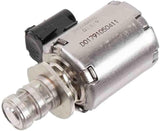 GM Genuine 24248893 Pressure Control Solenoid
$55.34GM Genuine pressure control solenoid. Confirm fitment by VIN before ordering.
 GM Genuine 24230298 1-2/3-4 Shift Solenoid
$17.21GM Genuine 1-2 and 3-4 shift solenoid for 4L60-E family transmissions. Confirm fitment by VIN before ordering.
 ACDelco Transmission Control Module 24276411
$254.99ACDelco transmission control module. Confirm fitment by VIN before ordering.


How Is P1811 Diagnosed?
- Read the transmission codes, not just the engine codes. Use a tool that reaches transmission data and history; GM notes P1811 may not show the way you expect.
- Record every code. P0748, gear ratio codes or torque converter codes change the picture.
- Check the fluid level and condition at operating temperature, by the procedure for your Buick.
- Look at shift times and adapt values for each upshift. One shift consistently long and maxed out points to the clutch or circuit that serves it.
- Check for bulletins by VIN. On a 2005–2008 LaCrosse/Allure 3.6L or 2007 Terraza, confirm whether the P1811 calibration is installed.
- Test line pressure with a gauge if the solenoid is suspected.
- Fix the hardware fault if one is found; reprogram only where GM's bulletin applies and the diagnosis is clean.
- Clear codes and road test, including light-throttle and coast-down shifts where the harshness showed up.
Parts and Cost
| Repair | What it involves | Cost picture |
|---|---|---|
| TCM reprogram | Latest calibration, where 09-07-30-013A applies | The cheapest outcome; GM lists 0.4 hour |
| Fluid correction | Correct level or service the fluid and filter | Low — but fluid alone rarely cures an established P1811 |
| Pressure control solenoid | Pan and valve body access on the 4T65-E | Moderate; part plus labor |
| Valve body work | Reconditioning or replacement after diagnosis | Moderate to significant |
| Overhaul or replacement | Worn clutch packs or other internal damage | The expensive end — justify it with diagnosis, not the code |
Fluid and service parts
 ACDelco Dexron VI Full Synthetic ATF, 1 Gal
$49.99Dexron VI full synthetic ATF, 1 gallon.
 ACDelco Gold TF337 Transmission Filter Kit
$33.74ACDelco Gold transmission filter kit. Confirm fitment by VIN before ordering.
 CARQUEST 96080 Transmission Filter Kit
$13.00Carquest transmission filter kit. Confirm fitment by VIN before ordering.
 GM Genuine 24297922 Transmission Pan Gasket
$46.81GM Genuine transmission pan gasket. Confirm fitment by VIN before ordering.


GM Documents That Name P1811 on a Buick
| Document | Subject | Status |
|---|---|---|
| 09-07-30-013A (Aug 2009) | Intermittent harsh upshifts or downshifts, DTC P1811 (Maximum Adapt and Long Shift). SES light not on; maximum line pressure; reprogram TCM. 0.4 hr | 2005–2008 LaCrosse/Allure 3.6L LY7 with 4T65 M15; 2007 Terraza — corroborated (full text reproduced online; we could not open a GM copy) |
| 08-07-30-013 (Mar 2008) | 4T65-E (M15) harsh shift, sets false DTC P1811 (reprogram TCM) | 2007 Terraza in the NHTSA index — corroborated (index summary) |
| 00-07-30-002B (Jul 2002) | Slips, harsh upshift or garage shifts, launch shudders, flares, erratic shifts; DTC P1811 or P0748 set | 2000–2002 Century, 1998–2002 LeSabre, 1997–2002 Park Avenue, 1999–2002 Regal, 2002 Rendezvous, 1997–1999 Riviera — corroborated (index summary) |
| 02-07-30-048 (Nov 2002) | Pressure control solenoid replacement for 4T65-E, 4T40-E and 4T45-E | 2000–2003 Century, 2002–2003 Rendezvous — corroborated (index summary). Does not name P1811 |
No GM document we could open in full names P1811 on a Buick; all four entries above are corroborated rather than verified. Have a dealer check your VIN for bulletins and calibrations rather than relying on any article, including this one.
What Other P1811 Pages Get Wrong
- "Check engine light on, P1811." On the Buicks GM's bulletin covers, P1811 does not light the SES lamp.
- Going straight to a rebuild. On the 2005–2008 LaCrosse/Allure 3.6L and 2007 Terraza, GM's documented fix is a TCM reprogram once diagnosis finds no fault.
- Treating it as a sensor code. P1811 is a shift-time performance code. There is no "P1811 sensor" to buy.
- Assuming a solenoid always fixes it. It often does on older 4T65-E Buicks, but if the code returns the clutches may be the real problem.
- Applying it to every Buick. P1811 belongs to the 4T65-E generation. Newer Buick transmissions use different codes.
Frequently Asked Questions
Why is there no check engine light with P1811 on my Buick?
GM's bulletin for the 2005–2008 LaCrosse/Allure 3.6L and 2007 Terraza states that with P1811 the SES light is not illuminated. The transmission goes to maximum line pressure instead, so you feel harsh shifts without any warning on the dash.
Can I keep driving with P1811?
The car will usually drive, but harsh shifts at maximum line pressure are hard on the transmission and mounts, and an underlying slip can get worse. Get it diagnosed soon rather than living with it.
Will clearing the code fix the harsh shifts?
Clearing may return normal shifts for a while, because the default only applies while the code is active. If the cause is still there, it will set again — and GM notes most shifts seem normal when the code is not active, which makes the problem look intermittent.
Does P1811 mean my Buick needs a new transmission?
Not by itself. On some Buicks GM's fix is a software update; on older 4T65-E cars the pressure control solenoid is a common cause. Worn clutches do need a teardown, but that should be proved by diagnosis.
Does P1811 apply to my 3800 V6 Century, LeSabre or Park Avenue?
The NHTSA index lists GM bulletin 00-07-30-002B, which names P1811 or P0748, against 2000–2002 Century, 1998–2002 LeSabre and 1997–2002 Park Avenue among others. Those cars use the 4T65-E, so yes, the code applies.
Why did P1811 show up after my transmission was rebuilt?
Transmission Digest describes P1811 as common a few months after a 4T65-E overhaul, usually linked to the pressure control solenoid or clutch pack clearances. Take it back to the rebuilder first; it may be covered by their warranty.
Shop Related Parts & Tools
P1811 is a performance code, not a part. Read the transmission data and check your VIN for the TCM calibration before buying anything — and order any transmission part by VIN.
-
 Launch CRE 2.0 GM All-System Scanner — a GM-focused all-system scanner that can reach transmission data on many Buicks — what you need to find a P1811 that never turns on the light. Confirm coverage for your model year.
-
 FOXWELL NT614 Elite OBD2 Scanner — reads more than engine codes; check the listing to confirm it covers transmission codes on your Buick before relying on it for P1811.
-
 FOXWELL BT705 Battery, Alternator & Load Tester — checks battery and charging health — worth doing before any TCM reprogram, since GM says stable voltage is critical during programming.
Related Guides
- P0700 Code on a Buick: Transmission Control System MIL Request — the code newer Buicks show instead
- GM Transmission Problems: Symptoms, Causes and What to Do
- Transmission Service Guide for GM Vehicles — fluid and service intervals
- P0741 Code: Torque Converter Clutch Performance or Stuck Off
- P0700 Code: GM Diagnosis and Repair Guide