
Three numbers decide which hitch ball you need, and only one of them comes from your truck. The ball diameter must match the size stamped on your trailer coupler exactly — 1-7/8, 2, or 2-5/16 inches. The shank diameter must match the hole in your ball mount. The capacity rating must exceed your loaded trailer weight. Your Silverado does not pick any of them.
That is the part most people get backwards. They search for a hitch ball by truck model and end up with a ball that fits the truck's ball mount and not the trailer they are about to tow. Start from the trailer, work back to the ball mount, and confirm the receiver last. Everything you need is in towing and hauling accessories for your GM truck.
Parts and tools you'll need
- A tape measure and something to write on — the whole job is measurements
- The correct hitch ball and ball mount for your combination — from towing and hauling accessories
- A torque wrench capable of the ball nut spec, which runs high — 250 lb-ft is common
- A hitch pin and clip, and a lock if the ball mount lives in the receiver
Hitch accessories
 Hitch Mounted Foldable 2 Bicycle Carrier 2” Receiver
$243.99Hitch-mounted accessories for 2-inch receivers. Confirm fitment by VIN before ordering.
Hitch Mounted Foldable 2 Bicycle Carrier 2” Receiver
$243.99Hitch-mounted accessories for 2-inch receivers. Confirm fitment by VIN before ordering.
 3 Bicycle Carrier 2” Receiver Hitch Mounted Foldable Rack SUV
$268.99Hitch-mounted accessories for 2-inch receivers. Confirm fitment by VIN before ordering.
3 Bicycle Carrier 2” Receiver Hitch Mounted Foldable Rack SUV
$268.99Hitch-mounted accessories for 2-inch receivers. Confirm fitment by VIN before ordering.
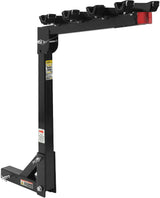 MaxxHaul 70210 4-Bike Hitch Mount Rack
$98.39Hitch-mounted accessories for 2-inch receivers. Confirm fitment by VIN before ordering.
MaxxHaul 70210 4-Bike Hitch Mount Rack
$98.39Hitch-mounted accessories for 2-inch receivers. Confirm fitment by VIN before ordering.
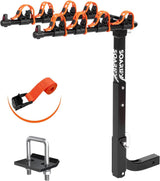 4-Bike Hitch Mount Bike Rack
$104.54Hitch-mounted accessories for 2-inch receivers. Confirm fitment by VIN before ordering.
4-Bike Hitch Mount Bike Rack
$104.54Hitch-mounted accessories for 2-inch receivers. Confirm fitment by VIN before ordering.

What size hitch ball do I need?
Whatever size is stamped on your trailer's coupler. The coupler is the clamp on the front of the trailer tongue, and the ball size it requires is marked on it — usually on the top or the side, cast or stamped into the metal. Match it exactly. There is no acceptable substitution in either direction.
Three sizes cover almost everything on a bumper-pull trailer in the United States. A fourth, 3-inch, exists for very heavy gooseneck applications.
| Ball diameter | Typical gross trailer weight range | Common shank diameters | What it usually tows |
|---|---|---|---|
| 1-7/8" | 2,000–3,500 lb GTW | 3/4" to 1" | Small utility trailers, jet ski trailers, light single-axle trailers |
| 2" | 3,500–12,000 lb GTW | 3/4" to 1-1/4" | Most utility, boat, and small-to-mid travel trailers |
| 2-5/16" | 6,000–30,000 lb GTW | 1" to 2" | Larger travel trailers, equipment trailers, car haulers, goosenecks |
| 3" | Around 30,000 lb GTW | 2" | Heavy gooseneck applications |
Those weight ranges are the ranges the size is available in, not a rating you can assume. A 2-inch ball can be rated anywhere from about 3,500 pounds to 12,000 depending on its shank and construction. The number that matters is the one stamped on the individual ball you are holding, and different manufacturers publish slightly different ranges for the same nominal size.
Safety note: a 1-7/8-inch ball will drop into a 2-inch coupler and appear to latch. It will also come off over a bump, because the coupler cannot close around a ball that is an eighth of an inch too small. This is one of the more common causes of a trailer separating from a tow vehicle, and it is entirely preventable by reading the coupler.
How do I tell 2-inch from 2-5/16 if the coupler is unmarked?
Measure the inside diameter of the coupler socket with a tape or a caliper. Seven-sixteenths of an inch is a visible difference once you have both in front of you, but it is not something to eyeball on a rusty trailer in a dim garage.
If the stamping has corroded away and you are not confident in your measurement, take the trailer to someone with calipers before you tow it. It is also worth painting or stamping the correct size onto the tongue afterward so the next person does not repeat the exercise.
One more check while you are down there: a coupler with a worn socket, a bent latch, or a stripped adjustment nut is a coupler to replace, not to work around with a different ball. The ball and coupler are a matched pair carrying the entire trailer.
What shank diameter do I need?
The shank is the threaded stud under the ball, and it has to fit the hole in your ball mount. The rule is simple: use the largest shank that fits the hole in your specific ball mount, and never use a shank that leaves visible slop in the hole.
Most ball mounts are drilled for either 1 inch or 1-1/4 inch, but manufacturers rarely print the hole size on the mount. Measure it. A shank that is too small will work loose and wallow out the hole, and a shank that is too large simply will not go through.
| Shank diameter | Typical torque for the ball nut | Notes |
|---|---|---|
| 3/4" | Roughly 150–160 lb-ft | Light-duty. Published figures vary slightly between manufacturers. |
| 1" | Around 250 lb-ft | The most common size on half-ton towing setups |
| 1-1/4" | Around 450 lb-ft | Requires a large torque wrench and a long breaker bar to reach |
Use the torque figure printed in the instructions that came with your specific hitch ball, not the table above. Published values differ between manufacturers and the table is here to tell you the order of magnitude — a hitch ball nut is not a hand-tight fastener, and most people badly undertighten them.
To put that in perspective: 250 lb-ft is well beyond a typical wheel lug nut, which is 140 lb-ft even on a full-size GM truck. If your torque wrench tops out around 150, it will not do this job. Our torque wrench buying guide covers picking a drive size and range that actually reaches these numbers.
Shank length matters too. It has to be long enough to pass through the ball mount platform and let the nut and washer seat fully, with the threads extending past the nut by at least one full thread. Common shank lengths run from about 1-5/8 inch up to 3-1/2 inch. If your ball mount platform is thick, a short shank will bottom out before the nut clamps.
What receiver size do GM trucks use?
Half-ton Silverado and Sierra models with a factory trailering package use a 2-inch receiver opening. Heavy-duty Silverado and Sierra 2500HD and 3500HD trucks are commonly fitted with a 2-1/2-inch receiver, though this has varied by model year and package.
Do not assume. Measure the inside of your receiver tube opening before you order a ball mount, because a 2-inch shank will not go into a 2-1/2-inch receiver without an adapter and a 2-1/2-inch shank will not go into a 2-inch receiver at all.
| Receiver opening | Where you'll find it | What to buy |
|---|---|---|
| 1-1/4" | Light-duty aftermarket hitches on cars and small crossovers | Class I / II ball mount, limited capacity |
| 2" | Silverado 1500, Sierra 1500, Tahoe, Suburban, Yukon and most GM SUVs with a tow package | Standard 2-inch shank ball mount |
| 2-1/2" | Commonly on Silverado / Sierra 2500HD and 3500HD | 2-1/2-inch shank ball mount, or a sleeve adapter if you must run 2-inch |
| 3" | Heavy commercial and specialty applications | Match the shank; adapters reduce capacity |
Reducing sleeves that let a 2-inch ball mount live in a 2-1/2-inch receiver do exist, and they work, but they introduce play and they usually derate the setup. If you tow regularly with an HD truck, buy the ball mount that matches the receiver.
The rating that actually limits you
Every part in the chain carries its own number, and the smallest one is your real ceiling. That list runs: the vehicle's tow rating, the receiver's rating, the ball mount's rating, the hitch ball's rating, the coupler's rating, and the trailer's own axle ratings.
Most receivers carry two ratings stamped on them — a lower weight-carrying figure and a higher weight-distributing figure. If your loaded trailer exceeds the weight-carrying number, you are required to use a weight distribution system to reach the higher one. Our guide to whether you need a weight distribution hitch covers the thresholds and how to tell.
None of this changes what your truck can pull. Receiver size, ball size and capacity ratings are all separate from the tow rating on your VIN, which is set by drivetrain, axle ratio, cab and bed configuration. Our breakdown of Silverado and Sierra tow ratings by year, engine and trim covers where that number actually comes from.
Trailer brake control
 ACDelco Trailer Brake Controller
$83.99Trailer brake controllers for GM trucks. Confirm fitment by VIN before ordering.
ACDelco Trailer Brake Controller
$83.99Trailer brake controllers for GM trucks. Confirm fitment by VIN before ordering.
 ACDelco Trailer Brake Controller
$86.99Trailer brake controllers for GM trucks. Confirm fitment by VIN before ordering.
ACDelco Trailer Brake Controller
$86.99Trailer brake controllers for GM trucks. Confirm fitment by VIN before ordering.
 ACDelco Trailer Brake Controllers, ACDelco GM Genuine Parts
$147.99Trailer brake controllers for GM trucks. Confirm fitment by VIN before ordering.
ACDelco Trailer Brake Controllers, ACDelco GM Genuine Parts
$147.99Trailer brake controllers for GM trucks. Confirm fitment by VIN before ordering.
 ACDelco Trailer Brake Controllers, ACDelco GM Genuine Parts
$212.99Trailer brake controllers for GM trucks. Confirm fitment by VIN before ordering.
ACDelco Trailer Brake Controllers, ACDelco GM Genuine Parts
$212.99Trailer brake controllers for GM trucks. Confirm fitment by VIN before ordering.


How much drop or rise does my ball mount need?
Measure two heights and subtract. Height A is from level ground to the top of the inside of your receiver tube opening. Height B is from level ground to the bottom of the trailer coupler with the trailer sitting level. B minus A is the drop you need.
- Park the truck on level ground, loaded the way you normally tow — fuel, passengers, gear in the bed.
- Measure from the ground to the top of the inside of the receiver opening. Write it down as A.
- Set the trailer level, using the tongue jack and a level on the frame rail.
- Measure from the ground to the bottom of the coupler. Write it down as B.
- Subtract A from B. A positive number is the drop you need; a negative number means you need a rise.
- Buy the ball mount with the closest available drop or rise, then check the result with the trailer coupled.
The goal is a trailer that sits level, or very slightly nose-down, when coupled. A trailer riding nose-high shifts weight rearward, reduces tongue weight, and is the single biggest contributor to trailer sway. A trailer riding nose-low overloads the front axle of the trailer and the rear of the truck.
Measure with the truck loaded, not empty. A half-ton squats meaningfully with a family and a full bed, and a drop calculated on an empty truck at the parts counter will be wrong by an inch or two in the driveway.
Do I need a different ball for weight distribution?
Usually yes, and it is a common oversight. Weight distribution hitch heads are designed for a specific ball, often with a particular shank length, and many require the ball to be installed at a specific angle or with the head tilted to a set number of washers.
Follow the instructions that came with the weight distribution system rather than transferring a ball off your old ball mount. The setup procedure on these systems — tilt angle, spring bar tension, and the resulting front axle height — is what makes them work, and the ball is part of that geometry.
The same applies to any hitch with a built-in ball or a swappable ball platform. Those are engineered assemblies, not generic mounts.
How tight should the hitch ball nut actually be?
Tight enough that it takes a real torque wrench. A 1-inch shank at 250 lb-ft is well beyond what most people apply with a ratchet and a foot of leverage, and an undertightened ball nut works loose, elongates the hole in the ball mount, and eventually fails.
- Clean the shank, the hole, and the underside of the ball platform before assembly.
- Fit the lock washer and nut in the order the manufacturer specifies.
- Torque to the value in the ball's instructions, using a wrench that actually covers that range.
- Confirm at least one full thread extends past the nut.
- Recheck the torque after the first few trips, then periodically.
Safety note: always cross the safety chains under the tongue and connect them to the tow vehicle, with enough slack to turn but not enough to drag. If the coupler ever lets go, the crossed chains catch the tongue instead of letting it hit the pavement.
What else goes wrong with hitch balls?
Wear, mostly. A ball that has towed for years develops a flat spot on the front face where the coupler rides, and a worn ball in a good coupler has more play than either part should. Run a hand over it — if you can feel a step or a flat, replace it.
Corrosion is the other one. A chrome ball with pitting will chew the inside of a coupler, and a rusted shank makes the nut misleading to torque. Grease the ball itself lightly to reduce wear, or use a ball cover if the truck sits.
And check the ball mount, not just the ball. An elongated hole, a bent shank, or a cracked weld on a ball mount is a replacement, not a repair. These are stamped or forged parts with published ratings, and welding on one voids everything the rating was based on.
Once you are hooked up, the rest of the setup is electrical and braking. Our guides to 4-pin, 7-pin and 12-pin trailer connectors and to factory versus aftermarket brake controllers cover those, and tow/haul mode covers what the truck does once you are moving.
What to check before you order
- Read the ball size stamped on your trailer coupler. That is the ball diameter, full stop.
- Measure the hole in your ball mount to get the shank diameter, and measure the platform thickness for shank length.
- Measure your receiver tube opening — 2 inch on most GM half-tons, often 2-1/2 inch on HD.
- Check the capacity stamped on the ball against your loaded trailer weight, not the empty weight.
- Measure hitch height and coupler height to calculate drop or rise, with the truck loaded.
- Confirm you own a torque wrench that reaches the ball nut spec before the trailer is in the driveway.
Tools
 ACDelco Tools Torque Wrenches, Digital LCD Display, 1/2 in.
$162.99Torque tools for the hitch ball nut.
ACDelco Tools Torque Wrenches, Digital LCD Display, 1/2 in.
$162.99Torque tools for the hitch ball nut.
 ACDelco Tools Torque Wrenches, Digital LCD Display, 3/8 in.
$249.99Torque tools for the hitch ball nut.
ACDelco Tools Torque Wrenches, Digital LCD Display, 3/8 in.
$249.99Torque tools for the hitch ball nut.


Frequently Asked Questions
What size hitch ball do I need for my Silverado?
Your truck does not determine it — your trailer does. The required ball size is stamped or cast into the trailer coupler, usually on the top or side: 1-7/8, 2 or 2-5/16 inches. Match it exactly, with no substitution in either direction.
What happens if the hitch ball is too small for the coupler?
It will drop in and appear to latch, then come off over a bump, because the coupler cannot close around a ball an eighth of an inch too small. A 1-7/8 ball in a 2-inch coupler is one of the more common causes of a trailer separating from a tow vehicle, and it is entirely preventable by reading the coupler.
How do I identify an unmarked trailer coupler?
Measure the inside diameter of the coupler socket with a tape or calipers. The difference between 2 and 2-5/16 is seven-sixteenths of an inch — visible with both in front of you, but not something to eyeball on a rusty trailer. If you are not confident, get it measured before towing, then stamp or paint the size on the tongue.
What shank diameter should I use?
The largest that fits the hole in your ball mount, with no visible slop. Most mounts are drilled for 1 inch or 1-1/4 inch but rarely print the size, so measure it. A shank too small works loose and wallows out the hole; too large simply will not pass through.
How tight does a hitch ball nut need to be?
Far tighter than most people apply. A 1-inch shank is commonly around 250 lb-ft — well beyond a wheel lug nut at 140 lb-ft on a full-size truck. Use the figure in your ball's instructions and a wrench that actually covers that range, and confirm at least one full thread extends past the nut.
What receiver size does a GM truck have?
Half-ton Silverado, Sierra, Tahoe, Suburban and Yukon models with a tow package use a 2-inch opening. HD 2500 and 3500 trucks are commonly 2-1/2 inch, though this varies by year and package. Measure yours — a 2-1/2-inch shank will not enter a 2-inch receiver at all.
How do I work out how much drop I need?
Measure ground to the top of the inside of your receiver opening with the truck loaded as you normally tow, then ground to the bottom of the coupler with the trailer level. Subtract the first from the second. A positive number is drop; negative means you need rise.
Why does the trailer need to sit level?
A trailer riding nose-high shifts weight rearward and reduces tongue weight, which is the single biggest contributor to trailer sway. Nose-low overloads the trailer's front axle and the rear of the truck. Level, or very slightly nose-down, is the target.
Does a bigger hitch ball increase towing capacity?
No. Every part in the chain has its own rating — vehicle, receiver, ball mount, ball, coupler and trailer axles — and the smallest is your real limit. Note that most receivers carry two ratings, a lower weight-carrying figure and a higher weight-distributing one.
Can I reuse my existing ball on a weight distribution hitch?
Usually not, and it is a common oversight. Weight distribution heads are designed around a specific ball and shank length, and many require a set installation angle or washer count. The tilt geometry is what makes the system work, so follow the instructions supplied with it.
A Note on Sourcing
Ball diameters, shank sizes and receiver openings are industry standards, but the capacity associated with any given size is not — a 2-inch ball can be rated anywhere from roughly 3,500 to 12,000 lb depending on shank and construction. The number stamped on the individual ball you are holding is the only one that applies to you, and manufacturers publish slightly different ranges for the same nominal size.
Torque figures in the table are indicative of magnitude, not specifications. Values differ between manufacturers, and the instructions supplied with your specific hitch ball govern. They are included because most people badly undertighten these fasteners, and knowing that 250 lb-ft is normal changes how you approach the job.
Receiver sizes on HD trucks have varied by model year and package, which is why this page tells you to measure rather than trusting the table.
The measuring procedures and the wear inspection advice are our own, based on service practice rather than manufacturer instruction.
More towing and ownership guides are collected in our GM owner guides library.
Will this fit your truck and trailer?
Check three things before you order: the ball size stamped on your coupler, the hole diameter in your ball mount, and the receiver opening on your truck. Get all three right and the rest is a torque wrench. Browse hitch balls, ball mounts and towing hardware and filter by the measurements you just took.